

Behavioural Finance In India: Why Your Mindset Matters More Than The Market


When it comes to investing, most people believe that numbers, charts, and market trends drive success. But the truth is, your mind plays a bigger role than the market itself. Traditional finance assumes investors always act rationally to maximise wealth but real-world investing tells a very different story.
This is where behavioural finance comes in. It explains how emotions, psychological biases, and decision-making shortcuts influence the way investors in India save, spend, and invest. From herd mentality during stock rallies to panic selling in market crashes, our behaviour often dictates returns more than actual market fundamentals.
In this blog, we will dive deep into the most common behavioural biases in investing, their impact on Indian investors, and how you can train your mind to make smarter financial decisions. Because in the world of money, mastering your emotions is just as important as mastering the markets.
Introduction To Behavioural Finance
Behavioural finance evaluates why investors often make irrational financial decisions even when they think they are being logical. It explains the psychology of investing about why markets do not always behave efficiently and why investors frequently act against their own best interests.
For Indian investors, understanding behavioural finance is particularly important in a market that is often driven by emotions and where information can spread rapidly through social media. Knowing how your mind works can be your greatest advantage.
Why Behavioural Finance Matters?
Behavioural finance matters because it helps recognise psychological traps such as panic selling, overtrading, and chasing trends, and develop strategies to avoid them. It is not just about understanding markets; it is about understanding yourself.
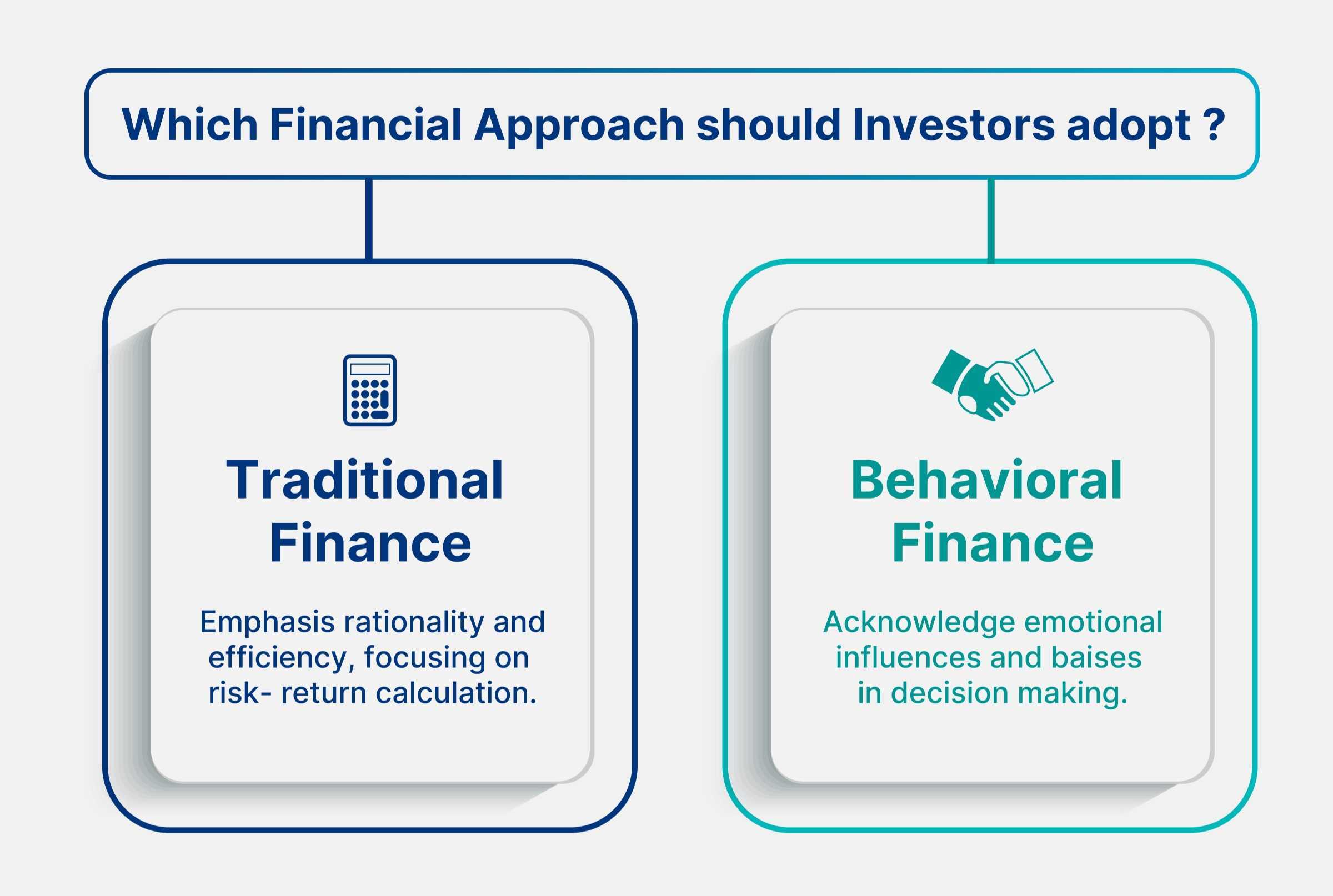
Unlike traditional finance theories that assume people always act rationally, behavioural finance recognises that emotions, biases, and mental shortcuts significantly impact your financial decisions.
Key Principles Of Behavioural Finance
1. Role Of Human Psychology In Investing
At its core, investor psychology drives market movements. Humans are hardwired with certain tendencies that lead to decision-making biases. For example, they tend to:
- Place more weight on recent experiences (recency bias)
- Finding only that information that confirms your existing beliefs (confirmation bias)
- Losses weigh more than gains in making decisions (loss aversion)
Investors often make investment decisions based on emotions rather than performing thorough analysis, leading to impulsive decision-making.
2. Link Between Market Trends And Investor Behaviour
Market trends and investor behaviour form a feedback loop. When markets rise, investor optimism increases, often leading to excessive risk-taking. When markets fall, fear takes over, frequently resulting in panic selling at the worst possible time.
This relationship explains why market cycles often overshoot in both directions. Understanding this relationship helps investors recognise when markets are being driven by emotions rather than fundamentals, creating opportunities for those who can maintain their discipline.
Read: Hedge Fund Vs Mutual Fund: Key Differences Indian Investors Must Know In 2025
Common Behavioural Biases That Impact Investors
1. Overconfidence Bias
Overconfidence bias in investing is one of the most common issues among Indian retail investors. It refers to the tendency to overestimate our knowledge, abilities, and the precision of our information.
2. Herd Mentality
Herd mentality in the stock market describes the tendency to follow and imitate what others are doing. This bias is particularly strong in India, where investment advice often spreads through family networks and social groups.
3. Loss Aversion
Loss aversion in investing refers to the preference for avoiding losses over acquiring equivalent gains. Sometimes the pain of losing is a bigger trigger than the joy of winning, and that leads to loss aversion bias.
4. Anchoring Bias
This bias is about trusting or relying on the initial information, which is also known as the anchor for decision-making. This often leads to poor investment choices based on arbitrary reference points.
How Behavioural Finance Influences Market Movements
1. Role in Stock Market Bubbles and Crashes
Behavioural economics in finance helps explain why markets frequently experience bubbles and crashes. These extreme movements are often driven by collective behavioural biases rather than fundamental changes in economic value.
The 2008 real estate bubble and subsequent crash in Indian metropolitan areas demonstrated classic behavioural patterns. Initial price increases attracted speculators who bought primarily because prices were rising (representativeness bias). Media coverage intensified (availability bias), leading more investors to fear missing out (regret aversion). When prices eventually began falling, panic selling accelerated the crash.
Understanding these patterns can help investors identify when markets are being driven by irrational exuberance or fear rather than fundamentals.
Read: Bhavish Aggarwal's Ola Ride: From Startup Speed Bumps To Unicorn Highway
2. Short-Term Volatility vs Long-Term Trends
Much of the short-term volatility in markets is driven by emotional investing pitfalls rather than changes in underlying economic value. Daily stock price movements correlate more strongly with sentiment indicators than with fundamental news. This creates opportunities for disciplined investors who can focus on long-term trends while others react emotionally to short-term noise.
During the COVID-19 market crash in March 2020, the Sensex fell nearly 37% to 25,9811. Investors who understood behavioural finance recognised this as panic selling rather than a reflection of long-term economic value. Those who maintained their investment plans and even added to positions during this period saw their portfolios recover completely in the coming years. This is one of the behavioural finance examples.
Conclusion
Understanding behavioural finance isn’t just theory; it is your practical edge in investing. By recognising biases like herd mentality, overconfidence, or loss aversion, you can sidestep the mistakes that derail most investors. The real key to long-term wealth isn’t predicting every market swing, but staying calm, disciplined, and consistent when others give in to fear or greed.
And while your mindset is your strongest tool, pairing it with the right investment platform can make all the difference. Log in to Grip Invest today and explore SEBI-regulated, fixed-income opportunities that help you invest smarter without letting emotions get in the way.
FAQs On Behavioural Finance In India
1. What is Behavioural Finance in Simple Terms?
Behavioural finance is the study of how psychology influences financial decisions. It examines why investors often make irrational financial choices and how these decisions affect markets.
2. How Does Psychology Influence Investment Decisions?
Psychology influences investment decisions in numerous ways. Human brains use mental shortcuts to make complex decisions manageable, but these shortcuts can lead to systematic errors. Emotions like fear and greed can override logical analysis. Social influences cause you to follow the crowd rather than think independently. These psychological factors often lead to poor timing of buys and sells, under-diversification, and failure to adapt to new information.
3. What Are the Most Common Investor Biases?
The most common investor biases include:
- Overconfidence bias: Overestimating our knowledge and abilities
- Loss aversion: Feeling losses more intensely than equivalent gains
- Herd mentality: Following what others are doing without independent analysis
- Anchoring bias: Relying too heavily on the first piece of information encountered
- Confirmation bias: Seeking only information that confirms existing beliefs
- Recency bias: Giving too much weight to recent events when making decisions
- Home bias: Preferring to invest in familiar domestic markets rather than diversifying globally
References:
1. PMC, accessed from: https://pmc.ncbi.nlm.nih.gov/articles/PMC8919983/
Want to stay at the top of your finances?
Join the community of 4 lakh+ investors and learn more about Grip Invest, the latest financial knick-knacks, and shenanigans in the world of investing.
Happy Investing!
Disclaimer - Investments in debt securities/municipal debt securities/securitised debt instruments are subject to risks, including delay and/ or default in payment. Read all the offer-related documents carefully. The investor is requested to take into consideration all the risk factors before the commencement of trading.
This communication is prepared by Grip Broking Private Limited (bearing SEBI Registration No. INZ000312836 and NSE ID 90319) and/or its affiliate/ group company(ies) (together referred to as “Grip”) and the contents of this disclaimer are applicable to this document and any and all written or oral communication(s) made by Grip or its directors, employees, associates, representatives and agents. This communication does not constitute advice relating to investing or otherwise dealing in securities and is not an offer or solicitation for the purchase or sale of any securities. Grip does not guarantee or assure any return on investments and accepts no liability for the consequences of any actions taken based on the information provided. For more details, please visit www.gripinvest.in
Registered Address - 106, II F, New Asiatic Building, H Block, Connaught Place, New Delhi 110001


