

Best Arbitrage Funds In India 2026: Low Risk Tax-Efficient Returns


Price gaps often exist in markets. Over the years, traders have taken advantage of this fact in a smart way by using a unique strategy called 'arbitrage'. Through this strategy, they aim to identify mispricing in assets across multiple markets, thereby generating a risk-free profit.
This low-risk strategy is also adopted by mutual funds, called arbitrage funds. Arbitrage funds aim to make returns through price gaps in the same asset across various markets. The return comes from this difference, not from market direction.
Arbitrage funds are commonly categorised as low-risk because both buying and selling happen simultaneously, which limits exposure to market fluctuations. In volatile markets, stock prices may fluctuate due to news, global conditions, or investor behaviour. This creates frequent price gaps between the spot and futures markets.
Arbitrage funds get more chances to capture these gaps during such periods. When volatility is low, opportunities are fewer, and returns remain modest. But when volatility rises, the number of profitable trades increases, making these funds more attractive for cautious investors. An investor must understand the know-how of these funds before investing.
How Arbitrage Funds Generate Returns
SEBI regulates arbitrage funds to invest atleast 65% of its allocation in equity and equity-related investments and derivatives1. Fund managers of arbitrage funds search for price differences between the cash and futures markets to identify the most efficient investments.
Arbitrage funds follow a market-neutral strategy. For example, if a stock is available at INR 1,000 in the cash market and INR 1,020 in the futures market, the fund buys it at INR 1,000 and sells it at INR 1,020 simultaneously. The INR 20 difference becomes the profit, before expenses.
Since the position is hedged, returns do not rely on any directional movements in the stock market. Instead, they depend on how often such price differences appear and how efficiently the fund manager executes the trades. Some portion of the portfolio may also be invested in short-term debt instruments to manage liquidity.
Best Arbitrage Mutual Funds For SIP In India
Among the various available arbitrage funds in India, investors can choose the ‘best funds’ based on historical returns of 10 years and check for their expense ratios. Some of the best arbitrage funds based on historical returns in India, along with their expense ratios, are:
| Fund Name | AUM (As of 31 Jan, 2026) | Returns (10-years)*2 | Returns (5-years)* | Expense Ratio (As of 31 Jan, 2026) |
| Edelweiss Arbitrage Fund | INR 15,619 Crores3 | 6.61% | 6.70% | 0.39%4 |
| Nippon India Arbitrage Fund | INR 16,390 Crores5 | 6.54% | 6.59% | 0.38%6 |
| Axis Arbitrage Fund | INR 8,739 Crores7 | 6.52% | 6.63% | 0.32%8 |
| Kotak Arbitrage Fund | INR 71,931 Crores9 | 6.52% | 6.73% | 0.44% |
| Invesco India Arbitrage Fund | INR 28,593 Crores10 | 6.51% | 6.82% | 0.40%11 |
| SBI Arbitrage Opportunities Fund | INR 43,574 Crores12 | 6.31% | 6.66% | 0.40% |
| ICICI Pru Equity Arbitrage Fund | INR 32,976 Crores13 | 6.43%14 | 6.57% | 0.40% |
*Data as on March 02, 2026
Since arbitrage returns are usually moderate, the expense ratio plays an important role. A high expense ratio reduces net returns over the long-term. Investors should prefer funds with lower operating costs to retain more of the arbitrage profit.
Taxation Of Arbitrage Funds
Because they hold a majority of their assets in equity and equity-oriented instruments, arbitrage funds are considered equity investments for tax purposes. Thus, the tax structure that is imposed on arbitrage funds is:
| Tax Type | Holding Period | Tax Rate15 |
| Short-Term Capital Gains (STCG) | Upto 12 months | 20% |
| Long-Term Capital Gains (LTCG) | > 12 months | 12.5% (above INR 1.25L) |
This gives arbitrage funds an advantage over fixed deposits for investors in higher tax brackets, as fixed deposit returns are taxed as per the investor’s tax slabs. However, these arbitrage funds' tax benefits are maximised only if the holding period exceeds 1 year.
For example, for a long-term investor, arbitrage funds have delivered almost 6.5% returns. Post-tax, these returns would be almost 5.7%. Compared to average fixed deposit returns of 6-6.5%, which equate to post-tax returns of almost 4.55% (for the highest tax slab of 30%).
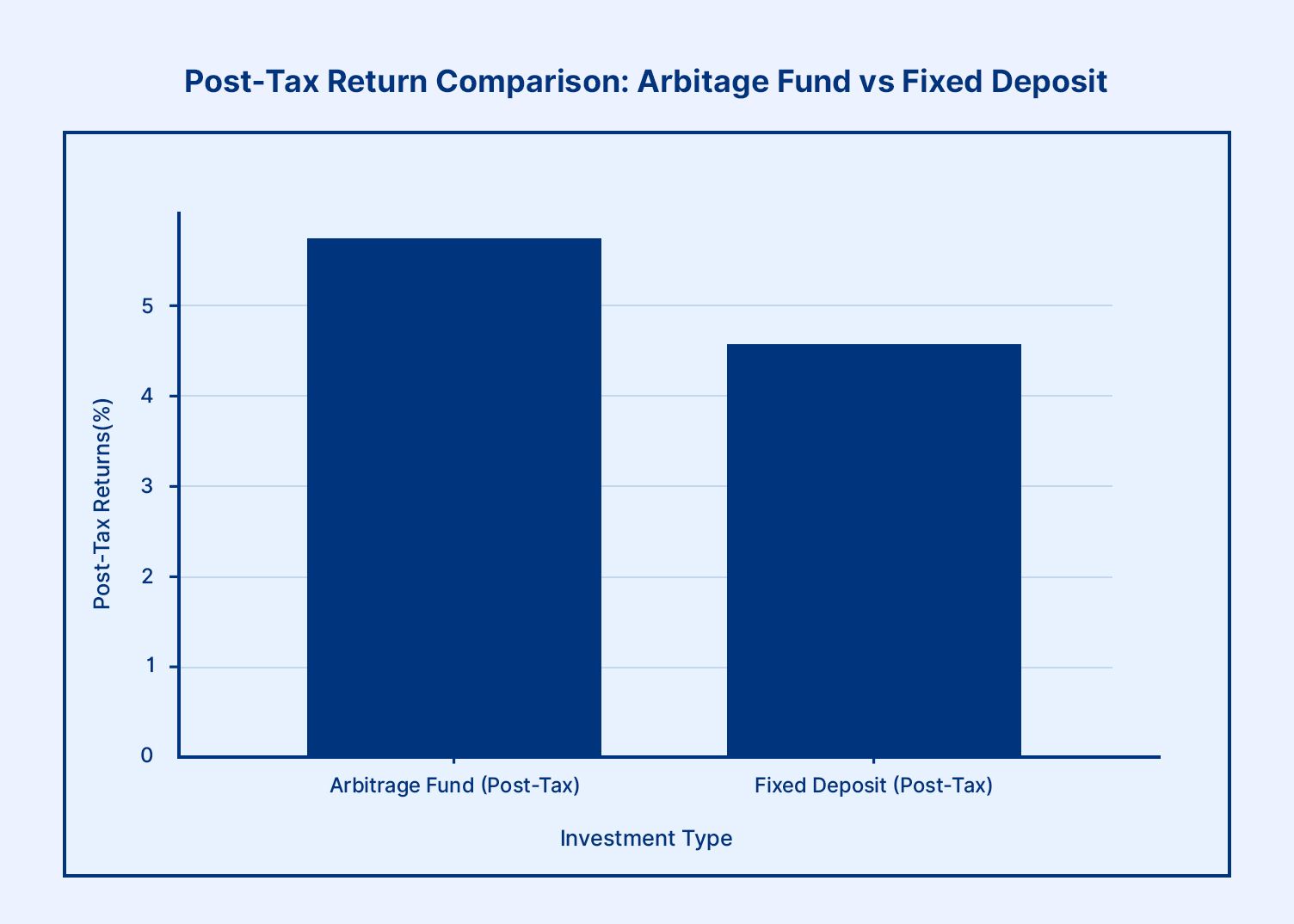
This shows how arbitrage funds may be considered more tax-efficient than fixed deposits in India.
Conclusion
Arbitrage funds are often considered amongst the top choices as low-risk hybrid funds in India. Arbitrage funds hold the potential to generate low-risk profits along with tax-efficiency. To profit from the existing market inefficiencies, investors often consider these funds suitable.
Their core highlight is to provide stable returns without exposing the invested money fully to market movements. These funds work best during volatile periods when price gaps appear more often. While they are not meant for high growth, they serve well as a parking option for surplus funds or for conservative investors who prefer controlled risk with better tax treatment.
FAQs
1. Are arbitrage funds safe?
Arbitrage funds are not 100% safe. They are considered relatively low risk because they use hedged positions. However, they are still market-linked and not risk-free like bank fixed deposits.
2. Are arbitrage funds better than FDs?
For investors in higher tax brackets, arbitrage funds can offer better post-tax returns than fixed deposits as observed historically. However, FDs provide guaranteed returns, while arbitrage funds do not.
3. How are arbitrage funds taxed?
Arbitrage funds follow equity taxation rules. Short-term gains are taxed at equity rates, while long-term gains enjoy lower tax treatment compared to debt funds.
References:
1. UTI MF, accessed from: https://www.utimf.com/articles/arbitrage-fund-vs-liquid-funds
2. AMFI India, accessed from: https://www.amfiindia.com/otherdata/fund-performance
3. Value share, accessed from: https://www.valueresearchonline.com/funds/27145/edelweiss-arbitrage-fund-direct-plan/
4. Edelweiss Arbitrage Fund, accessed from: https://shorturl.at/GYo6J
5. Value share, accessed from: https://www.valueresearchonline.com/funds/17008/nippon-india-arbitrage-fund-direct-plan/#other
6. Nippon India, accessed from: https://mf.nipponindiaim.com/InvestorServices/FundwiseFactsheet/NipponIndia-Arbitrage-Fund-MF-Factsheet-2026.pdf
7. Value share, accessed from: https://www.valueresearchonline.com/funds/27587/axis-arbitrage-fund-direct-plan/#other
8. Value share, accessed from: https://www.valueresearchonline.com/funds/27587/axis-arbitrage-fund-direct-plan/#other
9. Value share, accessed from: https://www.valueresearchonline.com/funds/17136/kotak-arbitrage-fund-direct-plan/#other
10. Value share, accessed from: https://www.valueresearchonline.com/funds/16368/invesco-india-arbitrage-fund-direct-plan/#other
11. Value share, accessed from: https://www.valueresearchonline.com/funds/16368/invesco-india-arbitrage-fund-direct-plan/#other
12. Value share, accessed from: https://www.valueresearchonline.com/funds/17570/sbi-arbitrage-opportunities-fund-direct-plan/#other
13. Value share, accessed from: https://www.valueresearchonline.com/funds/17396/icici-prudential-equity-arbitrage-fund-direct-plan/#other
14. Value share, accessed from: https://www.valueresearchonline.com/funds/17396/icici-prudential-equity-arbitrage-fund-direct-plan/#performance
15. UTI MF, accessed from: https://www.utimf.com/articles/what-is-arbitage-fund
Want to stay at the top of your finances?
Join the community of 4 lakh+ investors and learn more about Grip Invest, the latest financial knick-knacks, and shenanigans in the world of investing.
Happy Investing!
Disclaimer - Investments in debt securities/municipal debt securities/securitised debt instruments are subject to risks including delay and/ or default in payment. Read all the offer related documents carefully. The investor is requested to take into consideration all the risk factors before the commencement of trading.
This communication is prepared by Grip Broking Private Limited (bearing SEBI Registration No. INZ000312836 and NSE ID 90319) and/or its affiliate/ group company(ies) (together referred to as “Grip”) and the contents of this disclaimer are applicable to this document and any and all written or oral communication(s) made by Grip or its directors, employees, associates, representatives and agents. This communication does not constitute advice relating to investing or otherwise dealing in securities and is not an offer or solicitation for the purchase or sale of any securities. Grip does not guarantee or assure any return on investments and accepts no liability for consequences of any actions taken based on the information provided. For more details, please visit www.gripinvest.in
Registered Address - 106, II F, New Asiatic Building, H Block, Connaught Place, New Delhi 110001


