

Bond Market Volatility In India 2026: Causes, Risks And Impact



Introduction
Have you ever thought why the value of a bond can change even when the issuer continues to make its payment transactions on time? The answer lies in the bond market volatility. Interest rates, government borrowing and global economic developments that can all influence bond prices and yields.
Being an investor, understanding bond market volatility in the Indian market is essential just because price movements can fluctuate investment returns, portfolio values and decisions about when to buy or sell.
In the year 2026, investors are required to understand how domestic monetary policy and global market situations interact.
Rather than assuming market movement, knowing what drives volatility helps the investors in order to estimate the risks to make their investment decisions.
What Is Bond Market Volatility?
Bond market volatility defines the fluctuation of how frequently and how significantly bond prices and yields change over a period of time1. When prices move sharply in response to economic news, interest rate decisions or investor activity, the market is experiencing volatility.
Let us understand this with an example- consider a government bond with a face value of INR 10,000 and a fixed annual coupon of INR 700. If market interest rates rise, newly issued bonds may offer higher returns. Investors may then be less willing to pay INR 10,000 for the older bond, which might cause its market price to fall.
The opposite can happen when market interest rates decrease. An existing bond with a relatively higher coupon may become more attractive, pushing its market price up.
Bond market volatility does not automatically mean that an issuer is unable to repay its debt. It explains the market price movements, which can occur even when the issuer's ability to pay remains unchanged.
What Causes Bond Market Volatility In India?
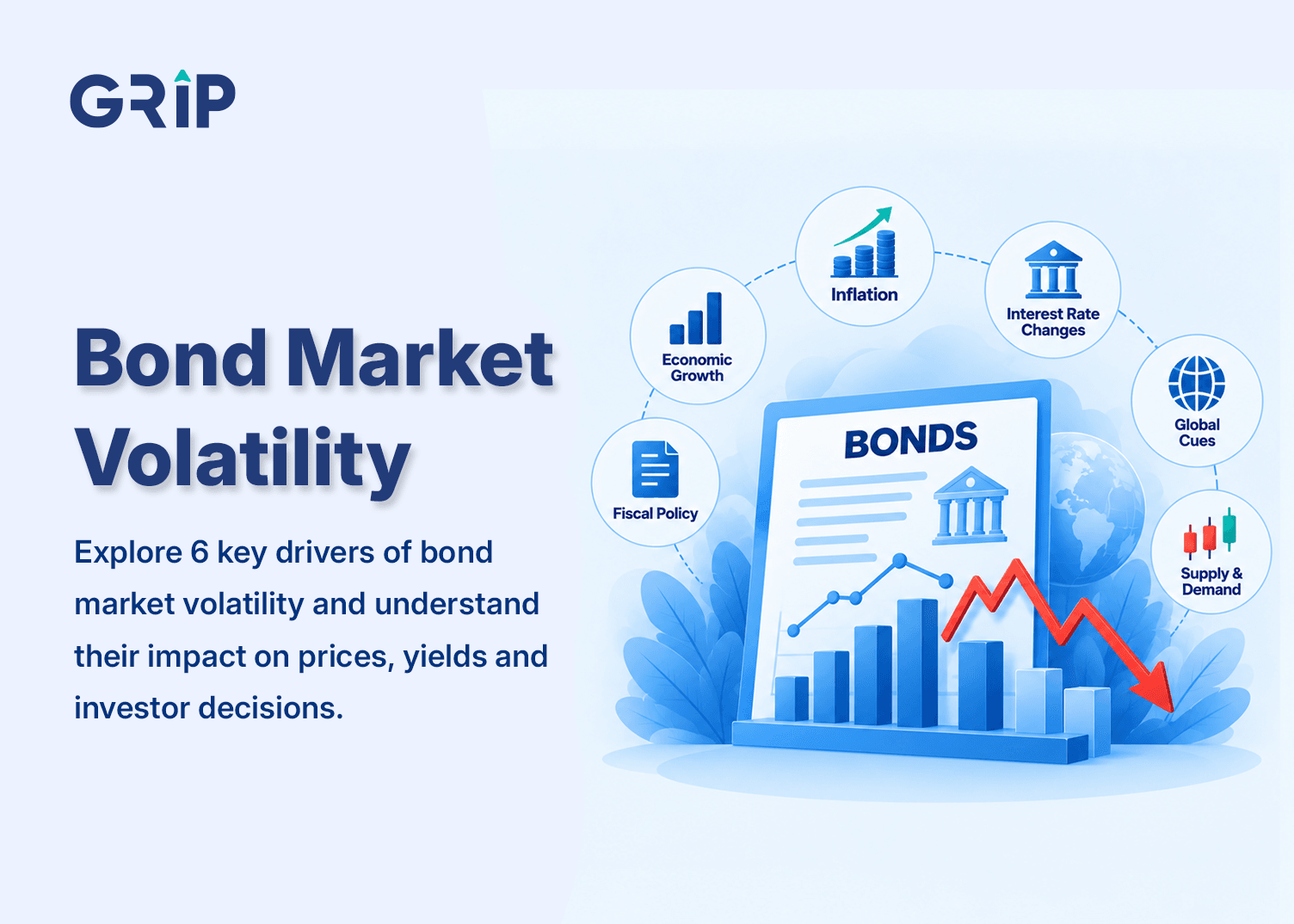
Several domestic and international factors influence Indian bond prices and yields-
1. RBI monetary policy
The Reserve Bank of India's interest rate decisions influence borrowing costs and market expectations. When investors anticipate changes in policy rates, bond yields may respond even before the RBI announces its decision.
2. Inflation
Inflation reduces the purchasing power of future interest payments. When inflation rises or is expected to remain high, investors may demand higher yields to compensate for the loss of purchasing power.
3. Government borrowing
The government's borrowing programme affects the supply of government securities. When the market expects a large supply of bonds, investors may seek higher yields to absorb that supply, depending on demand and other market conditions.2
4. Liquidity
Liquidity refers to how easily bonds can be bought or sold without significantly affecting their prices. When liquidity is low, even relatively small transactions can cause noticeable price movements.
5. Crude oil prices and global yields
India imports substantial quantities of crude oil, so changes in international oil prices can affect inflation expectations and external economic conditions. Meanwhile, movements in major global bond markets can influence investor demand for Indian securities.
6. Foreign investment flows
Foreign investors' purchases and sales can affect demand for Indian bonds, particularly securities accessible to international investors. Changes in global risk appetite, currency expectations and relative yields may influence these flows.
How Do Interest Rates Affect Bond Prices And Yields?
Bond prices and market yields usually move in opposite directions. This relationship is one of the most important concepts for understanding bond price volatility.3
If comparable market yields instead fall to 6%, your bond's INR 700 annual payment becomes relatively attractive. Its price may rise as investors compete for its higher fixed income.
The extent of the price movement depends partly on the bond's maturity and duration. Generally, bonds with longer durations are more sensitive to changes in interest rates than shorter-duration bonds.
This is why two government bonds from the same issuer can experience different levels of bond price volatility, even when their credit risk is similar.
What Has Driven Bond Market Volatility In India In 2026?
Bond market volatility in the year 2026 that requires to be understood through the interaction of monetary policy, inflation expectations, government borrowing and international financial conditions.4 These factors can influence bond yields even when there is no change in an individual bond's coupon or repayment terms.
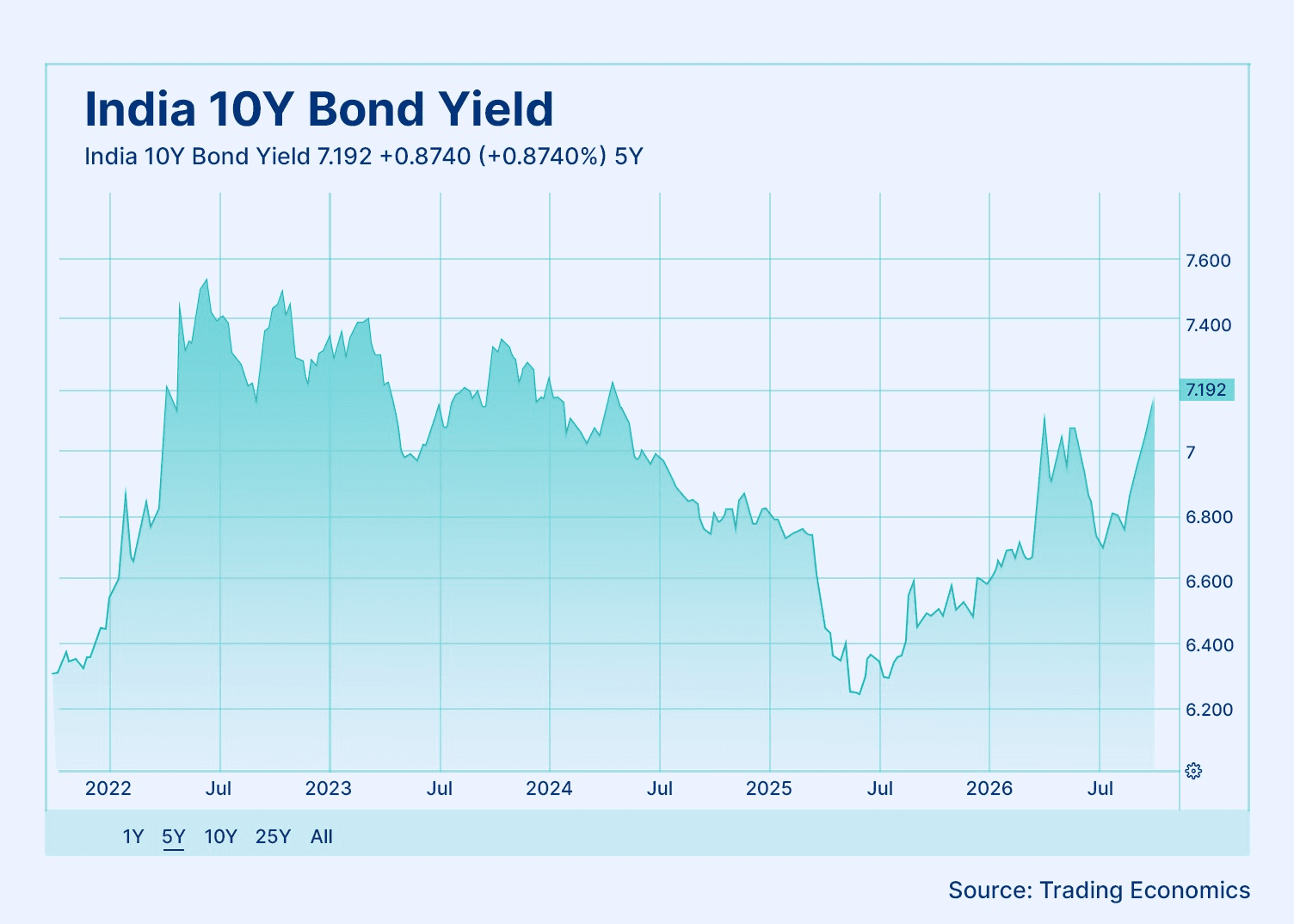
Let us understand this with an example- if investors expect inflation just to remain elevated, they may demand higher yields on its newly traded bonds. In the same way, expectations about the RBI's policy decisions can change demand for securities with different maturities.
Government borrowing is another factor to monitor. Changes in the expected supply of government securities can influence the yields investors require, particularly when demand does not increase at the same pace.
Global bond yields, crude oil prices and foreign investment activity can add another layer of uncertainty. International developments may affect how investors assess Indian bonds relative to other investment opportunities.
How Does Bond Market Volatility Affect Investors?
Bond market volatility affects investors differently depending on their investment horizon, bond selection and need for liquidity.
For investors who trade bonds before maturity, falling market prices can create losses when selling. For example, an investor who purchases a bond for INR 10,000 and later sells it for INR 9,600 experiences a INR 400 capital loss, excluding interest received and transaction costs.
Investors who hold bonds until maturity may be less affected by interim price fluctuations if the issuer makes all contractual payments. However, they still face inflation risk, opportunity cost and the possibility of needing to sell before maturity.6
Volatility can also affect the availability and its pricing of new corporate bonds. Issuers may need to offer higher yields when investors demand greater compensation for uncertainty.
When evaluating bonds, investors should consider four factors together:
- Yield: The return indicated by the bond's price and promised payments.
- Maturity: How long the investment remains outstanding.
- Credit quality: The issuer's ability to meet its obligations.
- Liquidity: How easily the bond can be sold at a reasonable price.
A high yield alone does not explain whether a bond is suitable for an investor's needs.
Bond Market Volatility vs Credit Risk: What Is the Difference?
Bond market volatility and credit risk are related to different types of uncertainty. Volatility concerns market price movements, while credit risk concerns the possibility that an issuer may fail to meet its payment obligations.
Factor | Bond market volatility | Credit risk |
| Meaning | Changes in bond prices and yields | Risk of delayed or missed payments |
| Main drivers | Interest rates, inflation, liquidity and demand | Issuer's financial position and repayment capacity |
| Possible effect | Market value rises or falls | Principal or interest may not be paid as promised |
| Example | A government bond price falls after yields rise | A company misses an interest payment |
| Key consideration | Duration and market conditions | Credit rating and issuer fundamentals
|
Bond Market Volatility vs Credit Risk: What Is The Difference?
A bond can have low credit risk but high price volatility. For example, a long-term government security may fluctuate significantly when market interest rates change, even if the government continues to make payments on time.7
Likewise, a corporate bond can have limited day-to-day price movements but still carry meaningful credit risk if it is rarely traded.
How Should Investors Evaluate Bonds During Volatile Markets?
Investors can use a structured approach to assess bond market risks instead of reacting to every daily price movement.
1. Understand the bond's duration
Duration helps estimate how sensitive a bond's price may be to changes in interest rates. A longer-duration bond generally experiences greater price changes for a given yield movement.
2. Check credit quality
Review the issuer's financial position, credit rating and repayment history. A bond's yield should be considered alongside the possibility of default or downgrade.8
3. Compare yield and maturity
Compare bonds with similar characteristics to understand whether differences in yield reflect maturity, credit risk or liquidity.
4. Assess liquidity
Check trading activity and the potential difficulty of selling the bond when required. A bond that is difficult to sell may not suit an investor who needs quick access to funds.
5. Match the investment to your time horizon
Consider whether you can hold the bond until maturity and whether its cash flows align with your financial requirements.
The aim is to understand the risks associated with a bond rather than predict every change in market yields.
Grip Invest helps investors explore fixed-income opportunities, including bonds. Before investing, compare available options and review their risks, terms and suitability for your financial goals.
FAQs

Want to stay at the top of your finances?
Join the community of 22 lakh+ investors and learn more about Grip Invest, the latest financial knick-knacks, and shenanigans in the world of investing.
Happy Investing!
Disclaimer - Investments in debt securities/municipal debt securities/securitised debt instruments are subject to risks including delay and/ or default in payment. Read all the offer related documents carefully. The investor is requested to take into consideration all the risk factors before the commencement of trading.
This communication is prepared by Grip Broking Private Limited (bearing SEBI Registration No. INZ000312836 and NSE ID 90319) and/or its affiliate/ group company(ies) (together referred to as “Grip”) and the contents of this disclaimer are applicable to this document and any and all written or oral communication(s) made by Grip or its directors, employees, associates, representatives and agents. This communication does not constitute advice relating to investing or otherwise dealing in securities and is not an offer or solicitation for the purchase or sale of any securities. Grip does not guarantee or assure any return on investments and accepts no liability for consequences of any actions taken based on the information provided. For more details, please visit www.gripinvest.in
Registered Address - 106, II F, New Asiatic Building, H Block, Connaught Place, New Delhi 110001


