

CAGR In Mutual Funds: What It Means, How to Calculate, And When To Use It (2026)


Sachin started investing in mutual funds through systematic investments. As a freelancer, he often had uneven income flows, and hence systematic investments were frequently paused for months. However, he still managed to invest sporadically throughout the period and after five years, his total appreciation of his funds was close to 25%.
He was quite satisfied with the returns and hailed his decision to invest early. However, one of his friends told him that he is looking at the absolute returns and not the CAGR of the funds. Sachin wondered what CAGR means and why it is important for evaluating mutual fund performance.
CAGR (Compound Annual Growth Rate) is a critical metric that every investor should use for evaluating the performance of a fund, investment or portfolio. It provides a clear idea of how the investment has fared on an annual basis, assuming that all the profits are reinvested each year.
Simple averages or absolute returns might not provide a correct outcome of an investment’s performance. CAGR provides a smoothed rate of return over time, better reflecting the true growth of investments than average or absolute returns. Keep reading to know more what is CAGR in mutual funds and how to use it.
How CAGR Is Calculated
The formula to calculate CAGR is as follows:
CAGR = (Final Value / Initial Value)^(1 / Number of Years) ? 1
For instance, if you had invested INR 1,00,000 in a fund and the value after 5 years is INR 1.80 lakh, the CAGR shall be:
(1,80,000 ÷ 1,00,000)1/5 ? 1 = 12.6% per annum.
This implies that even though the fund might not have provided 12.60% average returns each year of investment (due to market volatility and fluctuations), its investment grew at this rate when compounded annually.
While CAGR can be used for SIPs, it’s more meaningful for lump sum investments. For SIPs, XIRR is the preferred calculation
However, investors often use CAGR as an indicative measure to understand the overall growth trend of a portfolio. Comparing CAGR vs XIRR provides deeper insight into how different investment approaches perform over time.
Why CAGR Matters For Investors
CAGR is often considered one of the best ways to evaluate how the investment has fared over a long period of time. This is because any short-term deviations are smoothed out with this tool. Unlike annual returns, which fluctuate depending on market conditions, CAGR offers a stable picture of performance over time. It is not only a helpful tool for evaluating portfolio performance. Still, it is a critical tool for comparing funds, thereby working as a crucial decision-making tool for investors.
For example, if two funds delivered similar cumulative returns over 10 years but one achieved this with higher volatility, CAGR would still highlight the difference in consistency. Investors also rely on it to compare across categories, large-cap, mid-cap, or hybrid funds, to decide where to allocate capital. So, irrespective of the financial goals of an individual investor, using CAGR inadvertently helps in making an informed decision.
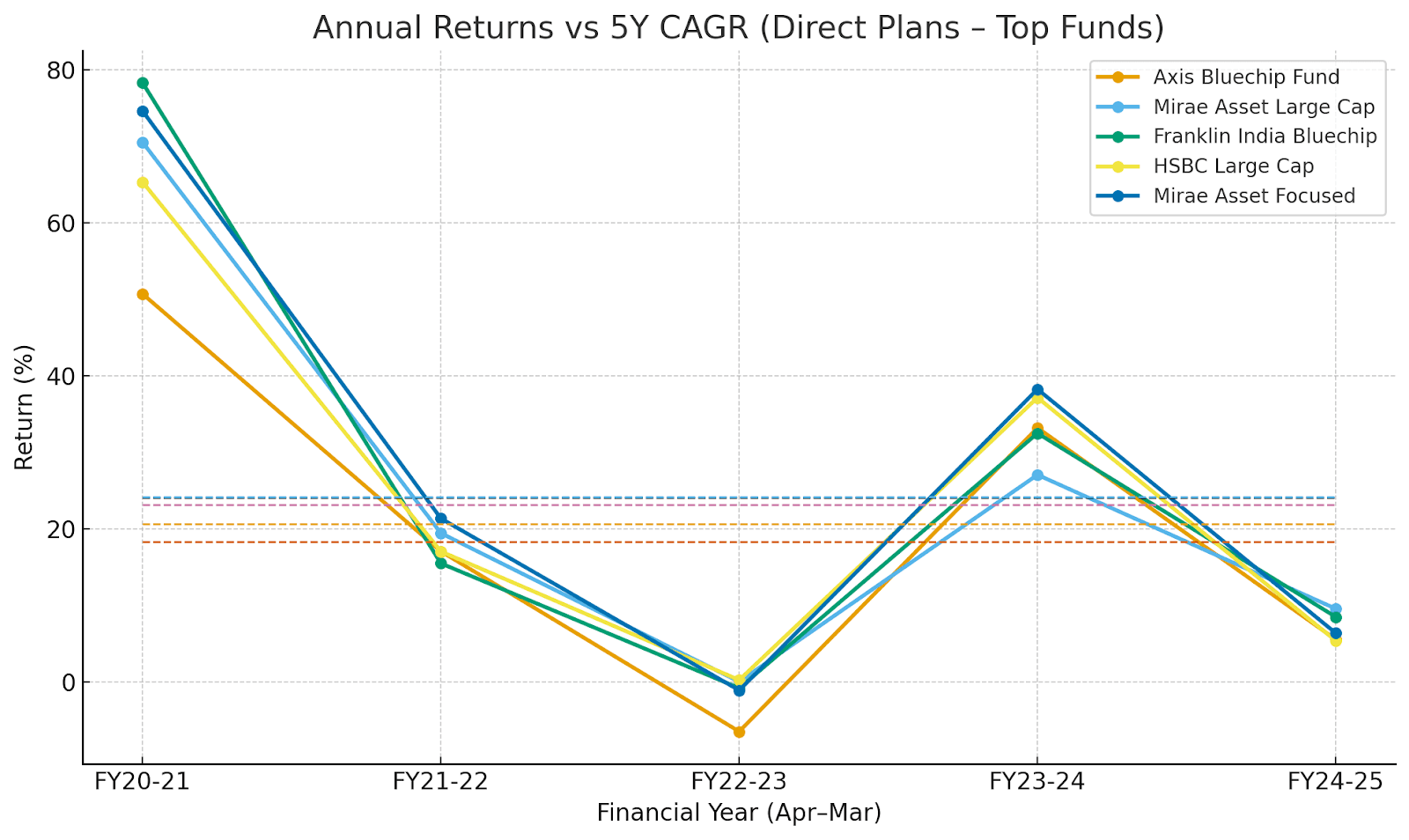
The above graph shows how the funds have performed individually in the five years, with volatile graphs (annualised returns). On the other hand, the 5-year CAGR is depicted by straight lines, which is a smoothed-up average of how the funds have performed overall in the given period.
Using CAGR To Build A Portfolio
As suggested before, it is a metric widely used by investors to evaluate the performance of a fund, especially when a lump-sum investment is made. While carrying out financial planning with specific goals in mind, CAGR can be used effectively to build a portfolio. By analyzing the long-term CAGRs of different funds, investors can identify consistent performers and balance them with other asset classes. For instance, if an equity mutual fund shows a strong 10-year CAGR but carries significant volatility, pairing it with bonds or debt funds can stabilize the portfolio while preserving growth.
In addition to the publicly available information for mutual funds, investors can evaluate Grip alternative investments using the CAGR lens. Usage of this metric is not restricted to mutual funds; other asset classes, such as fixed income securities, bonds, and debentures, can also be compared with mutual funds. This allows investors to assess how these opportunities compare to mutual funds and fixed-income products. However, it is important to understand that the CAGR just reflects the growth of an asset and does not include other decision-making criteria such as liquidity, fees or risk factors.
Since the investment objectives and risk perception of each investor are different from one another, it is imperative that CAGR, though a very important metric to evaluate growth, should not be the only criterion to accept or reject a fund.
Conclusion
CAGR is one of the simplest yet most powerful measures to evaluate investment growth. It gives investors a realistic understanding of how their money compounds annually, cutting through the noise of market volatility. Whether you are comparing funds within a category, deciding between lump sum and SIP strategies, or looking at diversified opportunities, CAGR provides a consistent measure of long-term growth.
You should not, however, depend on a single metric while considering an asset for your portfolio. It is important to consider other benchmarks, such as liquidity, risk factors, and always aim to diversify your portfolio by including fixed income securities that can be critical for consistent growth and attaining portfolio objectives in a bearish environment. By integrating it into your analysis, you can make more informed choices and create a strategy designed for steady, long-term wealth creation in the context of mutual fund CAGR India and beyond.
With Grip Invest, India’s one-stop destination for fixed income returns, you can explore curated opportunities to strengthen and balance your portfolio.
FAQs CAGR In Mutual Funds
1. How do you calculate CAGR for SIP investments?
For SIPs, CAGR isn’t accurate since cash flows occur at different times. Instead, use XIRR, which accounts for each installment’s timing. CAGR can only give an indicative return if you treat the SIP as a lump sum.
2. What is the difference between CAGR and absolute returns?
Absolute returns show total growth over a period, without annualising. CAGR annualises the growth, showing the smoothed year-on-year compounding rate.
3. Is CAGR the best way to evaluate mutual fund performance?
CAGR is useful for long-term performance, but it doesn’t capture volatility or cash-flow timing. It works best when combined with metrics like XIRR, risk ratios, and drawdown analysis.
Want to stay at the top of your finances?
Join the community of 4 lakh+ investors and learn more about Grip Invest, the latest financial knick-knacks, and shenanigans in the world of investing.
Happy Investing!
Disclaimer - Investments in debt securities/municipal debt securities/securitised debt instruments are subject to risks including delay and/ or default in payment. Read all the offer related documents carefully. The investor is requested to take into consideration all the risk factors before the commencement of trading.
This communication is prepared by Grip Broking Private Limited (bearing SEBI Registration No. INZ000312836 and NSE ID 90319) and/or its affiliate/ group company(ies) (together referred to as “Grip”) and the contents of this disclaimer are applicable to this document and any and all written or oral communication(s) made by Grip or its directors, employees, associates, representatives and agents. This communication does not constitute advice relating to investing or otherwise dealing in securities and is not an offer or solicitation for the purchase or sale of any securities. Grip does not guarantee or assure any return on investments and accepts no liability for consequences of any actions taken based on the information provided. For more details, please visit www.gripinvest.in
Registered Address - 106, II F, New Asiatic Building, H Block, Connaught Place, New Delhi 110001


