

Covered Bonds vs Fixed Income Securities: Key Differences Explained



What Is a Covered Bond?
The covered bond meaning refers to a debt security issued by banks or other financial institutions that is collateralised by a defined pool of assets, including residential mortgages or public-sector loans.
The investors have dual recourse in covered bonds. So if the issuer defaults, the investors can claim repayment from the issuer and, subject to the applicable legal framework, have a preferential claim on the assets in the cover pool.
The covered bond structure requires the cover pool to meet eligibility, coverage, monitoring and other requirements designed to protect bondholders. The assets generally stay on the balance sheet of an issuer.
When considering covered bonds vs bonds, the key distinction is the additional cover pool that supports the covered bonds alongside the obligation of the issuer to repay investors. This also distinguishes covered bonds from other securitisation structures, where assets are transferred to a separate special purpose vehicle (SPV) and investors rely on the underlying assets for repayment.
In India, covered bonds operate purely on a contractual basis between the investor and the issuer rather than under a dedicated statutory covered bond act.
What Are Fixed Income Securities?
Fixed income securities are investments that represent lending money to an issuer in return for interest or other predetermined cash flows and repayment of principal according to the terms of the security. Bonds issued by governments and companies are common examples.
The term fixed income investments covers a broad range of debt instruments. These can include government securities, corporate bonds, debentures, certificates of deposit and securitised debt instruments. Their maturity, interest payment, issuer and level of risk can differ significantly.
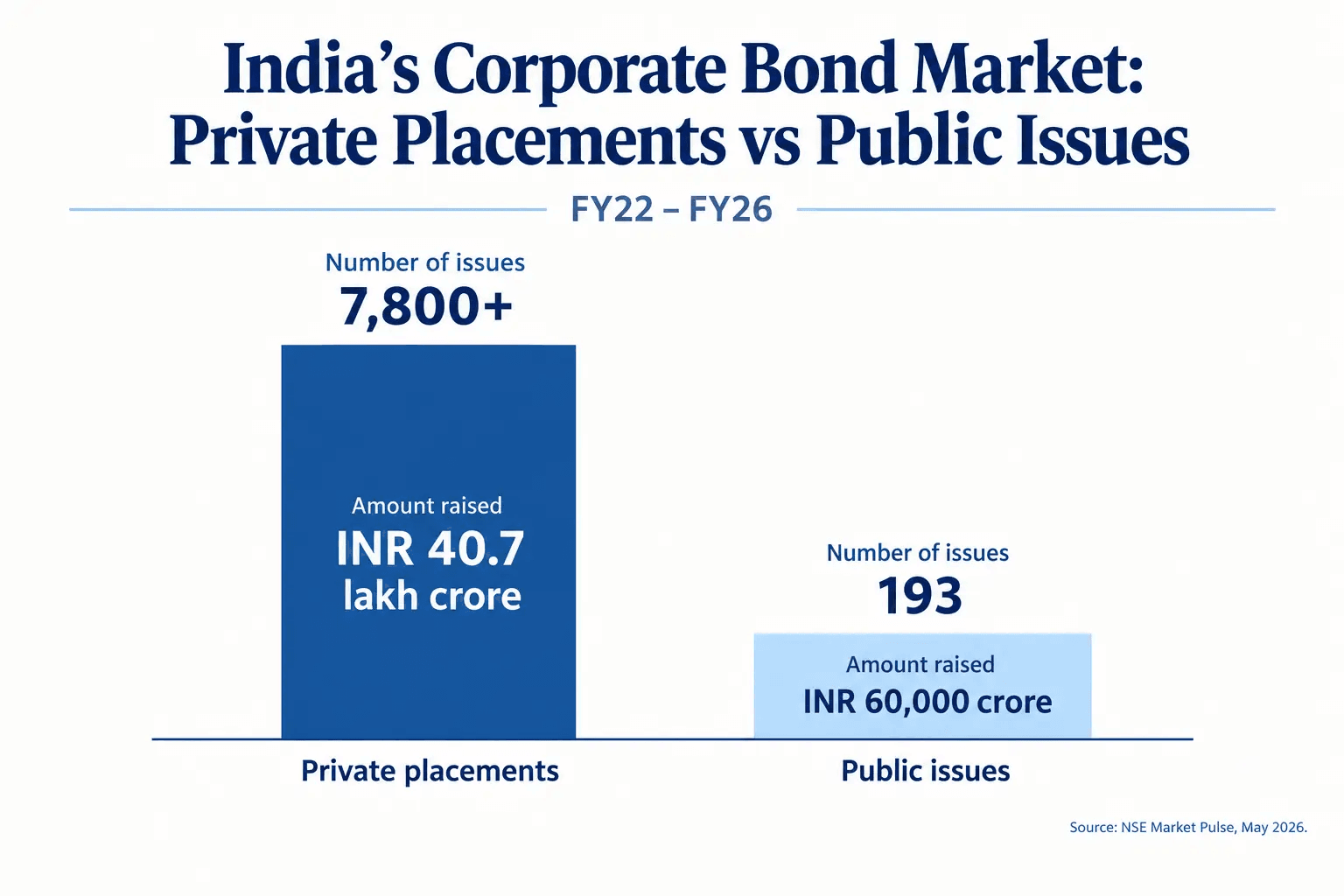
Fixed-income securities can reach investors through different issuance routes, with private and public placements forming a significant part of India’s debt market. The chart shows that during FY22-FY26, more than 7,800 private placements raised INR 40.7 lakh crore compared to 193 public issues that raised around INR 60,000 crore.
Despite being termed “fixed income”, the payment structure can sometimes feature floating or adjustable rates rather than a strictly static return. Further, depending on their structure, they can be secured or unsecured, senior or subordinated. A secured bond has specified assets supporting the debt, while an unsecured bond relies primarily on the ability of the issuer to repay. Its risk mostly depends on factors such as the credit quality of the issuer, interest-rate movements, maturity and liquidity.
Covered Bonds Vs Fixed Income Securities
A covered bond is a specialised low-risk subset of fixed-income securities. Therefore, the comparison below is between a covered bond as a specialised type within the broad fixed-income category, rather than two asset classes.
| Feature | Covered Bonds | Fixed Income Securities |
| Asset class | A specialised type of fixed income security | Broad category of fixed income investments |
| Issuer | Typically banks or eligible financial institutions | Governments, companies, banks and other institutions |
| Asset support | Defined cover pool | May be secured or unsecured |
| Investor claim | Dual recourse to issuer and cover pool | Depends on the security's structure |
| Asset treatment | Cover assets generally remain on issuer's balance sheet | Depends on the instrument |
| Examples | Mortgage-backed or public-sector covered bonds | Government bonds, corporate bonds, debentures, T-bills and others |
| Main risks | Issuer, cover pool, interest-rate and liquidity risks | Varies by security and issuer |
How Does A Covered Bond Work?
A covered bond works through a defined cover pool that supports the bond, along with the issuer and their obligation towards interest and principal according to the terms of the bond.
The covered bond structure has four important features:
- On-balance sheet: The assets in the cover pool generally remain on the issuer's balance sheet. This may differ from other securitisation structures, where assets are transferred to a separate entity, depending on the jurisdiction.
- Dual recourse: The investors have a general claim against the issuing bank or institution and a priority claim over the cover pool if the issuer defaults, which is subject to the applicable legal framework.
- Pool maintenance: The issuers are required to dynamically monitor and manage the pool, replacing non-performing, prepaid, or ineligible assets to ensure the quality and value of the pool stays intact.
- Overcollateralisation: The cover pool is typically required by law or program guidelines to exceed the total value of the outstanding bonds to provide a buffer for investors.
Risks And Factors To Check Before Investing
Covered bonds can offer additional structural protection, but they are not risk-free. Investors should assess the issuer, cover pool and terms of the specific security before investing.
1. Issuer credit risk: The issuer remains responsible for payments. A default or financial stress at the issuer can affect the investment and may trigger the covered-bond protections.
2. Cover pool risk: The value and quality of the underlying assets matter. Investors should examine the type of assets, eligibility requirements, coverage level and any over-collateralisation.
3. Interest-rate risk: The market price of a covered bond can fall when market interest rates rise, particularly when the investor sells before maturity.
4. Liquidity risk: A bond may not always have an active secondary market. An investor who wants to exit before maturity may have to sell at a price below the purchase price.
5. Legal and structural risk: The rights attached to the covered pool depend on the legal and contractual framework governing the bond. This is particularly important in India, where there is no specific covered-bond law.
Are Covered Bonds Different From Other Fixed Income Investments?
Yes. Covered bonds are different from other fixed income investments mainly in their structure and investor protection.
They are a specialised type of fixed income security in which investors have a claim on the issuer and, subject to the applicable legal framework, a preferential claim on the cover pool.
Other fixed income investments can be secured or unsecured and may offer different levels of credit protection, depending on their terms.
Investors looking to explore fixed income opportunities can also explore the fixed-income investments available through Grip Invest.
Conclusion
Covered bonds are a combination of debt investment features and collateral supporting the bond. Its dual-recourse structure sets it apart from the other fixed income securities within the broader fixed income investment category.
The distinction is particularly important for Indian investors because covered bonds do not currently have a specific law in India. Therefore, investors should examine the exact legal structure, issuer obligations and asset protection attached to any instrument described as a covered bond.
FAQs

Want to stay at the top of your finances?
Join the community of 22 lakh+ investors and learn more about Grip Invest, the latest financial knick-knacks, and shenanigans in the world of investing.
Happy Investing!
Disclaimer - Investments in debt securities/municipal debt securities/securitised debt instruments are subject to risks including delay and/ or default in payment. Read all the offer related documents carefully. The investor is requested to take into consideration all the risk factors before the commencement of trading.
This communication is prepared by Grip Broking Private Limited (bearing SEBI Registration No. INZ000312836 and NSE ID 90319) and/or its affiliate/ group company(ies) (together referred to as “Grip”) and the contents of this disclaimer are applicable to this document and any and all written or oral communication(s) made by Grip or its directors, employees, associates, representatives and agents. This communication does not constitute advice relating to investing or otherwise dealing in securities and is not an offer or solicitation for the purchase or sale of any securities. Grip does not guarantee or assure any return on investments and accepts no liability for consequences of any actions taken based on the information provided. For more details, please visit www.gripinvest.in
Registered Address - 106, II F, New Asiatic Building, H Block, Connaught Place, New Delhi 110001


