

Cryptocurrency Tax In India 2026: The Complete Investor Guide


Introduction
Crypto trading may be volatile, but taxes on it are not. In 2025–26, crypto investors in India face a clear framework: a flat tax on gains and mandatory tax deduction at source. The rules around cryptocurrency tax India have become stricter and simpler at once; profits from digital assets are taxed at a uniform rate, and compliance is enforced via mandatory reporting. The flat Crypto tax India 2025 is a 30% rate and 1% TDS under Section 194S, aiming to ensure every profit-generating transaction is captured1.
This article explains how crypto is taxed in India, the events that trigger tax liability, how to calculate taxes with examples, and whether crypto still makes sense for a long-term portfolio under this tax regime.
How Crypto Is Taxed In India
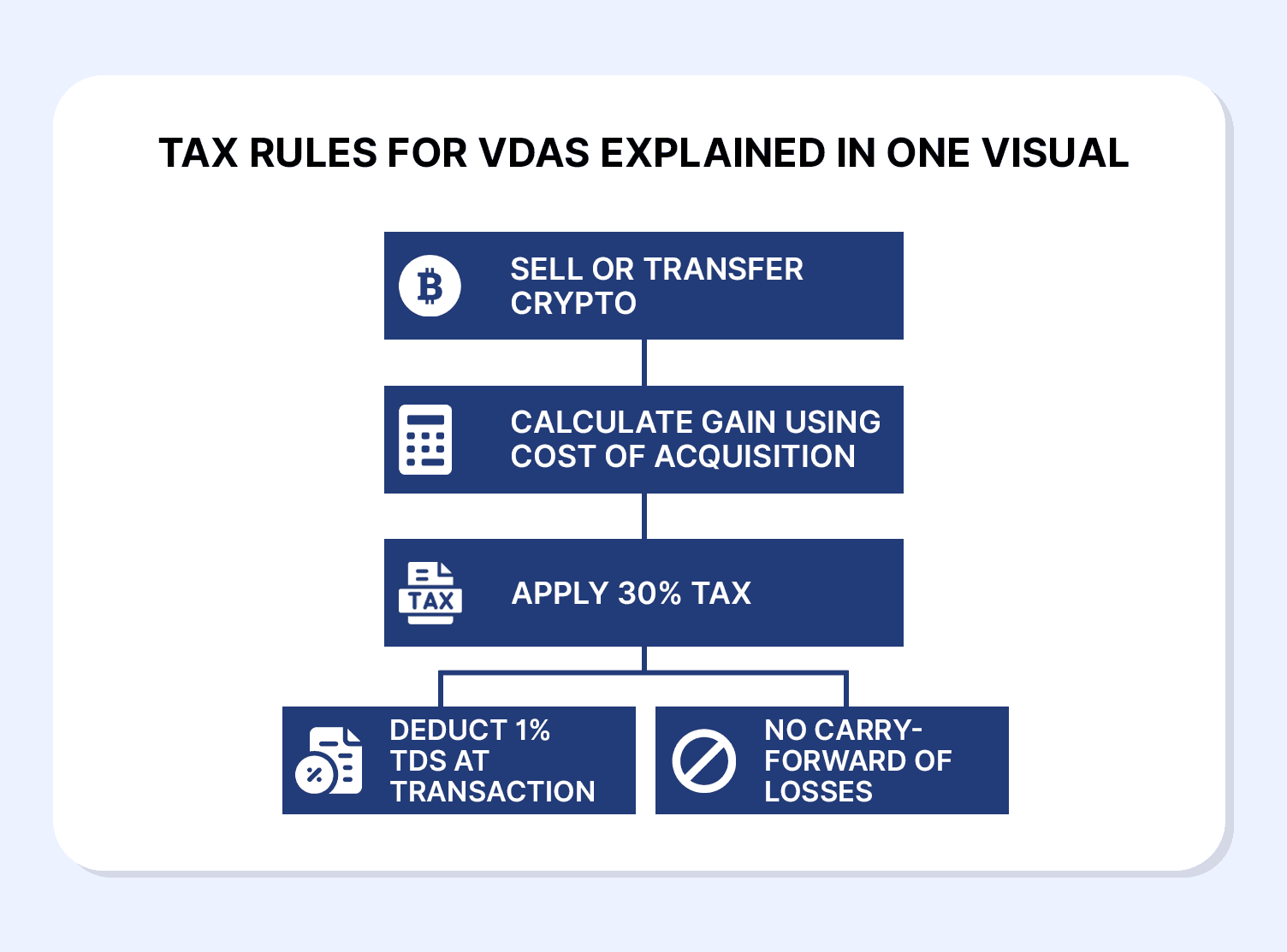
Cryptocurrencies can be considered as belonging to a more general category under Indian law, viz., Virtual Digital Assets (VDA). So, here are a few points to understand how is crypto taxed in India:
- Profits obtained as a result of the disposal or transfer of VDAs are taxed at a fixed rate of 30 percent, regardless of holding2.
- Cost of acquisition is the only deduction that is permitted. Any other expenses, such as transaction charges, mining and trading expenses, are not deductible.
- Cryptocurrency losses cannot be counterbalanced with other income or capital gains. There are no losses that can be carried forward.
- Additionally, a 1% TDS is applied on the sale or exchange of crypto assets under Section 194S3.
- Goods and Services Tax (GST) of 18 percent is imposed on the charge of services and commissions imposed by cryptocurrency exchanges in India, but not on the cryptocurrency itself4. In the Cryptocurrency GST India Act, cryptocurrencies fall under the category of goods, but their tax would be levied on the services offered to facilitate a crypto transaction by the platforms.
Due to these regulations, the crypto tax India has standardised all the gains as taxable; the tax slabs on other income do not apply to crypto gains.
What Is Considered A Taxable Crypto Transaction?
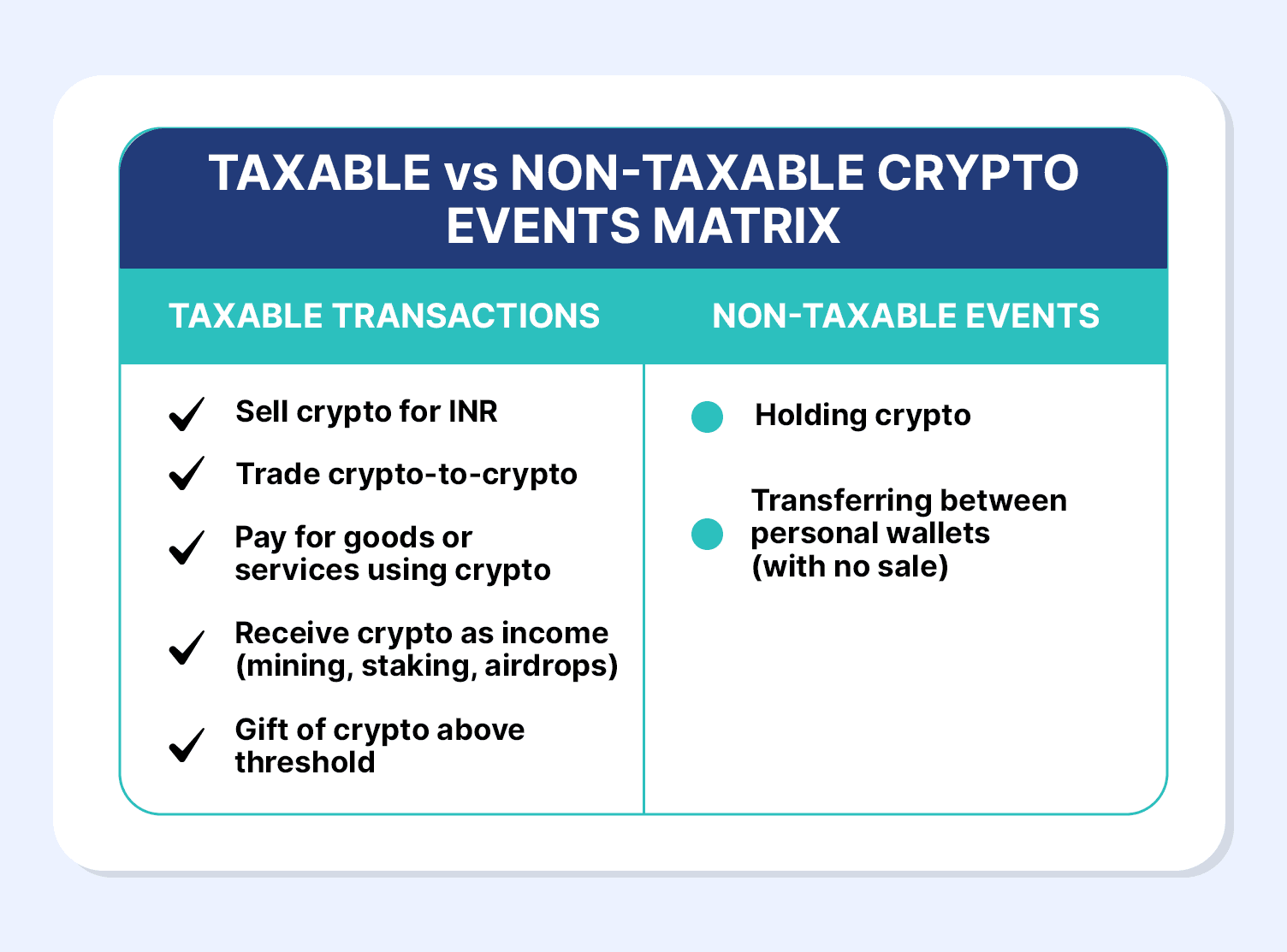
The following events typically trigger tax liability under the current crypto taxation rules India:
- Selling crypto for fiat (INR).
- Exchanging one cryptocurrency with another.
- Purchasing any goods or services with the help of crypto (spending crypto). That qualifies as a transfer of VDA.
- Cryptocurrency obtained as income, such as through mining, staking, airdrops, or rewards, could be treated as income and must once more be taxed on its disposal.
- Cryptocurrency gifts: when received over exemption limits and not themselves received as a gift, they are taxed and assessed again on sale.
If none of these events happen and the crypto is merely held, tax typically applies only when it is eventually disposed of or transferred.
How To Calculate Crypto Taxes (With Example)
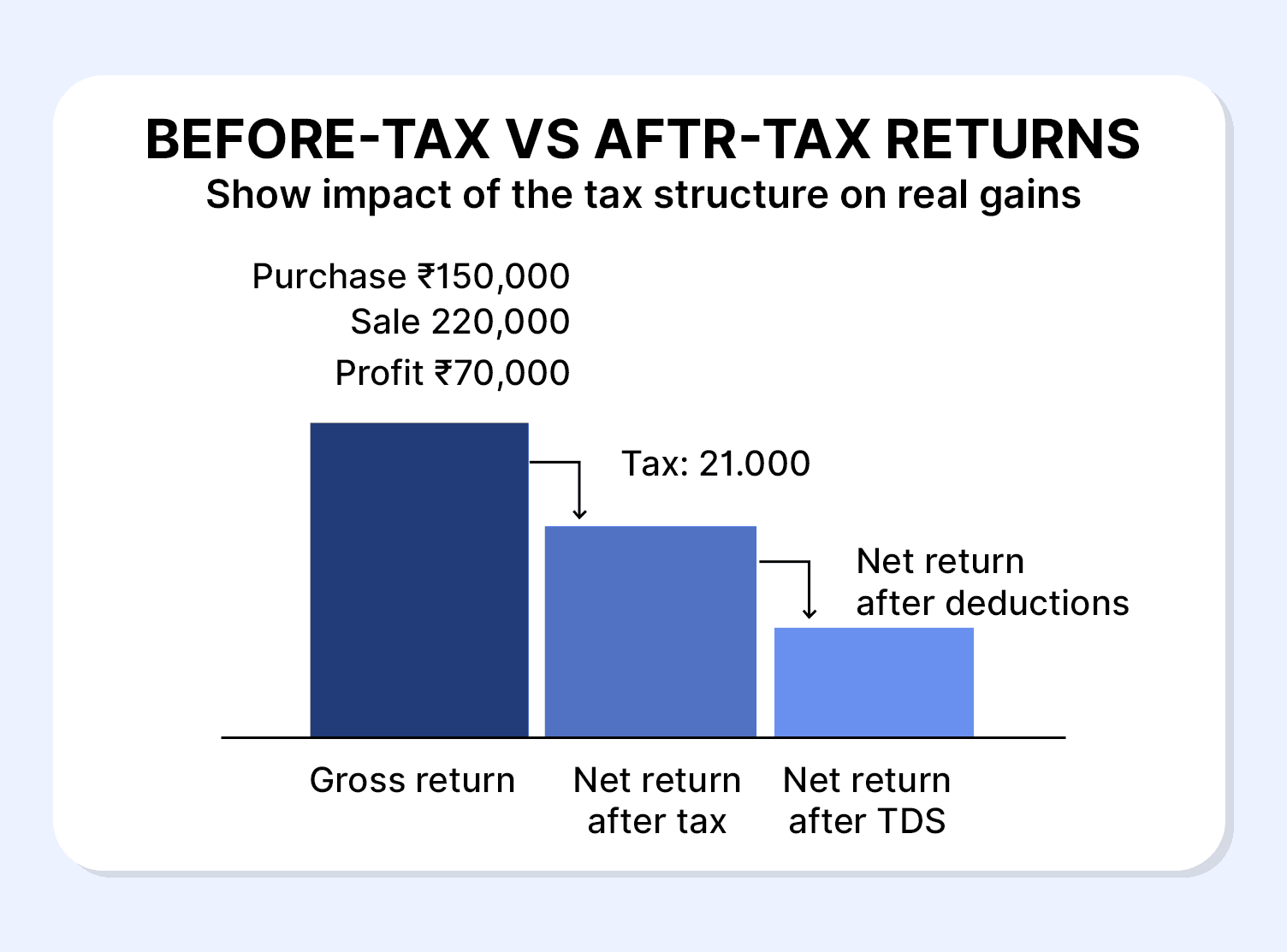
Example: Buy Sell gain calculation
In May 2025, a person bought 1 Bitcoin at a price of INR 150,000. Then, later sold in December 2025, and it was priced at INR 220,000. This brought about a taxable profit of INR 70,000 calculated by subtracting the cost of acquisition (INR 150,000) and the sale value (INR 220,000). Taking into account the cryptocurrency capital gains tax rate of 30% to be paid on such profit, the tax will be INR 21000.
TDS deduction example
In case the exchange makes a deduction of 1% for crypto TDS India at the time of sale, then 1% of INR 220,000 of INR 2,200 is deductible. Consequently, the person gets a net payment of INR 217,800. The deducted TDS of INR 2200 can be charged against the total tax liability in filing the income tax return, and there will be a reduced tax due of INR 18800.
Should Investors Include Crypto In A Portfolio Given The Tax Landscape?
The cryptocurrency tax regime minimises part of the crypto accenture. There is still high volatility, though a flat tax of 30 percent would greatly decrease the net post-tax returns.
Other disadvantages: cannot counterbalance losses or carry them to a later time, and 1% TDS on each transaction. That reduces flexibility.
Given this, many investors may look for more predictable assets offering steadier returns and lower tax friction. Safer options include regulated fixed-income instruments such as corporate bonds, structured debt instruments, or stable-yield products. Diversifying with such instruments alongside limited crypto exposure can balance risk and return under the prevailing cryptocurrency tax India framework.
Visit Grip Invest today!
FAQs On Cryptocurrency Tax In India 2026
1. What is the tax on crypto in India?
Profits from the sale or transfer of crypto / VDAs are taxed at a flat 30% under Section 115BBH. No deduction other than acquisition cost is allowed.
2. How is TDS on crypto deducted?
Under Section 194S, a 1% TDS applies on the transfer or sale of crypto assets. The exchange or buyer deducts this when payment is made. This TDS can be claimed as tax paid when filing returns.
3. Do I pay tax if I lose money in crypto?
No, crypto transactions that result in losses cannot be offset with any other income or capital gains. Under current laws, losses can not be carried forward either.
References:
1. India filings, accessed from: https://www.indiafilings.com/learn/crypto-tax-in-india-taxation-on-cryptocurrency/#:~:text=may%20be%20subject,VDA%20in%20your
2. Clear tax, accessed from: https://tinyurl.com/ycjajsws
3.Income tax India, accessed from: https://incometaxindia.gov.in/tutorials/72.tds-on-payment-for-the-transfer-of-virtual-digital-assets.pdf
4. Coin DCX, accessed from: https://tinyurl.com/2nz8aa57
Want to stay at the top of your finances?
Join the community of 4 lakh+ investors and learn more about Grip Invest, the latest financial knick-knacks, and shenanigans in the world of investing.
Happy Investing!
Disclaimer - Investments in debt securities/municipal debt securities/securitised debt instruments are subject to risks including delay and/ or default in payment. Read all the offer related documents carefully. The investor is requested to take into consideration all the risk factors before the commencement of trading.
This communication is prepared by Grip Broking Private Limited (bearing SEBI Registration No. INZ000312836 and NSE ID 90319) and/or its affiliate/ group company(ies) (together referred to as “Grip”) and the contents of this disclaimer are applicable to this document and any and all written or oral communication(s) made by Grip or its directors, employees, associates, representatives and agents. This communication does not constitute advice relating to investing or otherwise dealing in securities and is not an offer or solicitation for the purchase or sale of any securities. Grip does not guarantee or assure any return on investments and accepts no liability for consequences of any actions taken based on the information provided. For more details, please visit www.gripinvest.in
Registered Address - 106, II F, New Asiatic Building, H Block, Connaught Place, New Delhi 110001


