

Gold Vs Cryptocurrency: Which Is The Better Bet For Indian Investors?


Introduction
The argument between gold vs cryptocurrency shows the presence of two entirely different types of assets. On the one hand, gold is a proven store of value for thousands of years. Conversely, crypto and major cryptocurrencies, including Bitcoin (BTC) and Ethereum (ETH), have contemporary digital expansion possibilities.
This blog examines how both perform, the risks involved, and which may better suit different investors in India.
Performance Comparison: Gold Vs Crypto
Long-Term Historical Performance
During the last decade, gold vs bitcoin returns India, gold has provided consistent growth. According to global data, between 2000 and 2025, gold paid off in the tune of 1,075%, and on average, 10.9%/year1. That is why gold is a sound wealth preserver for decades.
By contrast, Bitcoin has delivered remarkable long-term returns.
Between late 2015 and late 2025, Bitcoin reportedly returned 25,789.2%, compared with gold’s 297.6% for the same period2. Such numbers illustrate the dramatic growth potential in crypto3.
Recent 5-Year Snapshot
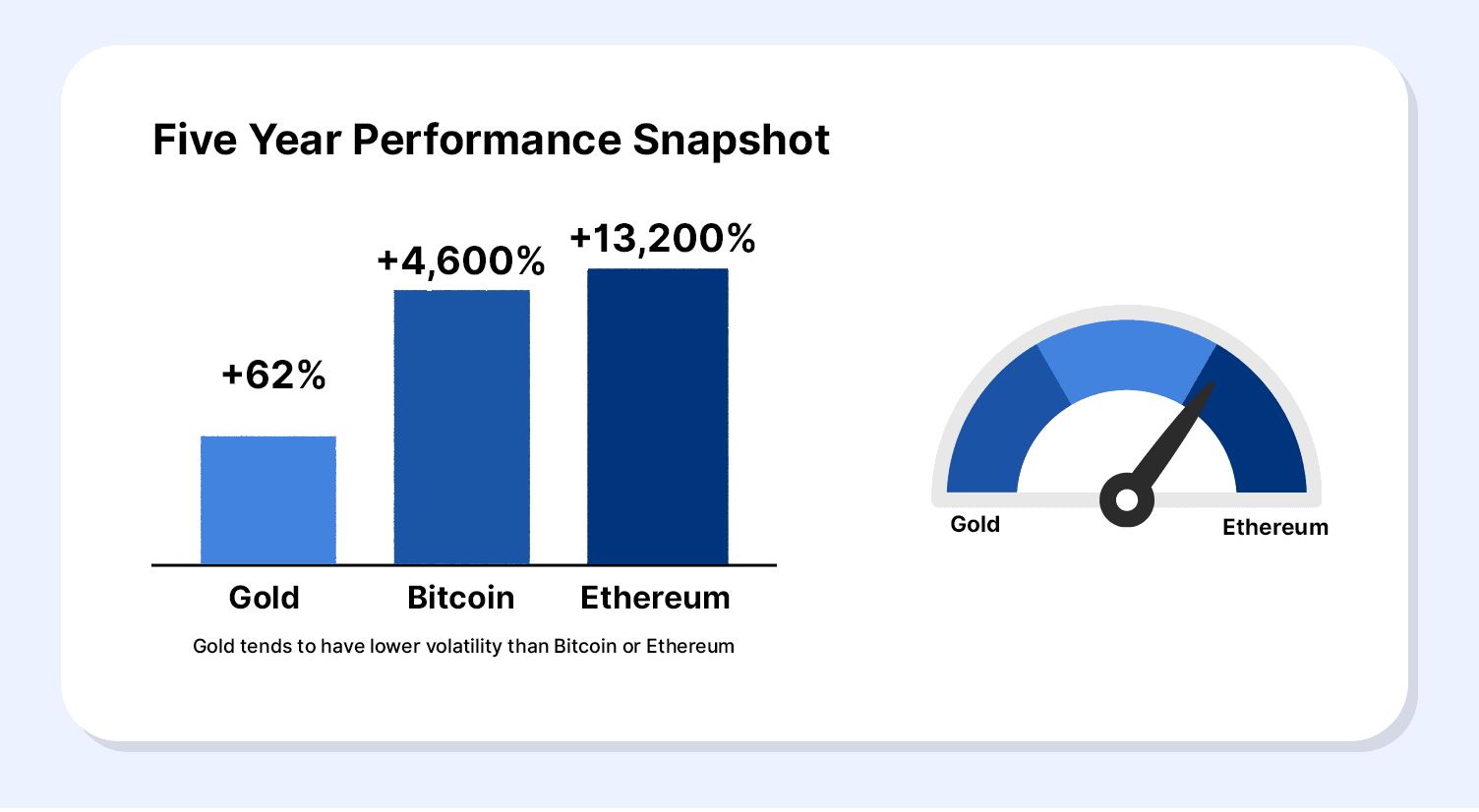
Over the past years, crypto, especially Bitcoin, has been on a boom: statistics indicate a significant increase in market capital and price over a five-year period. Meanwhile, gold has equally improved, though in a softer and more consistent manner. This difference shows the essence of bitcoin vs gold in India or gold vs crypto investment: stability vs high-growth potential.
Moreover, a recent 5-year analysis of gold vs Bitcoin returns India suggested Bitcoin’s market capitalisation rose by about 724%, while gold increased by around 114%4.
Also Read: Gold As A Macro Hedge
Inflation Hedge And Stability
Gold has been used as insurance in times of economic uncertainty and inflation. Historically, gold is likely to rise or appreciate during a world crisis or high inflation.
Crypto, however, remains more speculative. While Bitcoin and other cryptocurrencies are touted by some as “digital gold,” their price swings are much larger. Typically, many investors are prone to having disproportionate returns but have to bear the risk of high volatility.
Considering these dynamics, there is a trade-off when analysing the performance of gold vs crypto volatility, i.e., bitcoin vs gold in India: steady and low-growth and stability compared to unpredictable and high-potential-reward.
Risk Factors To Consider
Crypto-Specific Risks
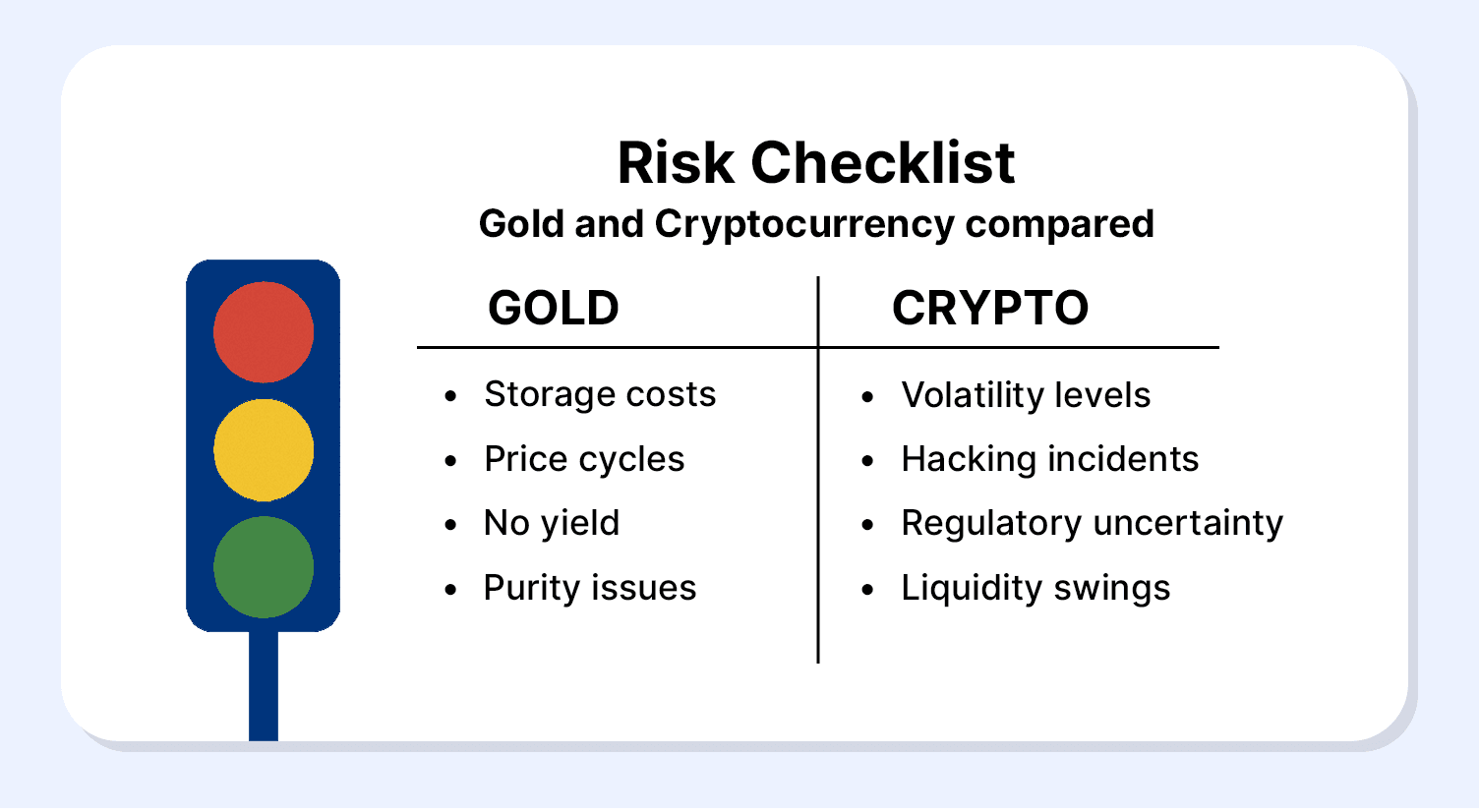
1. Volatility: Prices on cryptocurrencies may change radically. To take the example of gold vs crypto volatility, major declines following an upsurge.
2. Political risk (India): The cryptocurrencies are operating within the context of a changing regulatory climate. Such ambiguity is capable of affecting value, adoption, and legitimacy.
3. Security risks and Hacking: Wallets and crypto exchanges will involve the risks of a hack or robbery. Losses may be irreversible.
4. Liquidity and sentiment in the market: Crypto prices are frequently subject to the moods and news of the global market, and to the speculative sentiment, rather than to fundamentals.
Gold-Specific Risks
1. Price movements and variations: The prices of gold increase and decrease with time. Although there is long-term growth, occasionally there are periods of correction.
2. Storage and security costs: Physical gold requires safe storage. Jewellery may incur additional making charges or purity issues.
3. Zero yield and zero dividends: Gold is not a source of regular income, and its profitability will solely rely on price increase.
4. Demand and money aspects: The value of gold can be affected by local inflation, currency-related issues (USD-INR), the policies of the local central bank, and the global demand.
Investment Use Cases: Who Should Prefer What?
Conservative And Stability-Seeking Investors - Gold
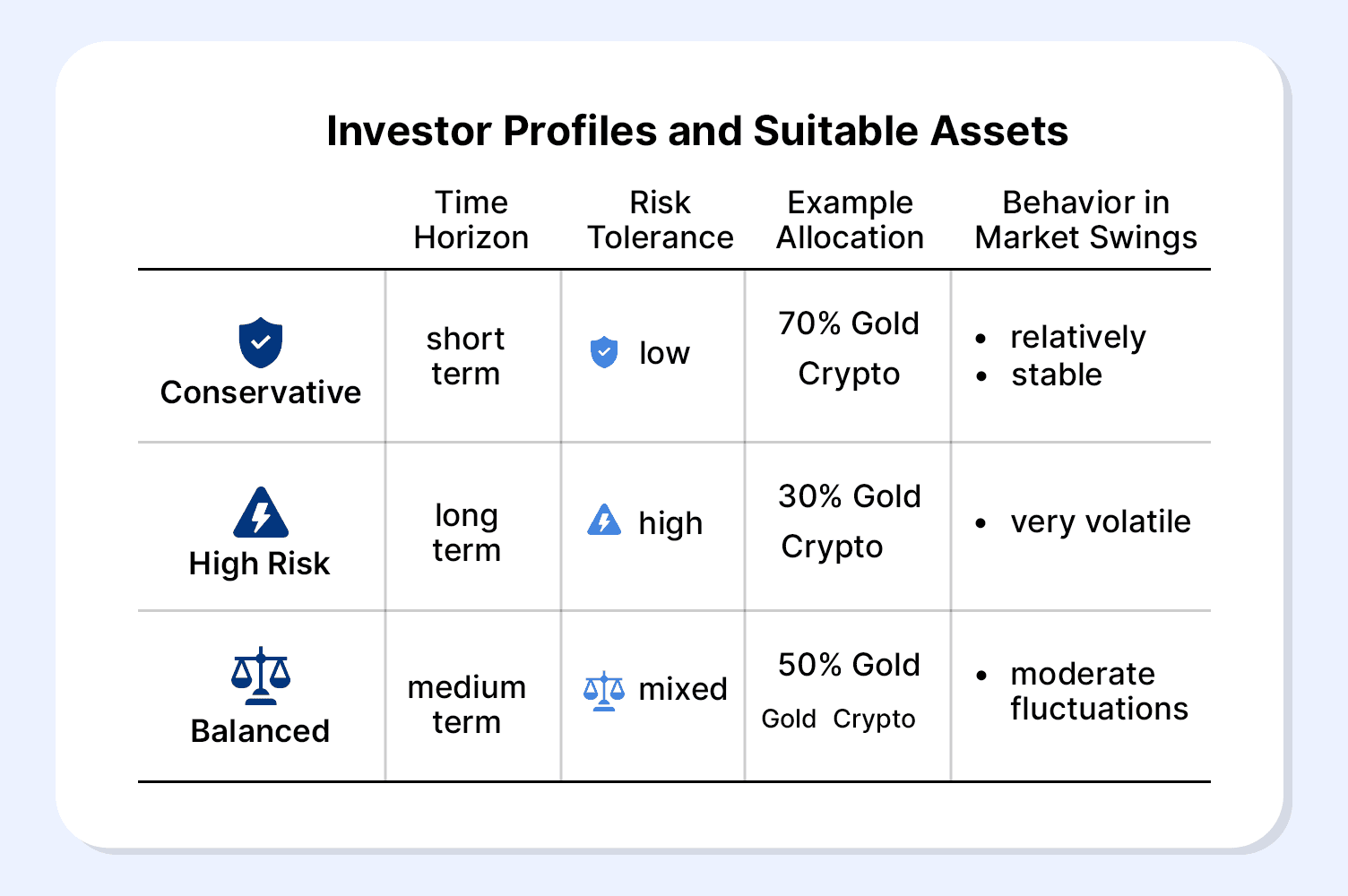
Gold is a good option for investors, as they are capital conservers, inflation hedgers, or risk-averse.
Hypothetical scenario: A 45-year-old, gold-on-salary professional borrows 5 lakh 10 years earlier and invests it in gold. Having increased at an average of 10-11%/year, the money invested today could have increased by a few folds, providing stability without extreme price movements.
Gold is good when one is nearer to retirement, and the level of risk is low.
Risk-Tolerant, Growth-Seeking Investors - Crypto
Crypto can be attractive to investors willing to tolerate high volatility and who seek high returns in case crypto offers them.
Hypothetical example: an investor who purchased 1 lakh worth of Bitcoin five years ago would have most likely experienced returns that are multiple times over, although with steep rises and falls. An individual holding can be worth considerably more than the initial principle.
This option is appropriate for younger investors or those with a longer horizon willing to take on major risk.
Balanced Or Diversified Portfolio - Mix Of Both
Many investors use gold to stabilise their portfolios and crypto to drive growth, creating a balance that can smooth overall volatility without sacrificing the potential for gains. This may encourage Indian investors to increase their exposure to physical gold, gold linked commodities, or carefully invest in crypto based on their risk tolerance, long term goals, and overall financial objectives.
Taxation And Regulatory Considerations In India
The Indian tax law has different treatment of gold and cryptocurrencies. Physical gold or gold bonds are taxed as capital gains, and under some favourable treatment in the long run, the gains are taxed favourably, particularly with respect to gold. Crypto is still being evaluated; it may alter the tax or legality of trade or the ease of trade.
Therefore, a question like “should I invest in gold or crypto” partly relies on tax, regulation, and legal security in the future.
Where Should Indian Investors Allocate?
There is no universal answer to the investment comparison of gold and crypto. It is allocated based on the risk appetite, age, and financial objectives. The sample guidance frameworks are as follows:
- Young investor (20s-30s), high risk tolerance: 60 per cent crypto, 40 per cent gold. Extensive growth orientation, long-run orientation.
- In the middle of the career (35-50), medium note of risk tolerance: 40 per cent gold, 30 per cent crypto, 30 per cent other assets (fixed income, equity). Equilibrium stability and development.
- Enhancing the nearing of retirement: low risk tolerance: 70-80 per cent good gold (or gold-linked), 10-20 per cent small crypto, remaining in fixed income or less risky investments.
This type of diversified placement keeps money intact and insures against a decline, yet provides little to no vulnerability to a growth profile.
In case of interlinking with the existing articles, reference previous articles on gold jewellery, gold ETFs in India, or crypto basics, whichever one should be used.
Conclusion
Gold and cryptocurrency sit on opposite ends of the investing spectrum. Gold has earned trust over centuries as a stable store of value, especially during market uncertainty. Crypto, meanwhile, offers high-growth potential backed by technology and innovation but comes with sharp volatility and evolving regulations. Your choice depends on how much risk you can handle and what role each asset plays in your financial goals.
For many Indian investors, a mix of both can work well. Gold can anchor your portfolio during tough market cycles, while crypto can add long-term growth if you’re comfortable with its ups and downs. And as you build this balance, remember that a strong foundation matters. Regulated fixed-income options like corporate bonds and SDIs on Grip Invest can bring steady stability alongside your gold and crypto investments.
FAQs On Gold Vs Crypto Investments
1. Is gold safer than cryptocurrency?
Yes, gold is far less volatile. It has a centuries-old history as a store of value. Crypto is unstable and more uncertain.
2. Which gives better returns: gold or crypto?
Crypto has paid much greater returns over time, in particular in bull runs. But these come with high risk. Gold generates stable, moderate returns.
3. Should both be held?
Having both is a way to balance between stability and growth, and leverage downside risk, but still have upside potential. A balanced portfolio usually works appropriately.
References:
1. Visual capital, accessed from: https://www.visualcapitalist.com/charted-golds-annual-returns-2000-2025/#:~:text=Gold%20prices%20are,July%203%2C%202025
2. Statmuse, accessed from: https://tinyurl.com/mpuar88p
Want to stay at the top of your finances?
Join the community of 4 lakh+ investors and learn more about Grip Invest, the latest financial knick-knacks, and shenanigans in the world of investing.
Happy Investing!
Disclaimer - Investments in debt securities/municipal debt securities/securitised debt instruments are subject to risks including delay and/ or default in payment. Read all the offer related documents carefully. The investor is requested to take into consideration all the risk factors before the commencement of trading.
This communication is prepared by Grip Broking Private Limited (bearing SEBI Registration No. INZ000312836 and NSE ID 90319) and/or its affiliate/ group company(ies) (together referred to as “Grip”) and the contents of this disclaimer are applicable to this document and any and all written or oral communication(s) made by Grip or its directors, employees, associates, representatives and agents. This communication does not constitute advice relating to investing or otherwise dealing in securities and is not an offer or solicitation for the purchase or sale of any securities. Grip does not guarantee or assure any return on investments and accepts no liability for consequences of any actions taken based on the information provided. For more details, please visit www.gripinvest.in
Registered Address - 106, II F, New Asiatic Building, H Block, Connaught Place, New Delhi 110001


