

Debt To Capital Employed Ratio: Meaning, Formula And Why It Matters


A company’s growth is not driven by profits alone. The way it balances borrowed funds and owned capital plays a major role in determining its long-term financial stability.
This is where the debt to capital employed ratio becomes important. The ratio helps investors, analysts, and lenders understand how much of a company’s operations are financed through debt compared to its overall capital base.
A higher ratio may indicate greater financial risk, while a balanced ratio often reflects stronger financial discipline. Understanding this metric can help stakeholders assess a company’s solvency, borrowing capacity, and overall financial health more effectively.
What Is Debt To Capital Employed Ratio?
The Debt to Capital Employed ratio indicates a business's financial performance. This ratio expresses the percentage of the company's total capital employed that is financed through borrowing.
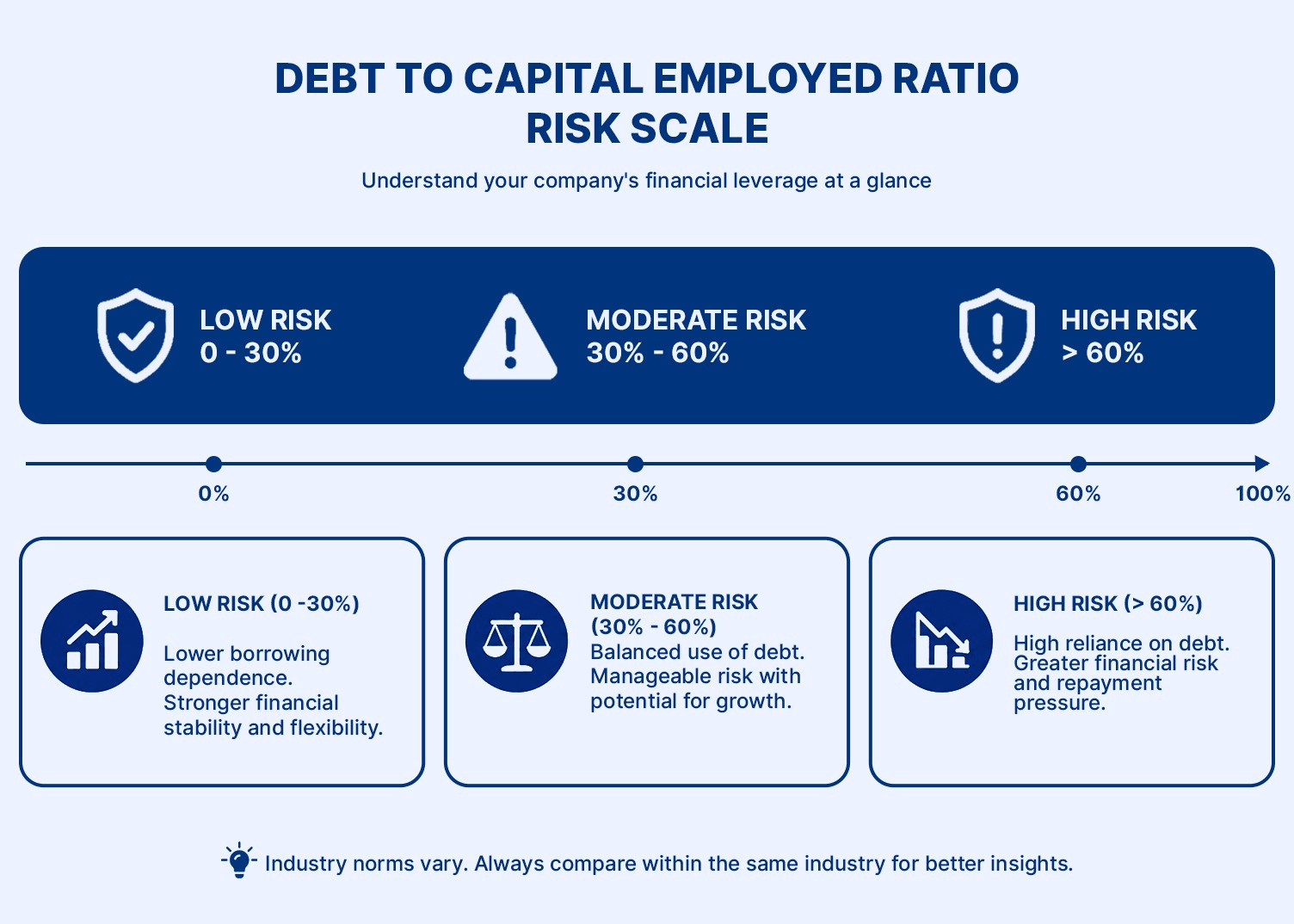
This business debt analysis plays a vital role in assessing financial performance by enabling analysts to estimate the firm's risk levels (since debt is often considered a benchmark for measuring risk). Highly leveraged businesses usually face greater repayment pressure when economic uncertainty prevails, while moderately leveraged businesses maintain a proper balance between growth and stability.
On the other hand, businesses also use this financial ratio to measure corporate leverage metrics. Moderate leverage results in higher returns and faster growth for businesses, while high leverage makes them highly vulnerable to financial risks. Hence, this ratio enables companies to achieve an appropriate balance between debt and equity financing.
Formula For Debt To Capital Employed Ratio
The debt-to-capital ratio, or capital employed ratio, indicates how much debt a company has relative to the total capital it uses. The equation for this ratio is:
Debt to Capital Employed formula = Capital Employed / Total Debt
(Here, total debts include total debts plus shareholders' equity)
For instance, if a company has INR 40 lakh debt and INR 100 lakh capital employed, then the Debt to Capital Employed ratio will be:
100/40 =0.40
This indicates that 40% of the total capital has been raised by debt financing.
Generally, total debt includes only long-term sources of financing (such as bank loans, bonds and leases), since short term sources are usually excluded from the total.
Whereas, capital employed refers to the capital that is employed in the operations of a business, and is calculated as follows:
Capital Employed=Total Assets-Current Liabilities
OR
Capital Employed=Equity+Long-term Debt
Once you understand each of these components, you will have accurate data for leverage ratio analysis.
How To Calculate Debt To Capital Employed Ratio
By calculating the debt to capital employed ratio, one can determine the extent to which capital is financed through borrowings.
First, determine the total amount of debt, including long-term debt and loans.
Secondly, determine the capital employed by subtracting the current liabilities from total assets.
Consider the following example:
Total assets = INR 150 lakh
Current liabilities = INR 30 lakh
Total debt = INR 60 lakh
Now, the ratio formula would be used as follows:
Capital employed = 150 - 30 = 120 lakh
Debt / Capital employed = 120 / 60 = 0.50
This implies that the debt amount represents 0.50 or 50% of capital.
In general, the lower the ratio, the less the leverage, while the higher the ratio, the greater the leverage.
Why Debt To Capital Employed Ratio Matters?
The debt to capital employed ratio is important because it provides insight into the financial stability and health of a business organization.
For starters, the ratio helps in determining the level of financial leverage. Organizations with strong leverage find it easier to expand their operations without being heavily burdened by debt.
Secondly, it assists in calculating debt dependency, with firms having high ratios becoming more susceptible to interest rate hikes and economic recessions because repayments must continue to flow despite poor revenues.
Thirdly, the ratio helps in the solvency ratio calculation. Good solvency positions will make it easier for organizations to get further funding in future.
Lastly, the ratio enables the determination of shifts in organizations' borrowing patterns over time.
Debt To Capital Employed Ratio vs Other Leverage Ratios
Even though the ratio is significant in its own right, it cannot be analyzed by itself. Comparing the ratio with other leverage ratios provides a broader perspective on the organization's financial state.
The capital employed ratio compares the size of debt to equity vs capital employed.
The debt ratio shows how much of the organization's assets is financed by debt.
The interest coverage ratio indicates whether the organization can cover its interest payments with its operating income.
Limitations Of Debt To Capital Employed Ratio
All financial ratios come with some limitations. For instance, the ratio is prone to industry variations. A few industries have varying leverage standards, with some having higher standards than others. A good illustration is the infrastructure industry, which has a higher leverage ratio than the technology industry.
Moreover, using the ratio alone might yield incomplete results.
Companies have to supplement this ratio with profitability and solvency ratios, including the return on capital employed ratio and the debt to equity ratio.
Conclusion
The debt/capital employed ratio is important for gauging the level of debt used to finance a business entity's operations.
The debt to capital employed ratio can be used to gauge the risk and financial soundness of companies, based on the percentage of capital financed by debt. However, it is always advisable to use additional ratios when analyzing performance.
FAQs On Debt To Capital Employed Ratio
 |
Author: Grip Invest Editorial Team The Grip Invest Editorial Team is a group of Chartered Accountants, MBA (Finance) graduates, and Qualified Research Analysts dedicated to helping you invest smarter. We dive deep into India's fixed income landscape to deliver content that is accurate, up-to-date, and easy to understand. Whether you're exploring bonds, fixed deposits, or other fixed income opportunities, our guides cut through the noise and give you the clarity to make better financial decisions. |
Want to stay at the top of your finances?
Join the community of 4 lakh+ investors and learn more about Grip Invest, the latest financial knick-knacks, and shenanigans in the world of investing.
Happy Investing!
Disclaimer - Investments in debt securities/municipal debt securities/securitised debt instruments are subject to risks including delay and/ or default in payment. Read all the offer related documents carefully. The investor is requested to take into consideration all the risk factors before the commencement of trading.
This communication is prepared by Grip Broking Private Limited (bearing SEBI Registration No. INZ000312836 and NSE ID 90319) and/or its affiliate/ group company(ies) (together referred to as “Grip”) and the contents of this disclaimer are applicable to this document and any and all written or oral communication(s) made by Grip or its directors, employees, associates, representatives and agents. This communication does not constitute advice relating to investing or otherwise dealing in securities and is not an offer or solicitation for the purchase or sale of any securities. Grip does not guarantee or assure any return on investments and accepts no liability for consequences of any actions taken based on the information provided. For more details, please visit www.gripinvest.in
Registered Address - 106, II F, New Asiatic Building, H Block, Connaught Place, New Delhi 110001


