

ESG ETFs In India: Invest With Purpose And Performance


Introduction: The Rise of Sustainable Investing In India
Sustainable investing India has gained remarkable momentum in recent years. The assets under management for Environmental, Social, and Governance (ESG) ETFs have grown from INR 2,703 crores in 2019 to over INR 11,000 crores by mid-20251. This growth is a result of increasing investor preferences towards sustainable investing.
The shift in investor mindset reflects a growing recognition that long-term value creation requires addressing ESG standards.
In this article, we will cover in-depth what ESG mutual funds are and everything else you need to know about them.
What Are ESG ETFs?
ESG ETFs India provide investors with exposure to companies having strong sustainability practices. These funds track specially constructed indices that evaluate companies not only on financial performance but also on their environmental impact, social responsibility, and governance structures.
The Indian ESG ETF landscape has evolved significantly since 2020, now featuring the best ESG ETF India from asset management companies, including SBI Mutual Fund, Mirae Asset, Kotak Mahindra, and ICICI Prudential, tracking various ESG-focused indices like the Nifty100 ESG and NSE ESG400.
The selection methodology evaluates environmental factors (carbon emissions, water usage, renewable energy adoption), social considerations (workforce diversity, community engagement, human rights), and governance practices (board independence, executive compensation, shareholder rights). This analysis creates portfolios of companies better positioned to navigate green investing India.
Also Read: One-Time Investment Plans In India: How To Grow A Lump Sum Wisely
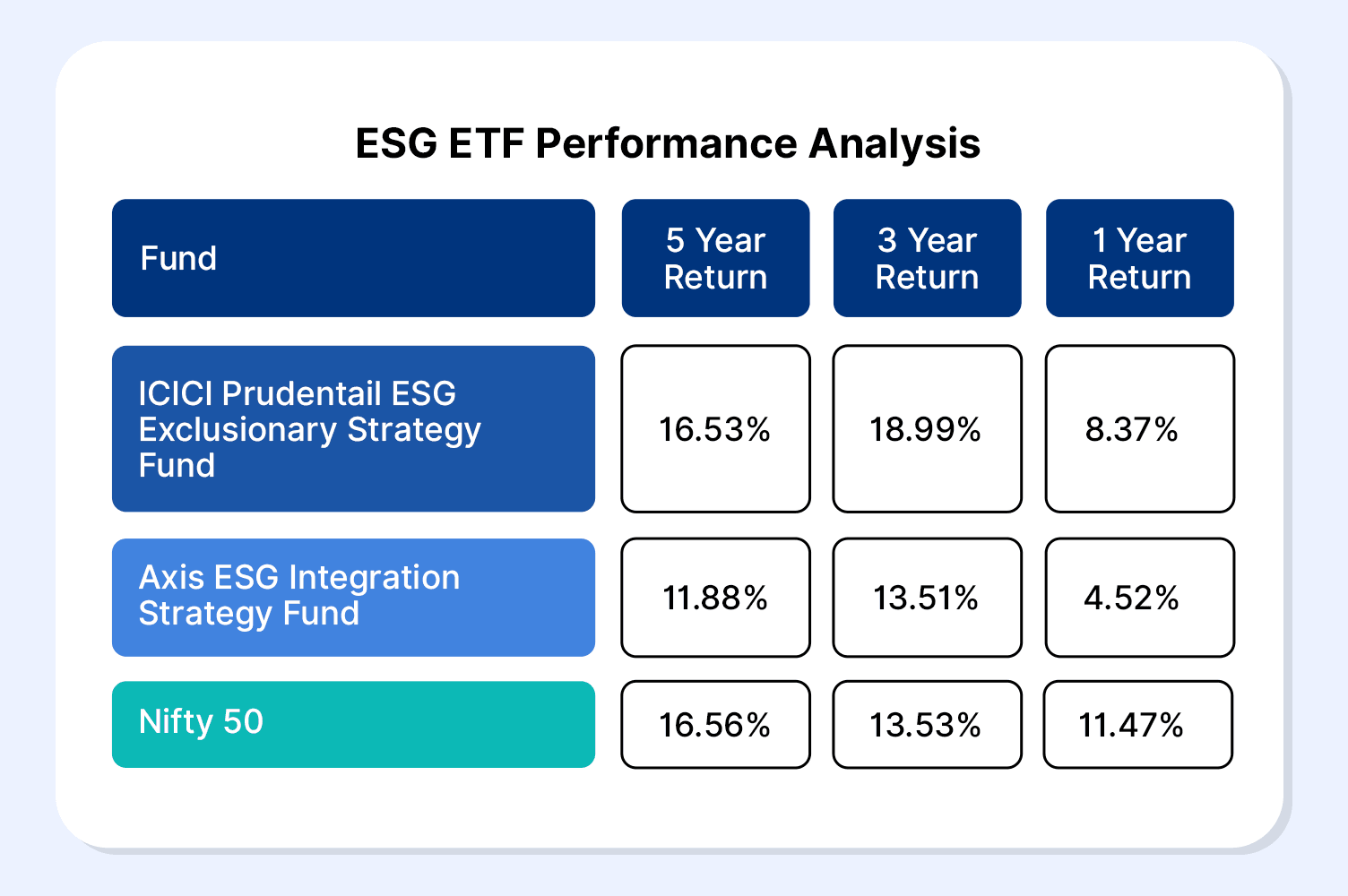
ESG ETF Performance Analysis
Source2
Environmental social governance funds have challenged the notion that ethical investing requires sacrificing returns. This performance pattern reveals that during the last 5 years and the 3-year period, especially for the 3-year period, both funds have given competitive returns than the Nifty 50 index. However, ESG mutual funds are concentrated and require a high risk appetite.
Why ESG Matters: Climate Goals, Governance, And Ethical Investing
Ethical investing India is crucial for investors for various reasons. Some of them are:
| Risk Management | Identification of environmental, regulatory, and reputational risks Avoidance of costly penalties and litigation Enhanced resilience during market volatility Comprehensive assessment beyond traditional metrics |
| Financial Performance | Greater resilience during market turbulence Potential for attractive long-term returns Access to growing ESG-focused capital pools Premium pricing for sustainable products and services |
| Strategic Advantages | Operational efficiencies through resource optimisation More resilient supply chains New opportunities for innovation and market development Strengthened brand reputation and customer loyalty |
| Governance Benefits | Improved transparency and accountability Enhanced board diversity and decision-making Stronger internal controls reduce misconduct risks More effective stakeholder engagement |
| Market Momentum | Growing institutional investor alignment with ESG Expanding regulatory frameworks mandating disclosures Increasing consumer preference for responsible businesses Positioning as future market leaders |
ESG Investing With Stability: Finding The Right Balance
While the case for ESG investment strategies is compelling, your portfolio construction requires balancing ESG-focused equity exposure with stable fixed-income assets. This hybrid approach allows investors to participate in sustainability transitions while maintaining portfolio stability.
Consider a hypothetical investor who allocates 60% to an ESG Fund focused on companies with strong sustainability practices and 40% to fixed-income assets through platforms like Grip Invest, including bonds, SGBs, and more.
This balanced approach supports companies aligned with personal values while maintaining stability through market cycles. Environmental risks, social factors, and governance issues can impact corporate financial performance, helping investors identify both opportunities and risks overlooked in conventional analysis.
Also Read: Systematic Transfer Plan (STP): Meaning, Types And Benefits
Conclusion
ESG ETFs in India allow investors to align their portfolios with both financial goals and values-driven choices. With sustainable investing showing competitive performance, the belief that investors must compromise returns for responsibility is becoming outdated.
As India advances its development and sustainability agenda, capital markets will increasingly channel funds toward companies that prioritise long-term environmental and social impact. ESG ETFs offer an accessible way for retail investors to participate in this shift while maintaining diversified and future-ready portfolios. A blend of purposeful equity exposure through ESG ETFs and stable fixed-income allocations can create a balanced, resilient investment strategy.
For investors looking to complement their ESG exposure with reliable fixed-income opportunities, platforms like Grip Invest provide curated products designed to deliver predictable, stable returns.
FAQs On ESG ETFs In India
1. Are ESG funds profitable?
In the long term, ESG funds India 2025 can deliver competitive returns relative to broader market indices. But they require patience and careful selection of funds.
2. How do ESG ETFs differ from regular ETFs?
ESG ETFs incorporate an additional layer of analysis focused on environmental, social, and governance factors, potentially excluding or underweighting companies with poor sustainability practices while overweighting sustainability leaders.
3. Which are the best ESG ETFs in India?
As of 2025, established options include Nippon India ETF NV20, SBI Nifty100 ESG ETF, and Mirae Asset ESG Sector Leaders ETF. Investors should evaluate expense ratios (ranging from 0.25% to 0.85%), tracking error, AUM size, and specific ESG methodologies when selecting funds.
References:
1. Research publish, accessed from: https://shorturl.at/I3G61
2. NIFTY Indices, accessed from: https://www.niftyindices.com/market-data/return-profile
Want to stay at the top of your finances?
Join the community of 4 lakh+ investors and learn more about Grip Invest, the latest financial knick-knacks, and shenanigans in the world of investing.
Happy Investing!
Disclaimer - Investments in debt securities/municipal debt securities/securitised debt instruments are subject to risks including delay and/ or default in payment. Read all the offer related documents carefully. The investor is requested to take into consideration all the risk factors before the commencement of trading.
This communication is prepared by Grip Broking Private Limited (bearing SEBI Registration No. INZ000312836 and NSE ID 90319) and/or its affiliate/ group company(ies) (together referred to as “Grip”) and the contents of this disclaimer are applicable to this document and any and all written or oral communication(s) made by Grip or its directors, employees, associates, representatives and agents. This communication does not constitute advice relating to investing or otherwise dealing in securities and is not an offer or solicitation for the purchase or sale of any securities. Grip does not guarantee or assure any return on investments and accepts no liability for consequences of any actions taken based on the information provided. For more details, please visit www.gripinvest.in
Registered Address - 106, II F, New Asiatic Building, H Block, Connaught Place, New Delhi 110001


