

What Is Ethanol Blended Petrol? Benefits, Challenges & India's E20 Fuel Mission


As fuel prices fluctuate continuously and change in climate becomes an increasingly urgent concern, countries worldwide are searching for cleaner and more sustainable energy alternatives. India is one of the world's biggest consumers of crude oil, and has taken an important step in this direction through ethanol blended petrol.1
But what exactly is ethanol blended petrol? Why is the Indian government aggressively promoting it? And how does it affect consumers, farmers, industries, and the environment?
In this blog, discussion brings explanations on everything you need to know about ethanol blended petrol, its benefits, challenges, and its growing role in India's journey toward energy independence.
What Is Ethanol Blended Petrol?
Ethanol blended petrol is a mixture of conventional petrol and ethanol a renewable biofuel produced from agricultural feedstocks such as maize, damaged food grains, sugarcane and other biomass.2
The blending percentage determines the ethanol content:
- E10: 10% ethanol + 90% petrol
- E20: 20% ethanol + 80% petrol
India is currently transitioning from E10 to E20 fuel as part of its ambitious National Biofuel Policy.
Unlike fossil fuels that take millions of years to form, ethanol is renewable just because it is produced annually from crops. This makes it an environmentally friendlier alternative while reducing dependence on imported crude oil.
India's Ethanol Blending Progress
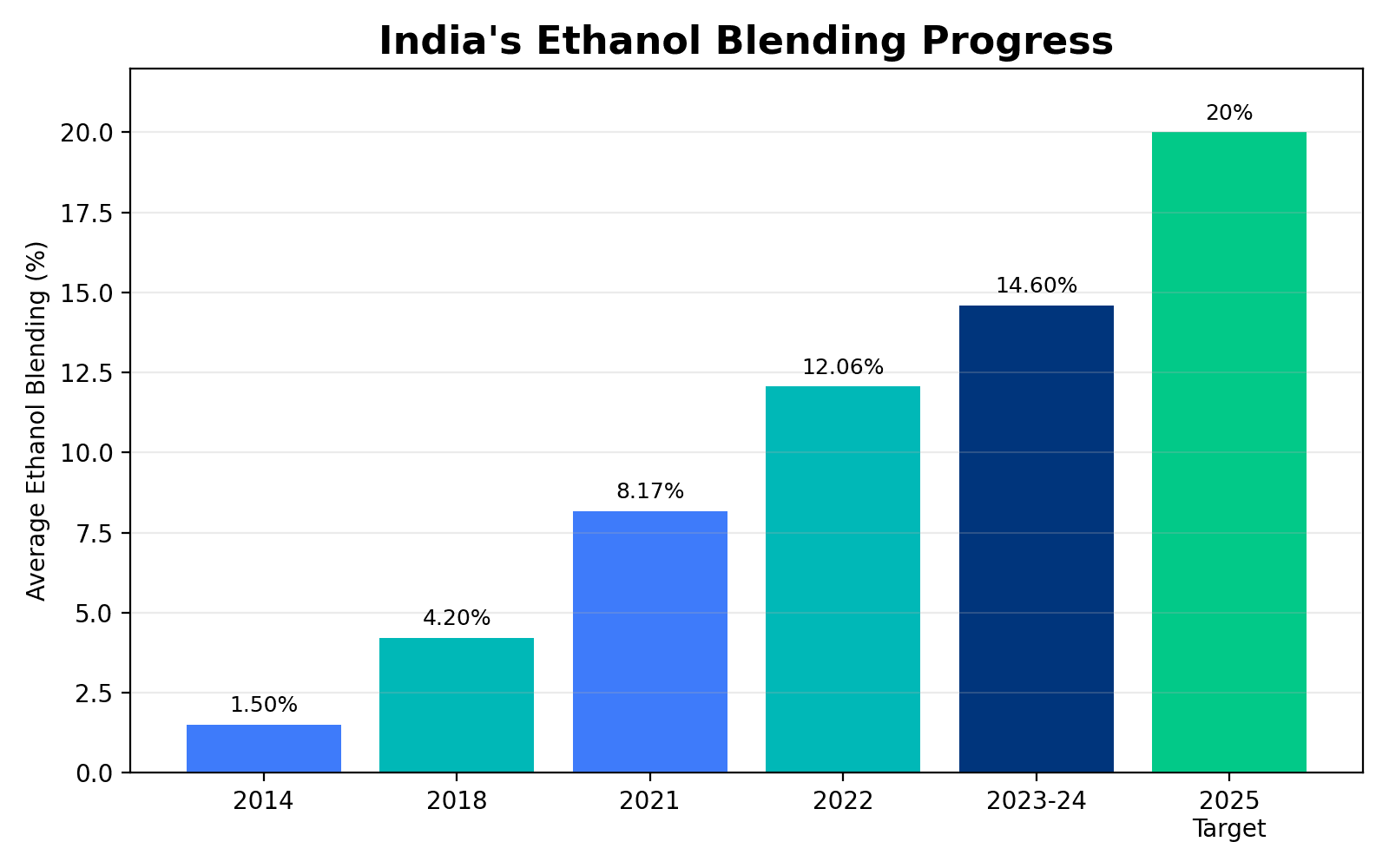
Year | Average Ethanol Blending |
2014 | 1.50% |
2018 | 4.20% |
2021 | 8.17% |
2022 | 12.06% |
2023-24 | 14.6%
|
2025 | 20% target by 2025 |
India has made remarkable progress over the last decade, moving from negligible blending levels to becoming one of the fastest-growing ethanol markets globally.
Why Is India Promoting Ethanol?
India imports nearly 85% of its crude oil requirements, making the economy highly vulnerable to global oil price fluctuations and geopolitical tensions.
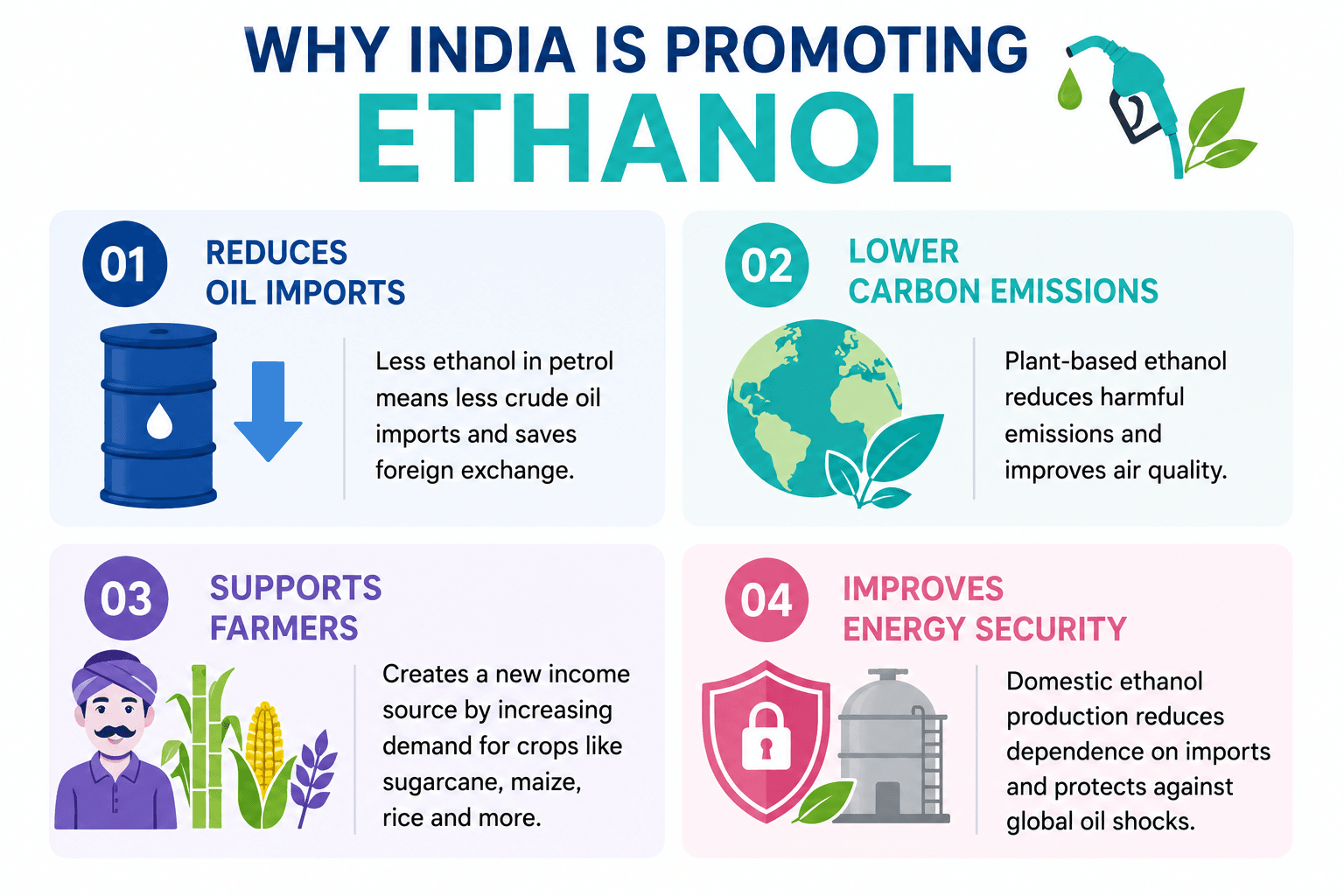
Promoting ethanol blending India serves multiple strategic objectives.
1. Reducing Oil Imports
Every litre of ethanol blended into petrol reduces India's dependence on imported fossil fuels.
According to government estimates, higher ethanol blending has already helped save thousands of crores in foreign exchange that would otherwise have been spent on crude oil imports.3
2. Lower Carbon Emissions
One of the biggest ethanol petrol benefits is its ability to reduce greenhouse gas emissions.
Since ethanol is plant-based, the carbon dioxide released during combustion is partially offset by the carbon absorbed during crop growth.
Compared to conventional petrol, ethanol blends can significantly reduce:
- Carbon monoxide emissions
- Hydrocarbon emissions
- Particulate pollutants
This contributes to cleaner air and improved public health.
3. Supporting Farmers
Unlike crude oil, ethanol is produced using agricultural products.
This creates a new income source for farmers by increasing demand for:
- Sugarcane
- Maize
- Damaged rice
- Broken grains
- Other agricultural residues
Instead of relying solely on food markets, farmers gain additional opportunities by supplying crops for biofuel production.
This also helps sugar mills reduce surplus sugar stocks while ensuring timely payments to farmers.
4. Improving Energy Security
Countries heavily dependent on imported fuel remain exposed to international conflicts, supply disruptions, and currency fluctuations.
Domestic ethanol production diversifies India's energy mix and strengthens national energy security.
A broader fuel portfolio means the country is less vulnerable to global oil shocks.
How Does Ethanol Blending Work?
Producing ethanol involves converting plant-based sugars and starches into alcohol through fermentation.
The process generally follows these steps:
Step 1: Raw Material Collection
Common feedstocks include:
- Sugarcane juice
- Molasses
- Maize
- Damaged food grains
- Rice
- Wheat4
Step 2: Fermentation
Microorganisms convert sugars into ethanol through fermentation.
Step 3: Distillation
The fermented liquid is purified to obtain fuel-grade ethanol.
Step 4: Blending
Oil Marketing Companies blend ethanol with petrol in controlled proportions before supplying it to fuel stations.
Benefits of Ethanol Blended Petrol
The shift toward ethanol blended petrol offers numerous economic, environmental, and social advantages.
Lower Pollution-Ethanol burns cleaner than petrol, helping reduce harmful vehicle emissions and improving urban air quality.5
Renewable Energy Source-Unlike fossil fuels, ethanol can be produced every agricultural season, making it a sustainable energy option.
Economic Savings-Lower crude oil imports reduce India's foreign exchange expenditure and improve the country's trade balance.
Rural Development
Growing demand for ethanol feedstocks supports:
- Farmers
- Sugar mills
- Distilleries
- Transport operators
- Rural employment
Boost to Biofuel Industry
Government support is encouraging investments in:
- Distilleries
- Storage infrastructure
- Biofuel technology
- Research and Development
This strengthens India's overall biofuel India ecosystem.
Challenges Of Ethanol Blending
Despite its benefits, ethanol blending also presents several challenges and these are-
1. Fuel Efficiency
Ethanol contains slightly less energy than petrol.
As a result, some users may experience a minor reduction in mileage, particularly with higher blends like E20.6
2. Vehicle Compatibility
Older vehicles may not be fully compatible with E20 fuel.
Many automobile manufacturers are now introducing flex fuel or E20-compatible engines to address this issue.
3. Water Consumption
Sugarcane cultivation requires substantial water resources.
Expanding ethanol production without sustainable agricultural practices could strain water availability in certain regions.
4. Supply Chain Infrastructure
Achieving nationwide ethanol blending requires:
- Additional distilleries
- Efficient logistics
- Storage facilities
- Pipeline infrastructure
Scaling these investments remains a major challenge.
Industries That Could Benefit
Several sectors stand to gain from India's ethanol expansion.
- Agriculture-Higher demand for feedstock crops creates new revenue opportunities for farmers.
- Sugar Industry-Sugar mills benefit from converting surplus sugar into ethanol instead of relying solely on sugar sales.
- Automobile Industry-Vehicle manufacturers are investing in E20-compatible and flex fuel vehicles.
- Renewable Energy-Biofuel companies and clean energy businesses receive increased investment opportunities.
- Logistics And Infrastructure-Transport and storage companies benefit from expanding ethanol distribution networks.
Is Your Car E20-Ready?
Before you fill up with E20 fuel, it is important to confirm whether your car is compatible with 20% ethanol-blended petrol. Most newer petrol vehicles are designed to support E20, but older models may need a closer check through the owner’s manual, fuel filler cap, or authorised service centre.
You can use this quick checklist to verify compatibility:
- Check the fuel cap or filler neck for “E20,” “E10,” or “Petrol only.”
- Read the fuel section in your owner’s manual.
- Confirm the compatibility status with your car manufacturer or authorised dealer using the VIN or chassis number.
- If your car is older, follow the manufacturer’s fuel recommendation before using E20 regularly.
If your vehicle is E20-ready, you can use E20 petrol without major concern. If it is not confirmed as compatible, it is safer to continue with the recommended fuel blend to avoid mileage loss or possible fuel-system issues.
Conclusion
India's shift to ethanol blended petrol is a major step toward a cleaner, more sustainable, and energy-secure future. By reducing oil imports, cutting emissions, and supporting farmers, ethanol blending is driving positive economic and environmental change. As the biofuel ecosystem expands, it also creates investment opportunities across sectors like agriculture, renewable energy, and infrastructure.
Platforms like Grip Invest can help investors explore these emerging opportunities and diversify their portfolios in line with India's evolving energy landscape.
Grip offers corporate bonds and other fixed-income investment options with yields up to 12.5% and institutional-grade security features.
FAQs On Ethanol Blended Petrol
 |
Author: Grip Invest Editorial Team The Grip Invest Editorial Team is a group of Chartered Accountants, MBA (Finance) graduates, and Qualified Research Analysts dedicated to helping you invest smarter. We dive deep into India's fixed income landscape to deliver content that is accurate, up-to-date, and easy to understand. Whether you're exploring bonds, fixed deposits, or other fixed income opportunities, our guides cut through the noise and give you the clarity to make better financial decisions. |
Want to stay at the top of your finances?
Join the community of 4 lakh+ investors and learn more about Grip Invest, the latest financial knick-knacks, and shenanigans in the world of investing.
Happy Investing!
Disclaimer - Investments in debt securities/municipal debt securities/securitised debt instruments are subject to risks including delay and/ or default in payment. Read all the offer related documents carefully. The investor is requested to take into consideration all the risk factors before the commencement of trading.
This communication is prepared by Grip Broking Private Limited (bearing SEBI Registration No. INZ000312836 and NSE ID 90319) and/or its affiliate/ group company(ies) (together referred to as “Grip”) and the contents of this disclaimer are applicable to this document and any and all written or oral communication(s) made by Grip or its directors, employees, associates, representatives and agents. This communication does not constitute advice relating to investing or otherwise dealing in securities and is not an offer or solicitation for the purchase or sale of any securities. Grip does not guarantee or assure any return on investments and accepts no liability for consequences of any actions taken based on the information provided. For more details, please visit www.gripinvest.in
Registered Address - 106, II F, New Asiatic Building, H Block, Connaught Place, New Delhi 110001


