

PM Visit To Seychelles: What It Means For India, Businesses And Investors


Prime Minister Narendra Modi’s state visit to Seychelles from 27 to 29 June 2026 came at a time when India’s Indian Ocean strategy is moving beyond security patrols and diplomatic goodwill.1
It is now about trade routes, digital payments, clean energy, development finance, and maritime capacity.
For readers tracking India-Seychelles relations, the PM's visit to Seychelles matters because Seychelles is small by land but large by ocean reach. Its economy depends on the sea, and its location gives India a steady partner in the western Indian Ocean.
PM Visit To Seychelles: What Was Announced?
The visit marked 50 years of diplomatic ties and widened the partnership across digital payments, maritime security, healthcare, agriculture, space, and legal cooperation. The outcome included 9 MoUs or legal instruments, along with development assistance and defence support.
Announcement | What it means |
INR 1250 crore Line of Credit | Supports development projects under India’s special economic package |
One Fast Patrol Vessel | Strengthens Seychelles Coast Guard capacity |
10 utility vehicles and 5 sets of Laser Radial class boats | Supports the Seychelles Defence Force |
6 ambulances | Adds to public health support |
500 MT rice and 8,500 MT cement | Links diplomacy with essential supplies and infrastructure needs |
UPI cooperation | Opens a route for India’s digital payment infrastructure in Seychelles |
Janaushadhi agreement | Supports affordable Indian generic medicines and medical supplies |
Extradition treaty | Deepens cooperation against transnational crime |
Seafarer certification MoU | Helps Indian seafarers serve on Seychelles-flagged vessels |
Source: PIB,2
Seychelles also described the broader package as USD 175 million, comprising USD 125 million in rupee-denominated Line of Credit and USD 50 million in grant assistance. The package will support social housing, e-mobility, vocational training, health, defence and maritime security.3
This makes the visit more than a diplomatic event. It connects India’s development finance with Seychelles’ domestic priorities and India's maritime security interests.
Why Seychelles Matters To India?
The answer sits less in land size and more in ocean geography.
Seychelles has an exclusive economic zone of around 1.4 million sq km, almost 3000x its land area. For India, that makes the island nation relevant to sea route awareness, regional stability, and blue economy India cooperation.4
1. Strategic location in the Indian Ocean
Geography gives the island nation a role far beyond its population size.
Seychelles lies in the western Indian Ocean, close to important shipping routes that connect Asia, Africa, and the Middle East. For India, this position matters because the country’s trade, energy security, and naval reach depend heavily on safe sea lanes.
India's Indian Ocean strategy has gradually widened from naval presence to partnerships with island states. Seychelles fits this shift. It is not only a security partner but also a development partner, climate partner, and ocean economy partner.
2. Maritime security cooperation
Defence ties give the relationship its hardest strategic edge.
During the June 2026 visit, both sides discussed defence cooperation, illegal fishing, drug trafficking, and piracy. Seychelles also recognised New Delhi’s role in surveillance, hydrography, and coast guard readiness.
The handover of a Fast Patrol Vessel and the refit of PS Zoroaster show how India is helping the island nation strengthen its sea based capability. This matters because smaller states often oversee vast ocean zones with limited monitoring resources.
For New Delhi, a stronger partner in Seychelles can improve regional awareness without placing the entire burden on Indian assets.
3. Anti-piracy operations
Sea-based threats rarely stay within national borders.
Piracy, narcotics flows, illegal fishing, and cross border crime affect shipping costs, insurance premiums, and regional trade confidence. Seychelles sits near waters where these risks have mattered for years, especially around the western Indian Ocean.
India’s role here is not limited to naval deployments. It includes patrol vessels, coast guard training, hydrography, intelligence sharing, and legal cooperation. The extradition treaty adds another layer because maritime crime often needs a stronger legal framework, not just sea patrols.
4. Blue economy partnership
Ocean assets are central to Seychelles’ economic model.
After tourism, fisheries is one of its key sectors, contributing 16% to GDP and employing 12% of the population. Fish and fish products accounted for 90% of domestic exports in 2019.
This gives the blue economy partnership a practical edge. New Delhi can assist in marine research, coastal management, climate resilience, renewable energy and digital public systems. In return, it gains a steadier partner in a region where sustainable ocean use and security increasingly meet.
What Does It Mean For Indian Businesses?
The commercial impact may not appear overnight, but the direction is clear.
Seychelles' trade with India remains modest, yet the relationship has space to grow. In 2024, Seychelles imported goods worth USD 91.73 million from India and exported USD 2.46 million to India.
The Indian High Commission notes that actual Indian origin goods may be higher because many consumer and food items reach Seychelles through the UAE and Singapore due to the absence of a direct shipping line.
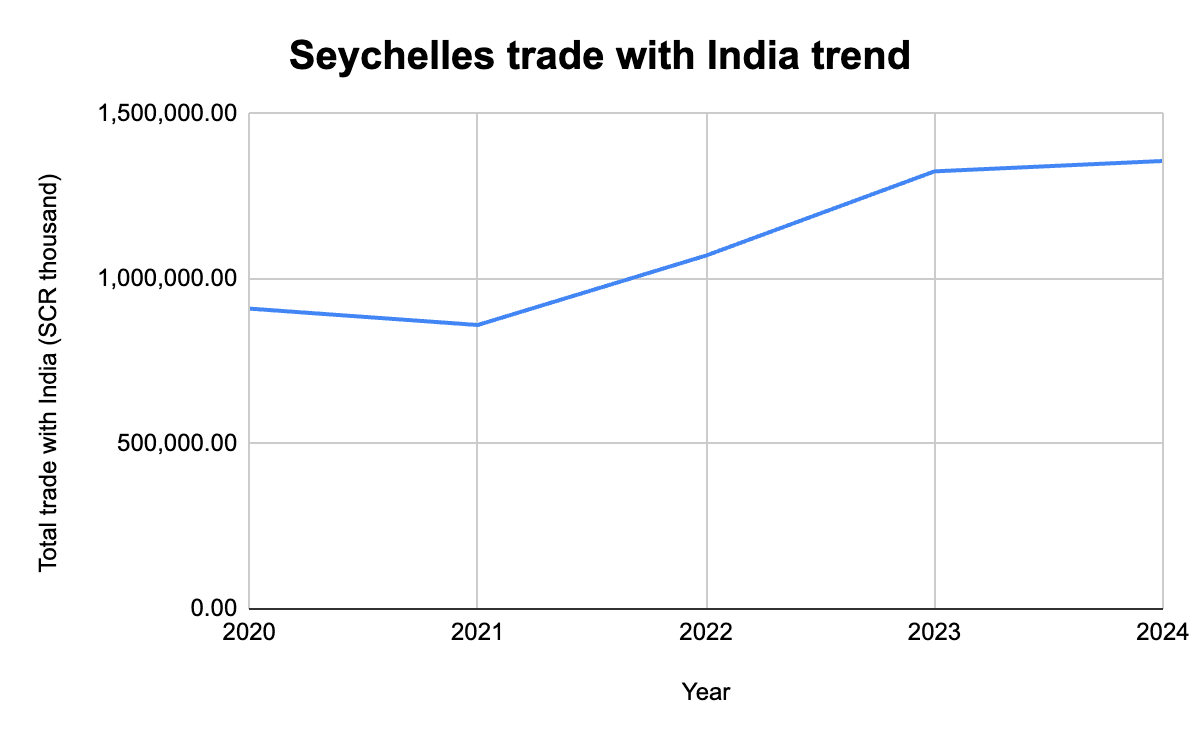
A simple trade trend shows the point more clearly.
Source: HCI Seychelles,5
The trade value rose from SCR 909.86 million in 2020 to SCR 1.36 billion in 2024, based on High Commission data. That is not a large market by volume, but it shows that India is gaining relevance in a small, import dependent economy.
1. Shipping and logistics
Connectivity is the first business signal.
The absence of a direct shipping line has kept trade below its potential. If India and Seychelles improve maritime connectivity, Indian exporters of rice, medicines, vehicles, cement, food products, and medical supplies could gain from shorter routes and lower indirect trade dependence.
The seafarer certification MoU also matters. It can create opportunities for Indian maritime professionals to work on Seychelles flagged vessels, adding a services angle to the trade relationship.
2. Ports
Infrastructure opportunities sit close to the shipping gap.
No new port project was announced during the visit, so this section needs careful reading. The business opportunity is not a single confirmed contract. It is the wider need for port efficiency, coastal infrastructure, vessel maintenance, maritime services, and supply chain support.
For Indian ports, shipping companies, and marine service providers, Seychelles may offer a small but strategic market. The logic is simple. Better connectivity can support trade, tourism, fisheries, and defence cooperation together.
3. Renewable energy
Clean power gives the partnership a development angle.
Seychelles has backed the International Solar Alliance and became one of its founding members. India and Seychelles also inaugurated three solar water pumping systems under the clean energy cooperation framework during the recent engagement.
For Indian businesses, this creates possible openings in solar systems, e-mobility, battery solutions, water management and energy services. These areas are relevant because island economies often face high fuel import costs and climate risks.
4. Defence manufacturing
Security cooperation can support specialised exports.
India’s gifting of a patrol vessel, utility vehicles, and support for Seychelles Coast Guard assets shows a defence partnership based on capacity building. It also gives Indian defence manufacturers a visible market signal.
The opportunity is likely to remain niche. Patrol vessels, surveillance systems, communication tools, marine equipment, and maintenance services may see more relevance than large defence platforms. That fits Seychelles’ requirements and India’s export ambitions.
Lessons For Investors
Portfolio decisions should not turn on one diplomatic visit, but this engagement gives investors a useful sectoral lens.
1. Track geopolitics as an early signal
Stronger India-Seychelles relations show how maritime diplomacy can influence trade routes, defence cooperation, logistics and clean energy before these shifts appear in company earnings.
2. Look beyond market size
Seychelles is a small economy, but its location gives it strategic weight. For investors, this means opportunity may come through specialised sectors rather than large consumer demand.
3. Watch maritime linked sectors
India's maritime security cooperation can support long term interest in ports, shipping services, coastal surveillance, vessel maintenance and marine equipment companies.
4. Assess defence export potential carefully
Patrol vessels, surveillance systems, communication tools and support services may gain relevance as India expands defence partnerships with island nations. However, investors should check order visibility, margins and execution record before drawing conclusions.
5. Follow renewable energy and e-mobility opportunities
The development package includes e-mobility and clean energy support. Indian companies in solar systems, battery storage, charging infrastructure, and energy services may benefit if such partnerships scale.
6. Do not ignore healthcare and digital payments
The Janaushadhi and UPI-related agreements show that India’s soft infrastructure is also part of its overseas strategy. This can create openings for generic medicines, health supplies, and digital payment ecosystem players.
7. Separate policy direction from company fundamentals
A diplomatic push can improve the operating environment, but it does not guarantee returns. Investors should still review revenue growth, debt levels, cash flows, export capability, and regulatory approvals.
A well-diversified portfolio is built by combining growth opportunities with stability. Investors looking for more predictable cash flows may also evaluate fixed income investments such as corporate bonds and other debt opportunities.
Platforms such as Grip Invest provide access to a range of fixed income investment options, helping investors diversify beyond listed equities while aligning investments with their risk profile and financial goals.
Conclusion
A small island state can still carry large strategic weight. The PM Visit to Seychelles matters because it brings India's relations into a wider economic and maritime frame. The visit produced concrete agreements, development finance, defence support, digital cooperation and stronger blue economy India alignment.
For India, Seychelles is not just another partner in the Indian Ocean. It is a gateway to maritime awareness, trade connectivity, anti-piracy cooperation and sustainable ocean development. For businesses and investors, the signal is not about immediate scale. It is about where policy, security and commerce may converge over the next few years.
That is why the PM's visit to Seychelles deserves attention beyond diplomacy. It shows how India’s economic interests and maritime strategy are now moving together in the Indian Ocean.
FAQs On PM Visit To Seychelles
 |
Author: Grip Invest Editorial Team The Grip Invest Editorial Team is a group of Chartered Accountants, MBA (Finance) graduates, and Qualified Research Analysts dedicated to helping you invest smarter. We dive deep into India's fixed income landscape to deliver content that is accurate, up-to-date, and easy to understand. Whether you're exploring bonds, fixed deposits, or other fixed income opportunities, our guides cut through the noise and give you the clarity to make better financial decisions. |
Want to stay at the top of your finances?
Join the community of 4 lakh+ investors and learn more about Grip Invest, the latest financial knick-knacks, and shenanigans in the world of investing.
Happy Investing!
Disclaimer - Investments in debt securities/municipal debt securities/securitised debt instruments are subject to risks including delay and/ or default in payment. Read all the offer related documents carefully. The investor is requested to take into consideration all the risk factors before the commencement of trading.
This communication is prepared by Grip Broking Private Limited (bearing SEBI Registration No. INZ000312836 and NSE ID 90319) and/or its affiliate/ group company(ies) (together referred to as “Grip”) and the contents of this disclaimer are applicable to this document and any and all written or oral communication(s) made by Grip or its directors, employees, associates, representatives and agents. This communication does not constitute advice relating to investing or otherwise dealing in securities and is not an offer or solicitation for the purchase or sale of any securities. Grip does not guarantee or assure any return on investments and accepts no liability for consequences of any actions taken based on the information provided. For more details, please visit www.gripinvest.in
Registered Address - 106, II F, New Asiatic Building, H Block, Connaught Place, New Delhi 110001


