

Foreign Currency Convertible Bonds (FCCBs): Meaning, Features, Benefits and Risks


There are numerous kinds of bonds, each apt for specific goals of investors. One such bond is Foreign Currency Convertible Bonds, or FCCBs. These are debt instruments that are issued by Indian companies but are denominated in foreign currency, becoming an essential part of the global bonds India market for increasing international capital. Investors lend money to a company through these bonds.
The company then returns it with interest at fixed intervals. In this process, investors can convert the bond into equity shares of the company that issued the bond.
FCCBs differ from domestic corporate bonds, where interest is issued in foreign currency rather than in Indian currency. They also offer a conversion option to shares of the company, which exposes investors to foreign exchange risk/ reward. In fact, the global market for such investors has remained strong, with issuance reaching approximately $46.5 billion in 20231.
If you do not know much about FCCBs, read on till the end. This blog will cover its benefits and risks in detail. But first, let’s understand how they work.
What Are Foreign Currency Convertible Bonds (FCCBs)?
Foreign Currency Convertible Bonds, or FCCBs, are special debt instruments issued by Indian companies in foreign currencies like the US Dollar or Euro. These bonds act like traditional loans, paying fixed-interest over a specified tenure.
However, what sets FCCBs apart is the unique option they provide to bondholders—the ability to convert these bonds into equity shares of the issuing company at a predetermined price.
This hybrid nature offers investors both fixed income security and the potential to benefit from the company’s stock appreciation, making FCCBs an attractive global investment opportunity for Indian investors seeking diversification beyond domestic markets.
Key Features Of FCCBs
Here are some of the key features of foreign currency convertible bonds:
- Issued in foreign currency, with all coupon and principal payments made in that currency, exposing investors to forex risk or reward.
- Lower coupon rates compared to conventional bonds, reflecting the embedded equity conversion option.
- Convertible into equity shares of the issuing company at a predetermined price after a specified period.
- Typically unsecured, requiring no collateral from the issuing company.
- Often listed on international stock exchanges, providing liquidity to investors.
- Include conversion rights, as well as call and put options enabling early redemption by issuer or investor.
- Governed by regulatory compliance from authorities such as SEBI and RBI, ensuring transparency and investor protection.
- Offer investors a balance of fixed income through interest payments, and potential capital appreciation via equity conversion.
How Foreign Currency Convertible Bonds Work?
The cycle of foreign currency convertible bonds is quite simple. Firstly, they start out as convertible debt providing a fixed interest payment in a foreign currency along with the right to convert the bonds into ordinary equity shares. The bonds will be redeemed upon maturity when they are not converted.
The following is the procedure for their issuance and other features.
1. Issue
The corporation issues FCCBs in a foreign currency like US Dollars or Euros. All of the bond characteristics such as coupon rate, maturity, and conversion price are determined at the issuance of FCCBs.
2. Coupon payments
Prior to maturity or conversion of FCCBs, the corporation makes periodic interest payments in the form of coupon payments in a foreign currency. Because of the low coupon rate compared to other foreign currency bonds, firms incur less expense on borrowing.
3. Conversion options
The investors have the right to convert their convertible bond of foreign currency into equity shares at the conversion price that is set before a particular conversion window period. This option becomes favourable when the market price of the firm’s stock exceeds the conversion price.
4. Equity conversion or redemption
In case the investors decide to convert the bond, then there will be no need for repayment of the principle. On the other hand, in case the investors do not exercise the option to convert, the FCCBs are redeemed through repayment of the principal amount along with interest.
Why Companies Issue FCCBs?
Companies can use FCCBs in order to secure funding from foreign investors at a lower cost of finance. This is because FCCBs provide more financial flexibility as compared to foreign commercial borrowings or foreign currency loans due to the fact that FCCBs are debt as well as equity instruments.
? Lower borrowing costs: Typically, FCCBs offer a cheaper cost of borrowing since investors get the right to exchange them for stocks.
? Access to global investors: By issuing foreign currency convertible bonds, firms will be able to access international capital markets and thereby diversify their sources of finance beyond domestic investors.
? Deferred equity dilution: In contrast to issuing stocks, companies can delay their equity dilution until the FCCB conversion right is exercised by investors.
? Overseas expansion: Firms looking for expansion and operations in other countries can raise money through FCCBs in foreign currency in order to finance themselves internationally.
? Foreign currency fundraising: Being foreign currency instruments, foreign currency convertible bonds help in raising foreign currency for international needs.
Benefits And Risks Of FCCBs
FCCBs can seem magnetic and are seen as a global investment opportunity for Indian Investors who are seeking both debt stability and equity growth potential. Investors interested in convertible bonds investing through FCCBs encounter a mix of debt stability and equity growth potential. In spite of this, investors should be mindful of the risks that come with dealing with the market.
Hedge, Diversify, Grow: FCCBs with Corporate Bonds
Diversification is a given when it comes to FCCBs, as they are linked to the international markets. Due to this, Indian investors' forex exposure is attained. This helps if the foreign currency strengthens against the Indian currency (INR).
FCCBs ensure investors a dual return. One is based on fixed coupons, and the other is income from a potential equity upside if the stock price increases in any circumstances. Indian investors can opt to explore a balanced strategy by pairing FCCBs with domestic corporate bonds. This will combine international growth with local stability.
Key Investment Risks
Let's discuss a few market risks that investors shouldn't overlook before investing:
- Forex Fluctuations: Over returns are bound to be affected if the issuing currency has weakened against the Indian currency. A weak issuing currency implies weak returns, getting nothing more than interest.
- Volatile Market: Conversion tends to become unpleasant when the issuer’s stock doesn't perform well. Investors are bound to rely on long-term interests.
- Credit risks: This can be considered a risk since companies going through a financial struggle may not be able to meet conversion obligations.
- Risk to Liquidity: Inactive participation in the secondary market is not pleasant in terms of FCCBs, as it makes exit more difficult.
Checklist Before Investing In FCCBs
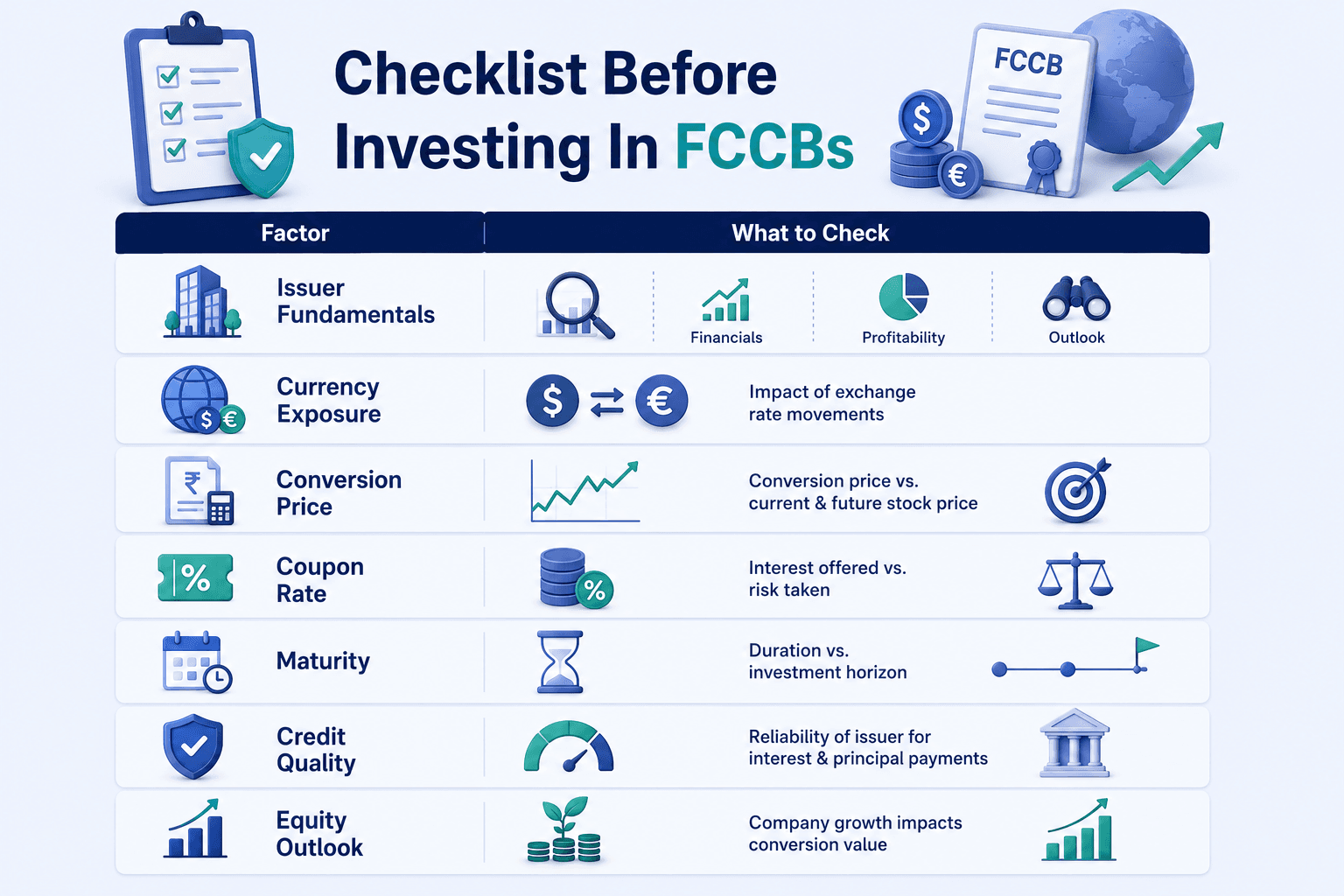
Before investing in FCCBs, consider these elements to gain insight into the return that could be earned from these instruments, as well as the possible risks involved.
Factor | What to Check |
Issuer Fundamentals | Look at the company's financial performance, its profitability, debt status, and business outlook. |
Currency Exposure | See how the fluctuation in exchange rates will impact coupon payments. |
Conversion Price | See how the conversion ratio compares with the present and future stock prices. |
Coupon Rate | See whether the interest provided makes up for the risks involved. |
Maturity | See whether the duration of the bond matches your investment horizon. |
Credit Quality | See how reliable the issuer is with regard to interest and principal payments. |
Equity Outlook | The growth of the company should be evaluated as it affects the FCCB conversion value. |
Who Should Invest In FCCB?
FCCBs offer a unique investment opportunity combining the safety of fixed income with the potential for equity growth through international diversification. These bonds are suited for investors with varying risk profiles who seek exposure to both foreign currency and equity markets in a single instrument.
Investor Type | Description |
Indian and Global Investors | Seek a combination of steady income plus equity growth potential through international diversification |
Moderate Risk Tolerance | Prefer exposure to foreign currency and equity markets without full direct equity investment risks |
Institutional Investors | Pension funds, mutual funds, hedge funds that want hybrid fixed-income instruments with growth opportunities |
Foreign Portfolio Investors | Overseas investors looking to invest in Indian companies and benefit from currency diversification |
Savvy Retail Investors | Experienced retail investors seeking alternative fixed income options with potential capital appreciation through conversion |
FCCBs vs Convertible Debentures vs ECBs
Feature | FCCBs | Convertible Debentures | ECBs (External Commercial Borrowings) |
| Currency | Foreign currency | Indian Rupee | Foreign currency |
| Conversion Option | Convertible into equity | May be convertible into equity | No conversion option |
| Investor Base | Global investors | Primarily domestic investors | Foreign lenders and financial institutions |
| Interest Rate | Generally lower | Usually higher than FCCBs | Varies based on loan terms |
| Equity Dilution | Only on conversion | Only if convertible | No equity dilution |
| Purpose | Foreign capital with growth potential | Domestic fundraising | Overseas borrowing without equity |
| Repayment | Equity conversion or redemption at maturity | Conversion or redemption | Principal and interest repayment |
Conclusion
Foreign currency convertible bonds allow you, as an investor, to enter and explore the international market through a fixed income and equity upside. They come with a lot of benefits, such as forex exposure, diversification, and growth potential. This also makes them a complementary domestic investment.
Keeping the benefits in mind, you must also rigidly accustom yourself to the risks of investments. These may include a volatile market, currency value risks, and the issuer’s credit.
If you are looking for an investment platform that facilitates investments in FCCBs, sign up with Grip today! The platform has an investor-first approach and allows you to start investing at just INR 1000. Moreover, it also allows you to invest in various other investment avenues like SDIs, high-yield FDs, etc.
FAQs On FCCB
References:
1. Reuters, accessed from: https://www.reuters.com/business/deals/global-convertible-bond-issuance-2023-2024-01-03/
 |
Author: Grip Invest Editorial Team The Grip Invest Editorial Team is a group of Chartered Accountants, MBA (Finance) graduates, and Qualified Research Analysts dedicated to helping you invest smarter. We dive deep into India's fixed income landscape to deliver content that is accurate, up-to-date, and easy to understand. Whether you're exploring bonds, fixed deposits, or other fixed income opportunities, our guides cut through the noise and give you the clarity to make better financial decisions. |
Want to stay at the top of your finances?
Join the community of 4 lakh+ investors and learn more about Grip Invest, the latest financial knick-knacks, and shenanigans in the world of investing.
Happy Investing!
Disclaimer - Investments in debt securities/municipal debt securities/securitised debt instruments are subject to risks including delay and/ or default in payment. Read all the offer related documents carefully. The investor is requested to take into consideration all the risk factors before the commencement of trading.
This communication is prepared by Grip Broking Private Limited (bearing SEBI Registration No. INZ000312836 and NSE ID 90319) and/or its affiliate/ group company(ies) (together referred to as “Grip”) and the contents of this disclaimer are applicable to this document and any and all written or oral communication(s) made by Grip or its directors, employees, associates, representatives and agents. This communication does not constitute advice relating to investing or otherwise dealing in securities and is not an offer or solicitation for the purchase or sale of any securities. Grip does not guarantee or assure any return on investments and accepts no liability for consequences of any actions taken based on the information provided. For more details, please visit www.gripinvest.in
Registered Address - 106, II F, New Asiatic Building, H Block, Connaught Place, New Delhi 110001


