

Foreign Direct Investment (FDI): Meaning, Types, Benefits And Impact on India


Why do multinational companies spend billions in other nations rather than in their native land? The reason behind this question is foreign direct investment (FDI). Foreign Direct Investment may be defined as an investment where there is the involvement of a foreign business organization or a business activity in other countries apart from its home nation.
This investment provides ownership shares to the investor as well as a certain level of control.
For instance, when a global car manufacturer establishes a factory in India, it is termed a foreign direct investment. These types of investments last for a longer period.
They have several advantages for economic development, such as the inflow of capital and advanced technology. India is one of the fastest-growing economies and attracts considerable FDI.
Hence, understanding the meaning of FDI is essential.
Types Of FDI
Foreign direct investments can vary according to the aims and strategies of the businesses involved. Knowing about these types will give you insight into how multinational firms are increasing their footprint abroad.
1. Horizontal Foreign Direct Investment
Horizontal foreign direct investment involves engaging in the same type of business activities in other countries. An illustration is when a multinational fast food company enters India by opening a restaurant.
2. Vertical Foreign Direct Investment
A vertical foreign direct investment strategy is one in which a firm invests in the other phase of production. An example is a multinational firm investing in Indian suppliers for raw materials and components.
3. Conglomerate FDI
Conglomerate FDI involves investment by a firm in a business that has no relation whatsoever to its own business operations. A good example is a foreign retail firm making an investment in the renewable energy sector in India.
4. Platform FDI
Platform FDI involves setting up operations in one country for the main purpose of manufacturing products or rendering services for export purposes into other countries. For instance, a multinational firm that has established itself in India to serve the Asian markets is said to have done platform FDI.
How Does FDI Work In India?
India provides foreign investors with the opportunity to make investments in Indian companies within a clean regulatory environment. Investments can either be made using the Automatic Route, which does not require any prior government approval, or the Government Route, which requires that government approval be sought prior to the investments being made.
Foreign investors are expected to adhere to various regulations pertaining to each individual sector, as well as reporting requirements. These are necessary for the attraction of foreign direct investment in an efficient manner.
FDI Approval Process in India
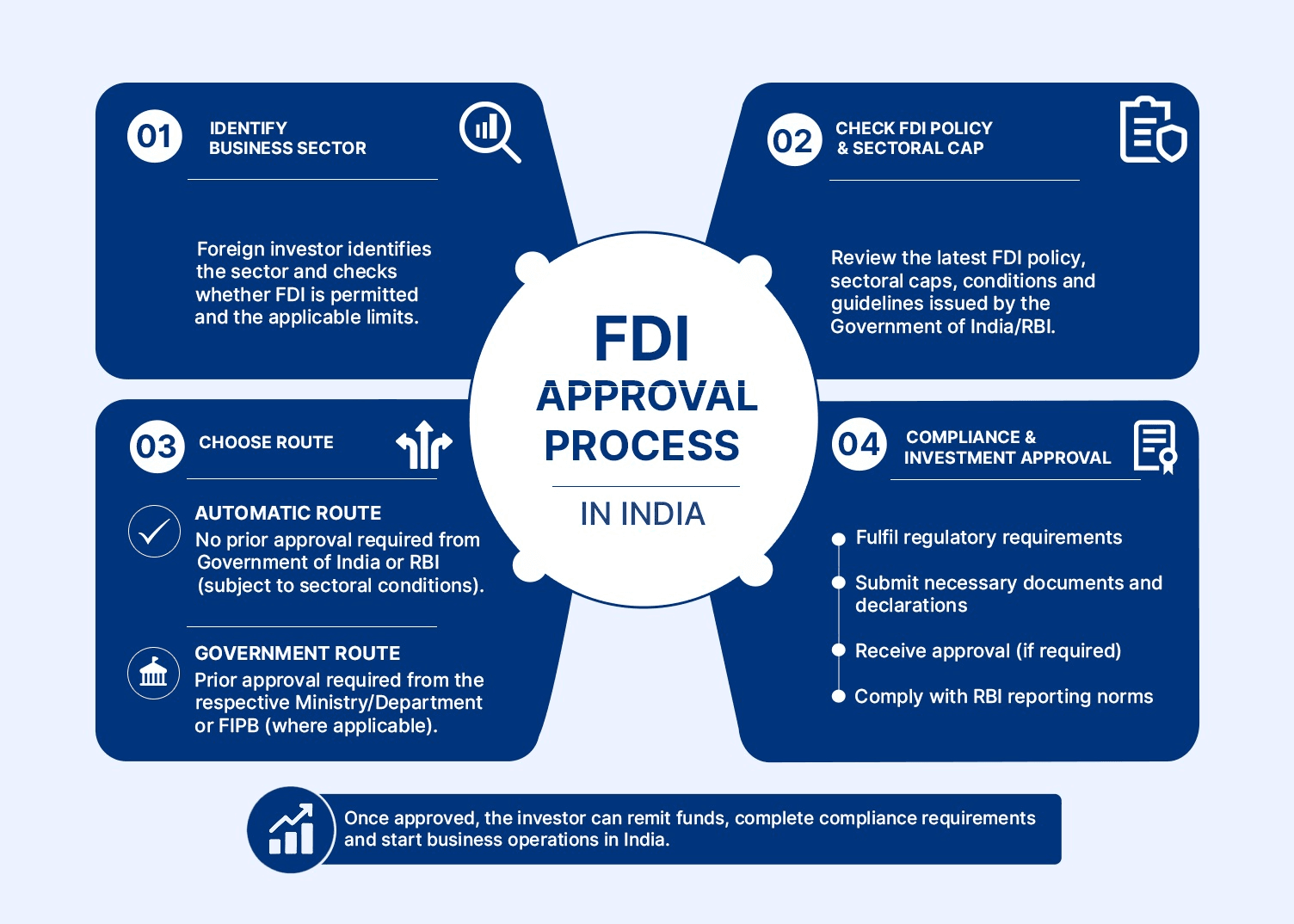
Major Sectors Receiving FDI
India has been receiving substantial FDI in various sectors due to its huge market, qualified labour force, and developing economy. This contributes to job creation, infrastructural development, and innovation in different sectors.
1. Services
- Helpful for the generation of employment in finance, insurance, and business services.
- Ensures high-quality services.
- Fosters financial inclusion and digitisation.
2. Computer Software and Hardware
- Introduction of innovative technology.
- Development of the Indian digital economy.
- Research and innovation.
3. Telecommunications
- Increases network capacity and connections.
- Increases digital service access.
- Facilitates the development of the digital economy.
4. Manufacturing
- Increases industrial output and exports.
- Generates substantial employment opportunities.
- Bolsters domestic supply chains.
5. Renewable Energy
- Increases the use of renewable energy.
- Helps India achieve its sustainability targets.
- Increases energy security.
FDI vs FPI
Foreign investments usually enter the country through Foreign Direct Investment (FDI) and Foreign Portfolio Investment (FPI).
Although both are forms of foreign investments, there is much that distinguishes them from each other.
Basis | FDI | FPI |
Full Form | Foreign Direct Investment | Foreign Portfolio Investment |
Purpose | Long-term business ownership | Financial returns from securities |
Ownership | Significant ownership stake | No significant ownership or control |
Management Control | Yes | No |
Investment Type | Factories, businesses, assets | Stocks, bonds, mutual funds |
Investment Horizon | Long-term | Short to medium-term |
Stability | Relatively stable | More volatile |
Economic Impact | Creates jobs and infrastructure | Improves market liquidity |
Exit Process | More complex | Easier and quicker |
Benefits And Challenges Of Foreign Direct Investment
Foreign direct investment is quite beneficial in terms of economic development. This includes financial, technological, and even global experience being infused into the economy. Like all other economic activities, foreign direct investment also presents both positives and negatives.
Advantages of FDI
- Inflow of Funds: This means that there will be more finances available to invest in the country's infrastructure.
- Employment Opportunities: More employment opportunities will come about.
- Technology Transfer: New technologies can now be used in businesses.
- Exports: Multinational corporations manufacture their products in India and then export them.
- Economic Growth: More investments mean higher economic growth.
Challenges Associated With FDI
- Market Competition: Major multinational corporations could generate tough competition for local companies.
- Repatriation of Profits: Some percentage of the profits generated may be repatriated to the home country of the investor.
- Imbalances Within Sectors: Some sectors tend to receive more investment than others.
- Regulatory Issues: New regulations could have an impact on future investments.
India's FDI Trends
India has become one of the main recipients of foreign direct investment due to its large market base, its economic reforms, and ease of conducting business operations. FDI inflows into India have been consistently on the rise over the years.
- Consistent FDI Inflows
FDI inflows into India have been increasing consistently throughout the last ten years. The reason behind the rising level of FDI inflows is that the government has been undertaking many positive actions to facilitate business and investment in India.
- Increasing FDI in Technology and Services
In particular, investments in services and software, as well as hardware, have continued to increase.
- Technological Growth and Services
Investment in technology, particularly computer hardware and software, along with services, remains a considerable attraction for foreign investors. The investments make way for innovations and job creation.
- Boost to the Manufacturing Industry
Incentives like 'Make in India' have motivated multinational companies to set up their manufacturing units in the nation, boosting manufacturing activity, exports, and logistics systems.
- Renewable Energy Projects
With India’s increasing focus on renewable energy, there have been several foreign investments in projects of solar and wind energy.
Conclusion
FDI has been an integral part of India’s success story. It provides much more than just finance; it brings in technology, creates jobs, develops infrastructure, and integrates India with the rest of the world market. As India improves its business environment, thanks to its policies and digitalisation, it is sure to continue attracting foreign investors.
Investors can learn from FDI about the factors that influence economic growth and provide long-term investment opportunities. Do you want to explore different types of investments other than the conventional ones? Try out Grip’s handpicked alternative investments for smart investing decisions.
FAQs On Foreign Direct Investment
 |
Author: Grip Invest Editorial Team The Grip Invest Editorial Team is a group of Chartered Accountants, MBA (Finance) graduates, and Qualified Research Analysts dedicated to helping you invest smarter. We dive deep into India's fixed income landscape to deliver content that is accurate, up-to-date, and easy to understand. Whether you're exploring bonds, fixed deposits, or other fixed income opportunities, our guides cut through the noise and give you the clarity to make better financial decisions. |
Want to stay at the top of your finances?
Join the community of 4 lakh+ investors and learn more about Grip Invest, the latest financial knick-knacks, and shenanigans in the world of investing.
Happy Investing!
Disclaimer - Investments in debt securities/municipal debt securities/securitised debt instruments are subject to risks including delay and/ or default in payment. Read all the offer related documents carefully. The investor is requested to take into consideration all the risk factors before the commencement of trading.
This communication is prepared by Grip Broking Private Limited (bearing SEBI Registration No. INZ000312836 and NSE ID 90319) and/or its affiliate/ group company(ies) (together referred to as “Grip”) and the contents of this disclaimer are applicable to this document and any and all written or oral communication(s) made by Grip or its directors, employees, associates, representatives and agents. This communication does not constitute advice relating to investing or otherwise dealing in securities and is not an offer or solicitation for the purchase or sale of any securities. Grip does not guarantee or assure any return on investments and accepts no liability for consequences of any actions taken based on the information provided. For more details, please visit www.gripinvest.in
Registered Address - 106, II F, New Asiatic Building, H Block, Connaught Place, New Delhi 110001


