

Gold Coins: Price, Purity, Making Charges and Investment Pros And Cons


In 2025, gold demand surged sharply despite steep price rises. On one hand, the investment demand jumped 73%, and on the other, the wedding season demand growth stood at 45%1. While the investment hike stems from the safe-haven nature of the asset amid the rising global uncertainties, the wedding season growth, which stood undeterred by high price levels, is linked strongly with the cultural significance of gold in India.
Gold symbolises abundance, purity, and divine blessings, making it an essential component of weddings and festivities. Apart from ornaments, gold coins serve as a popular choice during the celebrations. They are favoured as practical, storable gifts that blend traditions and financial prudence. Therefore, this blog decodes gold coins, including their price, purity, making charges, etc., to help investors analyse their pros and cons before making decisions.
Gold Coin Price Calculation
The final price of a gold coin in India is a combination of several key components, namely the prevailing market gold rate, weight and purity of gold, making charges, and the applicable taxes. Therefore, as the first step to decoding the investibility of gold coins, listed below is a detailed explanation of each of these components.
- Gold Rate
The most important aspect in determining the price of a gold coin is the current market gold rate, which changes daily. Gold rates are generally stated based on the weight and purity of gold. For figuring out the base value of a gold coin, multiply the current gold rate per gram by the weight and purity percentage.
For instance, if the 24 Karat gold rate is INR 10,000 per gram, a 10-gram 24 Karat gold coin would be worth INR 1,00,000 (INR 10,000 x 10 grams). The graph below shows the prevailing gold rate on 19 February 2026 to further illustrate how the gold rate works.
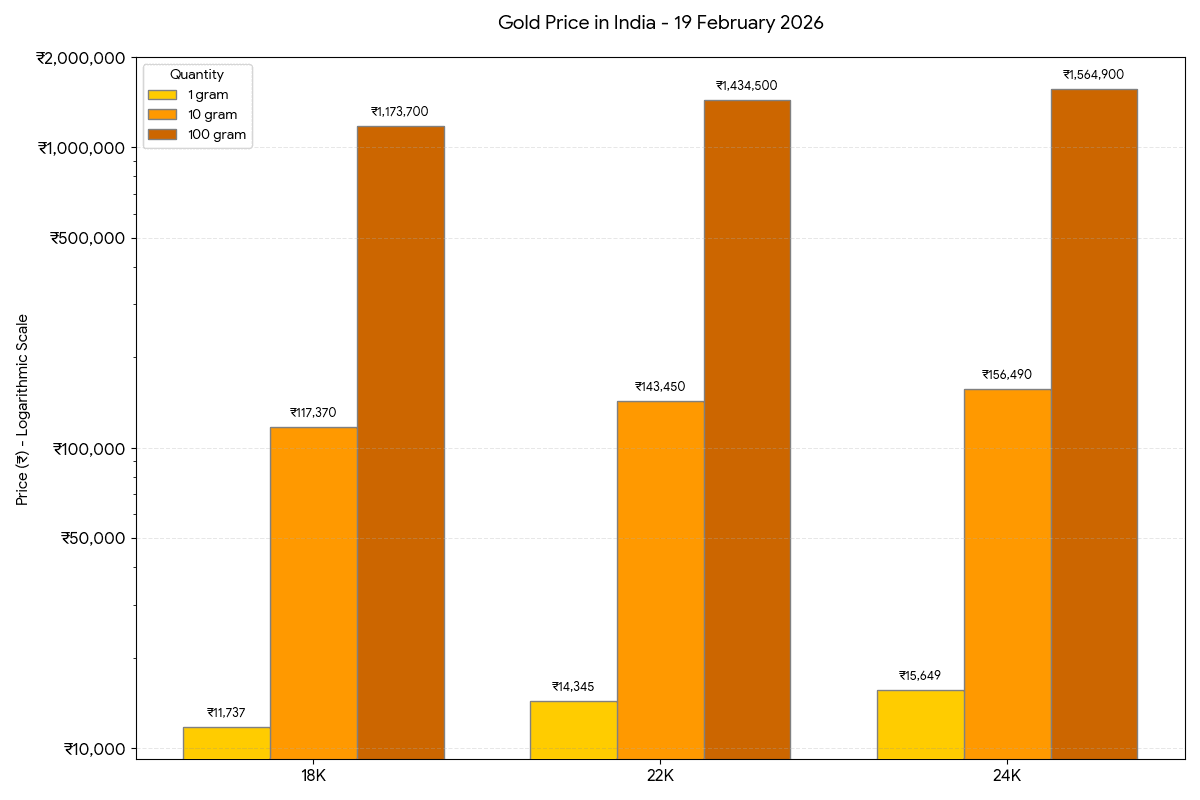
Source: Good Retuens2
- Gold Coin Making Charges: Making charges are the costs incurred for designing and crafting a gold item. While these charges can be a significant component for intricate gold jewellery, gold coins usually have minimal or no making charges because their production is standardised and less labour-intensive. If any making charges are applied, they are typically a small percentage of the gold's value or a fixed amount per coin.
- Goods and Services Tax (GST): A key component, GST, is levied on the final price of gold articles, like coins in India, in two distinct ways3. First, a uniform 3% GST is applied directly to the value of the gold coin itself. Secondly, if any making charges are levied, a separate 5% GST is applied specifically to the amount of the making charge.
Therefore, the formula for gold coin price calculation is given below.
Total Price = Gold Value + GST on Gold Value + Making Charges (if any) + GST on Making Charges (if any) |
Suppose Mr K purchased a 10 gram, 22 Karat gold coin today. If the gold rate stands at INR 1,00,000, at 1%, the making charge is INR 1000 (1% of INR 1,00,000). Therefore, the GST on gold would be INR 3,000 (3% of INR 1,00,000), and the GST on making charge would be INR 50 (5% of INR 1,000). Thus, the total price of the gold coin is:
INR 1,00,000 + INR 3,000 + INR 1,000 + INR 50 = INR 1,04,050 |
The pie chart illustrates and breaks down the components of the gold coin price today in India.
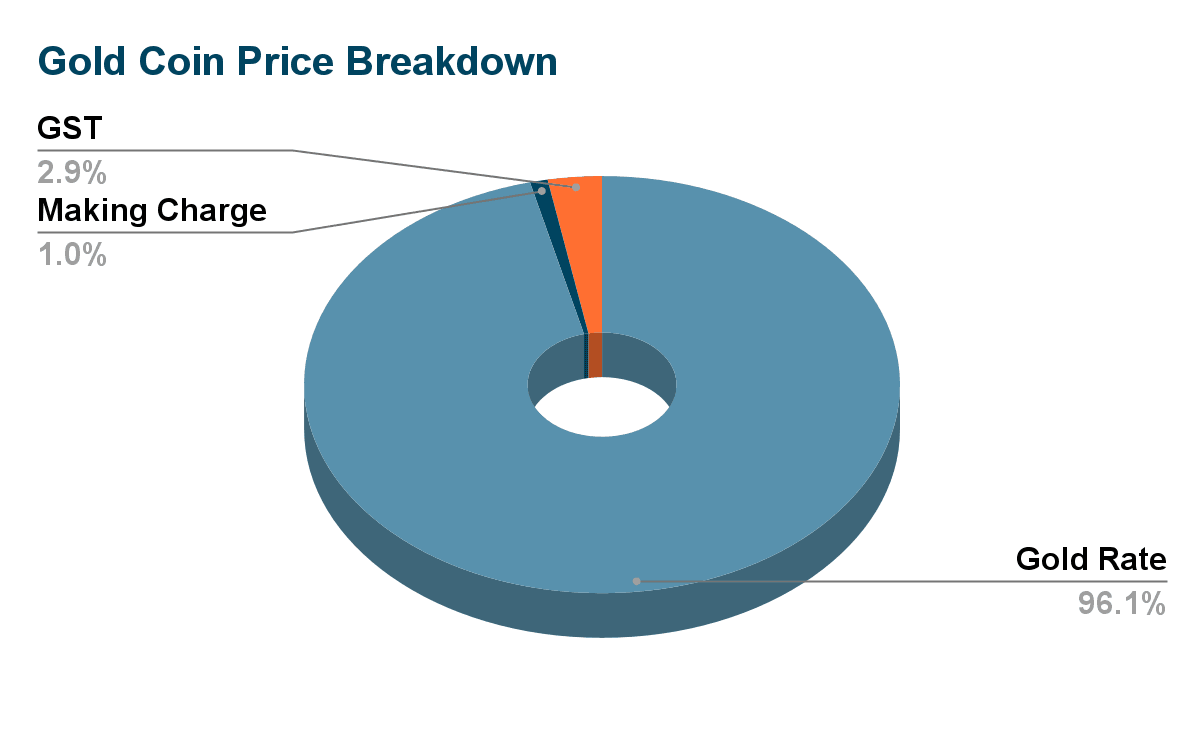
With this pricing structure of gold coins in mind, let us analyse the benefits and challenges of this asset.
Pros And Cons Of Investing In Gold Coins
Weighing the benefits and drawbacks of purchasing gold coins at celebrations and weddings frequently misses the point since these expenditures are motivated by tradition, symbolism, and cultural feeling rather than pure financial reasoning.
However, when it comes to selecting gold as a hedge and investment opportunity, weighing the advantages and disadvantages of gold coins as an investment is critical. Some important considerations are discussed below.
- Liquidity: Unlike other physical assets, such as real estate, gold coins are simply and quickly convertible into cash. Furthermore, gold coins are widely acknowledged around the world, regardless of geography. Furthermore, there are various channels of liquidation, expanding investor choice. Gold coins can be sold through local bullion dealers, online precious metals platforms, banks, etc. However, gold prices vary regionally as well. For example, due to differences in local transportation costs, taxes, and other factors, the gold price in Maharashtra may differ from that in West Bengal. As a result, before liquidating a gold coin, the investor should ideally examine the current gold rate in their location.
- Storage Risk: Physical gold is subject to theft and loss. As a result, it needs strong security controls, which are sometimes costly and scarce. For instance, bank lockers not only charge annual upkeep fees, but their availability also varies. Furthermore, stored gold may not be immediately accessible during emergencies or market opportunities.
- No Interest Income: Gold coins do not generate any fixed-income flow. Therefore, returns from investing in gold in the form of coins can emerge only from capital gains from market price increases. This not only makes returns susceptible to economic and market conditions, but it also makes gold coins an unfit option for those who want fixed-returns. Additionally, without income generation, storage and insurance costs become more burdensome over time. Thus, even high-karat gold coins, like 24K gold coin investments, can be less effective in this case.
Now, let us compare alternative gold investment mechanisms to choose one that fits the investor's needs.
Gold Coins Vs Sovereign Gold Bonds Vs Gold ETFs
The three gold investment channels, namely gold coins, sovereign gold bonds, and gold exchange-traded funds (ETFs), are compared in the table below.
| Parameters | Gold Coins | Sovereign Gold Bonds | Gold ETFs |
| Returns | No fixed returns, but an increase in the gold rate creates capital gains on gold coins | 2.5% annual interest payable semi-annually, along with capital appreciation from the gold rate increase4 | Returns vary from one ETF to another, but the one-year category average performance stands at 74.70%, while three-year performance is at 37.84% as of 18 February 20265 |
| Tax Treatment6 | During Purchase: 3% on GST on gold, 5% GST on making charges During Sale: If held till 24 months, it is treated as a short-term capital gain and taxed at applicable tax slabs If held for over 24 months, it is treated as a long-term capital gain and taxed at 12.5% without indexation | During Purchase: No GST payable Interest Income Tax: Interest income is taxed at the applicable tax slabs Capital Gains Tax: If held till maturity and bought in the primary market, no tax is levied, but the exemption does not apply if bought in the secondary market Therefore, when tax is applicable: If sold within 12 months, it is treated as a short-term capital gain and taxed at applicable tax slabs If held beyond 12 months, tax is levied at 12,5% without indexation. | During Purchase: No GST payable During Sale: If held up to 12 months, it is treated as a short-term capital gain and taxed at applicable tax slabs If held for over 12 months, it is treated as a long-term capital gain and taxed at 12.5% without indexation |
| Liquidity | High liquidity | Moderate liquidity | High liquidity |
This leads us to the most significant question. Given the different ways to invest in gold and the unique advantages and limitations of gold coins, investors must analyse what purpose gold coins truly serve.
Should You Buy Gold Coins For Investment Or Gifting?
Gold is a key safe-haven asset that appreciates during market downturns and global uncertainties, whilst having significant cultural and traditional values in the Indian subcontinent. However, different forms of gold fit different individual needs. While gold coins remain a dominant choice for festivities and wedding gifting, given their social significance, their making charges, storage concerns, and other hurdles make it less efficient as an investment. In such a scenario, options like gold ETFs and sovereign gold bonds can serve as effective means of gold allocation.
However, investors must consider that optimal investment requires portfolio diversification. Therefore, apart from gold, other fixed-return assets like bonds and high-yield FDs must be analysed. A comprehensive curation of these investments can be found on Grip, which offers up to 12.5% YTM.
Visit Grip Invest Today!
FAQs
1. Are gold coins a good investment?
Given their social significance, gold coins are still a popular choice for celebrations and wedding gifts, but their making charges, storage complications, and other drawbacks make them less effective as investments.
2. What is the resale value of gold coins?
The resale value of gold coins depends on the prevailing gold rate on the day of sale. Investors must consult the gold price for the particular gold coin purity and weight before sale to time it optimally.
3. Is a 24K gold coin better than a 22K?
The choice between 24K and 22K depends on the purpose of the gold purchase. 24K gold coins are generally preferred for investment because they have higher purity, while 22K gold is slightly more durable, making it suitable for gifts.
References:
1. TOI, accessed from: https://timesofindia.indiatimes.com/city/ahmedabad/wedding-bells-ring-in-gold-boom-demand-up-by-45/articleshow/118488065.cms
2. Good Returns, accessed from: https://www.goodreturns.in/gold-rates/
3. Avis max life, accessed from: https://www.axismaxlife.com/blog/tax-savings/gst-on-gold
4. RBI, accessed from: https://www.rbi.org.in/commonman/English/scripts/FAQs.aspx?Id=1658
5. Value research, accessed from: https://www.valueresearchonline.com/funds/selector/category/144/commodities-gold/?end-type=1&plan-type=direct&exclude=suspended-plans
6. ET, accessed from: https://economictimes.indiatimes.com/wealth/tax/did-budget-2026-make-any-changes-how-your-gold-and-silver-investments-will-be-taxed-from-now-onwards/articleshow/127824399.cms?from=mdr
Want to stay at the top of your finances?
Join the community of 4 lakh+ investors and learn more about Grip Invest, the latest financial knick-knacks, and shenanigans in the world of investing.
Happy Investing!
Disclaimer - Investments in debt securities/municipal debt securities/securitised debt instruments are subject to risks including delay and/ or default in payment. Read all the offer related documents carefully. The investor is requested to take into consideration all the risk factors before the commencement of trading.
This communication is prepared by Grip Broking Private Limited (bearing SEBI Registration No. INZ000312836 and NSE ID 90319) and/or its affiliate/ group company(ies) (together referred to as “Grip”) and the contents of this disclaimer are applicable to this document and any and all written or oral communication(s) made by Grip or its directors, employees, associates, representatives and agents. This communication does not constitute advice relating to investing or otherwise dealing in securities and is not an offer or solicitation for the purchase or sale of any securities. Grip does not guarantee or assure any return on investments and accepts no liability for consequences of any actions taken based on the information provided. For more details, please visit www.gripinvest.in
Registered Address - 106, II F, New Asiatic Building, H Block, Connaught Place, New Delhi 110001


