

Gold ETF Vs Silver ETF: Which Commodity ETF Fits Your Portfolio Better?


Diversification, as they say, is the only "free lunch" in investing. Equities drive growth, fixed deposits offer safety, and commodities precious metals investment are the shock absorbers of a portfolio. They add not only glitter but also a hedge against inflation and currency depreciation.
For generations, Indian investors used physical lockers to store wealth. The modern investor, though, is turning increasingly to Commodity ETFs India(Exchange Traded Funds). These digital instruments carry the safety of gold and silver, sans making charges or storage costs, or purity concerns.
Recently, a new trend has emerged: a rising interest in Silver ETFs among retail investors. Driven by the "green energy" boom-solar panels and EVs-silver is stepping out of gold's shadow. But does that mean it's the right choice for your portfolio?
Let us dive into the Gold ETF vs Silver ETF debate.
What Is A Gold ETF?
A Gold ETF is an open-ended passive investment fund that tracks the domestic price of physical gold. When you buy a unit of a Gold ETF taxation, you are essentially buying a digital certificate backed by high-purity physical gold-99.5% or higher-held in safe vaults by the fund house.
How It Works:
- Pricing: Usually, one unit represents 0.01 grams or 1 gram of gold.
- Trading: These can be bought and sold on the stock exchange (NSE/BSE) during market hours, much like shares.
- Portfolio Role: Traditionally, gold is considered a "Safe Haven." When geopolitical disturbances occur or the stock market falls, there is usually an increase in gold prices. For Indian portfolios, it is a defensive asset that protects the purchasing power of money over time.
What Is A Silver ETF?
A Silver ETF works just like a Gold ETF in that it similarly tracks the price of physical silver, but the underlying drivers of silver are fundamentally different.
Industrial versus investment demand:
While gold is hoarded as a store of value, silver is consumed. About 50-60% of the global demand for silver is industrial. Silver ETF returns is an indispensable component in the following:
- Solar panels (Photovoltaic cells)
- Electric Vehicles (EVs)
- 5G technology and electronics
- Medical Devices
Due to this industrial exposure, Silver ETFs are more prone to economic cycles. If the economy is thriving and manufacturing is on, silver prices tend to rocket. On the other hand, during a recession, industrial demand may lower, affecting prices more than gold.
Key Differences Between Gold ETF Vs Silver ETF
Understanding how Gold ETF vs Silver ETF behave differently will enable you to make an informed decision.
| Feature | Gold ETF | Silver ETF |
| Primary Driver | Fear, Inflation, Geopolitics | Industrial Growth, Economic Activity |
| Volatility | Low to Moderate | High (Prices swing sharper and faster) |
| Liquidity | Very High | High (but slightly lower than gold) |
| Risk Profile | Defensive / Conservative | Aggressive / Cyclical |
| Role in Portfolio | Wealth Preservation (Hedge) | Wealth Generation (Tactical Play) |
| Correlation to Stocks | Low / Negative | Moderate (often moves with industrial sectors) |
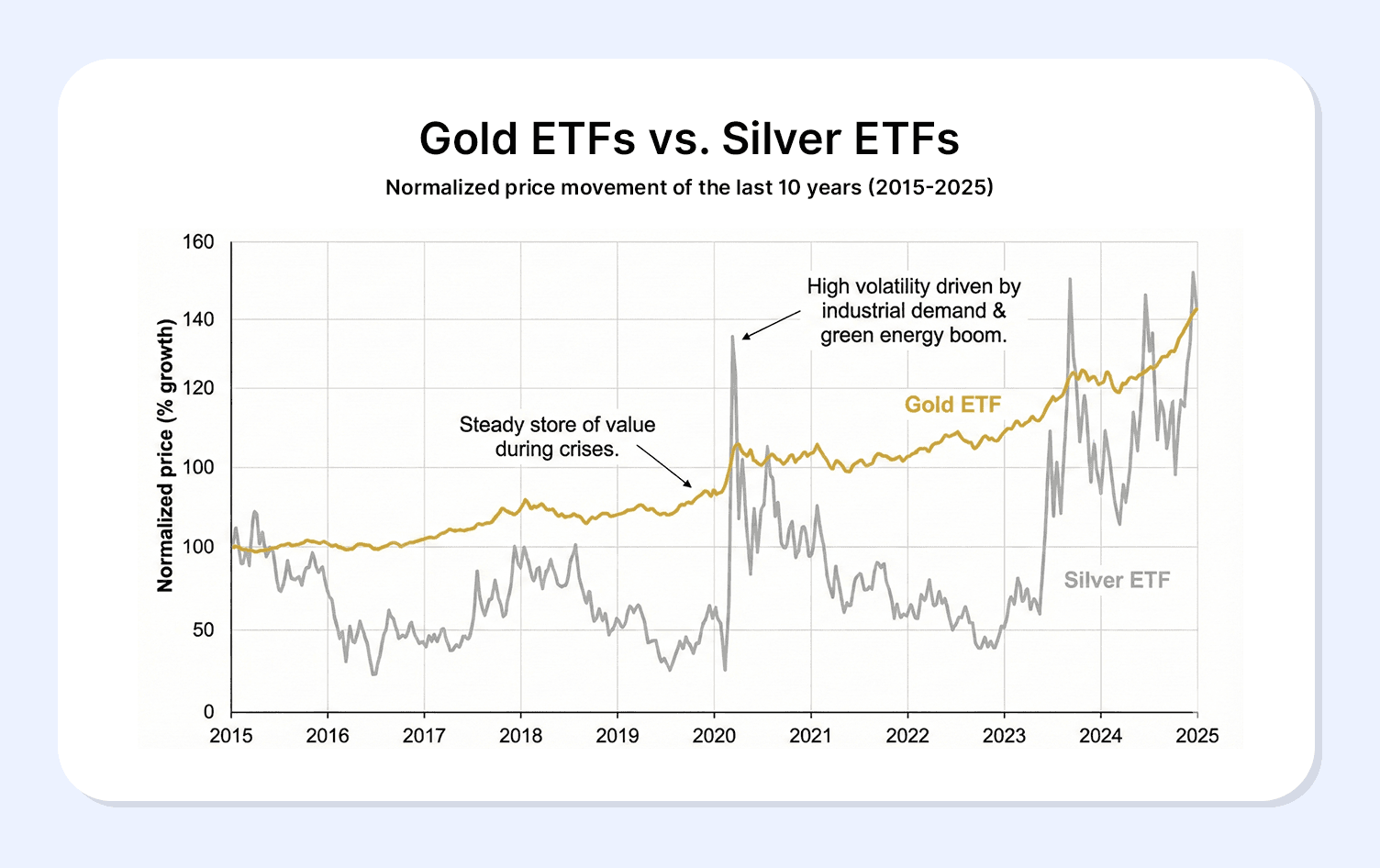
Data Insight: Gold vs silver investment India usually offers a return in the range of 10-12% CAGR with lower volatility. Where silver can offer relatively higher returns, such as 50-90% rallies in short bursts, the volatility in it is almost double that of gold.
Which ETF Should Investors Choose?
The choice between gold ETF vs. silver ETF does not come down to which metal is "better," but rather which one suits your financial personality.
1. The Risk-Averse Investor (The "Safety First" Approach)
For those investors whose aim is the protection of capital and beating inflation without losing any sleep over the price swings, Gold ETFs stand out as clear winners. They act as portfolio insurance.
- Ideal Allocation: 10-15% of your portfolio.
- Why: It reduces overall portfolio risk and provides liquidity in emergencies.
2. For the Growth-Oriented Investor The "Opportunity Seeker"
If you are bullish on the green energy revolution and can stomach the short-term losses for higher long-term gains, the Silver ETFs look attractive.
- Ideal Allocation: 5-10% (Tactical allocation).
- Why: A surge in industrial demand due to the push for solar energy and EVs in India-and indeed around the world-will create a supply deficit that could drive up prices of the metal.
3. Balancing Commodities with Stability: The "Smart Hybrid" Approach
While commodities are excellent diversifiers, they do have one weakness: They don't kick out regular income. You only make money if the price goes up.
You need to balance the volatility of commodities with the predictability of fixed-income assets to have an actually robust portfolio.
Enter Grip Invest:
Through platforms like Grip investors are able to complement commodity holdings with regulated, fixed-income opportunities.
- Stability: Unlike Silver ETFs, which may fluctuate wildly, the Corporate Bonds or SDIs offered on Grip Invest offer predefined returns.
- Regular Income: While Gold sits idle in your Demat account, waiting for capital appreciation, assets on Grip Invest can give monthly or quarterly interest payouts.
- Diversification: A portfolio consisting of Equities + Silver ETF (Growth) + Grip Invest Assets (Stability/Income) will lead to an all-rounded financial fortress.
Taxation Of Gold And Silver ETFs (Updated For FY 2025-26)
Taxing gold ETFs is important to be considered for calculating net returns. Post the announcements in Union Budget 2024, the taxation environment has turned out to be long-term investor-friendly.
- Holding Period: The meaning of "Long Term" has been shortened to 12 months (previously 36 months).
- Short-Term Capital Gains: If sold within 12 months, gains are taxed at a flat rate of 15 percent, irrespective of the investor’s income slab.
- Long-Term Capital Gains (LTCG): If held for more than 12 months, gains above INR 1 lakh in a financial year are taxed at 10 percent, without indexation, under Section 112A of the Income Tax Act.
Note: This is true for both Gold and Silver ETFs, making them equal to listed equity assets in terms of holding period, which is a key advantage over conventional fixed deposits.
Conclusion
A smart approach to Gold and Silver ETFs is all about making a balance between them. While Gold is a stabilizing element in a portfolio, ensuring it rides out any storms, it also has immense potential for growth in future technologies. However, both of them fail to generate money in a passive manner. In order to build a bright financial future, it is a smarter choice to mix both of these precious metals along with fixed income investments, which could be Corporate Bonds or SDIs.
To bring stability to such a portfolio, investors can consider complementing commodity ETFs with fixed income instruments that offer predictable returns. Platforms like Grip Invest provide access to regulated corporate bonds and SDIs that generate regular income, helping balance volatility while long term commodity investments play out. This combination allows investors to pursue growth without compromising on cash flow or portfolio stability.
FAQs
1. Is Silver ETF riskier than Gold ETF?
Yes, considerably. Silver is a smaller market than gold, which makes it easier for large trades or economic news to push prices one direction or the other. Its heavy reliance on industrial demand means that a manufacturing slowdown can hurt silver prices even if gold is rising.
2. Are gold ETFs better than physical gold?
For investment purposes, yes. The Gold ETFs rule out the risks of theft, storage costs, and "making charges" that could eat up 20-30% of jewellery value. You also get price transparency closest to the actual market rate.
3. Can gold and silver ETFs be held together?
This is correct, as a lot of investors have a "Precious Metals" basket comprising 70% Gold for stability and 30% Silver for the potential of growth in industry. This way, one can hedge against inflation while capturing the upside of the industrial boom.
Want to stay at the top of your finances?
Join the community of 4 lakh+ investors and learn more about Grip Invest, the latest financial knick-knacks, and shenanigans in the world of investing.
Happy Investing!
Disclaimer - Investments in debt securities/municipal debt securities/securitised debt instruments are subject to risks including delay and/ or default in payment. Read all the offer related documents carefully. The investor is requested to take into consideration all the risk factors before the commencement of trading.
This communication is prepared by Grip Broking Private Limited (bearing SEBI Registration No. INZ000312836 and NSE ID 90319) and/or its affiliate/ group company(ies) (together referred to as “Grip”) and the contents of this disclaimer are applicable to this document and any and all written or oral communication(s) made by Grip or its directors, employees, associates, representatives and agents. This communication does not constitute advice relating to investing or otherwise dealing in securities and is not an offer or solicitation for the purchase or sale of any securities. Grip does not guarantee or assure any return on investments and accepts no liability for consequences of any actions taken based on the information provided. For more details, please visit www.gripinvest.in
Registered Address - 106, II F, New Asiatic Building, H Block, Connaught Place, New Delhi 110001


