

International ETFs 2026: Smart Global Diversification For Indians


Diversification is one of the simplest ways to keep your portfolio steady and protect it from market swings. Instead of relying on a single source of returns, spreading your investments across different avenues helps balance risk and long term growth. This can be done at multiple levels. You can diversify across asset classes such as equity, bullion, fixed deposits, bonds, real estate, and digital assets.
Even within equity, spreading your money across sectors like IT, automobiles, and emerging technologies ensures that the performance of any one segment does not dictate your entire portfolio.
However, an effective way of hedging your portfolio is through geographic diversification. You can invest in securities and funds from different countries to benefit from the economic cycle and market dimensions abroad. An effective way of doing this is through international ETFs (Exchange Traded Funds). These funds give you exposure to global giants like Apple, Nvidia, and Tesla without the complexities of opening overseas accounts.
As India’s economy matures, complementing local holdings with global diversification ETFs is fast becoming a strategic move for investors seeking long-term, balanced portfolios.
Let us explore the topic and find out how you can also invest in international ETFs (and whether it is worth investing). Before we go any further, here is a chart comparing the returns of three major indices in the past five years:
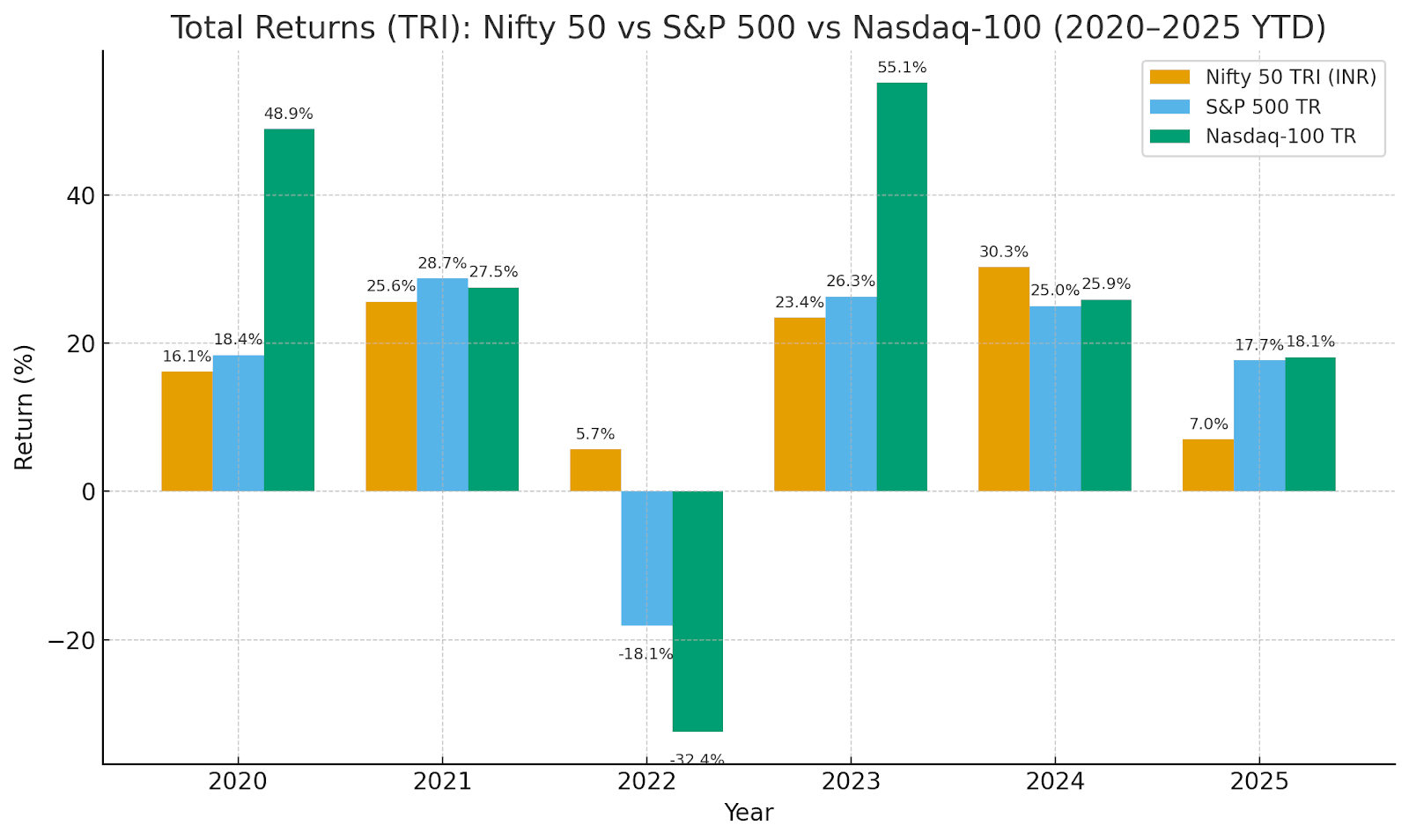
The above chart shows the TR (Total Returns) of the two US-based indices compared with the Nifty 50. Even though historical performance is not a predictor of future performance, it is clear that the US-based indices have performed slightly better than the Indian counterpart over the past five years (and have also delivered negative returns).
Also Read: 3x Bull ETFs: What Does It Mean?
What Are International ETFs?
An international ETF is a mutual-fund-like basket of overseas securities that trades on Indian exchanges just like a stock. These funds track major global benchmarks, such as the S&P 500, Nasdaq-100, or MSCI World Index. There are various AMCs based in India that offer FOFs (Fund of Funds) and ETFs that mimic the performance of these indices (such as the Motilal Oswal Nasdaq 100 ETF and the Mirae Asset NYSE FANG+ ETF).
Broadly, international ETFs can be classified into:
1. Global ETFs: These funds invest across multiple countries and sectors, giving you broad exposure to global markets through a single investment.
2. Regional ETFs: These target specific geographies such as the US, Europe, Japan, or emerging Asia. They are useful if you want focused exposure to a particular economy or region.
3. Thematic ETFs: These follow high growth global themes such as artificial intelligence, green energy, electric vehicles, cybersecurity, and cloud computing. They allow investors to participate in long term global trends that may not yet be fully developed in India.
Why You Should Consider International ETFs
As explained earlier, one of the first factors that encourages an investor to consider international ETFs is portfolio diversification. In the event of consolidation or bearish trends in the Indian markets, having exposure to global markets can help smooth returns.
It also offers an excellent opportunity for an investor to gain a first-mover advantage. You can access some of the world’s most valuable companies, such as Apple, Microsoft, Nvidia, and Tesla, which are leaders in technology, innovation, and productivity growth. Through global ETF investments, you participate in industries that may not yet exist at scale in India.
There is also the currency appreciation factor, which further enhances the overall return on investment. Over time, the U.S. dollar has strengthened against the rupee, meaning your returns from US stock ETFs India can gain from both market performance and currency movement.
Risks And Tax Implications Of International ETFs
Even though US-based indices have performed slightly better than Indian indices, historical performance is not a reliable benchmark for future movements. Just like any other investment asset, the timing of your entry and exit is critical here. Additionally, you should be aware of the risks you assume when investing in international ETFs.
The first is currency risk. Since these ETFs hold dollar-denominated assets, any depreciation of the rupee can boost returns, but a sudden rupee appreciation may reduce them. Next is the expense ratio, which tends to be slightly higher than domestic ETFs due to international custody and management costs. You can cross-check the expense ratio with your AMC before committing any investment.
From a taxation standpoint, international ETF tax India rules treat them as non-equity funds. Hence, you are not eligible for any indexation benefits, irrespective of the holding period of the ETFs.
Why Consider International ETFs : A Case Study
Rajesh, an Indian investor, wanted to diversify beyond the domestic market to reduce portfolio risks and gain exposure to global tech giants like Apple, Microsoft, Nvidia, and Tesla. He chose to invest in the Motilal Oswal Nasdaq 100 ETF and Mirae Asset NYSE FANG+ ETF, which trade on Indian exchanges and provide direct exposure to these US-based indexes. Over two years, Rajesh benefited from portfolio diversification, capturing growth from emerging tech themes and currency appreciation as the US dollar strengthened against the rupee.
Despite moderate expense ratios and tax considerations, this international ETF strategy helped Rajesh build a more resilient and growth-oriented portfolio aligned with global megatrends.
Balancing Global Exposure With Domestic Stability
Even though investment in international ETFs provides you with a range of growth opportunities, you should be aware of the risks associated with global exposure. As a rule, you should not invest more than 10–20% allocation in international ETFs to have a balance between domestic and global investments.
Pairing global equity exposure with fixed-income options, such as Grip bonds and other asset-backed investments, can help offset short-term volatility. International markets may deliver superior growth during bullish cycles, but local debt or hybrid instruments act as a cushion during global downturns.
Conclusion
International ETFs provide seamless access to global markets, tech innovation, and currency diversification, all while remaining accessible on Indian exchanges. When thoughtfully paired with stable domestic assets, these funds help investors build resilient portfolios that benefit from both global growth and India’s long-term economic momentum.
However, do consider the expense ratio and tax implications, and remember that the historic performance of a fund or index should not be a criterion for your investment, as future results can be very different.
Visit Grip Invest today!
FAQ’s On International ETFs
1. Are global ETFs a good option for Indian investors?
Yes, they help you diversify beyond the Indian market and gain exposure to top global companies and sectors.
2. Do currency fluctuations affect global ETF returns?
They do. If the rupee weakens, your returns may rise, and if it strengthens, returns can dip.
3. How are global ETFs taxed for Indian investors?
They are taxed like debt funds, meaning LTCG applies after 36 months and STCG is added to your income slab.
Want to stay at the top of your finances?
Join the community of 4 lakh+ investors and learn more about Grip Invest, the latest financial knick-knacks, and shenanigans in the world of investing.
Happy Investing!
Disclaimer - Investments in debt securities/municipal debt securities/securitised debt instruments are subject to risks including delay and/ or default in payment. Read all the offer related documents carefully. The investor is requested to take into consideration all the risk factors before the commencement of trading.
This communication is prepared by Grip Broking Private Limited (bearing SEBI Registration No. INZ000312836 and NSE ID 90319) and/or its affiliate/ group company(ies) (together referred to as “Grip”) and the contents of this disclaimer are applicable to this document and any and all written or oral communication(s) made by Grip or its directors, employees, associates, representatives and agents. This communication does not constitute advice relating to investing or otherwise dealing in securities and is not an offer or solicitation for the purchase or sale of any securities. Grip does not guarantee or assure any return on investments and accepts no liability for consequences of any actions taken based on the information provided. For more details, please visit www.gripinvest.in
Registered Address - 106, II F, New Asiatic Building, H Block, Connaught Place, New Delhi 110001


