

Gold Filled Jewellery Vs Gold Plated: Which Lasts Longer And Holds Value?


Introduction — Why Gold Jewellery Labels Matter
All the gold we have ever dug up from the Earth would fit in just three and a half Olympic-sized swimming pools1. It explains why real gold jewellery costs what it does.
Yet, shopping for “gold” is not always straightforward. Two pieces can look equally “gold” on day one, sit in a similar price range, and still age very differently. One stays bright through daily wear, while the other can fade faster once it meets water, sweat, perfume, and constant rubbing.
Gold-filled vs gold-plated are the labels that trip people up most. The names sound close, the finish can look identical online, and the price gap makes it hard to tell what is worth paying for.
In this blog, we break down what each type really is, which one lasts longer, and which one holds value better, so you can buy with clarity.
What Is Gold Filled Jewellery?
Gold-filled jewellery sits among modern gold jewellery types. However, it is not the same as solid gold. In the gold-filled vs plated comparison, “gold-filled” means makers mechanically bond a gold alloy layer onto a base metal core, rather than painting or dipping it on.
Globally, the commonly used standard expects the gold layer to be at least 10 karat fineness and to account for at least 1/20 (or 5%) of the item’s total metal weight2. You may also see markings that state the karat and the term, such as “14 Kt. G.F.” or “14 Karat Gold Filled, which helps you identify what you are buying.
In India, it is typically sold as fashion jewellery, so gold filled jewellery quality is usually not backed by BIS hallmarking.
BIS hallmarking applies to gold jewellery/artefacts in specific karats, and BIS marks typically include the BIS mark, a purity mark like 22K916 / 18K750 / 14K585, plus a six-digit alphanumeric code (HUID) since July 20213. A gold-filled piece typically will not have these BIS marks.
Also read: 22 Carat Gold vs 24 Carat Gold: What Should You Really Buy in 2026
What Is Gold Plated Jewellery?
Gold-plated jewellery is also not solid gold. Makers start with a base metal like brass, copper, or sometimes silver, then add a thin gold layer through electroplating. That surface layer gives the gold look at a lower cost, but it does not behave like real gold jewellery over time.
Friction, sweat, perfume, and moisture can make gold-plated wear off faster, and durability mainly depends on plating thickness, plus how you store and clean it.
Similar to gold-filled jewellery, gold-plated pieces usually do not carry BIS hallmarking. There are also international standards used by the trade. ISO 10713 is specifically about gold alloy coatings and defines terms like “gold plated” using minimum mass, thickness, and fineness requirements4.
In the US, for example, gold electroplates at 0.175 microns and heavy gold electroplates at 2.5 microns, with 10K or higher. Some places set stricter rules5. France, for example, requires at least 3 microns of gold to call jewellery “plaqué or”(gold plated)6.
Also read: 18K Gold Jewellery As An Investment: Style Or Smart Money Moves
Gold Filled Vs Gold Plated: Key Differences
Gold-filled and gold-plated can look similar at checkout, but their build quality differs sharply. The core gap is gold thickness and how makers attach it to the base metal.
Aspect | Gold filled | Gold plated |
What it is | Thick gold layer bonded to a base metal, often brass | Thin gold coating over a base metal such as brass, copper, or nickel |
How it is made | Heat and pressure fuse gold sheets to the core | Electroplating deposits gold from a solution using an electric current |
Gold amount | Higher gold content because the layer is much thicker | Very little gold because the layer is microscopic |
Value retention | Holds value better for wear value because it stays presentable longer, but it is still not treated like solid gold. | Holds very limited value since the gold content is tiny and wear reduces appeal quickly. |
Wear pattern | Holds colour longer, even in regular use | Wears faster on rings, clasps, edges, and high-rub areas |
Skin feel | Often more comfortable, depending on the base metal | Higher irritation risk once the coating thins and base metal touches skin |
Environmental angle | Avoids chemical-heavy plating baths that can create toxic waste | Relies on chemical baths, so waste handling matters more |
Best for | Daily staples you want to keep for years | Trend pieces, occasional wear, and budget-led buys |
Longevity | Better for everyday wear because the gold layer stays intact for longer on edges and contact points. | Better for occasional wear because frequent contact usually shortens the life of the coating. |
Investment Perspective
In 2016, the average annual 24K gold price in India was ~INR 2,862 per gram. The latest figure as of 16 January 2026 is INR 1,434 per gram, the rise is roughly 401%.
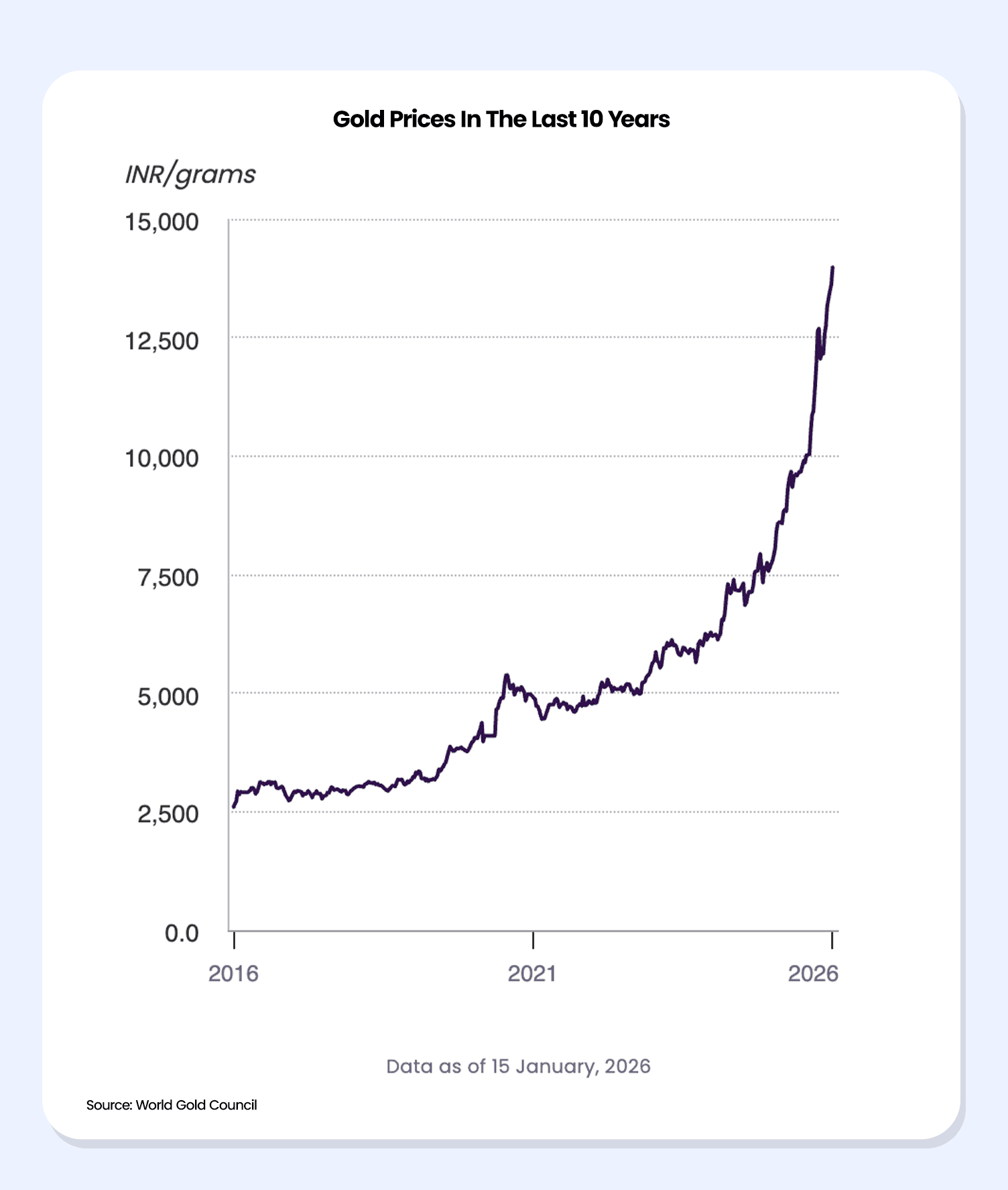
Even so, as noted earlier, gold-filled and gold-plated jewellery are not solid gold, so they do not behave like an “investment gold” holding. The gold content is limited, and resale pricing usually treats these pieces as fashion jewellery, not as gold by weight.
In general, people buy jewellery to wear, gift, and keep as something tangible. The price also includes design, making charges, brand margin, and taxes, so resale value rarely matches what you paid. Also, physical gold does not generate cash flow, so your return depends mainly on resale value and market demand.
If your goal is closer tracking of gold prices, financial gold products like gold ETFs are structured for that. Each unit typically represents a defined weight of gold, and the unit price broadly moves in line with the domestic price of gold.
Similarly, for regular income and clearer return expectations, fixed-income products pay interest or coupons. The interest rate paid on a bond is called the coupon rate, and you can compare options by rate, tenure, and credit risk.
Platforms such as Grip may make it easier to browse and compare bonds in one place.
Explore Grip’s curated list of fixed-income opportunities offering up to 12.5% post-tax returns!
Visit Grip Invest today!
FAQs On Gold Filled vs Gold Plated Jewellery
1. Is gold-filled better than gold-plated?
Yes, gold-filled is usually better than gold-plated if you care about everyday wear and how long the finish lasts. Gold-filled has a much thicker gold layer bonded to a base metal. Gold-plated has a very thin gold coating, so it tends to fade faster.
2. Does gold-plated jewellery fade?
The finish may dull with time, especially after frequent contact with sweat, perfume, or friction. The pace depends on the coating thickness and your care routine.
3. Does gold-filled jewellery hold resale value in India?
Not really in the way solid gold does. Gold-filled jewellery has more gold than plated pieces, but resale buyers usually treat it as fashion jewellery. The price depends on condition and demand, not gold weight.
4. Is gold-filled the same as gold vermeil?
No. Gold vermeil uses a thick gold layer over sterling silver, while gold-filled bonds gold to a base metal like brass. Vermeil sits higher in quality than plated, but it still does not qualify as investment-grade gold.
References:
1. Youtube, accessed from:
https://www.youtube.com/watch?v=h1KoQ5xA7nI
2. Federal trade commission, accessed from: https://tinyurl.com/bdhr2wys
3. BIS, accessed from: https://www.bis.gov.in/wp-content/uploads/2020/12/brief-on-Hallmarking.pdf
4. ISO, accessed from: https://www.iso.org/standard/84976.html
5. Federal trade commission, accessed from: https://tinyurl.com/w78he47b
6. Economie, accessed from:
https://www.economie.gouv.fr/dgccrf/laction-de-la-dgccrf/les-enquetes/loyaute-et-securite-des-bijoux-fantaisie
7. World Gold Council, accessed from: https://www.gold.org/
Want to stay at the top of your finances?
Join the community of 4 lakh+ investors and learn more about Grip Invest, the latest financial knick-knacks, and shenanigans in the world of investing.
Happy Investing!
Disclaimer - Investments in debt securities/municipal debt securities/securitised debt instruments are subject to risks including delay and/ or default in payment. Read all the offer related documents carefully. The investor is requested to take into consideration all the risk factors before the commencement of trading.
This communication is prepared by Grip Broking Private Limited (bearing SEBI Registration No. INZ000312836 and NSE ID 90319) and/or its affiliate/ group company(ies) (together referred to as “Grip”) and the contents of this disclaimer are applicable to this document and any and all written or oral communication(s) made by Grip or its directors, employees, associates, representatives and agents. This communication does not constitute advice relating to investing or otherwise dealing in securities and is not an offer or solicitation for the purchase or sale of any securities. Grip does not guarantee or assure any return on investments and accepts no liability for consequences of any actions taken based on the information provided. For more details, please visit www.gripinvest.in
Registered Address - 106, II F, New Asiatic Building, H Block, Connaught Place, New Delhi 110001


