

Gold BeES Vs Gold ETFs: Which Gold Investment Option Should You Pick?


Gold has a long-standing place in Indian households, rooted in tradition and long-term wealth habits. Actually, research estimates that Indian households hold up to 25,000 tonnes of gold, which is more than the collective reserves of the world’s top 10 apex banks1. Many investors consider gold to be a safe-haven asset that can provide a safety net during times of economic distress and hedge against inflation.
Today, investors can take exposure to gold without holding it in physical form.
Gold BeES and Gold ETFs are among the more popular forms of indirect gold exposure in India. While they keep track of the domestic price of gold and both are traded on the stock exchange, they are fundamentally different products in terms of cost, structure, liquidity, and historical long-term performance. While investing, you must consider more than just returns; you must also understand how the products work, their costs, and how they fit into your portfolio. In this article, we will discuss the differences between Gold BeES and Gold ETFs on different parameters to analyse the suitability for your portfolio.
Also Read: Best ETFs To Invest In 2026
Understanding Gold BeES And Gold ETFs
1. What Are Gold BeES?
Gold BeES is India's first gold-based ETF issued by Nippon India MF (earlier Reliance MF) and traded on stock exchanges. It tracks domestic gold prices, offering exposure without owning physical metal. Each unit typically equals 0.01 gram of gold, with value changing alongside gold prices. Gold BeES provides a low-cost, straightforward way to invest in gold. Gold BeES returns are tied to the price of gold and are similar to Gold ETFs.
2. What Are Gold ETFs?
Gold ETFs are mutual funds listed on stock exchanges that represent high-purity physical gold. They track gold prices and are traded like shares during market hours. Similar to Gold BeES, different fund houses offer Gold ETFs with varying expenses, liquidity, and tracking. Investors use them for hedging, diversification, or wealth preservation. Gold BeES is also a type of ETF and is considered one of the best gold ETFs in India.
Gold BeES vs Gold ETFs: Expense Ratio, Tracking Error, Liquidity Comparison
Both options allow you to invest in a dematerialised format in gold; however, they have considerable differences in costs, liquidity, and trade execution method.
1. Expense Ratio And Liquidity
Gold BeES is renowned for its low (and fixed) expense ratio. Gold BeES expense ratio stands at around 0.80%, which can be slightly higher than the gold ETFs' average expense ratio in India (0.5%-1%)1. The fundamentals of gold BeES investment are similar to those of Gold ETFs. The table below shows the comparison of the expense ratio of Gold BeES with its peers.
| ETF | Expense Ratio | Liquidity |
| Nippon India ETF Gold BeES | 0.80% | High |
| HDFC Gold Exchange Traded Fund | 0.59% | High |
| SBI Gold ETF | 0.70% | High |
| ICICI Prudential Gold ETF | 0.50% | High |
Source: Tickertape2
2. Trading Method And NAV Pricing
Gold BeES, like other gold ETFs, is traded on NSE and BSE, and its market price can differ from the NAV due to bid–ask spreads. Owing to its high trading volumes and large investor base, Gold BeES has historically maintained narrower spreads compared to many other gold ETFs.
The daily NAV of a gold ETF is determined by the market value of its physical gold holdings, which move in line with domestic gold prices. While the NAV reflects these price movements, factors such as the fund’s expense ratio, small cash holdings, and timing differences in asset valuation can lead to minor tracking errors between the NAV and the underlying gold price.
Check out the price comparison of Gold BeES with SBI Gold ETF in the graph below. It clearly shows that they have delivered almost identical performance. But the expense ratio of SBI Gold ETF is less than that of Gold BeES.
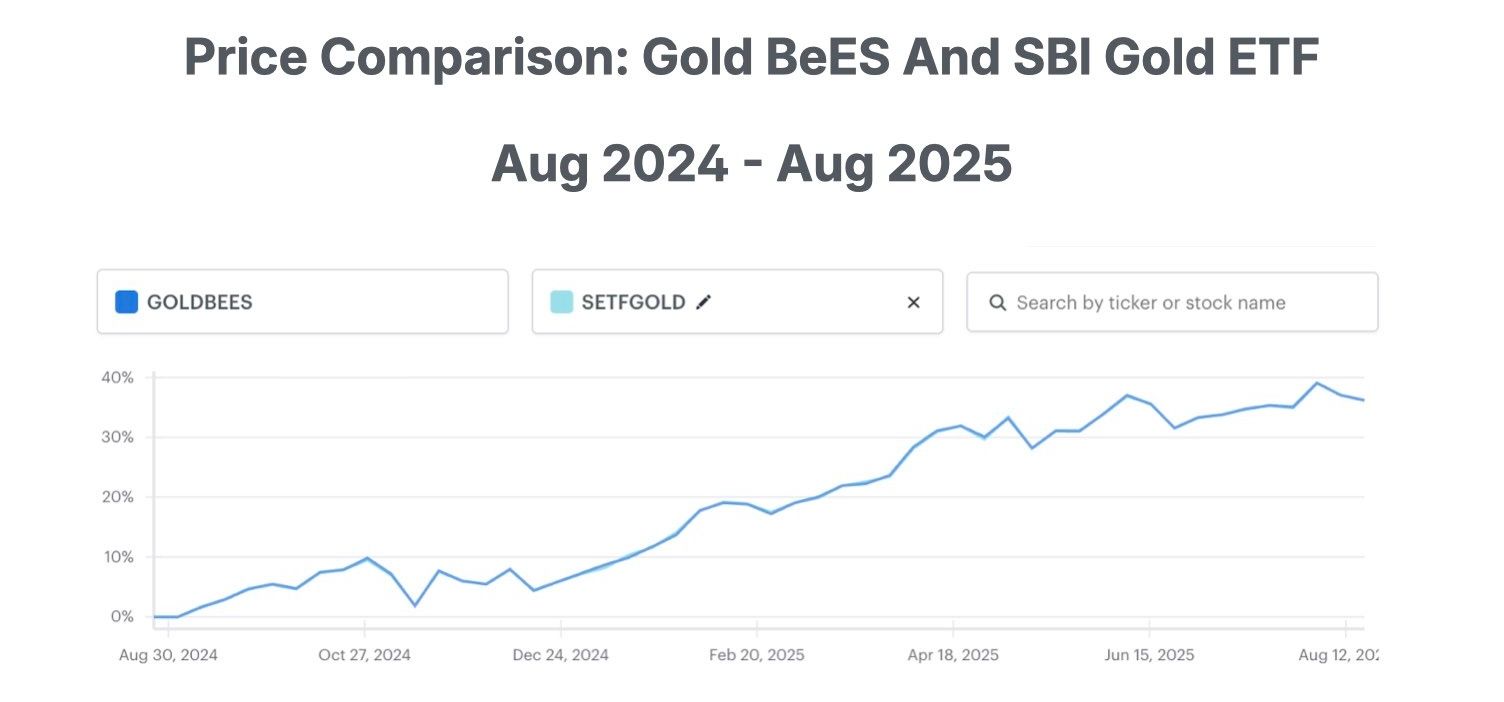
Source: Tickertape2
While both Gold BeES and Gold ETFs offer convenient ways to invest in gold digitally, eliminating the need to store it physically, there are some key distinctions to be aware of:
Feature | Gold BeES | Gold ETFs (General) |
Scope | A specific Gold ETF offered by Nippon India Mutual Fund, historically one of the earliest and most widely traded Gold ETFs in India. | A broad category encompassing various Exchange Traded Funds (ETFs) backed by physical gold or gold-related assets like futures contracts. Multiple fund houses offer Gold ETFs. |
Management | Passively managed, specifically focusing on tracking the domestic price of physical gold (99.5% purity). | Generally passively managed, aiming to replicate the performance of the spot gold price by investing in physical gold or gold futures contracts. |
Expense ratio | Has a slightly higher expense ratio compared to other Gold ETFs, fixed at 0.80%. | Varies between 0.32% and 0.78% depending on the fund house and its operational efficiency. |
Tracking Error | Aims for a low tracking error, striving to match the performance of domestic gold prices closely. Nippon India Gold BeES has a tracking error of 0.22% (as of Aug 2025). | The accuracy of tracking gold price movements can vary depending on the specific fund, with higher expense ratios or less efficient fund management potentially leading to higher tracking errors. Funds like UTI and Quantum Gold ETFs have even lower tracking errors (as low as 0.14–0.15%). |
Fund House | Managed solely by Nippon India Mutual Fund (formerly Reliance Mutual Fund). | Available from various AMCs like HDFC, ICICI, Axis, Kotak, and others. |
Taxation And Investment Costs
1. Capital Gains Tax Rules For Both
For transfers made on or after 23 July 2024:
- LTCG (holding for over 12 months) for gold ETFs/BeES is taxed at 12.5% flat—no indexation.
- STCG (holding under 12 months) is taxed at slab rates.
Also Read: (New) Tax Rules For Debt Mutual Funds In 2025 – What Every Investor Must Know
2. Brokerage And Other Costs To Consider
Beyond the ETF’s expense ratio (TER),
- Brokerage: Can be INR 0 or a small fee per order, depending on the broker.
- Bid–ask spread: This is the hidden cost in the execution price..
- Stamp duty: For delivery-style exchange trades, it is commonly charged at 0.015% on the buy side.
- Regulatory and taxes: SEBI and GST is typically applied on applicable charges.
- DP charges (sell side): Charged when units are debited from demat, and it varies by broker.
STT does not apply to Gold ETFs. The bid-ask spread also affects execution price. Small differences in TER can lead to noticeably different long-term outcomes because fees reduce returns continuously.
Pros and Cons: Gold BeES vs Gold ETF
Pros
- Low minimum investment makes it accessible for retail investors
- Demat-based — no hassle of storing physical gold
- High liquidity — can buy and sell anytime during market hours
- Transparent pricing — closely tracks domestic gold price
- Ideal for diversification as a hedge during market volatility
Cons
- Demat + brokerage costs apply, unlike physical gold
- Tracking error may cause returns to slightly deviate from actual gold price
- Market liquidity varies across different Gold ETFs
- No option to take physical delivery in most ETFs
- Short-term price volatility may impact near-term returns
Risks Of Investing In Gold ETFs
Gold ETFs carry several risks that investors should understand before investing.
- Price risk: ETF returns move with gold prices. If gold falls, the ETF value can fall too.
- Safe-haven risk: Gold can help in some stress periods, but it does not protect in every downturn. Outcomes depend on what is driving the market move.
- Tracking risk: ETF performance may not perfectly match gold price movement due to expenses, cash balances, timing differences, and transaction costs.
- Premium or discount to NAV: ETF market price can trade above or below NAV due to demand and supply on the exchange.
- Currency and global timing risk: Domestic gold valuation depends on international prices and USD-INR conversion. Global moves can show up as gaps when Indian markets open.
- Operational and custody risk: Since the fund holds physical gold via custodians and vaults, there are operational risks that can affect the scheme in rare scenarios.
- Regulatory and tax change risk: Changes in rules can affect trading, pricing, and net returns.
Which Option Is Better For Long-Term Investors?
For long-term holding, the key drivers are expense ratio (TER) and tracking quality. Liquidity matters mainly if you trade often.
Gold BeES is itself a gold ETF. So the real choice is Gold BeES versus other gold ETFs.
Gold BeES can suit long-term investors who want a large, widely traded fund. However, its TER is not always the lowest, so a lower-cost gold ETF can be a better fit if you plan to buy and hold.
A simple way to decide:
- If you trade rarely, pick the ETF with lower TER and a steady tracking record.
- If you may exit quickly, pick the ETF with tighter spreads and better depth, then compare TER.
Which One Should You Choose?
Ultimately, the investments you choose between Gold BeES and Gold ETFs will come down to your particular investment goals, cost preferences, and your style of investing. The following are some important factors that you should consider before picking one out of Gold BeES and Gold ETFs for your portfolio:
1. Liquidity: Gold BeES is indeed highly liquid due to its age, size, and popularity, but several other top Gold ETFs (SBI, HDFC, ICICI, etc.) also provide strong liquidity.
2. Cost: Gold BeES generally has a slightly higher (but fixed) expense ratio of around 0.80%, as a few Gold ETFs offer a lower expense ratio (0.40%-1.00%). You need to carry out a Gold ETF expense ratio comparison before reaching a decision.
3. Holding period: Short-term traders and liquidity act enthusiasts often overlook minor expenses, but long-term investors pay close attention to a 0.1% cost difference, as it can significantly compound over time.
Investor Profiles Suitable For Each Option
Gold BeES makes sense for long-term investors seeking an investment with low costs, liquidity, simple structure, easy access to liquidity, and stability.
Other Gold ETFs make sense for those who prefer their specific fund house, want to diversify their exposure across issuers, and/or need ETFs that fit into their existing mutual fund portfolio linked to a demat account.
Conclusion
Gold BeES and gold ETFs in India are both cost-effective ways to own gold without the concerns of storage and purity. Gold BeES (as a type of Gold ETF) typically have greater liquidity, but many of the best-performing gold ETFs have comparable efficiency. Your final decision should consider liquidity needs, sensitivity to costs, and your longer-term financial goals.
As with any investment, be careful not to concentrate your entire portfolio in a single asset. It is good investment practice to diversify not only with gold but also with other fixed-income investments such as corporate bonds and SDIs (Secured Debt Instruments) to balance your risk-reward profile. To learn more about investing and balancing a portfolio, sign up on Grip Invest today.
Frequently Asked Questions On Gold BeES And Gold ETFs
1. Are Gold BeES better than Gold ETFs?
Gold BeES might have cost and liquidity advantages (in a few cases), but the best choice depends on your preferred fund house, how often you'll be trading, and, most importantly, your investment timeline.
2. Can I convert Gold BeES into physical gold?
No. Gold BeES, like most gold ETFs, are not redeemable for physical gold. They serve as a way to gain paper-based gold exposure.
3. How do I invest in Gold BeES in India?
You will need a demat and trading account. You simply search for "Gold BeES" on NSE/BSE and place a buy order for the shareholders to hold that quantity, which will be credited to your demat account after the successful trade.
4. Which has lower expense ratio?
Some gold ETFs show a lower expense ratio than Gold BeES (0.80%). For example, ICICI Prudential Gold ETF is shown at 0.50% and HDFC Gold Exchange Traded Fund at 0.59% on 16 Feb 2026.
5. Are returns different between GoldBeES and ETFs?
Performance is usually close because both track the domestic gold price. Small gaps can still show up due to expense ratios, tracking error, and bid–ask spreads.
6. Which is better for SIP investors?
For SIP-style investing, outcomes tend to be similar because both track domestic gold prices. Differences, when they show up, usually come from expense ratio, tracking quality, and the bid–ask spread on the day you buy.
References:
1. The Business Standard, accessed from: https://www.business-standard.com/finance/news/india-s-household-gold-holdings-surpass-reserves-of-top-10-central-banks-125032801144_1.html
Economic Times, accessed from: https://economictimes.indiatimes.com/nippon-india-etf-gold-bees/mffactsheet/schemeid-4957.cms?from=mdr
2. Tickertape, accessed from: https://www.tickertape.in/etfs/nippon-india-gold-bees-etf-GBES
Want to stay at the top of your finances?
Join the community of 4 lakh+ investors and learn more about Grip Invest, the latest financial knick-knacks, and shenanigans in the world of investing.
Happy Investing!
Disclaimer - Investments in debt securities/municipal debt securities/securitised debt instruments are subject to risks including delay and/ or default in payment. Read all the offer related documents carefully. The investor is requested to take into consideration all the risk factors before the commencement of trading.
This communication is prepared by Grip Broking Private Limited (bearing SEBI Registration No. INZ000312836 and NSE ID 90319) and/or its affiliate/ group company(ies) (together referred to as “Grip”) and the contents of this disclaimer are applicable to this document and any and all written or oral communication(s) made by Grip or its directors, employees, associates, representatives and agents. This communication does not constitute advice relating to investing or otherwise dealing in securities and is not an offer or solicitation for the purchase or sale of any securities. Grip does not guarantee or assure any return on investments and accepts no liability for consequences of any actions taken based on the information provided. For more details, please visit www.gripinvest.in
Registered Address - 106, II F, New Asiatic Building, H Block, Connaught Place, New Delhi 110001


