

Gold BeES Explained: What Is Gold ETF, Returns, Taxation And How To Invest


In India, gold has been a symbol of wealth and security for ages. However, investing in gold was generally confined to ornaments or coins. Although these options provided security, they also had several drawbacks, such as storage difficulties, safety complications, extra making charges, and even liquidity difficulties.
How would you feel if you got to know there is a way to invest in gold while avoiding such complexities? Sounds convenient, right? Well, this is exactly what Gold BeES is for. It assists in online gold investment in India.
If you have doubts about investing in digital gold, you must know that globally, physically backed gold ETFs saw USD 6.6 billion of net inflows in April 2026. In India too, Gold ETF inflows increased 34% month-on-month to INR 3,040.3 crore in April 2026. This massive figure shows an increase in trust in online gold investment1. So, why lag behind? But before investing in Gold BeES, read this article till the end to learn about Gold BeES meaning in detail.2
What Are Gold BeES?
To understand Gold ETF meaning, think of it as an exchange-traded fund that gives investors exposure to gold without requiring them to buy, store or insure physical gold themselves. A Gold ETF is listed on the stock exchange and its units can be bought and sold during market hours, much like shares.
Gold BeES is an open-ended gold ETF investment in India that is listed on exchanges and invests in physical gold. “Gold BeES” is commonly used for Nippon India ETF Gold BeES, which is listed and traded on the stock exchange ( NSE-GOLDBEES; BSE- 590095) like a share.
Units are also created and redeemed through a “creation and redemption” process, but this is typically done by authorised participants or market makers in large creation-unit lots (for Gold BeES, 120,000 units as of 30 April 2026, with an approximate basket value of INR 1.48 crore). This supports liquidity and helps keep prices aligned with the underlying gold value.3
How Do Gold BeES Work?
When you invest in Gold BeEs, you buy units representing a specific quantity of gold, usually equivalent to 0.01 gram. Dematerialised gold is securely stored, with each unit being carefully safeguarded in a secure and controlled environment. These are listed and traded on stock exchanges so that you may buy and sell them conveniently.
The price of Gold BeES replicates the price of gold in the market, thus providing you an opportunity to profit from fluctuations in gold prices. Demat accounts complete the transaction without errors or cumbersome procedures.
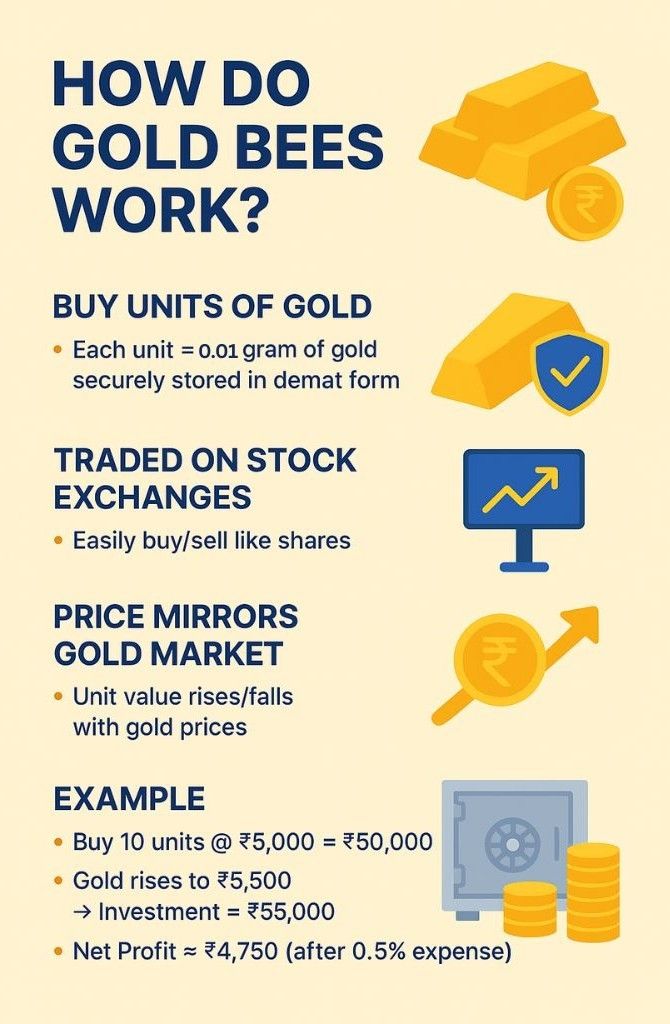
For example, if the market price of gold is INR 5,000 per gram, and you decide to invest INR 50,000. Each unit of Gold BeES represents 0.01 gram of gold, so with INR 50,000, you can buy 1,000 units (since each unit costs INR 50).
Now, if the price of gold increases to INR 5,500 per gram, the value of each Gold BeES unit will rise to INR 55. Your investment is now worth INR 55,000 (1,000 units × INR 55), giving you a profit of INR 5,000. Even if you deduct a small expense ratio on this profit, say 0.5% (INR 250 on your INR 50,000 investment), you still get a net profit of INR 4,750.
GoldBeES vs Physical Gold
Here is a clean comparison between Gold BeES meaning and physical gold:
Factor | Gold BeES | Physical gold |
Purpose | Investment exposure to the domestic price of gold by holding physical gold (purity 995 / 99.5%) inside the fund. | Wear, gift or hold as an asset |
Storage | No home storage needed (units sit in demat) | You manage storage and safety |
Costs | Brokerage/charges to buy/sell on the exchange, plus the fund’s ongoing fee (TER) | Making charges (jewellery) + storage + buy-sell spread |
GST on purchase | No GST | 3% GST on gold value; jewellery also has 5% GST on making charges |
Convenience and safety | Held in demat form. No storage worries, and you can buy/sell during market hours on exchanges. | You will want safe storage (home risk or locker costs). It’s also more hassle to verify purity at resale. |
Liquidity | Generally straightforward because it trades like a stock, but your final price can depend on market liquidity and the bid–ask spread at that moment. | Depends on where you sell, what you’re selling (jewellery vs bar), and purity checks. |
Price tracking | Tries to track gold price before expenses; may differ a bit in market trading | Depends on purity, charges, and what buyers offer |
Gold BeES Returns And Historical Performance
Gold BeES performance broadly moves with gold prices. Gold BeES returns can vary across periods and do not indicate future results.
As of 15 May 2026, the latest NAV of Nippon India ETF Gold BeES was INR 130.0030. As per Nippon India Mutual Fund’s performance data, the following returns were reported as of 30 April 20264:
Period | Return |
1 year | 57.19% |
3 year | 33.98% CAGR |
5 years | 24.80% CAGR |
Since inception* | 14.36% CAGR |
*The scheme’s inception date is 8 March 2007. The performance is computed based on the last day of the month preceding the date of the advertisement.
Benefits Of Investing In Gold BeES
Gold BeES investment comes with many benefits, which is also why it is becoming one of investors' favourite choices. Some of the Gold BeES investment benefits are listed as follows:
1. High Liquidity
If you own Gold BeES, then managing your investments becomes easy. You can trade them on stock exchanges like NSE and BSE, which allows you to buy or sell them at any time without bothering to find an ideal buyer or waiting for the right price. It does not have the liquidity issues like physical gold, which is much harder to trade.
2. Cost-Effective
Unlike physical gold, you do not have to worry about where to store your assets or pay for costly safekeeping options. This makes Gold BeES much more convenient for investors who want to avoid all the hassles of dealing with physical gold. Apart from eliminating storage-related expenses, Gold BeES is generally more affordable due to its low expense ratios.
3. Flexible And Secure Transactions
With Gold BeES, you can invest securely and conveniently in gold without the hassles of various risks associated with actually having physical gold. These risks can be theft, damage, impurity, or loss. In fact, as the investment is maintained electronically, trading becomes simple and secure. Moreover, each unit of Gold BeES stands for physical gold with 99.5%2 purity, which guarantees the highest quality.
4. Ability To Purchase In Small Quantities
Gold BeES allows you to invest in gold as per your investment capacity, with the typical unit amounting to 0.01 grams of gold. This flexibility means being accessible to investors with different financial capabilities. For example, you can invest just INR 5,000 and buy pieces equivalent to about 7.7 grams worth of gold, slowly building your portfolio. Such low affordability makes Gold BeES an excellent option for new and seasoned investors.
5. Serves As A Trading Margin
Gold BeES can be used as collateral for margin trading, giving added flexibility to active investors. This enables you to trade in the stock market while also investing in gold. Under SEBI regulations, equity ETFs such as Gold beES are now considered eligible for margin trading. This makes them a very smart option for investors seeking versatile choices in this dynamic market.
Also Read: Diamonds or Gold: Which Offers Better Returns and Safety?
Disadvantages Of Investing In Gold BeES
Though Gold BeES has many advantages, it also has certain disadvantages. Thus, it is important for you to be aware of them before investing. Some of these disadvantages are:
1. Liquidity Risk
You may have to face a situation where there is no buyer or seller at the price you wish, as the volumes traded have been very low. This especially happens during market downturns. For example, selling a high holding when the market is down may result in having to settle for a lower price, or it may take a bit longer to trade. This becomes problematic if you are in urgent need of funds.
2. Price Volatility
Gold prices fluctuate as a result of international factors like economic trends or changes in politics and currency. Therefore, since Gold BeES tracks the prices of gold, they tend to be random. For example, in the event of a global recession, gold prices would shoot up when investors rush to this preferred safe investment. However, those prices fall as quickly as they rise when the economy stabilises again, thereby affecting the worth of your gold investment in India.
3. Market Inefficiencies
Sometimes, due to Market inefficiencies, including low trading volumes, supply-demand imbalances, etc., the price of Gold BeEs may fluctuate from the price of real gold. Due to this difference, you might be required to buy the Gold BeEs at a higher price than the real value of gold. Similarly, you might even have to sell at a lower price than the real price of gold.
4. Counterparty Risk
Investing in Gold BeEs is partially dependent on the trustworthiness of your fund manager, who is responsible for making all the crucial investment decisions. These decisions they make can significantly affect your investment. Thus, if your fund manager mismanages your assets or fails to track the gold prices efficiently, then it could directly impact your investment. This could further incur huge losses.
Taxation Of Gold BeES
It is essential that you learn about Gold BeES Taxation before investing in them. Gold BeES is a gold ETF run by Nippon India Mutual Fund. Tax is mainly about capital gains when you sell.
Capital gains (for transfers on or after 23 July 2024):
- If you sell within 12 months, the gain is treated as short-term capital gain or STCG and is taxed at your income slab rate (plus surcharge and cess).
- If you sell after 12 months, the gain is treated as long-term capital gain/ LTCG and is taxed at 12.5% without indexation (plus surcharge and cess).
Please note that the INR 1.25 lakh exemption for LTCG does not apply here. That exemption is linked to equity-oriented assets. Gold ETFs are not treated as equity-oriented funds, and STT is not applicable to non-equity schemes.
3. Tax on IDCW (Dividend) payouts from Gold BeES
Gold BeES may pay out IDCW (Income Distribution cum Capital Withdrawal) from time to time, but it is not guaranteed and can be nil for long periods. Any IDCW you receive is taxable in your hands as per your income tax slab. Also, no TDS is deducted if IDCW paid or credited is below INR 10,000 in a financial year (subject to conditions)5.
Gold BeES Available In India
If you are exploring options beyond Gold BeES, as noted earlier, Gold BeES is a single product name. It is one of the many gold ETFs available in India. Here are some popular gold ETFs (as of 15 May 2026):
S. No. | Gold ETF | Expense ratio (%) | AUM | Price (INR) | 1Y return (%) |
1 | Quantum Gold Fund | 0.55% | 710.28 | 129.69 | 68.54% |
2 | Aditya Birla Sun Life Gold ETF | 0.37% | 2,807.73 | 137.40 | 67.68% |
3 | UTI Gold Exchange Traded Fund | 0.52% | 4,201.45 | 131.80 | 68.43% |
4 | Invesco India Gold Exchange Traded Fund | 0.42% | 727.30 | 135.50 | 67.74% |
5 | Kotak Gold ETF | 0.52% | 14,339.53 | 130.69 | 68.05% |
How To Invest In Gold BeES
You can easily invest in Gold BeES, as it is available through stock exchanges. However, if you are doing it for the first time, just follow the steps below:
Step 1: Start by opening a demat or trading account with an authorised stockbroker. These accounts would keep the number of Gold BeES units in the electronic format.
Step 2: Once you are registered, choose from available Gold BeES schemes based on your investment goals. The most sought-after choices include Nippon India Gold BeES and SBI Gold, both of which come with the backing of 99.5% pure gold.
Step 3: Lastly, transfer the amount you want to invest into your trading account. This is the fund that would be used to purchase the Gold BeES units.
Who Should Invest in GoldBeES?
Gold BeES tends to fit people who want gold exposure in a Demat-friendly format, mainly as a portfolio diversifier. It suits:
- Investors building a balanced portfolio: If you already hold equities and debt, a small gold allocation can help diversify because gold often behaves differently to risk assets, especially during stressed markets.
- People who want gold without physical hassles: If you do not want storage, purity checks, or making charges, an exchange-traded gold fund can be a cleaner route.
- Those comfortable buying on the exchange: It can work well if you already use a broker account and prefer simple buying and selling like a stock.
Is Gold BeES Worth It in 2026?
In Q1 2026, India’s domestic gold price rose sharply. The World Gold Council reported that MCX spot gold prices were up 20% quarter-on-quarter and 81% year-on-year, reaching a record Q1 average of INR 151,108 per 10 grams. Prices also touched a record high of INR 175,231 per 10 grams before correcting by around 15%.
This makes Gold BeES relevant, but not risk-free. High prices can trigger profit-booking, short-term corrections and weaker jewellery demand. At the same time, gold investment demand and Gold ETF flows have remained strong, showing that investors are still using gold as a market-linked asset in uncertain conditions.
Gold BeES may make sense if you want measured exposure to gold through a regulated Gold ETF, understand that returns can move up or down, and are not buying only because past returns look strong.
Conclusion
Gold BeES has emerged as a clear and simple investment avenue that combines the ageless metallic value of gold with the need for accessible modernity. Due to its flexibility, reasonable price, and long-term tax benefits, including it in your portfolio can be ideal for diversification across assets.
However, if you are yet to start your investment journey, sign up with Grip today! It is a user-friendly investment platform that allows you to invest your funds in high-yield alternate investment opportunities.
FAQs On Gold BeEs
1. Can I use Gold BeES as collateral for loans?
Yes, you can take loans against gold BeES. Gold BeES are traded on the stock exchange, and since they are backed by physical gold, financial institutions accept them as security. This is a very interesting way to leverage your gold investment without having to sell it.
2. Is there a minimum investment amount for Gold BeES?
For Gold BeES, the minimum investment amount is normally one unit, which usually comprises 0.01 gram of gold. This gives it much wider access to investors because it allows one to invest even with just an amount as little as INR 5,000, depending on the price of precious metals.
3. Do Gold BeES have a lock-in period?
No, they do not have a lock-in period. During market hours, Gold BeES can be bought and sold at any time. This liquid nature would appeal to a person looking for a flexible gold investment without the requirement to abide by long-term commitments.
4. Is it good to invest in goldbees?
Goldbees, or gold ETFs, provide a simple and affordable way to invest in gold without the need to store it. They offer easy access to cash, closely follow gold prices, and serve as a safe option for diversification. However, returns rely solely on changes in gold prices.
5. What advantages do Gold BeES offer over physical gold?
Gold BeES offers several advantages over physical gold: it eliminates concerns of storage and security, as it's held electronically in your demat account. It's more liquid, allowing easy buying/selling on stock exchanges. You also avoid making charges and purity issues linked to physical gold. Additionally, Gold BeES allows for small, systematic investments and tracks gold prices accurately, making it a cost-efficient and transparent way to invest in gold.
6. How are Gold BeES taxed in India?
Gold BeES are taxed in India the same way as other gold ETFs. Capital gains from holdings longer than 3 years are taxed at 20% with indexation. Gains from shorter periods are added to your income and taxed based on your income slab.
References:
1. Gold Hub, accessed from: https://www.gold.org/goldhub/data/global-gold-backed-etf-holdings-and-flows
2. ET, accessed from: https://economictimes.indiatimes.com/mf/analysis/gold-etf-inflows-jump-34-to-rs-3040-crore-in-april-silver-etfs-log-third-straight-outflow/articleshow/131030740.cms
3. Nippon India, accessed from: https://mf.nipponindiaim.com/FundsAndPerformance/ProductNotes/NipponIndia-ETF-Gold-BeES-Apr-2026.pdf
4. Nippon India, accessed from: https://mf.nipponindiaim.com/FundsAndPerformance/Pages/NipponIndia-ETF-Gold-BeES.aspx
5. Income Tax India, accessed from: https://www.incometaxindia.gov.in/w/section-194k-14
6. Business Today, accessed from: https://www.businesstoday.in/personal-finance/investment/story/nippon-india-etf-gold-bees-ranks-10th-worldwide-in-ytd-fund-flows-check-details-before-investment-445759-2024-09-13>
 |
Author: Grip Invest Editorial Team The Grip Invest Editorial Team is a group of Chartered Accountants, MBA (Finance) graduates, and Qualified Research Analysts dedicated to helping you invest smarter. We dive deep into India's fixed income landscape to deliver content that is accurate, up-to-date, and easy to understand. Whether you're exploring bonds, fixed deposits, or other fixed income opportunities, our guides cut through the noise and give you the clarity to make better financial decisions. |
Want to stay at the top of your finances?
Join the community of 4 lakh+ investors and learn more about Grip Invest, the latest financial knick-knacks, and shenanigans in the world of investing.
Happy Investing!
Disclaimer - Investments in debt securities/municipal debt securities/securitised debt instruments are subject to risks including delay and/ or default in payment. Read all the offer related documents carefully. The investor is requested to take into consideration all the risk factors before the commencement of trading.
This communication is prepared by Grip Broking Private Limited (bearing SEBI Registration No. INZ000312836 and NSE ID 90319) and/or its affiliate/ group company(ies) (together referred to as “Grip”) and the contents of this disclaimer are applicable to this document and any and all written or oral communication(s) made by Grip or its directors, employees, associates, representatives and agents. This communication does not constitute advice relating to investing or otherwise dealing in securities and is not an offer or solicitation for the purchase or sale of any securities. Grip does not guarantee or assure any return on investments and accepts no liability for consequences of any actions taken based on the information provided. For more details, please visit www.gripinvest.in
Registered Address - 106, II F, New Asiatic Building, H Block, Connaught Place, New Delhi 110001


