

Best ETF To Invest In India: How To Choose The Right ETF For Your Portfolio


Exchange Traded Funds (ETFs) have become one of the most popular investment options among investors of India in recent years. With the increasing awareness about passive investing, lower expense ratios, and easy diversification, ETFs are increasingly being preferred by both beginners and experienced investors.
But with the different or various ETF investment options available in the market, how do you choose the best ETF to invest in India?
This guide contains the details of everything that you need to know about ETFs, the different types available, factors to consider before investing, and how to select the best exchange traded funds for your future financial goals.
What Is An ETF?
An Exchange Traded Fund (ETF) is an investment fund that trades on stock exchanges, just like shares. ETFs usually track an index, commodity, sector, or asset class. Instead of buying individual stocks, investors can buy a single ETF unit to gain exposure to a diversified portfolio.1
For example, a Nifty 50 ETF tracks the performance of the Nifty 50 index. If the index rises, the ETF value also increases proportionately.
How ETFs Work?
ETFs pool money from multiple investors and invest it in assets according to the fund objective. Since most ETFs are passively managed, they aim to replicate the performance of an index rather than outperform it.
Why Passive Investing Is Growing In India?
Passive investing India trends have grown significantly due to:
- Lower expense ratios compared to mutual funds
- Simplicity and transparency
- Long-term wealth creation potential
- Easy access through Demat accounts
- Increasing financial awareness among millennials
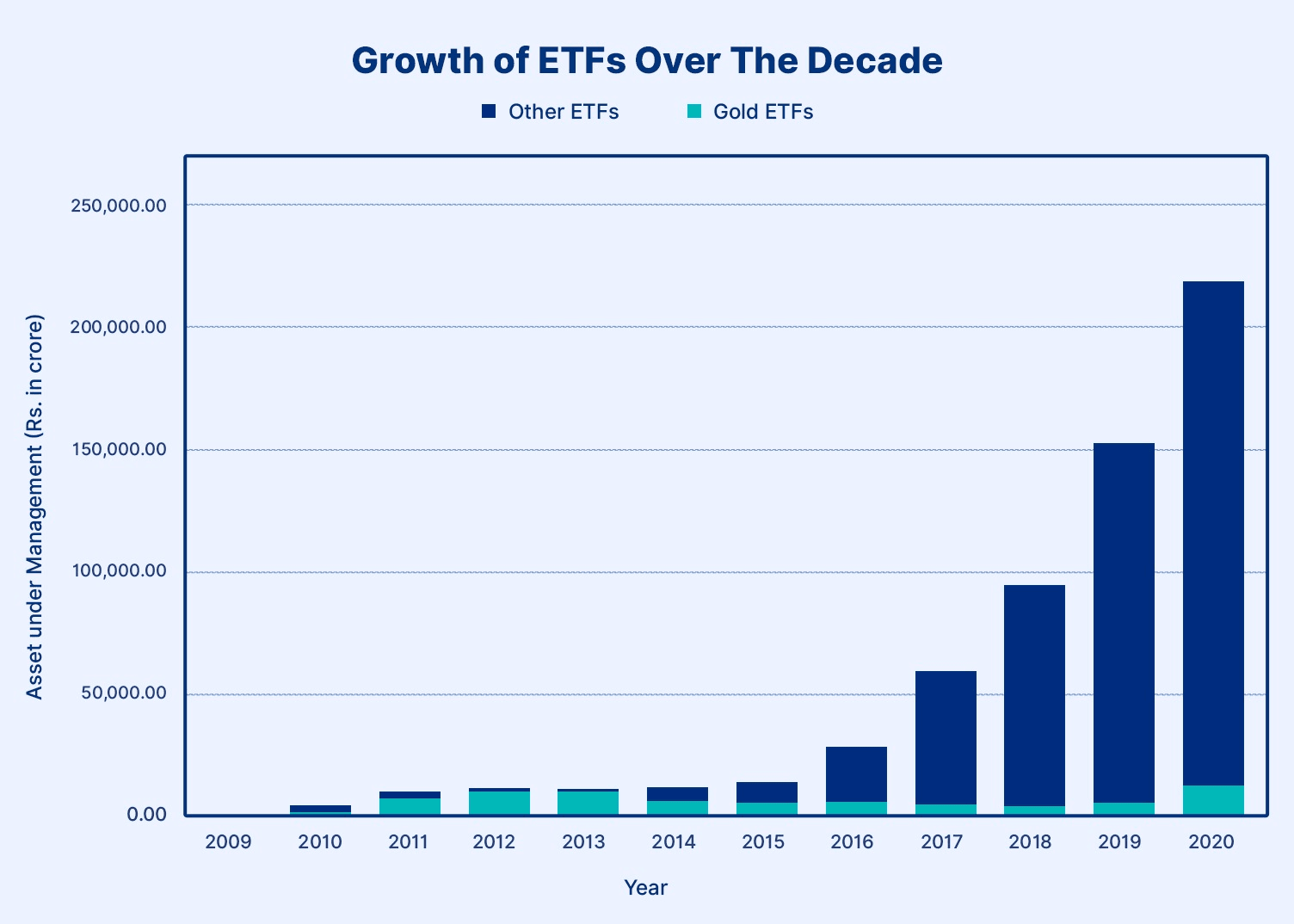
According to AMFI data, ETF assets under management (AUM) in India have witnessed strong growth over the past few years, especially in equity and gold ETFs.
Also Read: EGR vs Gold ETFs: Where Should You Invest?
Types Of ETFs To Invest In
Understanding ETF categories is important before choosing the best ETF for beginners or long-term investors.
1. Index ETFs
Index ETFs track benchmark indices such as:
- Nifty 50
- Sensex
- Nifty Bank
These are considered among the best long term ETF options because they offer diversified equity exposure at low cost.3
Suitable For:
- Beginners
- Long-term investors
- Passive investors
2. Gold ETFs
Gold ETFs invest in physical gold and track gold prices.
They are ideal for investors seeking:
- Inflation protection
- Portfolio stability
- Safe-haven assets
Gold ETF vs Index ETF
Feature | Gold ETF | Index ETF |
| Asset Type | Gold | Stocks |
| Risk Level | Moderate | Moderate to High |
| Returns Potential | Stable | Higher long-term growth |
| Best For | Hedging | Wealth creation
|
3. Debt ETFs
Debt ETFs invest in government securities, bonds, and fixed-income instruments.
These ETFs are suitable for conservative investors looking for:
- Stable returns
- Lower volatility
- Better liquidity than traditional bonds.4
4. International ETFs
International ETFs provide exposure to foreign markets such as:
- US technology companies
- Global indices
- International sectors
These help in ETF portfolio diversification beyond India.
5. Sector ETFs
Sector ETFs focus on specific industries such as:
- Banking
- IT
- Pharma
- Energy
While they can offer higher growth potential, they also carry higher sector-specific risk.
How To Choose The Best ETF To Invest?
Choosing the best ETF to invest depends on multiple factors.
1. Define Your Investment Goal
Before investing, identify whether your goal is:
- Wealth creation
- Retirement planning
- Short-term gains
- Diversification
- Stability
For example:
- Index ETFs suit long-term wealth creation.
- Gold ETFs suit risk protection.
- Debt ETFs suit conservative goals.
2. Understand Your Risk Appetite
Every ETF category carries different levels of risk.
ETF Type | Risk Level |
| Debt ETF | Low |
| Gold ETF | Moderate |
| Index ETF | Moderate |
| Sector ETF | High
|
Investors should choose ETFs according to their comfort with market fluctuations.
3. Check Liquidity
Liquidity refers to how easily ETF units can be bought or sold on the exchange.
Higher liquidity generally means:
- Better price efficiency
- Easier transactions
- Lower bid-ask spreads
Always choose ETFs with higher trading volumes.
4. Evaluate Tracking Error
Tracking error measures how closely an ETF follows its benchmark index.
Lower tracking error indicates:
- Better fund efficiency
- Accurate index replication
For example:
If the Nifty rises by 10% but the ETF rises only 8.5%, the difference represents tracking error.
5. Look at Fund Size
A larger Asset Under Management (AUM) often indicates:
- Investor confidence
- Better liquidity
- Lower operational risks
Top ETF funds India investors prefer usually have strong AUM and consistent performance history.
Best ETF Categories For Different Investors
The best ETF depends on an investor’s financial goals, risk appetite, and investment horizon. While some ETFs focus on market growth, others help with stability and diversification.
Understanding different ETF categories can help beginners and experienced investors build a balanced portfolio.
Best ETFs for Beginners
For new investors, ETFs that track broad market indices can be a simple way to start investing. These ETFs offer exposure to multiple companies through a single investment, reducing the need to analyse individual stocks.
Beginners can consider:
- Nifty 50 ETFs:
These ETFs track India’s top 50 companies by market capitalisation and provide exposure to established large-cap businesses across sectors.
- Sensex ETFs:
Sensex ETFs follow the performance of the 30 companies included in the BSE Sensex index, offering a simple way to invest in leading Indian companies.
- Broad Market ETFs:
These ETFs track wider indices and provide exposure to a larger set of companies, helping beginners diversify beyond a few stocks.
For first-time investors, index-based ETFs can offer a combination of simplicity, transparency, and lower costs compared to actively managed funds.
Best ETFs for Long-Term Investors
Investors with long-term goals such as retirement planning or wealth creation often look for ETFs that can benefit from market growth over several years.
Long-term investors may consider:
- Index ETFs:
Index ETFs aim to replicate the performance of a benchmark index, allowing investors to participate in overall market growth without actively selecting stocks.
- International ETFs:
These ETFs provide exposure to global markets and companies outside India, helping investors diversify geographically.
- Sector ETFs:
Investors who understand specific industries may explore sector-based ETFs focused on areas such as technology, banking, or healthcare. However, these may carry higher concentration risk compared to broad market ETFs.
For long-term investing, consistency and staying invested through market cycles are important factors alongside ETF selection.
Best ETFs for Conservative Investors
Investors who prefer relatively lower volatility may look beyond equity ETFs and consider asset classes designed for stability.
Conservative investors may explore:
- Debt ETFs:
Debt ETFs invest in fixed income instruments such as government securities or bonds. They can help add stability to a portfolio and may be suitable for investors seeking predictable income exposure.
- Gold ETFs:
Gold ETFs track gold prices and allow investors to gain exposure to gold without storing physical gold. They are often used as a portfolio diversification tool.
These ETFs can help balance equity exposure and reduce dependence on stock market movements.
Best ETFs for Portfolio Diversification
A diversified ETF portfolio can combine different asset classes to balance growth potential and risk.
Investors may combine:
- Equity ETFs: For long-term capital appreciation
- Gold ETFs: For hedging and diversification
- International ETFs: For global market exposure
- Debt ETFs: For stability and income generation
Using a mix of ETFs across asset classes can help create a more balanced investment strategy based on individual goals and risk tolerance.
Risks Of Investing In ETFs
Although ETFs are considered efficient investment tools, they still involve risks.
1. Market Volatility
ETFs tracking stock markets can fluctuate significantly during market downturns.
Example:
A banking ETF may decline sharply during financial sector corrections.
2. Tracking Risk
Some ETFs may not perfectly replicate index performance due to:
- Fund expenses
- Market timing differences
- Cash holdings
3. Low Liquidity in Niche ETFs
Sector-specific or less popular ETFs may face:
- Lower trading volumes
- Higher spreads
- Difficulty during volatile markets
Investors should carefully assess liquidity before investing.
ETF vs Mutual Fund: Which Is Better?
Both ETFs and mutual funds are popular investment vehicles, but they differ in several ways.
Feature | ETF | Mutual Fund |
Lower | Higher | |
Trading | Real-time on exchange | End-of-day NAV |
Flexibility | High | Moderate |
Minimum Investment | Price of one unit | SIP possible |
Management Style | Mostly passive | Mostly active
|
Which One Should You Choose?
- ETFs are suitable for cost-conscious and self-directed investors.
- Mutual funds may suit investors seeking professional active management and SIP flexibility.
Conclusion
ETFs can be powerful low-cost investment tools when selected carefully according to financial goals, risk appetite, and long-term investment strategy.
Whether you are a beginner, conservative investor, or someone looking for global diversification, there are several ETF investment options available in India.
The key to selecting the best ETF to invest in India lies in understanding liquidity, tracking error, fund size, and portfolio suitability.
With growing awareness around passive investing India trends, ETFs are expected to play a major role in modern wealth creation strategies.
FAQs On Best ETFs To Invest In India
 |
Author: Grip Invest Editorial Team The Grip Invest Editorial Team is a group of Chartered Accountants, MBA (Finance) graduates, and Qualified Research Analysts dedicated to helping you invest smarter. We dive deep into India's fixed income landscape to deliver content that is accurate, up-to-date, and easy to understand. Whether you're exploring bonds, fixed deposits, or other fixed income opportunities, our guides cut through the noise and give you the clarity to make better financial decisions. |
Want to stay at the top of your finances?
Join the community of 4 lakh+ investors and learn more about Grip Invest, the latest financial knick-knacks, and shenanigans in the world of investing.
Happy Investing!
Disclaimer - Investments in debt securities/municipal debt securities/securitised debt instruments are subject to risks including delay and/ or default in payment. Read all the offer related documents carefully. The investor is requested to take into consideration all the risk factors before the commencement of trading.
This communication is prepared by Grip Broking Private Limited (bearing SEBI Registration No. INZ000312836 and NSE ID 90319) and/or its affiliate/ group company(ies) (together referred to as “Grip”) and the contents of this disclaimer are applicable to this document and any and all written or oral communication(s) made by Grip or its directors, employees, associates, representatives and agents. This communication does not constitute advice relating to investing or otherwise dealing in securities and is not an offer or solicitation for the purchase or sale of any securities. Grip does not guarantee or assure any return on investments and accepts no liability for consequences of any actions taken based on the information provided. For more details, please visit www.gripinvest.in
Registered Address - 106, II F, New Asiatic Building, H Block, Connaught Place, New Delhi 110001


