

HDFC Mutual Fund Returns: Performance Across Top Funds Explained (2026)


When Indian investors search for a reliable and well-managed mutual fund for investment, then HDFC Asset Management Company is one of the top choices for every investor.
HDFC has built a strong reputation for disciplined investing and gaining investor trust by providing a good percentage of return with its Assets Under Management (AUM) scheme of more than INR 7 lakh crore and over 20 years of experience. But how do HDFC mutual funds actually perform across the different categories?
And how can you make the right choice for investment among the different HDFC schemes for your financial goals?
In this blog, we will explain how HDFC mutual fund performs in different schemes in the equity, hybrid, and debt categories.
The blog will also cover what drives their returns and help you understand whether these funds are a good fit for your portfolio in 2026.
HDFC Mutual Fund Returns Across Categories
HDFC AMC has over 80 schemes such as equity, hybrid, debt, and solution-oriented funds.1
Here is how the top HDFC funds stack up:
HDFC Top Fund Returns -
Fund Name | Category | 1-Year | 3-Year | 5-Year |
| HDFC Flexi Cap Fund | Flexi Cap | 4.32% | 20.51% | 20.72% |
| HDFC Mid-Cap Opportunities | Mid Cap | 4.88% | 12.6% | 11,95% |
| HDFC ELSS Tax Saver | ELSS | 19.3% | 17.5% | 13.4% |
| HDFC Infrastructure Fund | Sectoral | 31.2% | 20.9% | 12.1% |
| HDFC Balanced Advantage | Hybrid | 15.8% | 14.3% | 11.7% |
| HDFC Short Term Debt Fund | Debt | 7.4% | 7.1% | 6.9% |
Source: HDFC2
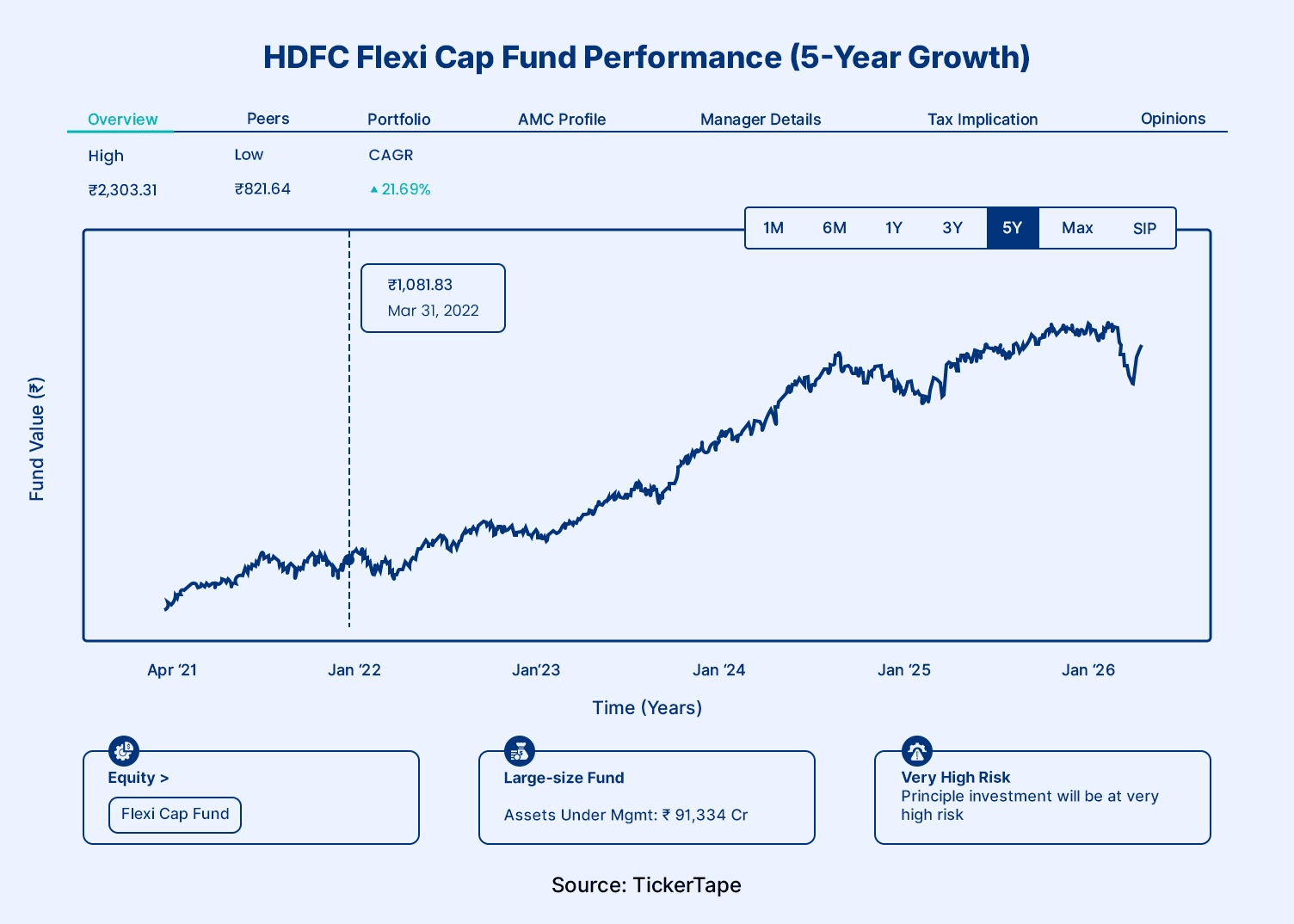
HDFC Flexi Cap Fund Performance (5-Year Growth)
1. Equity Funds
Among HDFC equity funds, HDFC Mid Cap Opportunities Fund (Direct) shows strong risk adjusted metrics:
- 1 year return: ~4.88%
- 3 year CAGR: ~12.66%
- 5 year CAGR: ~11.95%
This makes it one of the top performing mid cap equity funds in India over the last 5 years, though mid caps are inherently more volatile than large cap funds.4
The HDFC Flexi Cap Fund (Direct) blends large cap stability with mid cap and small cap growth:
- 1 year return: ~4.32%
- Over the past 5 years, the direct plan has delivered an annualised return of ~20.72%, making it a strong core equity holding for long term investors.
For tax conscious investors, HDFC ELSS Tax Saver Fund (Direct) offers:
- 1 year: ~5.6%
- 3 year: ~18.9%
- 5 year: ~19.3%
- Since inception, it has delivered an average annual return of about 22.5%, placing it among the higher performing ELSS schemes.5
2. Hybrid Funds
HDFC Balanced Advantage Fund (Direct) is one of India’s largest hybrid funds by AUM and dynamically shifts equity debt allocation based on valuation triggers.
- 1 year return: ~5.3%
- 3 year annualized return: ~11.8% (approx., based on trailing 3 year data)
- Till date annualized return: ~14.7% (as per recent data providers).
This dynamic asset allocation approach makes it attractive for moderate risk investors who are looking for equity like growth with lower volatility than pure equity funds.
3. Debt Funds
For capital preservation and stable income, HDFC Short Term Debt Fund (Direct) is a popular choice:
- 1 year return: ~6.0%
- 3 year annualized return: ~7.7%
- 5 year annualized return: ~6.7%6
These figures are broadly in line with the 6.5-7.5% CAGR range you mention for stable debt funds, confirming its role as a low volatility portfolio stabilizer.
Factors Affecting HDFC Fund Returns
1. Market Cycles
Equity fund returns are directly linked to Sensex and Nifty movements. During bull markets (like 2020-2021 and 2023-2024), HDFC equity funds delivered exceptional returns. In bear phases, returns moderate or even turn negative temporarily. Debt funds are affected by interest rate cycles when the RBI cuts rates, existing bond prices rise, boosting debt fund NAVs 7
2. Fund Management Strategy
HDFC AMC's fund managers like Prashant Jain (though recently succeeded) built a legacy of value-oriented investing buying undervalued businesses and staying patient.
The current management continues this philosophy, which tends to underperform in momentum-driven rallies but outperform over full market cycles.
3. Expense Ratio
A regular plan of the HDFC Flexi Cap Fund might carry an expense ratio of ~1.6%, while the direct plan comes in at ~0.7%. That difference of ~0.9% compounded over 10 years can translate into a meaningful return gap. Always compare direct vs regular plan returns before investing.8
4. Investment Horizon
Hypothetical Example: Priya invests INR 10,000/month via SIP in HDFC Mid-Cap Opportunities Fund. Over 10 years at a hypothetical CAGR of 18%, her corpus grows to approximately INR 37.3 lakh against a total investment of INR 12 lakh illustrating the power of compounding with a longer horizon.
Risks Of Investing In HDFC Mutual Funds
No investment is without risk. Here's what investors must keep in mind:
1. Market Risk: Equity funds are subject to market volatility. A 20-30% drawdown is not uncommon during corrections.
2. Concentration Risk: Sector funds like HDFC Infrastructure Fund can underperform for extended periods if the underlying sector faces headwinds.
3. Interest Rate Risk: Debt funds with longer durations can see NAV dips if interest rates rise unexpectedly.9
4. Liquidity Risk: Close-ended funds and ELSS schemes (3-year lock-in) restrict premature withdrawals.
5. Inflation Risk: Debt fund returns post-tax may barely beat inflation in high-inflation environments.
The key is not to avoid these risks but to understand them and invest in schemes aligned with your risk tolerance and time horizon.
Should You Invest In HDFC Mutual Funds?
HDFC mutual funds are well-suited for:
1. Long-term retail investors seeking wealth creation through SIPs in equity or flexi-cap funds
2. Tax-savvy individuals looking for ELSS funds with Section 80C benefits
3. Conservative investors who prefer hybrid or debt funds for moderate returns with lower risk
4. First-time investors who want the backing of a reputed, SEBI-registered AMC with a long track record
Conclusion
HDFC mutual funds work best as the equity or hybrid engine of your portfolio providing growth potential over 5-10+ years. Moreover, for truly balanced portfolios, growth assets like equity mutual funds should be complemented with stable, income-generating instruments.
This is where platforms like Grip Invest come in. By investing in fixed-income instruments such as bonds, leasing, and other structured products available on Grip Invest, you can earn predictable returns that stabilise your portfolio even when equity markets are choppy.
Combining the growth potential of HDFC mutual funds with the stability of Grip's fixed-income offerings is a textbook approach to smart diversification.
FAQs On HDFC Mutual Fund Returns
 |
Author: Grip Invest Editorial Team The Grip Invest Editorial Team is a group of Chartered Accountants, MBA (Finance) graduates, and Qualified Research Analysts dedicated to helping you invest smarter. We dive deep into India's fixed income landscape to deliver content that is accurate, up-to-date, and easy to understand. Whether you're exploring bonds, fixed deposits, or other fixed income opportunities, our guides cut through the noise and give you the clarity to make better financial decisions. |
Want to stay at the top of your finances?
Join the community of 4 lakh+ investors and learn more about Grip Invest, the latest financial knick-knacks, and shenanigans in the world of investing.
Happy Investing!
Disclaimer - Investments in debt securities/municipal debt securities/securitised debt instruments are subject to risks including delay and/ or default in payment. Read all the offer related documents carefully. The investor is requested to take into consideration all the risk factors before the commencement of trading.
This communication is prepared by Grip Broking Private Limited (bearing SEBI Registration No. INZ000312836 and NSE ID 90319) and/or its affiliate/ group company(ies) (together referred to as “Grip”) and the contents of this disclaimer are applicable to this document and any and all written or oral communication(s) made by Grip or its directors, employees, associates, representatives and agents. This communication does not constitute advice relating to investing or otherwise dealing in securities and is not an offer or solicitation for the purchase or sale of any securities. Grip does not guarantee or assure any return on investments and accepts no liability for consequences of any actions taken based on the information provided. For more details, please visit www.gripinvest.in
Registered Address - 106, II F, New Asiatic Building, H Block, Connaught Place, New Delhi 110001


