

IDFC First Bank INR 590 Crore Fraud Impact: Stock Reaction, Risks And Investor Takeaways


In one of the recent disclosures regarding the IDFC First Bank Fraud, it was reported to regulators that there was a INR 590 crore mismatch in the balances of the Haryana government's account maintained at the Chandigarh branch.
The update triggered widespread selling of IDFC shares on the stock exchanges, as the scrip plummeted by 20% on Monday and continued to fall until Wednesday (February 25, 2026).
Any fraud involving banks or financial institutions not only hampers the goodwill and financial performance of the involved institutions but also raises serious questions about investor trust, governance perceptions, and valuation multiples. The fact that the amount of fraud exceeds the bank's reported quarterly earnings (INR 503 crore) is concerning to investors, who are concerned about the exact quantum of the fraud and its implications for the bank’s valuation, share price, and profitability. There are, of course, concerns related to governance, internal controls, and possible future financial impact.
In addition, investors might want to know whether the damage is already done (the impact has been absorbed by the market) or whether it could affect the long-term investment case for IDFC First Bank.
Let us understand what really happened, the market reaction, and how investors could navigate similar challenges in the future.
What Happened In The IDFC First Bank Fraud Case?
The fraud relates to the Chandigarh branch of IDFC Bank and accounts maintained by the Haryana Government. During a routine reconciliation, government officials found a significant mismatch between the bank balances and those maintained by the government. It was reported that employees and external parties allegedly carried out unauthorised transactions and misappropriated funds. There were suspicious transactions involving 170 accounts and hundreds of irregular entries.
The bank reported the matter to the regulators (including the Central Bank) and lodged a formal police complaint. The management underlined that the issue occurred due to certain employees colluding with external parties and is confined to the Chandigarh branch. The top management also asserted that the bank's internal controls and systems are operating in accordance with accepted standards.
The Haryana government has removed IDFC Bank from its list of empanelled banks and has moved its accounts to another financial institution. Haryana government’s total deposits of INR 1450 crore were approximately 0.5% of the bank’s total deposits. The Chief Minister of the state has shared a critical update that INR 556 crore has already recovered by the government.
How The Market Reacted
The IDFC First Bank share price reaction was swift and severe. The stock fell as much as 20 per cent in a single trading session following the disclosure, hitting lower circuit levels and marking one of its steepest declines in recent years. Here is how the stock has fared in the past five days (the fraud was reported on Monday). The IDFC First Bank stock analysis is as follows:
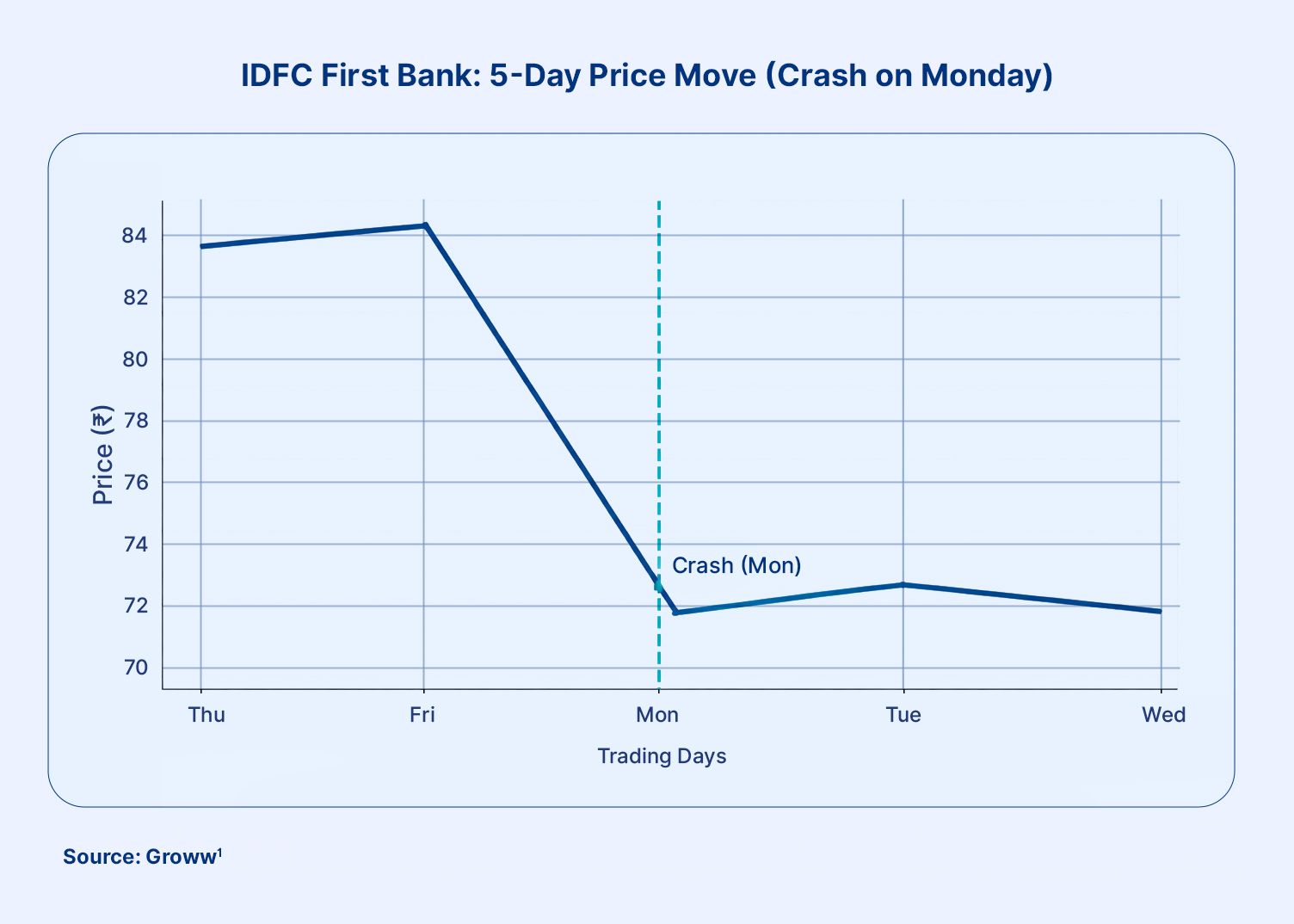
The stock’s intraday volatility increased significantly, and it approached key technical support levels as traders reacted to negative sentiment. The trend has continued through Wednesday, with almost 70% of open trades for sale.
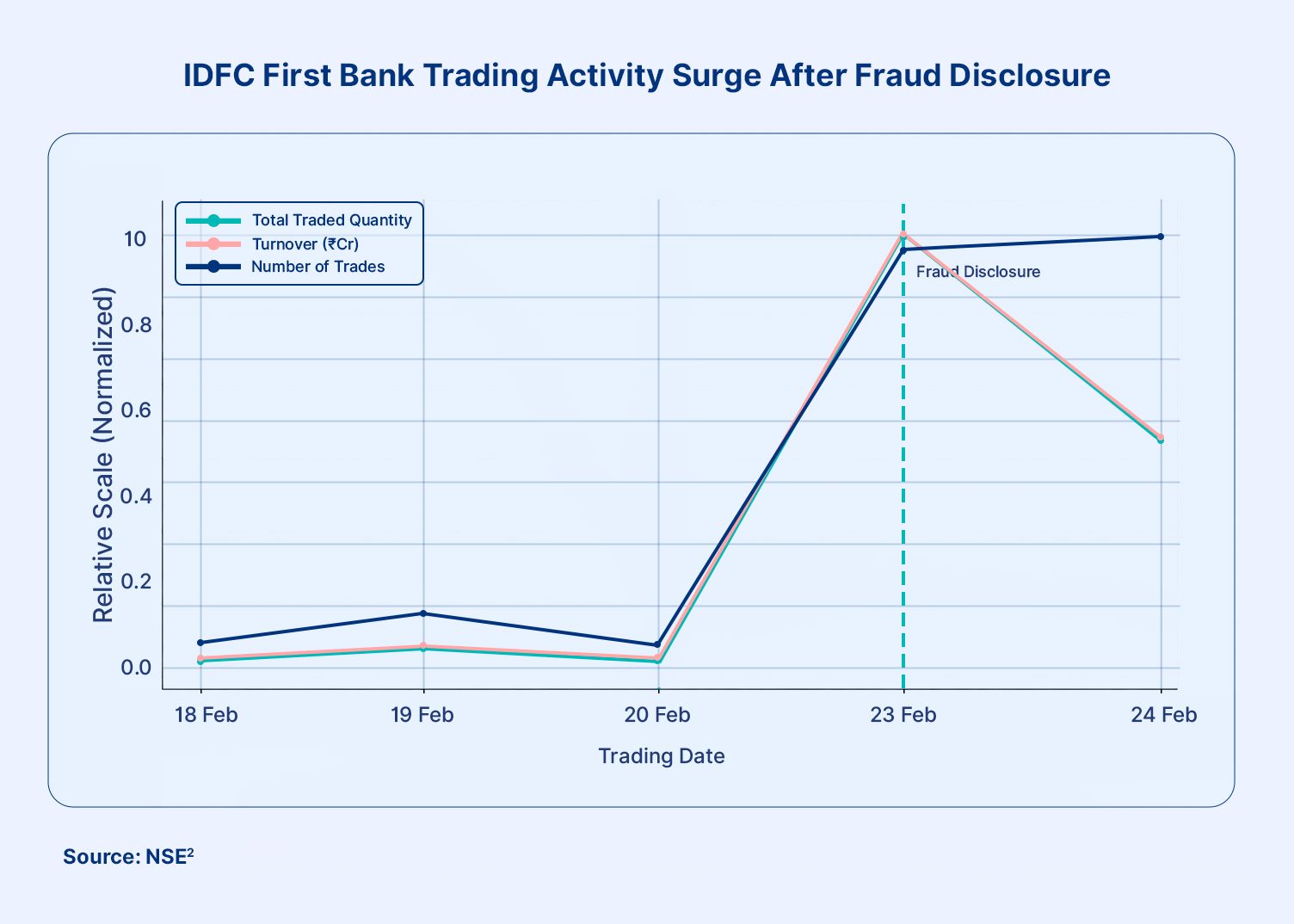
Volume Spike Analysis
There was a critical increase in the three components: quantity, number of trades, and total turnover in the past five days. Trading volumes surged substantially during the sell-off as a response to the INR 590 crore fraud impact, indicating strong participation from institutional investors and traders. High volumes during price declines typically signal rapid repricing and repositioning rather than gradual valuation adjustments.
Short Term Vs Medium Term Investor Sentiment
There was an obvious panic among short-term investors and traders, who went on a selling spree after the disclosure was made public. This is a common phenomenon in which a stock price is affected by fear and uncertainty. However, medium-term sentiment depends more on whether the fraud remains an isolated operational issue or reveals deeper governance weaknesses. The stock has stabilised a bit after the drastic fall on Monday, as the market might have factored in a major part of the expected financial impact.
Is It Material Enough To Change The Long-Term Story?
- Loan Book Size Context: As per the Q3 FY26 financial reports of IDFC First Bank, the total loan book (loans and advances) is approximately INR 2.79 lakh crore. Compared to the loan book size, the amount of fraud is not too material to change the long-term story.
- Historical Fraud Comparisons in Indian Banking: Some of the major banks, including ICICI Bank, and, more recently, RBL Bank (INR 1550 crore) and IndusInd Bank (INR 2000 crore), have disclosed accounting discrepancies and fraud that allegedly involved bank officials. Even though banks and financial institutions maintain the highest regulatory and compliance standards, such incidents are not uncommon. Historically, banking stock fraud India has not affected the long-term prospects of the financial institutions.
- Management Credibility Factor: The management of IDFC Bank was swift in cooperating with the regulators, suspending employees allegedly involved in the case, and ordering a forensic audit of the entire matter, showcasing its seriousness and commitment to the highest governance standards.
- One-Time Event vs Systemic Weakness: The management has reasserted that the incident was a one-time event confined to a single branch, as the bank's systems are robust and no similar instance has occurred in the past.
Key Risks Investors Should Watch
1. Governance Concerns
Fraud involving internal employees raises concerns about internal controls, monitoring mechanisms, and supervisory effectiveness. Even isolated incidents can affect investor perception and valuation.
2. Credit Monitoring Systems
While this fraud was operational rather than credit-related, it highlights the importance of robust monitoring systems. Banks must ensure strong checks and balances to prevent similar incidents.
3. Possible Regulatory Scrutiny
Regulators may conduct independent reviews to ensure compliance with and maintenance of governance standards. Increased scrutiny can affect operational flexibility in the short term.
4. Future Provisioning Risks
The Haryana government has already delisted IDFC First Bank from its list of empanelled financial institutions. This can be a major setback for the bank, as a significant portion of its total deposits (around INR 1450 crores) is linked to the Haryana government accounts.
What Should Investors Do?
1. For Short-Term Investors
Short-term investors should expect continued volatility as markets react to updates from forensic audits, regulatory developments, and management disclosures. Sentiment-driven movements may dominate price action in the near term.
2. For Long-Term Investors
Long-term investors should focus on fundamentals rather than short-term price movements. The key question remains whether fraud has been priced in fully or if further sentiment-driven corrections are possible. The next couple of weeks will be critical for evaluating whether the market has fully absorbed the impact. In addition, if the bank demonstrates strong governance improvements and stable financial performance, the long-term impact may remain limited.
3. Importance of Portfolio Diversification
The entire case reiterates the importance of portfolio diversification across asset classes. Having an equity-only portfolio or investing heavily in a single sector can be extremely risky. To ensure that your portfolio achieves its long-term goals, consider investing in high-yield corporate bonds through platforms like Grip that help reduce concentration risk and ensure consistent returns.
Conclusion
Here is the thing: markets react first to uncertainty, then to numbers. The INR 590 crore fraud triggered panic selling, but the long-term impact will depend less on the headline amount and more on governance follow-through, regulatory outcomes, and business stability.
For investors, this episode is a reminder that even fundamentally strong institutions can face sudden shocks. That is exactly why diversification matters. Instead of concentrating risk in a single stock or sector, investors can balance equity exposure with fixed-income instruments such as high-yield corporate bonds. Platforms like Grip Invest make it easier to access curated bond opportunities, helping investors build a more stable and risk-aware portfolio alongside their equity investments.
FAQs
1. What is the INR 590 crore fraud in IDFC First Bank about?
The fraud relates to a mismatch in Haryana government account balances at the bank’s Chandigarh branch. It allegedly involved unauthorised transactions across multiple accounts, with employees and external parties suspected of collusion.
2. How did the IDFC First Bank share price react to the fraud disclosure?
The stock fell nearly 20% in a single trading session after the disclosure and saw a sharp spike in trading volumes. The intense selling suggests rapid repricing by institutional and short-term investors.
3. Is the INR 590 crore fraud financially material for the bank?
When compared to the bank’s total loan book of around INR 2.79 lakh crore, the fraud amount is relatively small in percentage terms. However, governance perception and trust factors can have a larger short-term impact than the financial hit itself.
4. Has the fraud already been priced into the stock?
A significant part of the immediate financial impact may have been priced in during the sharp correction. That said, further movement will depend on forensic audit findings, regulatory scrutiny, and management’s ability to reinforce governance confidence.
References:
1. Groww, accessed from:
https://groww.in/stocks/idfc-bank-ltd
2. NSE, accessed from: https://www.nseindia.com/report-detail/eq_security
Want to stay at the top of your finances?
Join the community of 4 lakh+ investors and learn more about Grip Invest, the latest financial knick-knacks, and shenanigans in the world of investing.
Happy Investing!
Disclaimer - Investments in debt securities/municipal debt securities/securitised debt instruments are subject to risks including delay and/ or default in payment. Read all the offer related documents carefully. The investor is requested to take into consideration all the risk factors before the commencement of trading.
This communication is prepared by Grip Broking Private Limited (bearing SEBI Registration No. INZ000312836 and NSE ID 90319) and/or its affiliate/ group company(ies) (together referred to as “Grip”) and the contents of this disclaimer are applicable to this document and any and all written or oral communication(s) made by Grip or its directors, employees, associates, representatives and agents. This communication does not constitute advice relating to investing or otherwise dealing in securities and is not an offer or solicitation for the purchase or sale of any securities. Grip does not guarantee or assure any return on investments and accepts no liability for consequences of any actions taken based on the information provided. For more details, please visit www.gripinvest.in
Registered Address - 106, II F, New Asiatic Building, H Block, Connaught Place, New Delhi 110001


