

Income Tax Return Delay: What Happens If You Miss the ITR Due Date?


An income tax return delay does not always mean that the return cannot be filed. However, it can change the cost, timeline and flexibility available to the taxpayer. AY 2026-27 relates to income earned in FY 2025-26.1 For this year, taxpayers still need to file their returns as per the Income Tax Act, 1961, since the ITA-2025 applies from 1 April 2026.2
A delayed ITR filing starts when a taxpayer misses the applicable ITR due date under Section-139(1). 3
The chart below shows how these filing windows move from the original due date to the later correction and disclosure routes.
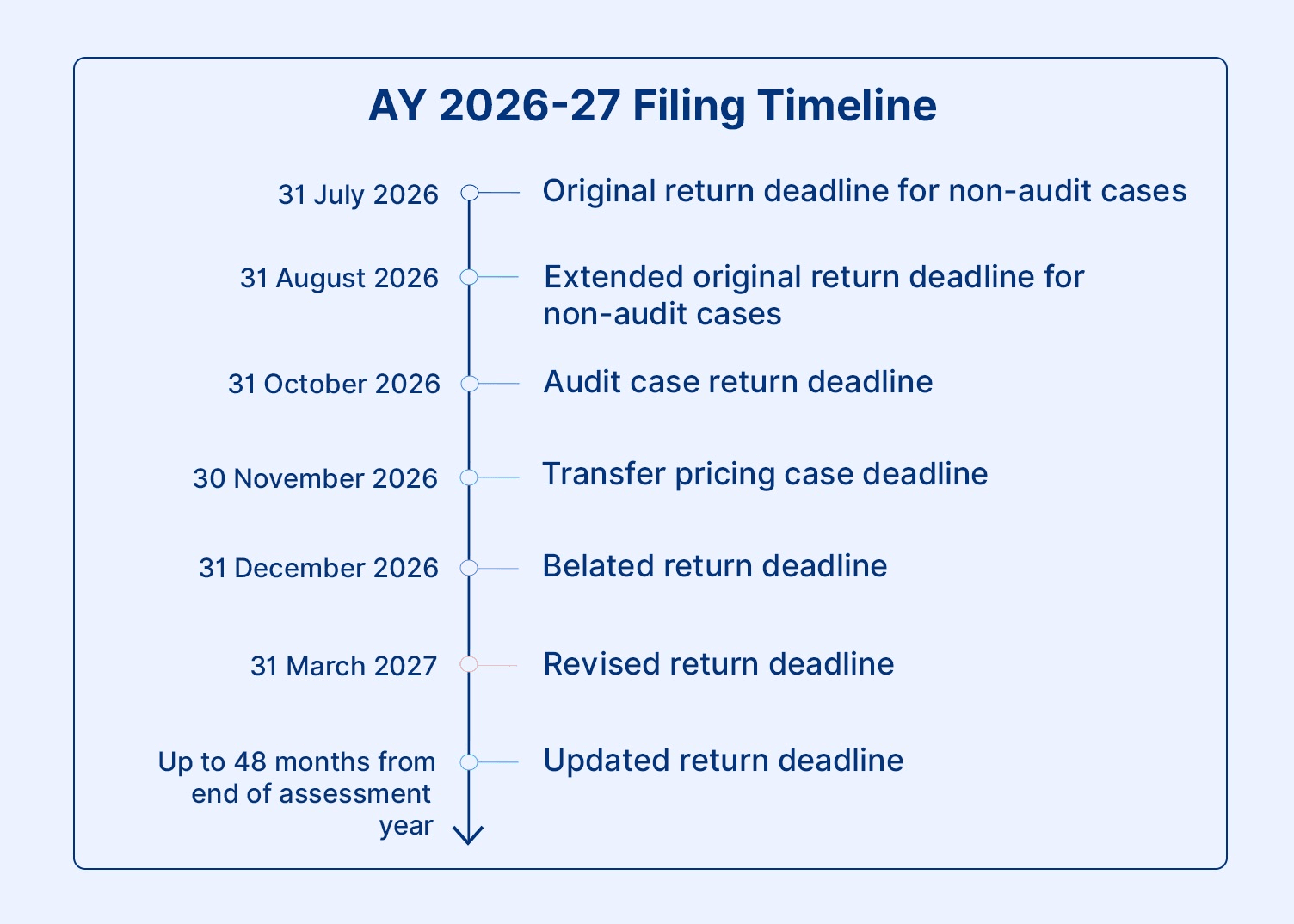
Every date in the timeline points to a specific filing route, with its own use and consequence. Like a belated return applies when the taxpayer has missed the original ITR due date and is filing later. While a revised return applies when a return has already been filed, but the taxpayer later finds an omission or error.
These filing routes help taxpayers stay compliant, but they do not remove the cost of delay. Once the original filing window is missed, there are different consequences in fees, interest, refund timelines and certain tax benefits may change.
Consequences Of Delayed ITR Filing
A late ITR filing can affect the taxpayer in four main ways. These include:
1. Late filing fee
A delay can trigger an income tax return penalty under Section 234F.4 Taxpayers with total income up to INR 5 lakh pay INR 1,000. If total income exceeds INR 5 lakh, the fee is INR 5,000.5 This fee does not apply where return filing itself is not mandatory.
2. Interest on unpaid tax
Interest may apply when tax remains unpaid after the due date. Section 234A charges 1% for every month,6 or part of a month, from the original filing deadline until the return is submitted. Even a short delay within a month can count as a full month for this calculation.
3. Loss of certain benefits
Late tax filing can also reduce flexibility. The Income Tax Department explains that filing a return of loss within the due date is necessary for carrying forward certain losses, including business loss and capital loss. This is relevant for taxpayers with equity, mutual fund, business or professional losses. House property loss has separate treatment, but many other loss claims become weak if the return is not filed on time.
4. Delayed refund processing
Refunds may also take longer. Filing late can delay processing, but refund failure can happen even after filing if bank details are not ready. The department lists reasons such as a non-prevalidated bank account, mismatch between the bank account name and PAN details, invalid IFSC, closed bank account and inoperative PAN.
The table below shows how the cost or consequence changes under different delayed filing situations:
Scenario | Likely consequence |
Income up to INR 5 lakh and return filed after due date | Section 234F fee capped at INR 1000 |
Income above INR 5 lakh and return filed after due date | INR 5000 payable as Section 234F fee |
Tax dues remain unpaid beyond the due date | Section 234A interest applies at 1% for each month or part month |
Return is filed but e-verification is delayed beyond 30 days | The filing date may be treated as the verification date, with possible late filing impact |
Return uploaded but never verified | Return is treated as invalid |
Refund claimed with invalid bank details | Refund may fail or get delayed |
Source: Income tax India,7,8,9,10
Can You Still File Your Income Tax Return?
Taxpayers still have options after the due date, but the right route depends on how late the return is and what needs to be corrected.
Belated return
For AY 26-27, it can be filed up to 31st December 2026, or before the assessment is completed, whichever is earlier. This is for taxpayers who missed the original due date but still want to report income, pay tax and claim any eligible refund.11
Revised return
If a taxpayer files the return and later notices a wrong bank account, missing interest income, incorrect deduction, capital gains error or TDS mismatch, the return can be revised. The correction window for AY 26-27 runs until 31 March 2027, subject to assessment status. However, if a revised return is filed after 31 December and up to 31 March, an additional fee under Section-234I applies. This fee is INR 1000 where total income is up to INR 5 lakh and INR 5000 where total income exceeds INR 5 lakh.12
Updated return
The third route is an updated return, also called ITR-U. This is mainly for taxpayers who need to report missed income or pay additional tax after the normal filing and revision windows have closed. From AY 26-27, taxpayers get up to 48 months from the end of the relevant assessment year to file an updated return.13
The cost of filing ITR-U increases as the delay gets longer. The additional tax is calculated on the aggregate tax and interest, and the rate depends on when the updated return is filed.
- Less than or equal to 12 months from the end of the assessment year: 25% additional tax applies.
- > 12 months and < 24 months: additional tax rises to 50%.
- > 24 months and < 36 months: additional tax increases to 60%.
- > 36 months and < 48 months: additional tax goes up to 70%.
So, an updated return gives taxpayers a longer correction window, but it becomes more expensive with time.14
ITR-U has clear limits. Taxpayers cannot use it to declare a loss, reduce their tax outgo or raise a refund claim. It is also blocked in certain search, survey, prosecution or pending proceeding situations. So, taxpayers should not treat ITR-U as a substitute for timely filing.
How To Avoid Delays In Future?
Avoiding an income tax return delay is mostly about preparation. A clear routine can reduce errors, mismatches and refund-related setbacks.
Step 1: Keep your documents ready
Start with the basic records before the filing season begins. This includes Form 16, Form 16A, bank interest certificates, rent receipts, home loan interest certificates, insurance proofs, investment proofs and tax payment challans.
Those who invest in equities or mutual funds should review capital gains reports early in the filing process. Broker statements should be checked against sale value, purchase cost and holding period before reporting gains.
Step 2: Check AIS and Form 26AS
AIS and Form 26AS help verify income details and available credits before submission. Form 26AS includes TDS, TCS, advance tax, self assessment tax, refunds, specified financial transactions and demand related information.
Compare salary TDS, interest income, capital gains, TCS and payments with personal documents. If any mismatch appears, get it corrected through the employer, bank, broker or deductor before submitting the return.
Step 3: Plan advance tax early
Advance tax is important for taxpayers with income beyond salary. This may include rental income, large interest income, capital gains, business income or freelance income.
Waiting until the return filing date can increase interest exposure. Paying tax during the year helps reduce last-minute pressure and avoids extra cost where advance tax applies.
Step 4: Maintain a tax folder for each year
Keep one folder for every financial year. It should include bank statements, demat reports, tax challans, deduction proofs, refund records and loan-related documents.
For AY 2026-27, this is more important because taxpayers need to separate FY 2025-26 income from Tax Year 2026-27 records during the transition to the new tax law framework.
Step 5: Complete final checks before submission
Before submitting the return, confirm the correct tax regime, check bank account prevalidation and review all tax credits.
After submission, complete e-verification within 30 days. This step is important because an unverified return can become invalid, even if the taxpayer has uploaded it on time.
Income Tax Filing And Smart Financial Planning
A return filed on time gives taxpayers a clearer view of their money position. It shows whether a refund is due, whether any liability remains and how much cash flow is available after dues are settled. That clarity can support better decisions through the year.
Tax planning and investment planning often move together. When returns are filed without delay, taxpayers can assess advance tax needs, review capital gains and avoid liquidity pressure near the deadline. It also reduces errors such as missing interest income, selecting the wrong ITR form or overlooking a TDS mismatch.
A timely return also helps investors keep their financial records clean for loan applications, visa documentation, business funding or future investment reviews. The benefit is not limited to avoiding an income tax return penalty. It creates a cleaner record of income, tax paid, refunds and assets.
Alongside tax compliance, investors may also review portfolio diversification. Fixed income investments such as corporate bonds through Grip Invest can help add predictable cash flow opportunities to a broader wealth plan. Orderly filing supports compliance, while disciplined investing keeps long term goals on track. Sign up to Grip Invest today!
FAQs On Income Tax Return Delay
 |
Author: Grip Invest Editorial Team The Grip Invest Editorial Team is a group of Chartered Accountants, MBA (Finance) graduates, and Qualified Research Analysts dedicated to helping you invest smarter. We dive deep into India's fixed income landscape to deliver content that is accurate, up-to-date, and easy to understand. Whether you're exploring bonds, fixed deposits, or other fixed income opportunities, our guides cut through the noise and give you the clarity to make better financial decisions. |
Want to stay at the top of your finances?
Join the community of 4 lakh+ investors and learn more about Grip Invest, the latest financial knick-knacks, and shenanigans in the world of investing.
Happy Investing!
Disclaimer - Investments in debt securities/municipal debt securities/securitised debt instruments are subject to risks including delay and/ or default in payment. Read all the offer related documents carefully. The investor is requested to take into consideration all the risk factors before the commencement of trading.
This communication is prepared by Grip Broking Private Limited (bearing SEBI Registration No. INZ000312836 and NSE ID 90319) and/or its affiliate/ group company(ies) (together referred to as “Grip”) and the contents of this disclaimer are applicable to this document and any and all written or oral communication(s) made by Grip or its directors, employees, associates, representatives and agents. This communication does not constitute advice relating to investing or otherwise dealing in securities and is not an offer or solicitation for the purchase or sale of any securities. Grip does not guarantee or assure any return on investments and accepts no liability for consequences of any actions taken based on the information provided. For more details, please visit www.gripinvest.in
Registered Address - 106, II F, New Asiatic Building, H Block, Connaught Place, New Delhi 110001


