

From INR 3 In 1947 To INR 90 In 2026: Tracing The Journey Of Indian Rupee Vs The US Dollar


The year 2026 saw the Indian currency Rupee suffer a 5% fall against the US Dollar.
Amidst the geopolitical tensions and tariff wars, Rupee had started the year at 85.7, and then went on to drop to 89.9 by the end of 2026.
But do you know how the journey of Rupee has been since independence? From standing at Rs 3 mark vs the US Dollar in 1947 to crossing the Rs 90 mark in 2026, let’s bring to you the history of Rupee vs US Dollar over the decades1,2:
From INR 3 To INR 90: Tracing The Journey Of Rupee Vs Dollar
Back in 1947, the Indian currency was at just Rs 3 mark vs the US Dollar. And over the years, it has depreciated to the 90 mark in 20263.
Here’s how the Indian currency has moved against the US Dollar over the decades:
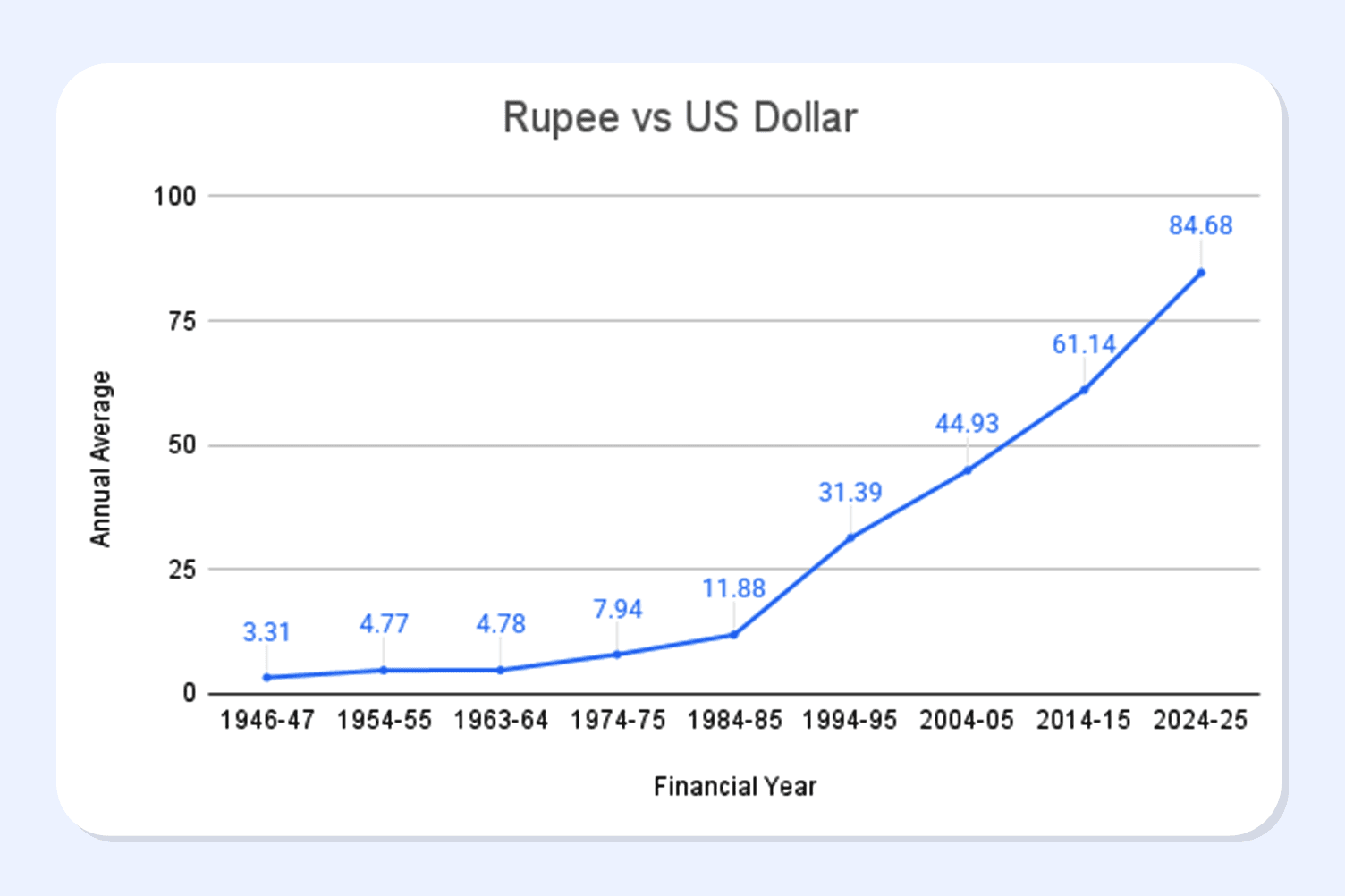
2026: The Rupee Hits Its Worst-Ever Level: A Historic Low
In early 2026, the Indian rupee scripted a painful new chapter in its history. After closing 2025 at INR 89.87, its steepest annual fall in three years, the rupee continued its slide through Q1 2026, breaching the psychologically significant INR 92 mark on January 28, 2026.
By March 30, 2026, it had collapsed further past INR 95, logging the worst fiscal year drop for the rupee in over a decade.
On May 3, 2026, the rupee closed at an all-time low of INR 95.23 against the US dollar, with intraday levels touching INR 95.63, a level never seen before in the currency's post-independence history.
What caused this historic fall? Several factors came together. Foreign investors pulled out nearly $18 billion from Indian equities in 2025. Crude oil prices also rose sharply. At the same time, US tariffs hurt Indian exports. The RBI, under Governor Sanjay Malhotra, also changed its approach. Instead of strongly defending the rupee, the RBI allowed the currency to move more freely. Its focus was on controlling volatility, not stopping the fall completely.
This marks a shift in India’s currency story. For many years, the rupee weakened slowly and in a controlled manner. But the 2026 low shows that global shocks, foreign investor moves, and trade uncertainty can now push the rupee down much faster than before.
Key Factors That Affect The Currency Exchange Rates
Now let’s dive into some of the key factors that influence these Dollar vs Rupee exchange rates4:
1. Inflation:
The inflation rates of respective countries, which in this case are India and USA, exert a significant influence on the currency exchange rate. Generally, countries who have a high growth and low inflation rate tend to record appreciation in their currency’s value. On the other hand, a country with higher inflation tends to typically experience depreciation in its currency, especially against an economically stronger country’s currency.
This is because a higher relative inflation of a country implies lower purchasing power for its currency, which in turn translates into a weaker currency.
2. Interest Rate:
Besides inflation, the interest rates in a country act as an indicator of the return on its capital. A higher inflation-adjusted interest rate would attract more foreign capital in a country, which would go on to strengthen its domestic currency and improve the exchange rate.
On the other hand, lower inflation-adjusted interest rates can cause outflow of foreign capital , and hence lead to depreciation of the country’s currency. This way, the country’s relative interest rate affects its foreign exchange rates.
3. Current Account and Trade Terms:
A country’s current account records the trade transactions with all of its trading partners in goods and services. If a country is importing more than its exports, there would likely be a deficit in the current account. This would imply that the demand for foreign currency is more than the country’s supply, hence leading to the domestic currency to depreciate. On the other hand, having a surplus in the trade account can put a country’s currency into a stronger position.
4. Govt’s Public Debt:
Another key factor that influences currency exchange rate is the public debt. This constitutes government borrowings for financing public sector projects. Given that such borrowings are under the government’s guarantee, a default on such loans would damage the country’s economic position and investor confidence. An unsustainable public debt can also lead to net foreign capital outflow and hence, depreciation of the domestic currency.
5. Country’s Political Stability:
Besides all these economic factors, a country’s political stability is another aspect that impacts the currency exchange rate. Usually, foreign investors prefer a country which has a stable and progressive political regime as this builds investor confidence. This consequently leads to more inflow of foreign capital, hence helping the domestic currency to appreciate.
Conclusion
When Rupee hit its all time low mark of 92 vs the US Dollar in January 2026, it grabbed the headlines. But seldom do we understand the reasons behind all that. Key factors that influence currency exchange rates, including those of Rupee vs Dollar, include inflation, interest rates, current account balance, public debt, and political stability. That is why it is important for a country to do well on all such parameters to keep their currency in a strong position.
FAQs
1. Is volatility the same as risk in investing?
No. Volatility refers to how much prices move up and down in the short term, while risk is the chance of permanently losing your invested capital.
2. Can a highly volatile investment still be low risk?
Yes. Assets like equity mutual funds can be volatile in the short run but may carry lower long-term risk if backed by strong fundamentals.
3. Why do investors confuse volatility with risk?
Because short-term price falls feel like losses, even when the underlying investment quality remains unchanged.
4. How can investors manage risk during volatile markets?
By diversifying across assets, aligning investments with time horizon, and avoiding emotional decisions based on short-term market movements.
References:
1. RBI, accessed from: https://www.rbi.org.in/commonman/english/scripts/FAQs.aspx?Id=1877
2. RBI, accessed from: https://www.rbi.org.in/scripts/referenceratearchive.aspx
3. RBI, accessed from: https://dbieold.rbi.org.in/DBIE/dbie.rbi?site=publications#!2
4. Bookmyforex, accessed from: https://www.bookmyforex.com/blog/top-5-factors-influence-foreign-exchange-rates/
Want to stay at the top of your finances?
Join the community of 4 lakh+ investors and learn more about Grip Invest, the latest financial knick-knacks, and shenanigans in the world of investing.
Happy Investing!
Disclaimer - Investments in debt securities/municipal debt securities/securitised debt instruments are subject to risks including delay and/ or default in payment. Read all the offer related documents carefully. The investor is requested to take into consideration all the risk factors before the commencement of trading.
This communication is prepared by Grip Broking Private Limited (bearing SEBI Registration No. INZ000312836 and NSE ID 90319) and/or its affiliate/ group company(ies) (together referred to as “Grip”) and the contents of this disclaimer are applicable to this document and any and all written or oral communication(s) made by Grip or its directors, employees, associates, representatives and agents. This communication does not constitute advice relating to investing or otherwise dealing in securities and is not an offer or solicitation for the purchase or sale of any securities. Grip does not guarantee or assure any return on investments and accepts no liability for consequences of any actions taken based on the information provided. For more details, please visit www.gripinvest.in
Registered Address - 106, II F, New Asiatic Building, H Block, Connaught Place, New Delhi 110001


