

India’s Wedding Economy Boom: Why The INR 130 Billion Industry Matters To Investors


Where do you think Indians spend most of their income (and wealth) in their lifetime? Besides food and groceries, the third largest expense of Indian households is on wedding celebrations. As per a report, the total size of the wedding market in India is approximately INR 10 lakh crores ($130 billion)1.
Indians spend on weddings during economic boom, recession, and even recession. The reason for such extravagant spending is that no other occasion combines emotion, tradition, and spending power the way weddings do.
Weddings include small family gatherings to large parties that can include celebrity guests and dance performances like award shows. It purely depends on the size of a family, as the budget for a marriage can be anywhere from a few lakh rupees to a hundred crore.
In recent years, the Indian wedding economy has expanded into a powerful consumption driver, touching everything from hospitality to jewellery and retail. If you are an investor, you must have a clear idea of how weddings have transformed from a family celebration to a vibrant economic sector. Let us find out the opportunities lined up for short and long-term investors here.
How Big Is India’s Wedding Market Today
It is absolutely massive. At a total Indian wedding industry size of $130 billion, India’s wedding market is not just about the sheer amount of money spent by households on marriage ceremonies. It is about the impact of a wedding function on multiple sectors. For instance, a wedding would generally include social media, website design, printing, textiles, jewellery, catering, restaurants, hotels, banquets, entertainment, transportation, and various other sub-sectors.
The busiest periods: typically November to February and again during April-May, create concentrated bursts of economic activity across cities and smaller towns alike. This cyclical, high-frequency demand pattern is a major reason analysts expect the wedding economy India to maintain strong growth momentum over the coming years.
As a centralised market, it is often witnessed that spending patterns of one region are adopted in other parts of the country. For instance, South Indian weddings did not use to have a ‘sangeet’ or ‘cocktail’ program earlier, which is now quite common.
Looking ahead, the wedding market India 2025 is projected to expand even further as demographics and rising incomes reshape spending behaviour. As mentioned earlier, weddings are celebrated even during economic downtimes and in a flourishing economic condition, the overall spending on marriages and wedding celebrations can only increase in the next decade.
Also Read: SEBI Eases Rules For Investment Advisers And Research Analysts
What Fuels This Boom: Social Trends + Rising Incomes
As explained above, weddings in India witness high spending even when the economic conditions are unfavourable. With rising incomes, wedding expenses are not just borne by parents or elders. Even the younger members of a family contribute in one way or the other, pushing the average spending per wedding higher in India.
1. Rising Average Spend Per Wedding
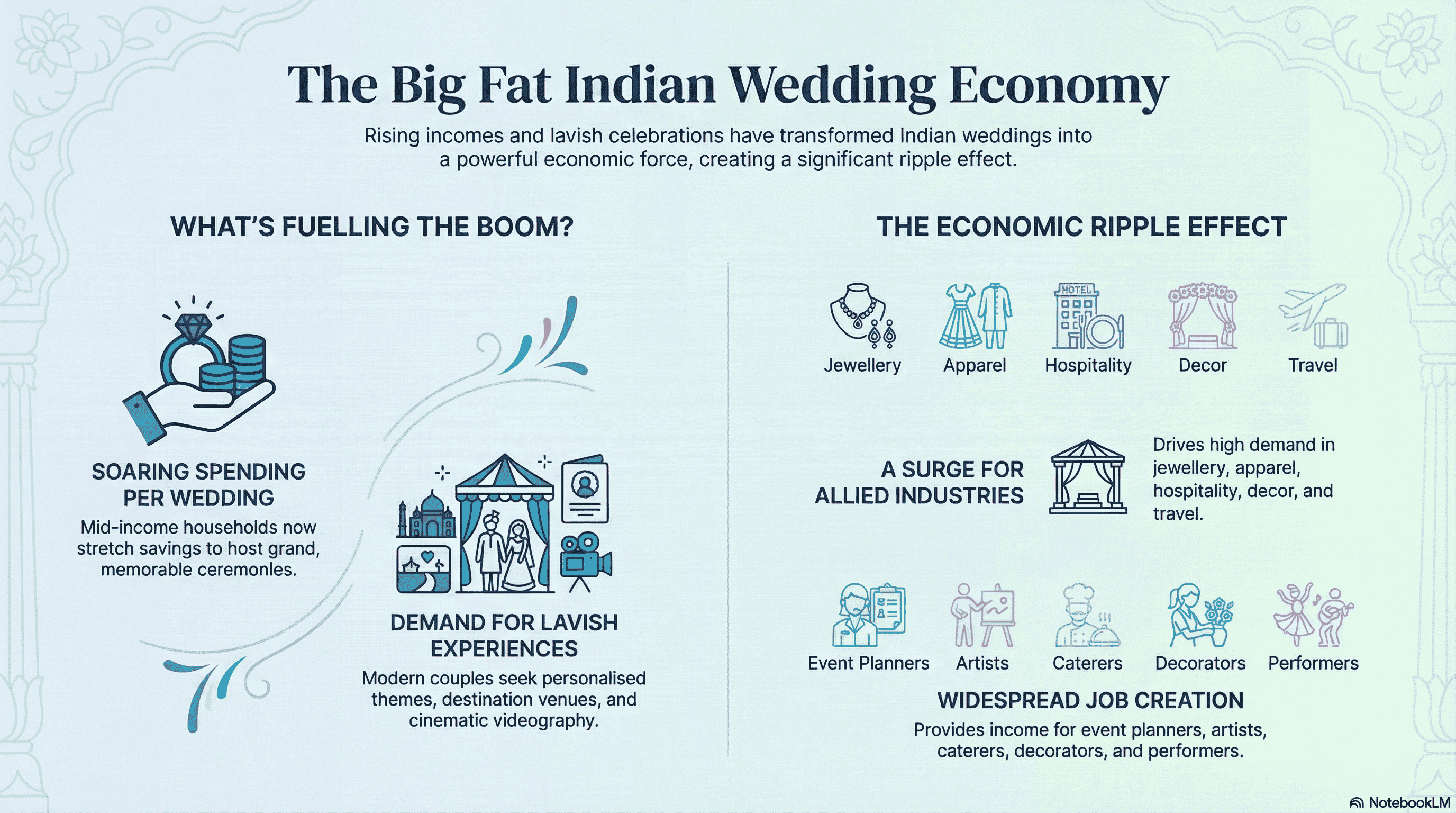
Recent wedding spending trends in India show that even mid-income households are willing to stretch savings or tap financing to host memorable ceremonies. This shift forms the backbone of what many now call the big fat Indian wedding, a term that reflects both cultural grandeur and economic heft. Families require more professional output in everything, and hence, even the middle and upper middle class spend extravagantly on venues, décor, designer apparel, hospitality, and photography.
2. Demand for Lavish, Experience-Driven Celebrations
With changing consumer preferences, weddings are no longer restricted to family get-togethers or inviting only near and dear ones. Modern couples need immersive and personalised experiences that include curated décor themes, cinematic videography, gourmet catering, and technology-enabled planning.
A major contributor to this trend is the rise of destination weddings in India, where families choose scenic domestic or international locations to host multi-day events. These weddings often involve larger guest management, longer stays, and expanded service requirements, significantly boosting revenue across hospitality and travel.
3. Weddings and Their Economic Ripple Effect
As mentioned before, a large wedding function will include services and inputs from a wide range of sub-sectors of an economy, thereby causing a ripple effect. Here is how weddings contribute heavily to the growth of allied sectors and assist in employment generation.
4. Impact on Allied Sectors
Weddings fuel a broad commercial ecosystem, driving demand across jewellery, apparel, décor, photography, and hospitality. Bridal shopping remains a major contributor to jewellery consumption India, while hotels and resorts benefit from peak-season bookings for multi-day celebrations.
Travel, logistics, gifting, and digital content production also see a strong uplift during wedding months. This surge supports the retail sector India growth/investment opportunities, as both organised and unorganised players experience high turnover across urban and semi-urban markets.
5. Employment Generation
Even though the wedding season remains seasonal, it provides employment opportunities to a wide range of people, starting from event planners, makeup artists, floral teams, decorators, caterers, and performers. With the expanding scope of wedding services India, people from transportation, hospitality, and other sectors gain consistent income from wedding events.
Also Read: SEBI’s New Proposal For REITs And InvITs: Why It Matters For Indian Investors
Investment Implications: What Investors Should Watch
Investors should track the wedding seasons, which might run up to 6-8 months during a financial year, and the relative impact on most related sectors such as jewellery, hospitality, transport, clothing, etc.
India’s wedding boom continues to shape multiple consumption-driven sectors, with rising consumer demand India weddings supporting strong performance across jewellery, apparel, hospitality, and travel. For investors, this trend aligns closely with broader themes such as investment in Indian consumption, where wedding-led spending remains a reliable growth driver.
Companies benefiting from the surge, particularly wedding-linked companies India, often reflect this momentum in quarterly results. Those tracking retail stocks India weddings, or exploring opportunities in hospitality investment India may find that wedding seasons consistently boost revenues, reinforcing the sector’s role as a stable, long-term demand engine within India’s consumption landscape.
Also Read: India’s Current Account Deficit: Causes, Impact And 2025 Outlook
Conclusion
India's wedding economy stands as a resilient INR 10 lakh crore powerhouse, fueling consumption across jewellery, retail, hospitality, and beyond while demonstrating remarkable stability through economic cycles. As rising incomes and evolving tastes drive wedding spending trends toward premium, experience-rich celebrations, especially destination weddings—this sector promises sustained growth into 2025 and beyond, creating compelling opportunities for investors in consumption-themed stocks and funds.
For balanced portfolio growth amid this boom, complement wedding-linked equities with stable fixed-income options. Log in to Grip Invest today to explore curated bonds yielding up to 14% and secure your financial future beyond the festivities!
FAQs On India’s Wedding Economy Boom
1. What is the average cost of weddings in India now?
Depending on location and scale, average wedding costs range from INR 10–25 lakh for middle-income families and can exceed INR 50 lakh in metros. Premium and destination weddings often run into several crores.
2. Which sectors benefit most from wedding spending in India?
Jewellery, apparel, hospitality, travel, décor, photography, catering, event management, gifting, and beauty services see the highest demand during the wedding season.
3. Is the Indian wedding market driven only by the affluent?
No. The market is powered by broad-based participation across income groups. While luxury weddings stand out visually, most of the economic activity comes from middle-income households who prioritise wedding spending regardless of economic conditions.
4. Do weddings really impact listed companies’ earnings?
Yes. Many listed jewellery retailers, apparel brands, hotel chains, and travel companies see a noticeable rise in revenues and footfalls during peak wedding seasons. This seasonal boost often reflects in quarterly results, especially for consumption-focused businesses.
5. Can investors gain exposure to the wedding economy without picking individual stocks?
Yes. Investors can participate indirectly through consumption-themed mutual funds, retail-focused ETFs, and hospitality-linked funds. These instruments capture wedding-driven demand as part of India’s broader middle-class consumption and lifestyle growth story.
References
1. The Hindi, accessed from: https://www.thehindu.com/business/Industry/big-fat-indian-wedding-at-10-lakh-crore-expenses-second-only-to-food-grocery/article68351491.ece
Want to stay at the top of your finances?
Join the community of 4 lakh+ investors and learn more about Grip Invest, the latest financial knick-knacks, and shenanigans in the world of investing.
Happy Investing!
Disclaimer - Investments in debt securities/municipal debt securities/securitised debt instruments are subject to risks including delay and/ or default in payment. Read all the offer related documents carefully. The investor is requested to take into consideration all the risk factors before the commencement of trading.
This communication is prepared by Grip Broking Private Limited (bearing SEBI Registration No. INZ000312836 and NSE ID 90319) and/or its affiliate/ group company(ies) (together referred to as “Grip”) and the contents of this disclaimer are applicable to this document and any and all written or oral communication(s) made by Grip or its directors, employees, associates, representatives and agents. This communication does not constitute advice relating to investing or otherwise dealing in securities and is not an offer or solicitation for the purchase or sale of any securities. Grip does not guarantee or assure any return on investments and accepts no liability for consequences of any actions taken based on the information provided. For more details, please visit www.gripinvest.in
Registered Address - 106, II F, New Asiatic Building, H Block, Connaught Place, New Delhi 110001


