

Infrastructure Financing In India: How Roads, Power, And Ports Are Funded


India has set high milestones for future growth. The country is gearing up to reach an economic size of USD 30 trillion by 20471. Subsequently, a continued rise in the domestic infrastructure prowess is key to accomplishing these milestones. Infrastructure fuels economic growth, and studies show how a 1% rise in the infrastructure stockpile contributes to a 1% increase in GDP2.
However, infrastructure development requires heavy capital investment. In a developing country like India, this can amount to significant budget allocations. Latest reports highlighted an infrastructure financing gap of over 5%. Therefore, understanding infrastructure growth is incomplete without exploring the infrastructure financing in India3.
Therefore, this blog breaks down Infrastructure Funding India.
What Is Infrastructure Financing in India?
Specialised funding of large-scale infrastructure projects through public funding, private funding or both is called infrastructure financing. Infrastructure projects in India receive funding from both public and private sources.
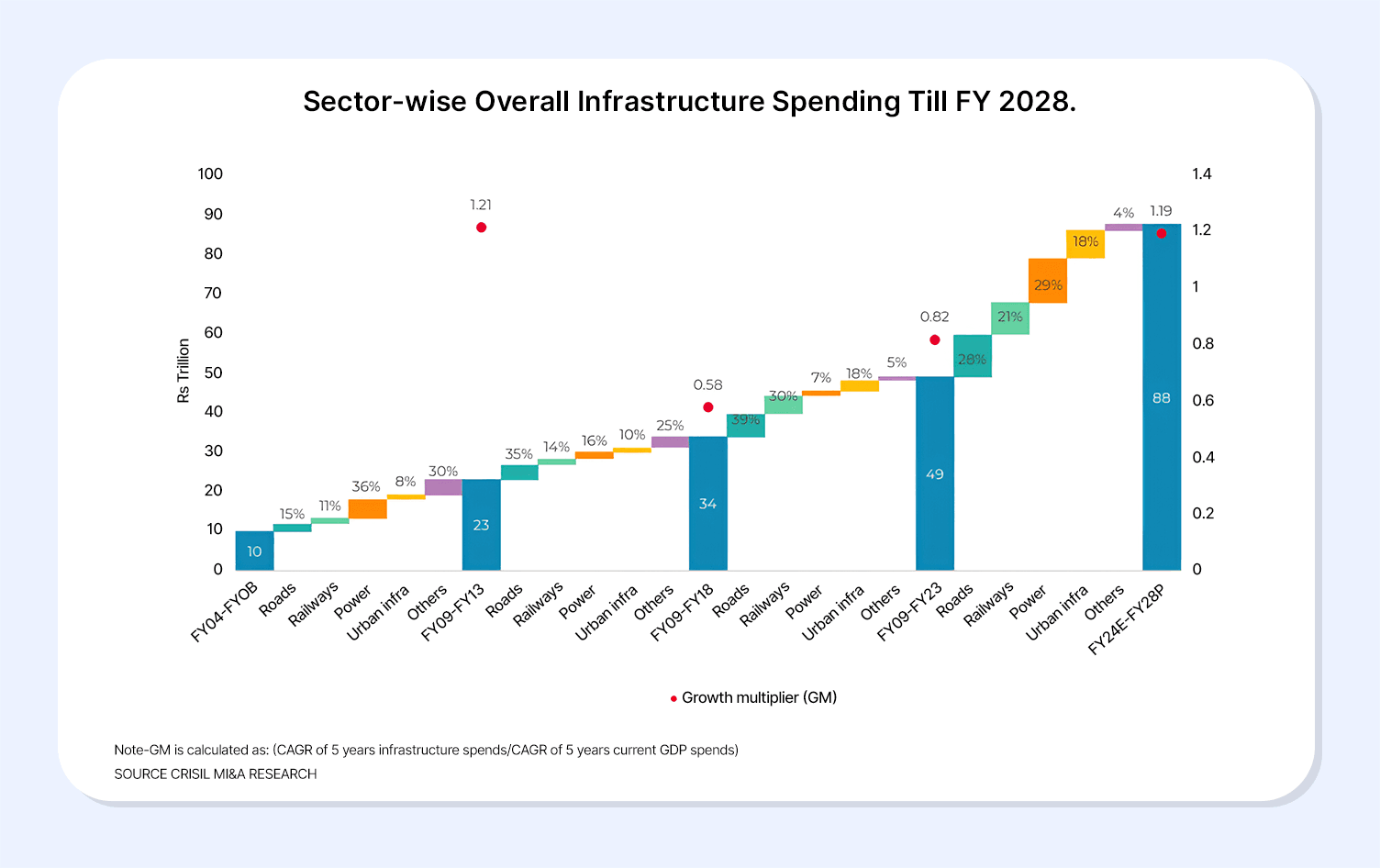
In India, infrastructure investment has surged with an 11% CAGR, reaching INR 12.2 trillion in FY 2023 from INR 7.7 trillion in FY 20194. The overall infrastructure spend is expected to increase further, with railways, power and road as flag bearers of growth. The graph below shows sector-wise overall infrastructure spending till FY 2028.
Key Sources Of Infrastructure Financing In India
Infrastructure projects carry national importance. As a result, it is one of the main elements of the budgetary allocation. However, along with the government, several private players, like banks, non-banking financial institutions, etc., extend funding. Discussed below are various sources of infrastructure financing in India.
1. Government Budget And NHAI
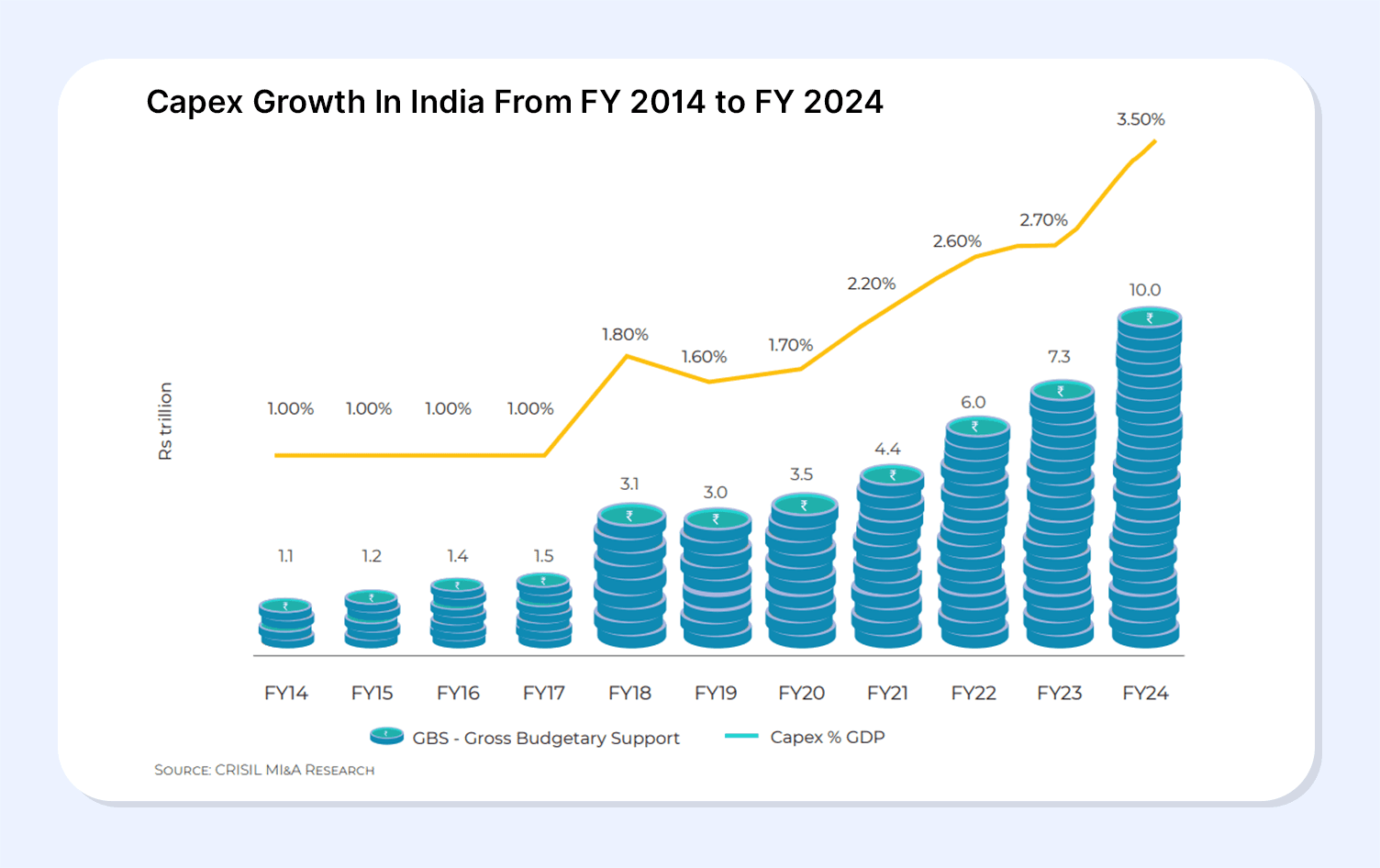
The centre has been continuously increasing its capital expenditure (capex) through significant budgetary allocations. In the Union Budget 2024-25, the government set aside INR 11,11,111 crore for infrastructure, which is around 3.4% of the GDP5. The graph below shows the capex growth in India from FY 2014 to FY 2024.
Now, the total budget allocation is directed towards the projects through different schemes and government bodies. Some of them are discussed below.
- National Infrastructure Pipeline: The Union Government has created a National Infrastructure Pipeline (NIP), which is a long-term infrastructure investment roadmap. Currently, it has around 15345 projects with a total cost of USD 2751.82 billion. The pipeline funds 62 sub-sectors like roads, railways, energy, etc6.
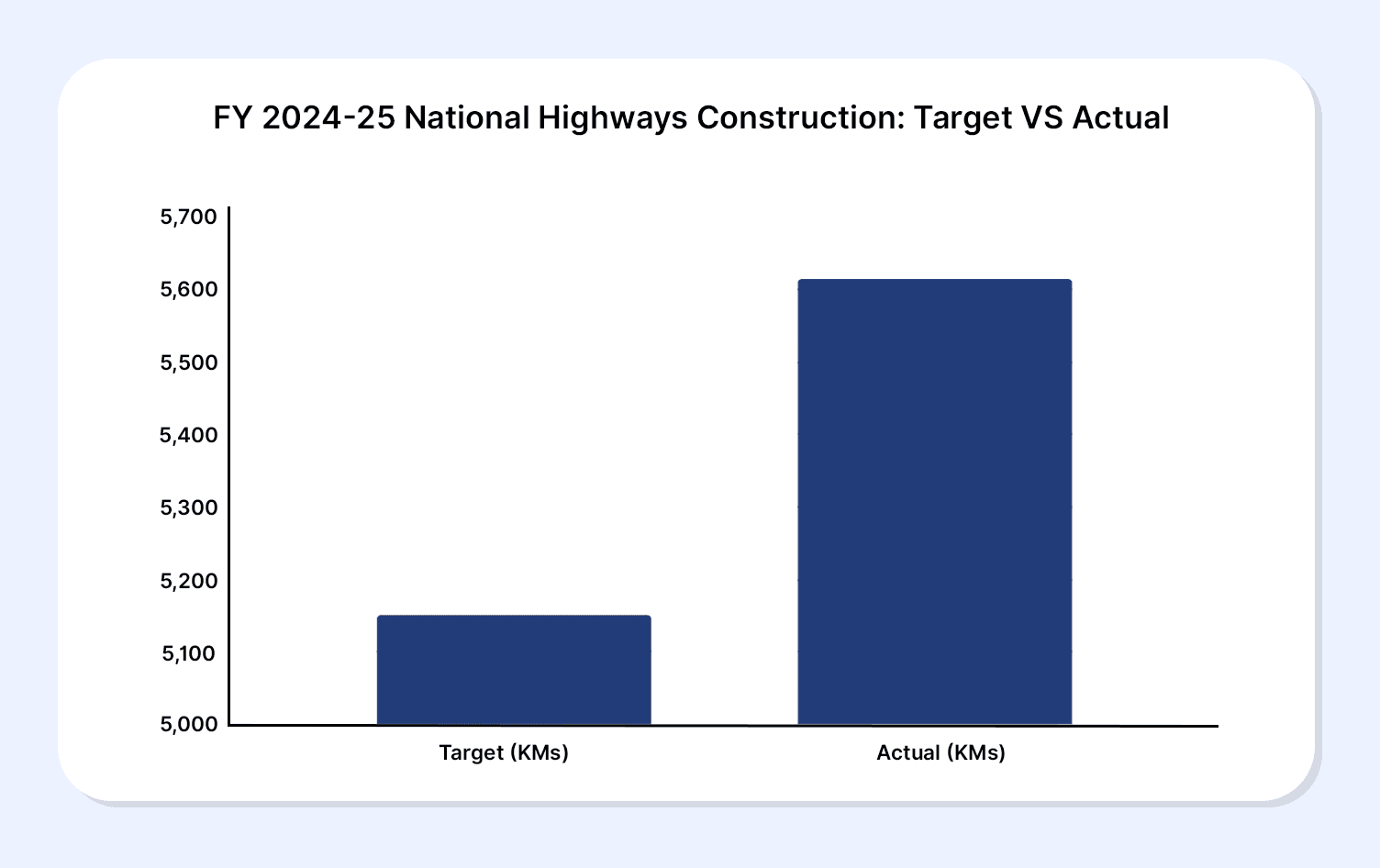
- National Highways Authority of India: Furthermore, the National Highways Authority of India (NHAI) puts the funds into action. In FY 2024-25, the NHAI has constructed 5,614 kilometres of National Highways compared to the benchmark of 5,150 kilometres7.
2. Banks and Non-Banking Finance Companies
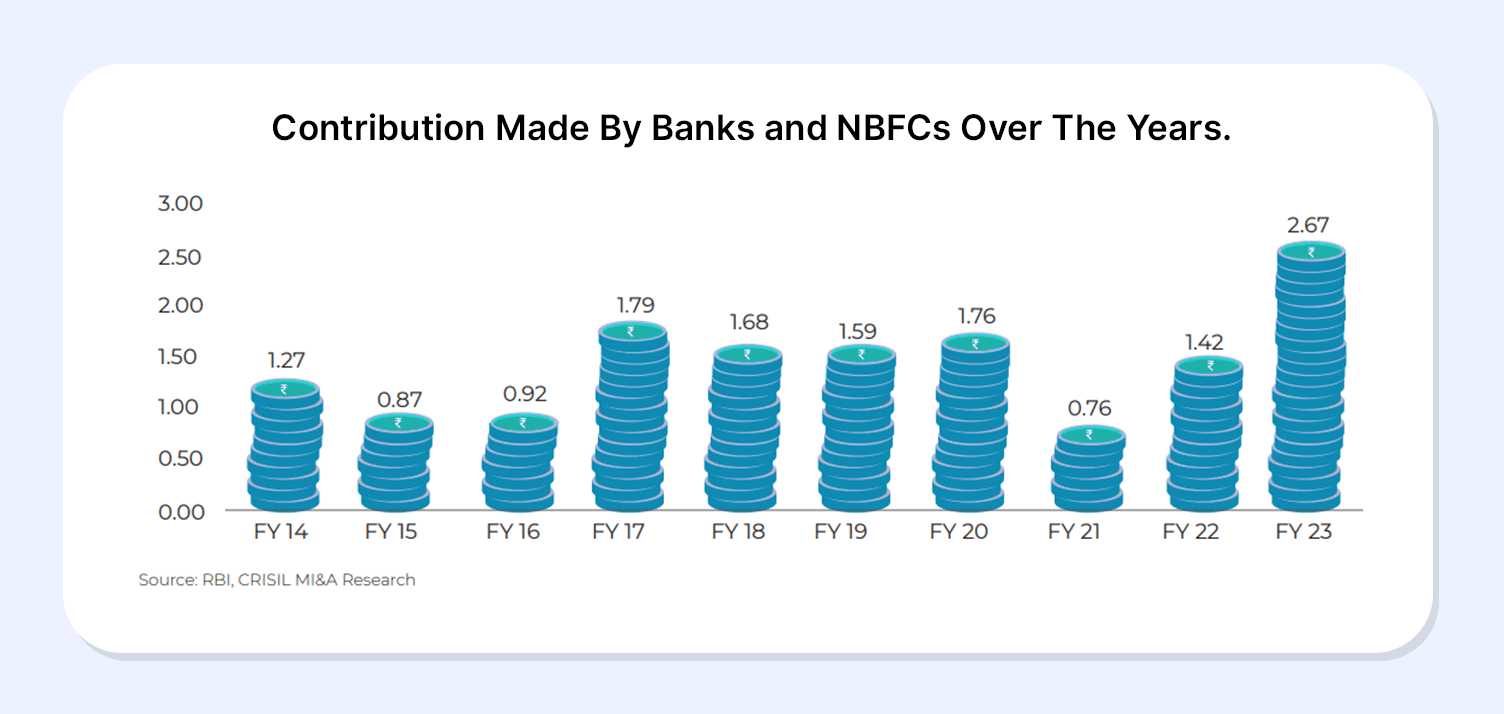
The banks and NBFCs often provide long-term debt in India to fund infrastructure projects. Funding of such projects often requires huge capital outlay and long-term commitment, which can be met by commercial banks and infra-focussed NBFCs. These institutes funded INR 2.67 trillion worth of infrastructure projects in FY 2023. Depicted below is the contribution made by banks and NBFCs over the years.
3. Corporate Bonds and Alternative Investment Platforms
Corporate bonds also contribute towards financing infrastructure projects. The bonds allow retail investors to participate in infrastructure projects and derive fixed returns from positive sectoral trends. Other than Infrastructure Bonds India, several other alternative investment options, like Real Estate Investment Trusts (REITs) and Infrastructure Investment Trusts (InvITs), democratise infrastructure investments by opening them to retail investors.
These sources of infrastructure financing in India raised funds through different models and techniques, resulting in unique features capable of addressing diverse investor needs.
Financing Models Used in Infrastructure Projects
The table below compares three key models of infrastructure financing.
| Parameter | PPP Projects India | InvIT investments | Debt Financing |
| Definition | The Public-Private Partnership model allows collaboration between the government and private players for completing infrastructure projects. | Infrastructure Investment Trusts pool individual investor capital to own and run revenue-generating assets. The returns are distributed among investors. | Direct loans from banks and NBFCs, bonds and other instruments can provide debt financing to infrastructure projects. |
| Retail Participation | No scope of direct participation. | These act like mutual funds and pool retail capital. | Retail participation is possible in some cases, like corporate bonds. |
Infrastructure finance creates growth prospects for both individual retail investors and the economy as a whole, resulting in its significance not only at a macro level but also at a micro level.
What Infrastructure Financing Means for Investors
As the infrastructure continues to grow, it becomes a source of stable long-term cash flow for its participants. However, investment in this sector is capital-intensive and involves a high gestation period, making this sector traditionally inaccessible to retail investors.
The modern investment landscape has evolved quite rapidly. Therefore, debt instruments like corporate and infrastructure bonds and alternative investments like InvITs and REITs have opened the infrastructure sector to retail investors. Individuals with a limited corpus can now anticipate consistent returns and participation in infrastructure sector growth.
Grip is a SEBI-registered platform that offers investment-grade corporate bonds with up to 12.5% YTM, offering periodic repayments.
Visit Grip Today!
FAQs on Infrastructure Financing In India
How are infrastructure projects funded in India?
Infrastructure projects in India are funded by the government, private players or both. Along with budget allocations, banks, NBFCs, bonds, etc., can fund infrastructure projects.
Are infrastructure bonds safe?
Bonds are a debt instrument, resulting in repayment priority over equity. However, a degree of risk is involved in any investment. Therefore, investors must analyse individual investments before investing.
What is the role of private investors in infrastructure?
Commercial banks and NBFCs offer large-scale debt funding to infrastructure projects. However, retail investors can also participate through bonds, REITs, InvITs, etc.
References:
1. Times Of India, accessed from: https://timesofindia.indiatimes.com/business/30-trillion-economy-document-to-outline-reforms-pitch/articleshow/104806581.cms
2. Nabard, accessed from: https://www.nabard.org/pdf/building-rural-india-through-infrastructure-development-eng.pdf
3. World Bank, accessed from: https://blogs.worldbank.org/en/ppps/bridging-india-s-infrastructure-financing-gap
4. EAAA, accessed from: https://www.eaaa.in/wp-content/uploads/2024/12/India_Infrastructure_Coming_of_Age.pdf
5. PIB, accessed from: https://shorturl.at/W7Y9h
6. India Investment Grid, accessed from: https://indiainvestmentgrid.gov.in/national-infrastructure-pipeline
7. PIB, accessed from: https://www.pib.gov.in/PressReleasePage.aspx?PRID=2117781®=3&lang=2
Want to stay at the top of your finances?
Join the community of 4 lakh+ investors and learn more about Grip Invest, the latest financial knick-knacks, and shenanigans in the world of investing.
Happy Investing!
Disclaimer - Investments in debt securities/municipal debt securities/securitised debt instruments are subject to risks including delay and/ or default in payment. Read all the offer related documents carefully. The investor is requested to take into consideration all the risk factors before the commencement of trading.
This communication is prepared by Grip Broking Private Limited (bearing SEBI Registration No. INZ000312836 and NSE ID 90319) and/or its affiliate/ group company(ies) (together referred to as “Grip”) and the contents of this disclaimer are applicable to this document and any and all written or oral communication(s) made by Grip or its directors, employees, associates, representatives and agents. This communication does not constitute advice relating to investing or otherwise dealing in securities and is not an offer or solicitation for the purchase or sale of any securities. Grip does not guarantee or assure any return on investments and accepts no liability for consequences of any actions taken based on the information provided. For more details, please visit www.gripinvest.in
Registered Address - 106, II F, New Asiatic Building, H Block, Connaught Place, New Delhi 110001


