

Mexico’s Tariff Move Against India: What’s Driving It And Why It Matters


After the United States, Mexico becomes the second North American nation to impose a 50% additional tariff on certain goods exported from India. The trade partnership between India and Mexico has been consistently growing, and in 2024, the total trade between the two developing economies surpassed $8.74 billion which included a trade surplus of $2.72 billion for India1.
The top exports from India to Mexico include vehicles (other than trams and railways), electronics, and machinery (including nuclear reactors and boilers)2.
The Mexican government has cited the reason for domestic industrial protection for applying these additional tariffs on Indian imports. The two countries do not have a free trade agreement, and even though the announcement has caused a bit of distress, it is an excellent opportunity for the two countries to sign a bilateral trade agreement and mitigate the impact of the additional tariffs.
At a time when protectionism is resurfacing globally, supply chains are being rewired for resilience, and trade blocs are tightening rules around who gets preferential access, it will be interesting to see how the two countries manage the entire situation.
This raises the obvious question: why does Mexico want to impose tariffs on India when bilateral commerce has been expanding, and Indian businesses have been steadily building distribution, dealer networks, and local partnerships across Latin America?
What Mexico’s New Tariff Policy Entails
The Mexican government has decided to impose additional tariffs up to 50% on Indian imports with a stated goal of strengthening local industry and jobs, while also raising additional revenue.
It is worth noting that the increased tariffs shall be applied on the top exported goods from India to Mexico, which include automobiles and components, steel and other metals, textiles and clothing, plastics, and other industrial goods. Here is how the tariffs will increase: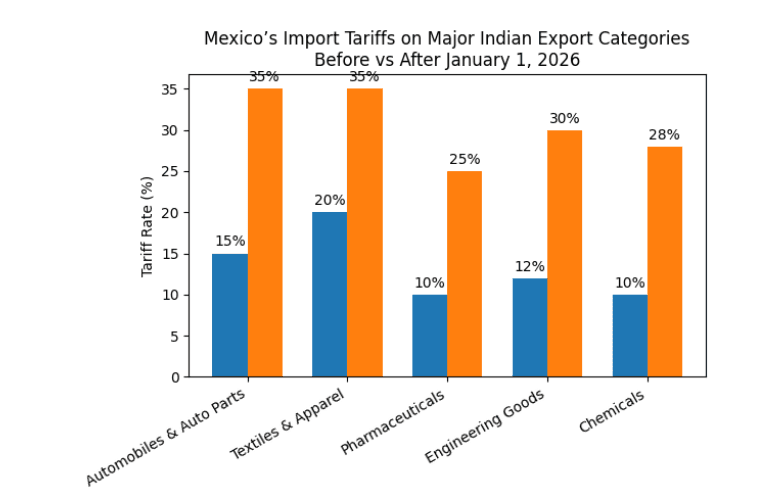
Figure 1.0: Before and After Tariffs on Indian Imports (Data Source: Reuters)
Also Read: Trump’s 200% Pharma Tariff: Impact On Indian Pharma Exports And Investors.
Why Mexico Is Raising Tariffs Now
The timing of the Mexican government’s announcement of the additional tariffs is critical. India is yet to reach a trade agreement with the US, which had earlier imposed similar tariffs on Indian imports. Mexico, India, and Brazil were three of the countries that were imposed high tariffs by the US earlier this year. The reasons provided by Mexico for the higher tariffs are as follows:
1. Protecting Local Industries
Mexico has been aggressively strengthening domestic manufacturing, particularly in automobiles, textiles, and industrial components. Indian imports, often priced competitively, have increasingly competed with local producers. Higher tariffs offer Mexican firms breathing room to retain market share and protect employment.
2. Trade Imbalance Concerns
Although bilateral trade has grown, Mexico consistently runs a trade deficit with India. From a policy standpoint, tariffs are a blunt but effective tool to curb import growth and rebalance trade flows under Mexico trade policy India observers are closely watching.
3. Geopolitical and US Alignment
Mexico’s trade strategy is deeply influenced by its economic integration with the United States and Canada. The USMCA influence on Mexico trade has grown stronger as nearshoring becomes a priority for North American supply chains. Aligning tariff structures discourages reliance on distant suppliers and incentivises sourcing from within the USMCA bloc.
4. Fiscal Considerations
With public spending pressures rising, import duties also provide a non-intrusive revenue source. Higher tariffs help Mexico boost customs collections without introducing politically sensitive domestic taxes.
What It Means For Indian Exports And Businesses
The immediate consequence is a rise in landed costs for Indian goods, which compress margins or force price hikes. The Indian exports to Mexico impact will be most visible in sectors where price competitiveness drives demand. Exporters face difficult choices: absorb higher duties, renegotiate contracts, or reconsider market presence. For MSMEs with thin margins, sustained tariff pressure could make Mexico unviable altogether. The role of the central government shall be critical in this context, as logistics, inventory planning, and currency hedging strategies will also need recalibration.
Also Read: Analyzing Donald Trump's Tariff War And Its Impact On The Stock Market
Case Studies: How This Plays Out On The Ground
1. Automobile Manufacturer Repricing Strategy
Let us consider a hypothetical case involving a leading Indian passenger vehicle exporter shipping compact cars and components to Mexico that faces tariffs climbing close to 30%. To remain viable, the company needs to rework its pricing model, reduce dealer margins, and explore partial assembly partnerships within Mexico to mitigate duties. The challenge of Indian auto exports Mexico tariffs becomes a catalyst for localisation rather than pure export-led growth.
2. Textile Exporter’s Shrinking Portfolio
Another case study can include an MSME, a mid-sized apparel exporter that supplies cotton garments to Mexican retailers, which sees duties jump to nearly 35%. Orders decline sharply as buyers shift to suppliers in Central America. Within six months, Mexico’s share of the firm’s export revenue halves, forcing a strategic pivot toward South American and Middle Eastern markets, which are subject to fewer tariffs on Indian goods.
3. Diversification Beyond Goods
exports such as design, R&D support, and technical consulting, areas unaffected by customs duties. Others expand into Colombia, Peru, and Chile, using Mexico as a learning curve for Latin American diversification.
Also Read: Currency Wars Explained: Impact On Markets And Investors
What India Is Doing In Response
As mentioned before, economic and trade deals carry a major geopolitical dimension, and the role of India's diplomatic soft power will be tested. From a policy’s perspective, India is expected to raise concerns through diplomatic and trade channels, seeking clarity on sectoral exemptions and phased implementation. While a comprehensive India Mexico trade deal remains under discussion, progress has historically been slow due to competing priorities on both sides. The current situation, however, gives a reason to speed up the proceedings.
The government had responded quite well to stimulate domestic consumption a few months ago by introducing GST-related changes. In addition, Indian export bodies are advising firms on compliance optimisation, alternative routing, and regional trade agreements that can soften tariff shocks. Over the medium term, the episode underscores the need for Indian exporters to build resilience against abrupt policy shifts rather than relying on single-market growth.
Conclusion
Changing geopolitical, diplomatic, and economic relationships is common, and any export-oriented business should be prepared to address such changes. In the era of protectionism, such an issue can easily arise with some of the biggest trade partners. This move is both a challenge and a reminder that export strategies must evolve alongside changing trade architectures.
For investors and policymakers alike, Mexico’s stance offers a case study in how emerging markets are recalibrating global trade relationships in an increasingly fragmented world. For investors looking to navigate such global shifts, platforms like Grip Invest help access regulated investment opportunities with greater transparency and diversification across market cycles.
FAQs
1. Why has Mexico imposed higher tariffs on Indian goods?
Mexico aims to protect domestic industries, reduce its trade deficit with India, align trade policy with USMCA priorities, and increase customs revenue.
2. Which Indian sectors will be most affected?
Automobiles and auto components, textiles and apparel, engineering goods, metals, chemicals, and select industrial products face the highest impact.
3. When will the new tariffs come into effect?
The additional tariffs are scheduled to take effect on January 1, 2026.
4. Does India have a free trade agreement with Mexico?
No, India and Mexico do not currently have a free trade agreement, which limits tariff relief options.
5. How can Indian exporters respond to this development?
Exporters may consider localisation, pricing restructuring, market diversification within Latin America, or expanding into service-led exports.
References:
1. Times of India, accessed from: https://timesofindia.indiatimes.com/business/india-business/trade-talks-india-mexico-open-dialogue-to-blunt-tariff-shock-preferential-pact-on-the-table/articleshow/125976849.cms#:~:text=India%E2%80%93Mexico%20merchandise%20trade%20stood,India%2C%20according%20to%20DGCI%26S%20data.
2. Trading economics, accessed from: https://tradingeconomics.com/india/exports/mexico
Want to stay at the top of your finances?
Join the community of 4 lakh+ investors and learn more about Grip Invest, the latest financial knick-knacks, and shenanigans in the world of investing.
Happy Investing!
Disclaimer - Investments in debt securities/municipal debt securities/securitised debt instruments are subject to risks including delay and/ or default in payment. Read all the offer related documents carefully. The investor is requested to take into consideration all the risk factors before the commencement of trading.
This communication is prepared by Grip Broking Private Limited (bearing SEBI Registration No. INZ000312836 and NSE ID 90319) and/or its affiliate/ group company(ies) (together referred to as “Grip”) and the contents of this disclaimer are applicable to this document and any and all written or oral communication(s) made by Grip or its directors, employees, associates, representatives and agents. This communication does not constitute advice relating to investing or otherwise dealing in securities and is not an offer or solicitation for the purchase or sale of any securities. Grip does not guarantee or assure any return on investments and accepts no liability for consequences of any actions taken based on the information provided. For more details, please visit www.gripinvest.in
Registered Address - 106, II F, New Asiatic Building, H Block, Connaught Place, New Delhi 110001


