

SEBI Check For Secure Investor Payments: What The New Validated UPI System Means For Investors


Investing today happens almost entirely online. From account opening to fund transfers, investors now rely on digital platforms and UPI payments to complete transactions quickly. However, this convenience has also led to a rise in frauds involving fake investment platforms, unverified UPI IDs, and misleading QR codes.
To protect investors, SEBI has introduced a validated UPI system for investor payments. This system helps investors check whether a UPI ID or QR code is officially linked to a SEBI registered intermediary before making any payment.
In simple terms, it ensures that your money goes to the right place and not to an impersonator.
Knowing how the SEBI Check for secure investor payments works is now essential for anyone investing digitally, especially as UPI becomes the preferred mode for mutual funds, IPOs, and other market linked investments.
Introduction To SEBI’s New Investor Payment Framework
Digital investing has made transactions faster, but it has also expanded the surface area for fraud. Many investors assume that UPI based payments are inherently safe, overlooking the fact that fraudsters often operate through lookalike UPI IDs and fake QR codes.
As of 28 February 2025, cyber frauds worth INR 36.45 lakh were reported on the National Cyber Crime Reporting Portal (NCRP), underlining the need for stronger payment verification mechanisms in digital investing.1.
While the crimes have taken several forms, impersonation scams have been a concern for far too long. To tackle the same, and ensure investor safety, the apex securities body of India, SEBI (Securities and Exchange Board of India), has introduced the new validated UPI system. Through this system, SEBI checks for secure investor payments, especially over the UPI (Unified Payments Interface) platform.
Also Read: SEBI Mandates NISM Certification For AIF Compliance Officers
What Is SEBI Check For Secure Investor Payments?
In its endeavour to ensure secure investment payments India, SEBI has introduced a verification tool called SEBI Check. Under the tool, investors can confirm the authenticity of a broker, mutual fund, or intermediary before making a payment. The verification works for both using UPI and other methods. The aim is to cross-verify the intermediary's legitimacy, which can significantly reduce the risk of digital financial fraud. The procedure under the same is simple:
1. First, the investor will fill in details like intermediary’s UPI handle, bank account + IFSC, or registration number into the SEBI Check tool.
2. Once the tool has the investor details, it wil cross-verify it through its data, which the various intermediaries provide.
3. If the intermediary is duly registered with SEBI, the details provided by the investors will match, allowing the investor to safely proceed with payment.
4. If the details do not match those of a SEBI-registered intermediary, then the tool will raise a red flag, warning the investor that it is not verified and may be risky.
It is a great step towards SEBI investor protection, as it allows investors to verify the intermediary's legitimacy before paying, especially when using UPI or scanning QR codes.
Also Read: RCom’s SBI Loan Declared Fraud: Here's What You Need To Know
Why SEBI Introduced Validated UPI Handles
Other than the SEBI check, the board has also introduced SEBI validated UPI handle. Under these investor safety measures SEBI, the board will issue a special UPI ID only to SEBI-registered intermediaries. These intermediaries will include stockbrokers and mutual fund houses. These verified UPI handles are to receive investor payments securely.
The IDs will contain “@valid”. They will also contain category identifiers like “.brk” for brokers and “.mf” for mutual funds, which will make it easy for investors to identify and differentiate between the various intermediaries. So, when an investor uses such a handle or scans its QR code, a visual confirmation symbol will appear, which will indicate that the payment is going to a verified account.
SEBI’s reason for introducing verified UPI for investments is simple: investor protection and fraud prevention. The board understood that it cannot eliminate UPI or other digital platforms from the trading world. Therefore, if focused on introducing SEBI payment verification methods. Now, through this validation system, investors will be able to clearly distinguish genuine SEBI-registered intermediaries from fraudulent ones, which will improve transparency, trust, and safety in digital investment payments.
Also Read: Why SEBI Is Warning You About Unregistered Online Bond Platforms
What This Means For Retail Investors
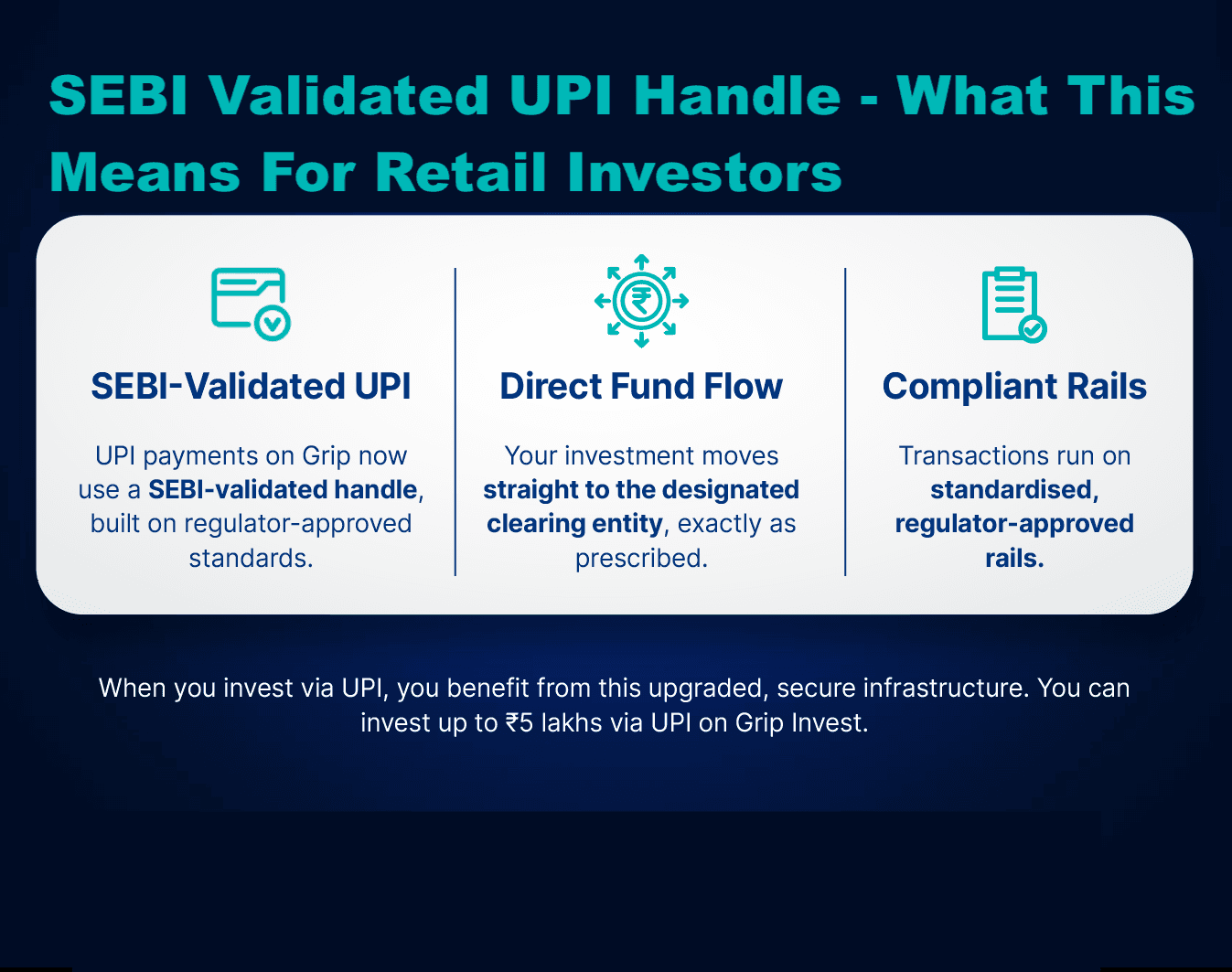
SEBI’s new validated UPI system is directly aiming to protect the investors from digital fraud. It is one of the greatest investor safety measures SEBI has taken in a while. As the whole purpose is to ensure a safe investment environment for investors, the retail investors are all set to benefit from it. While the tools will lower the risk of misdirected or fraudulent payments, they will also boost confidence while investing digitally.
The moves will also better facilitate long-term investing across different investment opportunities like equities, mutual funds, and fixed income instruments like bonds. The move will also make it easier for investors to use online platforms like Grip Invest, as with SEBI’s verified UPI for investments, the entire investment ecosystem has become safer.
Also Read: SEBI’s New Proposal For REITs And InvITs: Why It Matters For Indian Investors
Conclusion
As investing continues to move online, ensuring payment safety has become just as important as choosing the right investment product. SEBI Check for secure investor payments and the new validated UPI system mark a significant step towards strengthening investor protection in India’s digital investment ecosystem. By allowing investors to verify UPI IDs, bank account details, and intermediary registrations before making payments, SEBI has reduced the risk of impersonation, misdirected funds, and UPI based investment frauds.
For retail investors, these measures bring much needed clarity and confidence. Whether investing in equities, mutual funds, or fixed income instruments like bonds, knowing that payments are going to a SEBI registered intermediary helps build trust and encourages long term participation in the markets. As UPI continues to be the preferred mode for investment payments, using SEBI Check should become a standard practice before transferring any funds.
To invest with greater confidence and transparency, choose platforms that follow SEBI’s investor safety measures and prioritise verified payment systems. Log in to Grip Invest to explore regulated fixed income investment opportunities and invest digitally with added clarity, security, and ease.
FAQs
1. What is SEBI Check for secure investor payments?
SEBI check for secure investor payments is a newly launched verification tool under which the investors will be able to check that the intermediary, whether it's a mutual fund or intermediary, is SEBI-registered or not before they make any payments via UPI, QR codes, or bank transfers.
2. Is SEBI-validated UPI mandatory for all investment payments?
SEBI validated UPI handles are another great step towards investor safety and protection. As they verify where the UPI ID is actually linked to a SEBI-registered intermediary, they are issued only to SEBI-registered intermediaries. However, this does not mean that investors can no longer use other payment methods like NEFT or RTGS after verifying details through SEBI Check.
3. How can investors identify a verified UPI handle?
If an investor chooses to pay a SEBI-registered intermediary through its UPI handle, they check if the UPI handle is verified or not. SEBI validated UPI handles will contain “@valid” along with intermediary identifiers like “.brk” or “.mf” . It will also show a visual confirmation symbol when scanned, indicating it belongs to a SEBI-registered intermediary.
4. Does SEBI Check apply to mutual funds and bond investments?
Yes, SEBI check for secure investor payments applies to payments made to all SEBI-registered intermediaries, therefore it will aslo apply to the payments made to mutual funds and other regulated investment products. This will help the investors in verifying the legitimacy of the intermediary before transferring funds.
References:
1. PIB, accessed from: https://www.pib.gov.in/PressNoteDetails.aspxNoteId=155384&ModuleId=3®=3&lang=2
Want to stay at the top of your finances?
Join the community of 4 lakh+ investors and learn more about Grip Invest, the latest financial knick-knacks, and shenanigans in the world of investing.
Happy Investing!
Disclaimer - Investments in debt securities/municipal debt securities/securitised debt instruments are subject to risks including delay and/ or default in payment. Read all the offer related documents carefully. The investor is requested to take into consideration all the risk factors before the commencement of trading.
This communication is prepared by Grip Broking Private Limited (bearing SEBI Registration No. INZ000312836 and NSE ID 90319) and/or its affiliate/ group company(ies) (together referred to as “Grip”) and the contents of this disclaimer are applicable to this document and any and all written or oral communication(s) made by Grip or its directors, employees, associates, representatives and agents. This communication does not constitute advice relating to investing or otherwise dealing in securities and is not an offer or solicitation for the purchase or sale of any securities. Grip does not guarantee or assure any return on investments and accepts no liability for consequences of any actions taken based on the information provided. For more details, please visit www.gripinvest.in
Registered Address - 106, II F, New Asiatic Building, H Block, Connaught Place, New Delhi 110001


