

LPG Crisis In India: What Caused The Shortage And How It Impacts The Economy


In the past ten days, the mainstream and social media have been full of updates regarding the potential LPG crisis India and how it can impact various other sectors. The government recently stated that the total number of LPG bookings had reduced to 77 lakhs, and people are trusting the online booking process since the supply has been streamlined.
The states and the central government have acted against any attempt to hoard or engage in black-market trade of the essential commodity.
Nevertheless, due to the ongoing Israel-US-Iran conflict and Iran's subsequent actions in the Strait of Hormuz, which crimped the petroleum supply, there were indeed major concerns about the continuous LPG supply to household and commercial consumers in India.
The country is one of the largest consumers of LPG (both domestic and commercial), and multiple sectors depend on a reliable supply for sustainable operations.
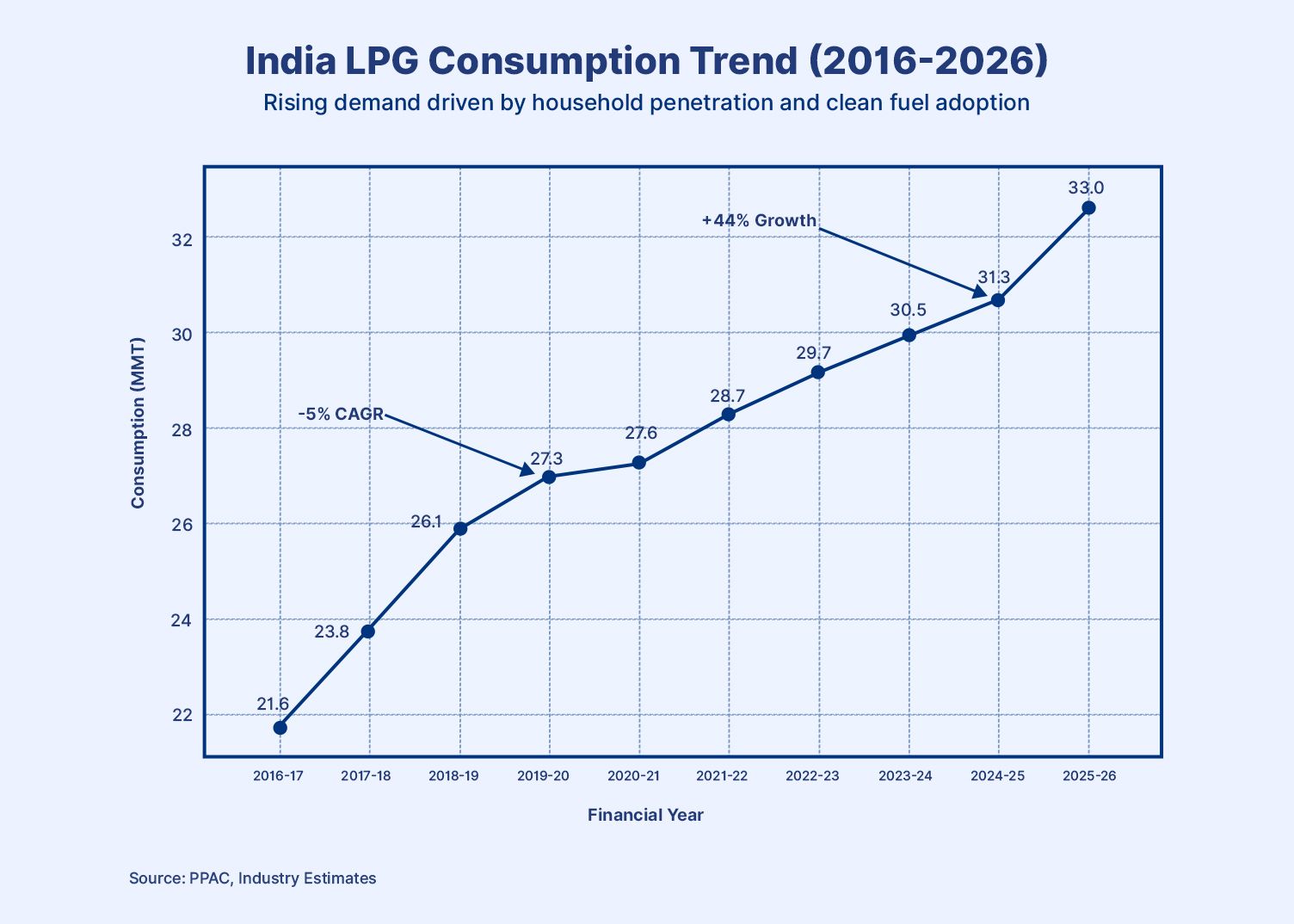
As illustrated in the graph above, demand and consumption of LPG in the country have been consistently increasing. With the government’s initiatives to replace conventional wood- and coal-burning with LPG, even in rural and remote areas, demand is expected to rise further in the next few years.
Major Causes Behind The LPG Crisis
1. Global Energy Supply Disruptions
Iran controls the strategic Strait of Hormuz, and it has made it clear that no tankers and vessels would be given a free pass through the strait. The US–Israel–Iran tensions have disrupted global energy flows, leading to supply uncertainty across oil, gas, and LPG markets. India, which relies heavily on imports, is directly exposed to these shocks.
2. Shipping and Logistics Bottlenecks
The Strait of Hormuz is a critical passage through which LPG is transported from Iran to India. Disruptions in this route have caused delays, with several vessels stranded or rerouted. This has slowed down supply cycles and created short-term shortages in domestic markets.
However, it is worth noting that almost 70% of India’s total oil imports pass through routes other than the Strait of Hormuz, underscoring that, despite obvious challenges, the situation is quite manageable for the country.
3. Middle East Tensions Impacting Energy Flows
Any instability in oil-producing nations such as Saudi Arabia, Qatar, and Kuwait, which are in direct conflict with Iran, can result in higher risk premiums, higher freight costs, and reduced availability. There can be extreme cases where these countries might prioritise their domestic energy security and might restrict petroleum supply to nations such as India.
Government Measures To Stabilize Supply
1. Policy Interventions
The government has introduced various measures, including making every effort to curb panic bookings, improving delivery timelines to boost customer confidence, punishing hoarders, and continuing subsidy support to control LPG prices in India.
2. Strategic Reserves and Supply Regulation
The government has also prioritized LPG supply for households. There was a pause in the supply of commercial LPG in a few states, but the government has recently resumed it. Additionally, refineries have been directed to maximise LPG output to bridge the supply gap.
3. Emergency Distribution Mechanisms
State governments and oil companies are coordinating to ensure equitable distribution. Measures such as regulated booking intervals and controlled allocation are being implemented to prevent hoarding and ensure steady availability
Shift Towards PNG: A Structural Change in Cooking Fuel
India is increasingly encouraging households to shift from LPG cylinders to piped natural gas (PNG), especially in urban areas with existing gas infrastructure. This move is driven by high LPG import dependence and supply risks linked to global disruptions.
PNG offers a continuous fuel supply, lower logistical costs, and reduced reliance on cylinder deliveries.
To accelerate adoption, authorities and gas distributors are offering incentives such as low or zero installation charges in select cities.
In some regions, LPG usage may gradually be deprioritised where PNG access is available, signalling a long-term structural shift in cooking fuel consumption. For consumers, this means greater convenience, while for the economy, it reduces exposure to global fuel volatility.
Impact On Financial Markets
1. Energy Sector Stocks
The energy sector stocks, which are generally considered to be decent and consistent assets, have taken a massive hit ever since the conflict began. Let us have a look at the Nifty Energy Index for the past couple of weeks:
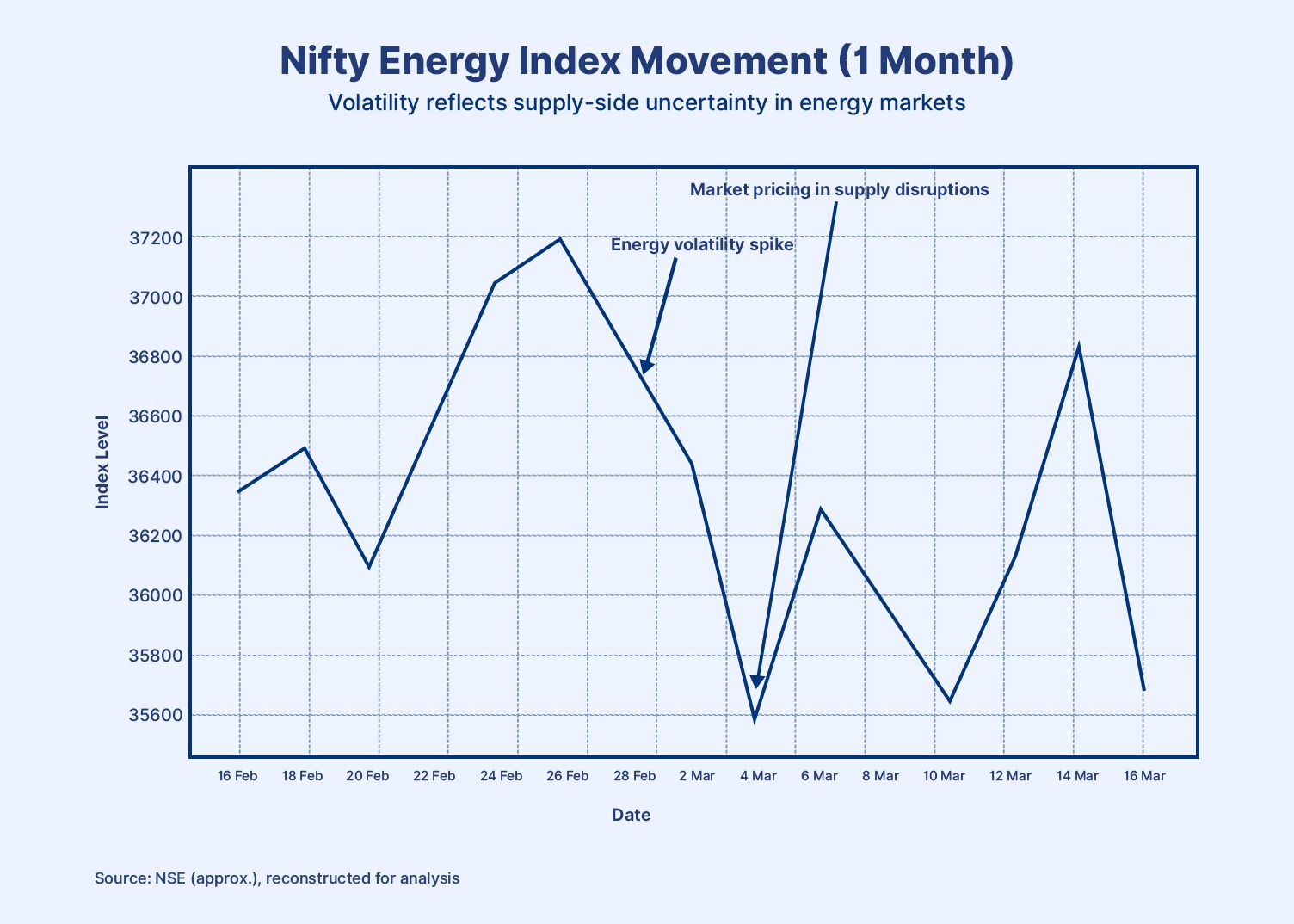
The index has lost more than 2.16% in the past couple of weeks. However, the energy companies, especially the ones that are involved in upstream production, may benefit from rising global prices. However, downstream companies such as oil marketing firms face margin pressures if retail prices are not fully adjusted.
2. Oil Marketing Companies (OMCs)
OMCs are at the centre of the entire issue. If the oil prices continue to rise (currently around the $103 per barrel mark), there might be a chance for these companies to have inventory gains. However, government-controlled pricing mechanisms often limit their ability to pass on costs fully, impacting profitability.
3. Commodity Price Movements
Crude oil prices have a direct impact on other sectors and industries. With a consistent increase in crude oil prices, it can result in putting inflationary pressures across sectors. This can lead to higher input costs for industries, especially those reliant on LPG, such as food processing and hospitality.
4. Investor Insight
Commodity-driven volatility presents a massive opportunity for investors to protect their portfolios and seek diversification. Even though a few investors would be interested in buying at dips, this might not be feasible for all investors, especially if you are pursuing long-term financial goals.
How The West Asia War Is Affecting LPG Prices In India
- India imports ~60% of its LPG needs, most of it routed through the Strait of Hormuz, which is currently disrupted by the conflict
- The government has prioritised domestic LPG use and is ramping up domestic production to reduce import pressure
- PM Modi assured Parliament that the burden of this global crisis will not be passed on to Indian households, similar to how urea prices were capped during COVID
What Investors Should Watch
1. Energy Supply Disruptions
Geopolitical developments in West Asia will remain the biggest driver of supply stability.
2. Global Crude and LPG Prices
Tracking global benchmarks can provide early signals of inflation and sectoral impact.
3. Policy Responses
Government interventions, including subsidies, pricing controls, and supply management, will determine how the crisis evolves domestically.
Conclusion
Geopolitical issues are uncontrollable events that often affect basic necessities such as cooking gas and petrol. There is every reason to believe that a country like India will most likely secure the energy requirements of its population, both domestic and commercial. However, short-term disruptions are to be expected, which is why the role of both the state and central governments should be pivotal in being proactive.
At the same time, the gradual shift from LPG to PNG highlights how India’s energy consumption patterns are evolving, with long-term implications for fuel demand, infrastructure investments, and energy companies.
From the perspective of investors, it is always critical to understand and follow these events as they have a direct implication on your portfolio and long-term financial planning. You must understand the importance of diversification, as these events are inevitable and may affect one sector or another due to the complexity of international affairs. You can visit the Grip Invest platform to evaluate a wide range of fixed-income securities that can help you earn a fair amount of returns without taking too many risks.
FAQs On LPG Crisis In India
1. What is causing the LPG crisis in India?
The LPG crisis in India is primarily driven by geopolitical tensions in West Asia, especially disruptions in the Strait of Hormuz. This has impacted global supply chains, increased import costs, and created short-term supply uncertainty.
2. How does India’s LPG import dependency affect the crisis?
India imports a large portion of its LPG requirements, mainly from Gulf countries. This high dependency makes the country vulnerable to global disruptions, price volatility, and supply chain bottlenecks.
3. How has the LPG crisis impacted prices in India?
Domestic LPG prices have risen due to increased global energy prices and import costs. A recent ?60 per cylinder hike reflects the immediate impact of supply disruptions and market volatility.
4. What sectors are most affected by the LPG shortage?
Households, restaurants, hotels, and small businesses that rely on LPG are the most affected. Additionally, industries dependent on energy inputs may face higher operational costs, contributing to inflationary pressure.
References:
1. India Today, accessed from: https://www.indiatoday.in/business/story/lpg-cylinder-shortage-live-updates-igas-supply-crisis-induction-households-restaurants-hotels-prices-hike-2882525-2026-03-16
2. Economic Times, accessed from: https://economictimes.indiatimes.com/industry/energy/oil-gas/lpg-bookings-fall-to-77-lakh-no-fuel-shortages-online-bookings-rise-after-govt-campaign/articleshow/129589655.cms?from=mdr
3. NewsonAir, accessed from: https://www.newsonair.gov.in/india-secures-70-of-crude-oil-imports-outside-strait-of-hormuz-petroleum-ministry/
4. Economic Times, accessed from: https://www.newsonair.gov.in/india-secures-70-of-crude-oil-imports-outside-strait-of-hormuz-petroleum-ministry/
5. The Siasat Daily, accessed from: https://www.siasat.com/commercial-lpg-supply-resumed-no-retail-shortage-oil-ministry-official-3435019/
6. NSE, Nifty Energy, accessed from: https://www.nseindia.com/index-tracker/NIFTY%20ENERGY
7. MSN, accessed from: https://www.msn.com/en-in/money/markets/crude-oil-prices-rise-2-to-103-on-supply-worries-amid-us-iran-war-what-s-the-near-term-outlook/ar-AA1YNGKl
Want to stay at the top of your finances?
Join the community of 4 lakh+ investors and learn more about Grip Invest, the latest financial knick-knacks, and shenanigans in the world of investing.
Happy Investing!
Disclaimer - Investments in debt securities/municipal debt securities/securitised debt instruments are subject to risks including delay and/ or default in payment. Read all the offer related documents carefully. The investor is requested to take into consideration all the risk factors before the commencement of trading.
This communication is prepared by Grip Broking Private Limited (bearing SEBI Registration No. INZ000312836 and NSE ID 90319) and/or its affiliate/ group company(ies) (together referred to as “Grip”) and the contents of this disclaimer are applicable to this document and any and all written or oral communication(s) made by Grip or its directors, employees, associates, representatives and agents. This communication does not constitute advice relating to investing or otherwise dealing in securities and is not an offer or solicitation for the purchase or sale of any securities. Grip does not guarantee or assure any return on investments and accepts no liability for consequences of any actions taken based on the information provided. For more details, please visit www.gripinvest.in
Registered Address - 106, II F, New Asiatic Building, H Block, Connaught Place, New Delhi 110001


