

Masked Aadhaar Vs Regular Aadhaar: Key Differences, Safety, And When To Use Each


Aadhaar has become the de facto identity document in India, with over 1.39 billion Aadhaar numbers issued, covering almost the entire adult population1. It is routinely required across sectors such as banking, taxation, telecom, education, and more as a valid proof of identity.
However, this growing dependence on Aadhaar has also raised serious concerns around data misuse, unauthorised storage, and identity fraud. As a result, many people are now seeking clarity on the difference between Masked Aadhaar vs Regular Aadhaar.
Several reported incidents show that Aadhaar photocopies casually shared at hotels, during job onboarding, or through courier services have been misused to obtain fraudulent SIM cards or even access unauthorised funds. To counter such risks and strengthen Aadhaar privacy, UIDAI introduced the concept of Masked Aadhaar.
Today, it is essential for every Aadhaar holder to clearly understand what Masked Aadhaar and Regular Aadhaar mean, so they can protect their personal data without compromising on the document’s legitimacy.
What Is A Regular Aadhaar?
A normal Aadhaar is the regular Aadhaar card issued by UIDAI, with the 12-digit Aadhaar number clearly printed on it. Also, the personal information displayed, mainly name, date of birth, sex, address, photo, and a QR code to verify this information.
This type of Aadhaar is typically required when complete identity authentication is legally required. Verification and backend authentication of the Aadhaar number are common requests from banks, government departments, income tax authorities, and services that provide subsidies.
Take a hypothetical case of an individual applying to a welfare scheme offered by the government, which is directly related to Direct Benefit Transfer based on Aadhaar. In this situation, the department will have to validate his Aadhaar number against UIDAI records. In this case, it will be inevitable to submit a regular Aadhaar.
Regular Aadhaar, regardless of its importance, poses a greater risk when it is unnecessarily shared. The UIDAI statistics and cybersecurity audits suggest that the majority of Aadhaar misuse cases involve the complete distribution of Aadhaar numbers for non-obligatory activities, and discretion is key in this case.
What Is Masked Aadhaar?
Aadhaar In a privacy-enhanced form of the Aadhaar, the initial eight characters of the Aadhaar number are obscured, and only the final four characters are visible. In case of an Aadhaar number, say BH-2345, is not shown in full number form but as XXXX-XXXX-2345.
The disguised masked Aadhaar meaning is exposure reduction. It is an electronically authenticated document issued by UIDAI, thus legally valid and unaltered, and it ensures that sensitive numerical data is not exposed.
Consider a situation in which an individual is employed at a private firm where identity is only required in the HR database, and no biometric or financial verification is needed. She can verify herself by providing a masked Aadhaar, which will not reveal her full Aadhaar number; thus, the risk will be minimized.
The UIDAI advisories state that masking would reduce exposure to Aadhaar numbers by almost 66%, making it much safer to use for regular identification2.
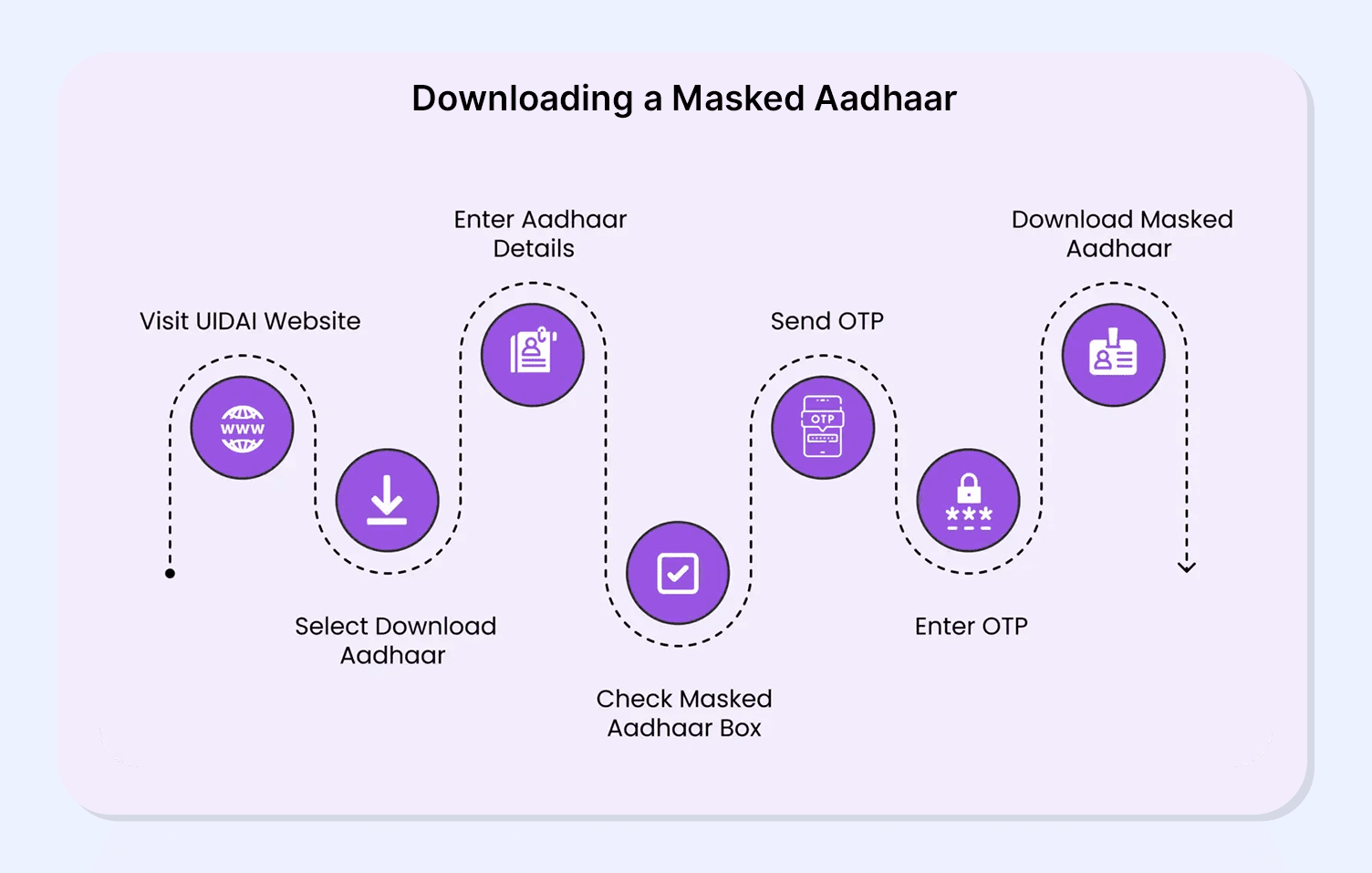
Here is a step-wise process to download a masked Aadhaar card for safe and secure use.
Masked Aadhaar Vs Regular Aadhaar: Key Differences
When comparing masked Aadhaar vs regular Aadhaar, the difference is not about validity but about data exposure and usage context.
Aspect | Regular Aadhaar | Masked Aadhaar |
Aadhaar number visibility | The entire 12-digit Aadhaar number is displayed, with the identity being completely visible. | Only the final four digits are visible, which can help reduce exposure to sensitive information. |
Privacy protection | The level of privacy is moderate, as the Aadhaar number, along with all its details, can be copied or saved. | Privacy is better because most Aadhaar numbers are concealed. |
Risk in case of misuse | The possibility of misuse is greater since the complete Aadhaar number can be used. | There is a reduced risk of misuse because incomplete Aadhaar details reduce the likelihood of fraud. |
Digital authentication | It is also verifiable digitally using the UIDAI QR code and signature. | It is also verifiable digitally, although the Aadhaar number is masked. |
Legal acceptance | It is mandatory in situations requiring Aadhaar-based authentication or seeding. | It is agreed that Aadhaar is mandatory for proving identity. |
Which Aadhaar Should You Use And When?
The choice between using a masked or regular Aadhaar depends on legal obligations, authentication needs, and the sensitivity of the information being shared. In certain situations, masked Aadhaar validity differs from that of a regular Aadhaar. For instance, masked Aadhaar cannot be used to avail government schemes or benefits.
A regular Aadhaar is required when the law mandates Aadhaar-based authentication. This typically includes opening a bank account, filing an Aadhaar-linked income tax return, receiving government subsidies, or completing biometric or OTP-based verification.
Masked Aadhaar, on the other hand, is suitable when Aadhaar is needed only as a proof of identity and not for authentication. Organisations such as hotels, employers, courier services, travel agencies, and educational institutions generally do not require access to the complete Aadhaar number, making masked Aadhaar a safer and sufficient option in such cases.
For its part, UIDAI suggests that its citizens provide masked Aadhaar by default and provide full Aadhaar only when demanded by law.
Aadhaar Privacy And Masked Aadhaar
Privacy In a digital-first economy, Aadhaar is no longer an option. Masked Aadhaar supports the concept of data minimization.
A digitally downloaded Aadhaar (masked) also carries a secure QR code that can be verified offline immediately without disclosing the Aadhaar number. This will create a balance between convenience and security and make people less reliant on photocopies, which are simpler to abuse.
Readers can explore Understanding KYC Compliance in India, Why Aadhaar Privacy Matters in Digital Transactions, and How to Prevent Identity Theft When Verifying Documents to gain a deeper context.
Conclusion:
As Aadhaar continues to sit at the centre of India’s digital identity framework, the real issue is no longer access but responsible usage. Understanding the difference between masked Aadhaar and regular Aadhaar helps you share only what is necessary, reduce data exposure, and stay in control of your personal information.
Choosing the masked version by default and reserving full Aadhaar disclosure strictly for legally mandated cases is a simple but effective step toward better financial and identity security.
Platforms like Grip Invest reinforce this approach by emphasising informed decision-making, strong data hygiene, and risk awareness across all financial actions, helping users navigate compliance requirements without compromising on privacy or safety.
FAQs
1. Is masked Aadhaar valid everywhere?
In most cases, a masked Aadhaar is considered valid for proving identity. It is, however, not legalized in the areas where full Aadhaar authentication or Aadhaar seeding is mandatory.
2. Is masked Aadhaar safer than regular Aadhaar?
Yes. The masked Aadhaar offers a significant security advantage in preventing identity theft, since most of the Aadhaar number is concealed, while still being digitally verifiable and approved by the UIDAI.
3. Can private companies store my Aadhaar details if I share them?
Private entities are generally not permitted to store or retain Aadhaar numbers unless explicitly authorised by law or UIDAI guidelines. In most non-financial or non-government use cases, organisations should only verify identity and not keep copies of Aadhaar documents. To stay safe, it is advisable to share a masked Aadhaar and confirm how your data will be used or stored before submission.
4. Is sharing an Aadhaar photocopy safe?
Sharing a regular Aadhaar photocopy carries a higher risk of misuse because the full Aadhaar number can be copied, stored, or circulated without your knowledge. If a photocopy is unavoidable, using a masked Aadhaar significantly lowers the risk of Aadhaar number exposure and data leakage.
5. Can masked Aadhaar be used for offline Aadhaar verification?
Yes. A masked Aadhaar contains a secure QR code that allows offline Aadhaar verification. This QR code can be scanned to confirm identity details without revealing the full Aadhaar number, making it a safer alternative for identity checks.
6. What does partial Aadhaar number meaning imply in masked Aadhaar?
The partial Aadhaar number shown in a masked Aadhaar refers to the last four digits of the 12-digit number. These digits help identify the document holder without exposing the complete Aadhaar number, reducing the risk of identity fraud.
7. How does masked Aadhaar help in Aadhaar misuse prevention?
Masked Aadhaar limits the amount of sensitive data shared during identity verification. By concealing most of the Aadhaar number, it lowers the chances of unauthorised SIM issuance, financial fraud, or identity theft arising from Aadhaar data misuse.
References:
1. Forbes, accessed from: https://www.forbesindia.com/article/15th-anniversary-special/aadhaar-a-shot-at-unique-identity-through-twists-and-turns/93174/1
2. UIDAI, accessed from: https://www.uidai.gov.in/en/283-faqs/aadhaar-online-services/e-aadhaar/1887-what-is-masked-aadhaar.html
Want to stay at the top of your finances?
Join the community of 4 lakh+ investors and learn more about Grip Invest, the latest financial knick-knacks, and shenanigans in the world of investing.
Happy Investing!
Disclaimer - Investments in debt securities are subject to risks. Read all the offer-related documents carefully. The investor is requested to take into consideration all the risk factors before the commencement of trading. This communication is prepared by Grip Broking Private Limited (bearing SEBI Registration No. INZ000312836 and NSE ID 90319) and/or its affiliate/ group company(ies) (together referred to as “Grip Invest”) and the contents of this disclaimer are applicable to this document and any and all written or oral communication(s) made by Grip Invest or its directors, employees, associates, representatives and agents. This communication does not constitute advice relating to investing or otherwise dealing in securities and is not an offer or solicitation for the purchase or sale of any securities. Grip Invest does not guarantee or assure any return on investments and accepts no liability for the consequences of any actions taken based on the information provided. For more details, please visit https://www.gripinvest.in/.
Registered Address - 106, II F, New Asiatic Building, H Block, Connaught Place, New Delhi 110001.


