

MCX Silver Investing: How It Works, Risks, And Alternatives


Introduction: Why MCX Silver Attracts Active Traders
If there is one metal that has experienced a massive bullish run and has become a critical choice for investors across different asset classes, it is silver. The white metal has risen tremendously in value in the past couple of years and has recently touched an all-time high in the Indian and international markets1.
Besides the recent bullish run, silver has always held a special place in financial markets. It is both a store of value and an industrial metal with wide usage in electronic components, solar panels, medical appliances, and automobiles. For this reason, it has also made silver highly sensitive to the overall economic cycle, including ups and downs, inflationary pressures, and currency fluctuations.
MCX silver investing is therefore popular among active traders, especially given its high liquidity and linkage to global pricing, coupled with a leverage-driven trading structure. MCX allows traders to participate in silver's price movement without actually possessing the physical metal. Thus, investors trade standardized futures contracts that represent international silver prices.
What Is MCX Silver?
MCX silver is a standardized futures contract that is traded on the Multi-Commodity Exchange of India. The said contracts enable market participants to speculate, hedge, or be exposed to the price of silver without necessarily delivering the underlying silver physically.
According to market data over the last couple of years, silver futures have remained among the top traded commodity contracts by volume on MCX, along with crude oil and gold. Such liquidity provides quick entry and exit, making MCX silver trading a lucrative avenue for short-term strategies, hedging, and tactical exposures.
However, leverage cuts both ways. While it amplifies gains, it also increases downside risk. Understanding how to buy silver MCX, the structure of the contracts, and where to place risks is important before diving into this segment of commodity trading.
Contract Types
1. MCX silver investing currently offers multiple variants of the contract to suit varied risk profiles and capital sizes:
2. Silver (Regular) Contract: The lot size is larger, so this type of contract is usually traded by institutional and high-volume traders.
3. Mini Silver MCX: A medium-sized contract, designed for active retail traders.
4. Silver Micro Trading: The contract size is small, primarily for beginners and participants with low capital. Prices are per kilogram and are quoted closely in line with international silver benchmarks, such as COMEX, adjusted for currency movements and import factors.
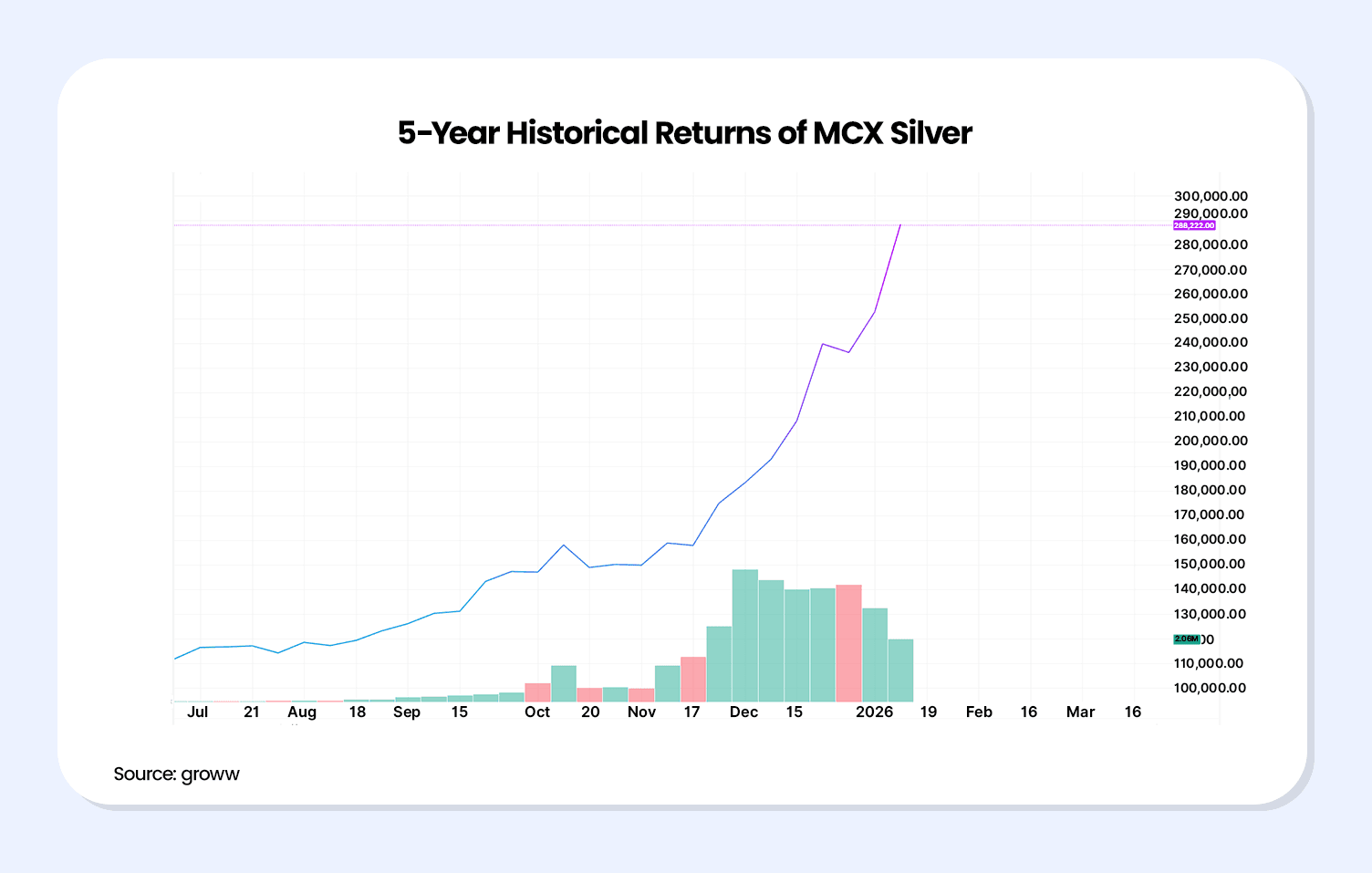
As shown by the 5-year graph, both the volumes and price of silver on the MCX have spiked up considerably in the past few quarters, demonstrating a bullish run.
How MCX Silver Investing Works
MCX silver investing works on a futures trading model in which individuals buy or sell contracts to deal in silver sometime in the future at a pre-decided price.
- Margin-Based Trading
Unlike physical silver, traders pay only a percentage of the contract value as margin. MCX silver margin requirements generally range between 5% and 12%, depending on volatility and regulatory updates.
For example, if a Silver Mini contract is valued at INR 3,75,000 and the margin is 8%, the trader needs only approximately INR 30,000 to take a position. If silver increases by 2%, the contract increases in value by INR 7,500 - a return of 25% on margin. Similarly, the same amount of leverage amplifies losses.
- Settlement
MCX silver contracts are usually cash-settled, meaning most retail traders square off their positions before expiry. Mark-to-market settlement credits your profit/loss on a daily basis. Upon expiry, the contract is settled based on the final settlement price published by MCX.
A beginner must read an Indian specific silver futures guide India to understand lots, months of contracts, and changes in margin.
MCX Silver Vs Other Silver Investment Options
Silver exposure is not limited to futures. Each option carries different risk-return characteristics.
Investment Method | Risk Level | Capital Required | Liquidity | Best For |
Low–Medium | High | Low | Long-term holding | |
Silver ETFs | Medium | Medium | High | Passive investors |
Medium | Low | Medium | Convenience-driven investors | |
MCX Silver Contracts | High | Low (margin) | Very High | Active traders |
Silver Mining Stocks | Medium–High | Medium | High | Equity investors |
Who Should Consider An Account At MCX Silver?
Commodity trading silver is most suited to active traders as well as experienced market participants who are conversant with the concepts of technicals and various global commodity considerations.
For instance, an intraday trader can buy silver mini MCX prior to an announcement of US inflation levels. A jeweler or an industry may hedge costs against futures to reduce commodity costs. A portfolio manager may use micro-trading in silver to diversify risk.
Futures are not well-suited to long-term investors seeking stability, predictable returns, and lower volatility. For them, holding silver, an ETF, or a portfolio of assets will be more suitable.
Before joining the MCX silver market, one must consider time commitment, emotional control, and risk tolerance.
Managing Risk With Diversification
The silver futures in India are very volatile, making risk management necessary. This is because silver may fluctuate wildly in value in response to changes in exchange rates, interest rates, geopolitical events, or industrial demand.
One of the best methods for managing this risk is diversification. Although traders can allocate some of their money to MCX silver, it is not prudent to invest all of it in leveraged commodities.
Offset trading risks with other investment alternatives with steady yields but with lower volatility, such as bonds and debt funds. The said investments produce fixed cash flows and usually perform differently from commodities when economic cycles come into play. You can explore multiple low-risk, high-yielding fixed-income securities on the Grip platform.
Conclusion
Here’s the bottom line. MCX silver investing is a high-intensity, high-risk way to participate in silver price movements. The leverage, liquidity, and global price linkage make it attractive for active traders, hedgers, and short-term strategies. But the same leverage that magnifies gains can just as easily magnify losses, especially during volatile macro events or sudden shifts in global sentiment.
What this really means is that MCX silver works best as a tactical allocation, not a core long-term holding. Investors looking for stability, predictable cash flows, or lower emotional stress may find futures trading unsuitable on its own.
This is where Grip Invest becomes relevant. By offering access to curated fixed-income instruments such as bonds and other yield-focused opportunities, Grip allows investors to balance high-volatility assets like silver with steady-return investments. Instead of relying solely on leveraged commodity trades, investors can build a more resilient portfolio that combines growth exposure with income stability, helping them stay invested across market cycles without taking outsized risks.
FAQs On MCX Silver Investing
1. What is the minimum capital required to start MCX silver trading?
The minimum capital depends on the contract type. Silver Micro contracts require the lowest margin, often allowing participation with INR 5,000–10,000, while Mini and Regular contracts need higher margins based on prevailing volatility.
2. Are MCX silver profits taxable in India?
Yes. Profits from MCX silver futures are treated as business income. They are taxed as per the individual’s income tax slab, and losses can be set off against other business income, subject to tax rules.
3. Is MCX silver suitable for beginners?
MCX silver can be risky for beginners due to leverage and daily mark-to-market settlement. New investors are better off starting with silver ETFs or physical silver before moving to futures once they understand margin dynamics and risk management.
References:
1. Money control, accessed from: https://www.moneycontrol.com/commodity/mcx-silver-price/?type=futures&exp=2026-03-05
2. Groww, accessed from: https://groww.in/charts/commodities/mcx_silver/mcx_silver05mar26fut
Want to stay at the top of your finances?
Join the community of 4 lakh+ investors and learn more about Grip Invest, the latest financial knick-knacks, and shenanigans in the world of investing.
Happy Investing!
Disclaimer - Investments in debt securities are subject to risks. Read all the offer-related documents carefully. The investor is requested to take into consideration all the risk factors before the commencement of trading. This communication is prepared by Grip Broking Private Limited (bearing SEBI Registration No. INZ000312836 and NSE ID 90319) and/or its affiliate/ group company(ies) (together referred to as “Grip Invest”) and the contents of this disclaimer are applicable to this document and any and all written or oral communication(s) made by Grip Invest or its directors, employees, associates, representatives and agents. This communication does not constitute advice relating to investing or otherwise dealing in securities and is not an offer or solicitation for the purchase or sale of any securities. Grip Invest does not guarantee or assure any return on investments and accepts no liability for the consequences of any actions taken based on the information provided. For more details, please visit https://www.gripinvest.in/.
Registered Address - 106, II F, New Asiatic Building, H Block, Connaught Place, New Delhi 110001.


