

Nifty 50 Index Fund Returns: Historical Performance And What To Expect


Planning to invest in a Nifty 50 index fund? Following this, an inevitable question arises about how profitable this type of investment can be. Index funds may not outperform the stock market, but their predictability and low expenses make them popular among passive investors in India.
However, before investing, it is crucial that you have adequate knowledge of the Nifty 50 index fund returns in India.
It will enable you to set reasonable expectations for your investments. Read on to learn about it in detail.
Historical Nifty 50 Index Fund Returns
The Nifty 50 index fund's returns are meant to mimic the returns generated by the NIFTY 50 index, which focuses on the fifty most popular stocks in the National Stock Exchange.
Although there might be slight variations among the fund returns, the general trend will remain in line with that of the index.
1-year
Over one year, the Nifty 50 fund returns are usually quite volatile. Based on the prevailing market conditions, returns can range from losses to substantial double-digit returns.
Consequently, 1-year returns can be used to make decisions on investing.
5-year
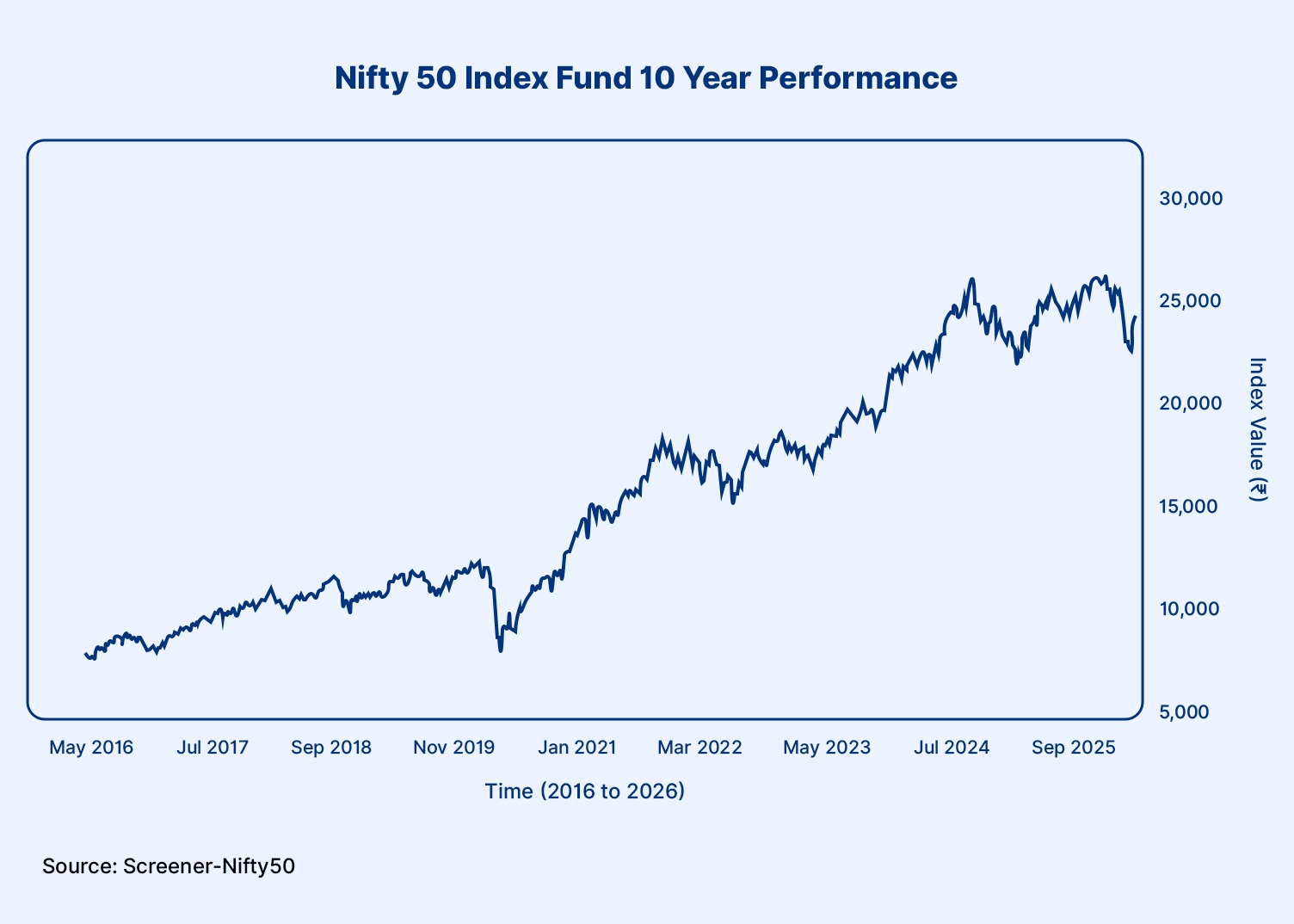
After five years, returns become more stable. They average at a 10-14% compound annual growth rate. The timeframe represents the ability of index funds to benefit from economic growth without experiencing volatility.
10-year
Nifty 50 index funds generate high returns in the long run. Historically, they have returned an average of 11-13% compound annual growth rate.
Factors Affecting The Returns
When investing in Nifty 50 index funds, your objective is to gain returns that mimic those of the NIFTY 50, but there could be some influencing factors that affect what you will actually make:
1. Market cycles
Since index funds are purely market-oriented, you do not have any cushion in the performance aspect, and hence, it is purely based on what happens in the market. In case of an excellent performance cycle in the market, you might experience impressive returns even within a short span of time.
2. Expense ratio
While index funds are relatively inexpensive to hold, they do have a fee attached, known as the expense ratio. Even though this may not appear significant (between 0.1% and 0.5%), it does end up eroding your gains over time.
For instance, two index funds that track the same index will generate varying results solely based on their higher expense ratio. Cost-saving translates into better performance.
3. Tracking error
The tracking error is what makes a great index fund better than a decent index fund. It is preferable that your fund will be very close to the index itself; however, there will always be some discrepancies.
Some of the reasons why there may be discrepancies include:
- Cash holdings by the fund manager
- Stock purchase/sale discrepancies
- Inefficiency in the fund’s operation
A low tracking error would imply that the index fund is performing efficiently.
Also Read: Understand What is Bull and Bear Market And Its Investment Strategies
Pros And Risks Of Index Funds
Index funds following the Nifty 50 have become an increasingly favoured option for investors due to their straightforward nature and reliability. However, they do possess some strengths and weaknesses as well.
Pros
1. Low Expense Ratio and Better Efficiency: As these funds only replicate the NIFTY 50 index, there's no need to select particular stocks. Thus, the cost of owning index funds is relatively lower compared to mutual funds that invest actively.
2. Exposure to the Whole Market: With the help of such funds, one can invest in shares of up to 50 Indian companies that have the biggest market capitalisation and are well-established.
3. Regular, Predictable Performance: In contrast to actively managed mutual funds, which strive to outperform the market, index funds seek to track it. Over a long period of time, such an approach brought steady returns.
4. Transparency and Simplicity: Index funds copy a publicly available index of companies' stocks, therefore being clear and transparent in terms of the investment portfolio.
Risks
1. No Potential for Outperformance: Index funds are not meant to outperform the markets but to replicate them. This means that when active funds outperform the markets, index funds will underperform.
2. No Defence Against Market Decline: When the markets decline, the index funds will decline as well because there is no defence against market decline in such investments.
3. Stock Concentration Risk: Index funds have a high stock concentration risk since the Nifty 50 comprises many large-cap stocks and some sectors.
4. No Flexibility: Index funds do not provide any flexibility for holding adjustments like active funds do.
Is the Nifty 50 Index Fund Enough?
With a Nifty 50 index fund, you have access to the best Indian businesses, including those listed in the NIFTY 50, giving it good potential as an investment option in your portfolio for a prolonged period. This makes it a useful component when investing, because the idea is simple, inexpensive, and linked to overall market growth.
Of course, using the above fund alone does not mean your portfolio will benefit maximally. Since it targets large-cap stocks alone, it could limit your growth potential in relation to mid-cap or small-cap stocks. Furthermore, it only comprises equities, which means that the portfolio could be volatile if there is a dip in the markets.
As such, some investors have used other strategies to diversify their portfolios by:
- Accessing other types of equities for growth
- Making income-generating investments
Conclusion
The returns generated by Nifty 50 index funds have consistently mirrored the growth of India’s biggest firms. This makes them reliable investment choices for investors with long-term plans. Although there may be short-term uncertainties, the overall trend has seen consistent wealth creation with reduced costs.
Nevertheless, investments should not only focus on returns.
They should be aimed at forming an investment portfolio. Mixing Nifty 50 index funds with other investments that generate income and growth can ensure that volatility does not affect your financial plans. You can access these investment options on trusted platforms like Grip Invest.
To start investing better and create a diversified portfolio, invest with Grip today!
FAQs On Nifty 50 Index Fund Returns (2026)
 |
Author: Grip Invest Editorial Team The Grip Invest Editorial Team is a group of Chartered Accountants, MBA (Finance) graduates, and Qualified Research Analysts dedicated to helping you invest smarter. We dive deep into India's fixed income landscape to deliver content that is accurate, up-to-date, and easy to understand. Whether you're exploring bonds, fixed deposits, or other fixed income opportunities, our guides cut through the noise and give you the clarity to make better financial decisions. |
Want to stay at the top of your finances?
Join the community of 4 lakh+ investors and learn more about Grip Invest, the latest financial knick-knacks, and shenanigans in the world of investing.
Happy Investing!
Disclaimer - Investments in debt securities/municipal debt securities/securitised debt instruments are subject to risks including delay and/ or default in payment. Read all the offer related documents carefully. The investor is requested to take into consideration all the risk factors before the commencement of trading.
This communication is prepared by Grip Broking Private Limited (bearing SEBI Registration No. INZ000312836 and NSE ID 90319) and/or its affiliate/ group company(ies) (together referred to as “Grip”) and the contents of this disclaimer are applicable to this document and any and all written or oral communication(s) made by Grip or its directors, employees, associates, representatives and agents. This communication does not constitute advice relating to investing or otherwise dealing in securities and is not an offer or solicitation for the purchase or sale of any securities. Grip does not guarantee or assure any return on investments and accepts no liability for consequences of any actions taken based on the information provided. For more details, please visit www.gripinvest.in
Registered Address - 106, II F, New Asiatic Building, H Block, Connaught Place, New Delhi 110001


