

Nippon India Corporate Bond Fund: A Detailed Breakdown


The growing sophistication and digitisation of the Indian investment landscape has led to a variety even amid traditional asset classes, like fixed-income securities.
Investment avenues like corporate bonds are rising in popularity.
According to a December 2025 Niti Ayog report, the corporate bond market in India recorded a significant annual growth rate of 12% as outstanding bond issuance rose from INR 17.5 trillion in FY2015 to INR 53.6 trillion in FY2025.1
The renewed investor interest in bonds has led to growth in related asset classes as well, like the corporate bond mutual funds.
In May 2025, these funds attracted the highest net inflows since March 2023 at INR 11,983 crore.2
Amid these trends, an analysis of popular corporate bond funds, along with their intrinsic features like the corporate bond fund NAV, portfolio, returns, etc., can help investors make optimal investment choices.
Therefore, this blog closely analyses the Nippon India Corporate Bond Fund. Issued by one of the most popular Asset Management Companies, the Nippon India corporate bond mutual fund is among the top 10 corporate bond funds, categorised as per their net assets, as of 27 April 2026.3
Let us begin with an overview of this fund.
What Is Nippon India Corporate Bond Fund ?
The Nippon India Corporate Bond Fund is an open-ended debt mutual fund scheme that invests primarily in AA+ or above-rated corporate bonds, resulting in a moderate overall risk profile.4 The fund was incorporated on 14 September 2000, and being a corporate bond fund, it aims to benefit from trends in the corporate bond market.5 Subsequently, this debt mutual fund invests depending on a short to medium term interest rate view and shape of the yield curve.
Therefore, the Nippon India Corporate Bond Fund is suitable for risk-averse investors who prioritise fixed income growth over market-linked equity growth.
According to the AMC, investors with a 24 to 36-month investment horizon can find this fund efficient. The table below highlights certain key features of the Nippon corporate bond mutual fund.
| Parameters | Details |
| NAV as of 27 April 2026 | INR 62.3344 |
| Monthly Average Fund Size | INR 8,748.70 Crore |
| Month-end Fund Size | INR 8,354.21 Crore |
| Total Expense Ratio | 0.36% |
| Fund Manager | Vivek Sharma has been managing the fund since February 2020 and has a total experience of over 19 years |
Like any mutual fund, the historical Nippon corporate bond fund returns reveal keen insights into its prospective performance. Although past returns are not a guarantee of future endeavours, a return review helps understand the trajectory and serves as proof of potential.
Returns And Performance Review
Analysing annualised returns and risk-adjusted return metrics of the Nippon India Corporate Bond Fund against category average performance can help investors identify over-performance or under-performance, resulting in optimal decision-making. There are three key methods of analysing fund performance. Let us analyse this Nippon debt fund through each of these methodologies.
1. Category Average Performance
Investors can comparatively analyse the performance of the Nippon India Corporate Bond Fund with the average performance of the whole corporate bond fund category.
The table below compares the fund’s performance against its category, based on different parameters as of 27 April 2026.
| Particulars | Nippon India Corporate Bonds Fund | Category Average Performance |
| 1-Year Return | 5.12% | 5.20% |
| 3-Year Return | 7.58% | 7.31% |
| 5-Year Return | 6.81% | 6.26% |
| Standard Deviation | 1.44% | 1.35% |
| Sortino Ratio | 1.36% | 1.20% |
| Sharpe Ratio | 1.00% | 0.86% |
Source: Value Research Online6
Apart from the one-year return, the Nippon Corporate bond fund overperformed compared to its category as a whole in both three-year and five-year tenures.
The standard deviation of the Nippon fund is higher, indicating greater volatility. On the other hand, the risk-adjusted metrics, like Sortino and Sharpe, of the fund are also higher, representing a better risk-adjusted return performance.
2. Benchmark Performance
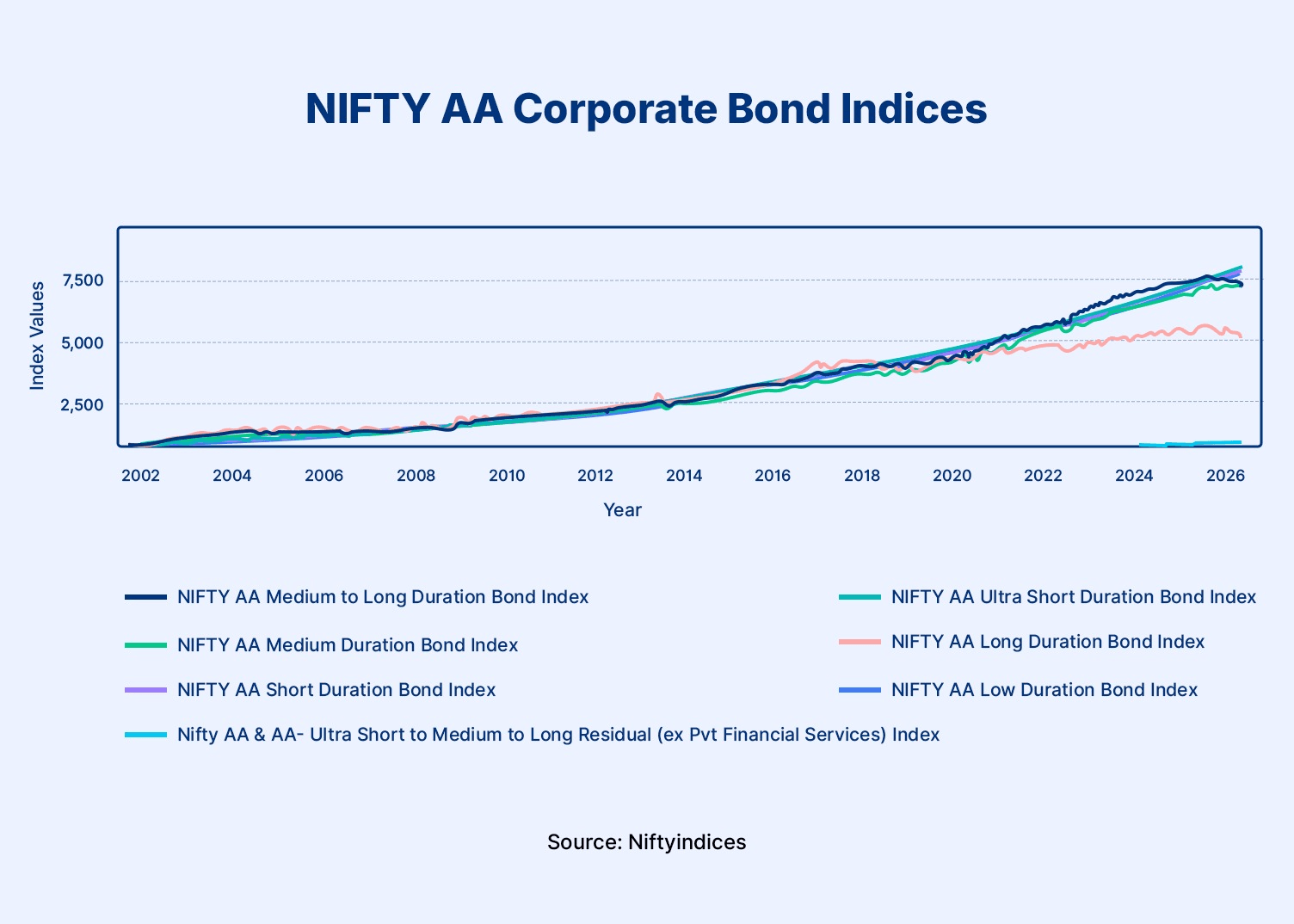
The Nippon India Corporate Bond Fund tracks the NIFTY Corporate Bond Index A-II benchmark. A mutual fund either tracks and emulates the performance of its benchmark or aims to outperform it.
Therefore, investors can analyse the performance of this benchmark to anticipate the trajectory of the Nippon fund. The graph below shows the performance of the NIFTY AA Corporate Bond Indices as of 31 March 2026.
3. Comparison With Individual Funds
With a 7.58% three-year return, the Nippon India Corporate Bond Fund ranks fourth among its corporate bond fund peers, as of 27 April 2026. During the same tenure, its 5-year percentage returns made the Nippon fund rank first among all its peers. The bar graph below compares the five-year performance of corporate bond funds as of 27 April 2026.
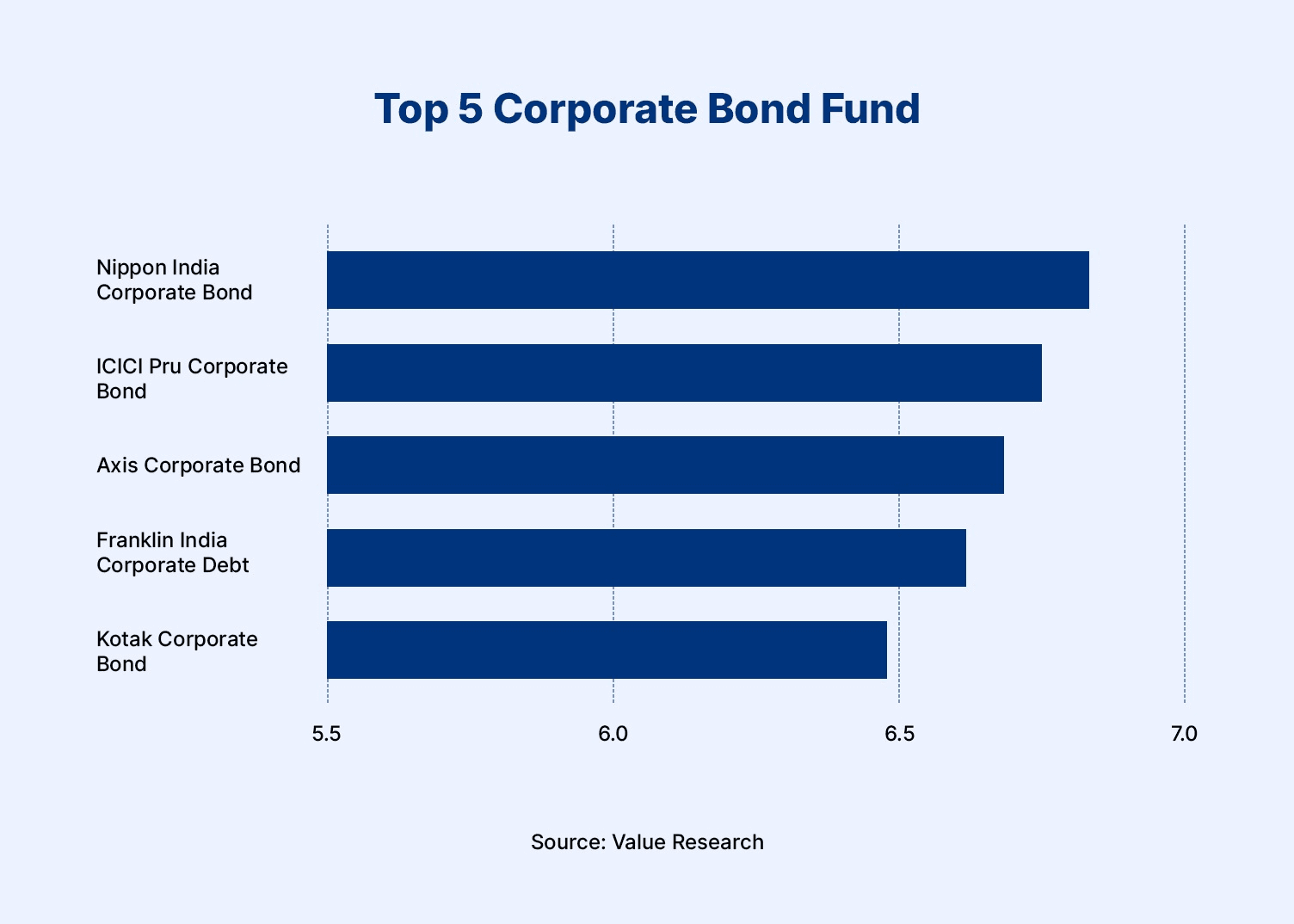
However, it is important to note that the performance of a fund depends primarily on the quality of its underlying assets. Therefore, portfolio analysis is crucial to understanding the Nippon India Corporate Bond Fund.
Portfolio Quality
According to the investment philosophy of the Nippon India Corporate Bond Fund, the fund aims to invest approximately 85% in long-term AAA-rated instruments, with the motive to maintain the portfolio duration between 1.25 and 4 years.9 This implies that, on average, the assets of this fund’s portfolio mature within the tenure range. As of 31 March 2026, the average maturity stands at 3.06 years, and 99.66% of the portfolio has an AAA rating.
A nuanced understanding of any investment medium requires a thorough analysis of risks and taxation, along with returns.
Risks And Tax Considerations
While the interest rate risk of Nippon India Corporate Bond Fund is relatively high, the credit risk remains moderate. This makes the average risk profile of the fund moderate. Discussed here are key parameters that investors must consider before investing.
1. Interest Rate Sensitivity: Since the primary underlying security of corporate bond funds is corporate bonds, they are subject to interest rate risk. If bonds with higher interest rates enter the market, the existing bonds look less appealing, resulting in a fall in their market value.
2. Liquidity Considerations: The Nippon India Corporate Bond Fund has no entry or exit load. Therefore, being an open-ended fund, investors can have high liquidity. The minimum investment requirement is INR 1,000.
3. Tax Rate: Since the Nippon India Corporate Bond Fund is a debt mutual fund, it is taxed at the rates applicable to debt funds. The table below explains the taxability in detail.
| Type | Capital Gain | Rate |
| Purchased till 31 March 2023 and sold on or after 23 July 2024 | STCG (held for 2 years or less) | Slab rate |
| LTCG (Held for over 2 years) | 12.5% | |
| Purchased on or after 1 April 2023 | LTCG | Slab rate |
Source: Mutual Fund taxation11
Conclusion
The growing investor affinity to corporate bonds has led to the rising popularity of corporate bond mutual funds, as well. In such a scenario, the Nippon India Corporate Bond Fund is one of the major mutual fund schemes in the category that has delivered the highest 5-year returns and the fourth largest 3-year returns, as of 27 April 2026. However, analysing performance against category and benchmark is not enough; investors also need to analyse the risk profile and risk-adjusted metrics. Moreover, since diversification is crucial to maintain stable growth, investors can blend mutual funds with direct bond exposure.
Grip offers a range of fixed-income securities, including high-yield FDs and corporate bonds, that can offer up to 12.5% YTM. Visit Grip today!
FAQs On Nippon India Corporate Bond Funds
 |
Author: Grip Invest Editorial Team The Grip Invest Editorial Team is a group of Chartered Accountants, MBA (Finance) graduates, and Qualified Research Analysts dedicated to helping you invest smarter. We dive deep into India's fixed income landscape to deliver content that is accurate, up-to-date, and easy to understand. Whether you're exploring bonds, fixed deposits, or other fixed income opportunities, our guides cut through the noise and give you the clarity to make better financial decisions. |
Want to stay at the top of your finances?
Join the community of 4 lakh+ investors and learn more about Grip Invest, the latest financial knick-knacks, and shenanigans in the world of investing.
Happy Investing!
Disclaimer - Investments in debt securities/municipal debt securities/securitised debt instruments are subject to risks including delay and/ or default in payment. Read all the offer related documents carefully. The investor is requested to take into consideration all the risk factors before the commencement of trading.
This communication is prepared by Grip Broking Private Limited (bearing SEBI Registration No. INZ000312836 and NSE ID 90319) and/or its affiliate/ group company(ies) (together referred to as “Grip”) and the contents of this disclaimer are applicable to this document and any and all written or oral communication(s) made by Grip or its directors, employees, associates, representatives and agents. This communication does not constitute advice relating to investing or otherwise dealing in securities and is not an offer or solicitation for the purchase or sale of any securities. Grip does not guarantee or assure any return on investments and accepts no liability for consequences of any actions taken based on the information provided. For more details, please visit www.gripinvest.in
Registered Address - 106, II F, New Asiatic Building, H Block, Connaught Place, New Delhi 110001


