

SBI Corporate Bond Fund: Returns, NAV And Portfolio Review


The market situation has been quite uncertain in the recent past. Changes in interest rates and inflation have led to the volatility of equity returns.
As such, most people are turning their attention to more stable investment choices, including the SBI corporate bond fund, whose main objective is to provide income.
Corporate bond funds usually involve investing in debt securities of high quality. These funds seek to generate higher returns compared to conventional methods.
In addition, they are less risky than stocks. Therefore, the SBI corporate bond fund would be ideal for someone who desires stability while generating some returns. Read on to learn about it in detail.
What Is The SBI Corporate Bond Fund?
The SBI Corporate Bond Mutual Fund Scheme is an instrument that invests in debt securities or funds. In other words, this mutual fund is mostly made up of corporate bonds with high ratings.
1. Fund Objective And Investment Strategy
The main objective of the SBI corporate bond scheme is to have 80 per cent of its investments in AAA-grade instruments. AAA-grade investments are issued by sound and financially strong organisations.
So if you invest INR 1 lakh, then a major portion of your money will be invested in AAA-grade bonds. This ensures that there are minimal chances of your investments going bad.
2. Credit Quality And Duration Profile
First, credit quality remains one of this investment option's advantages. The fund consists of bonds with AAA ratings, which means minimal credit risk.
Second, the fund employs active management of duration, adjusting maturity in response to interest rate fluctuations. This allows avoiding volatility when the market situation changes.
3. Who Should Consider This Fund?
The SBI corporate bond fund can be recommended to cautious investors who expect stable yields with relatively low risk.
You can choose this fund for your investments if you plan to invest in short to mid-term projects or if you need to diversify your stock portfolio.
Historical Returns And Performance
The SBI corporate bond fund has provided fairly consistent returns over time. The emphasis is more on stability than on making quick money through high volatility.
Hence, this is a good choice for those looking to earn a consistent income.
1. 1-year, 3-year, and 5-year Returns
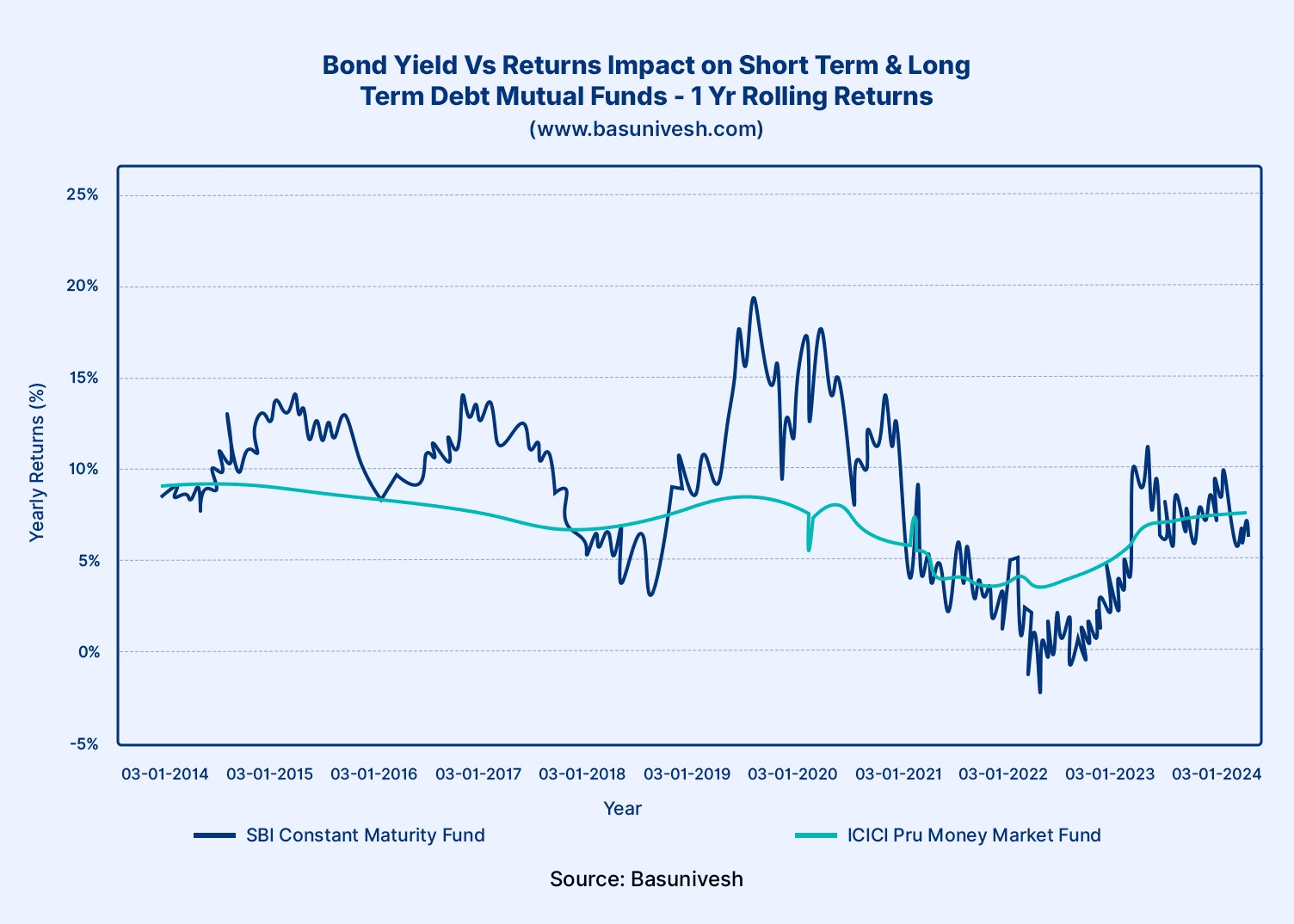
The SBI corporate bond fund returns are dependent on the interest rate cycle. Recently, the SBI corporate bond fund has been providing yearly returns of about 6%-8%.
If one invests INR 1 lakh in the SBI corporate bond fund for five years, their returns might not be highly significant but more consistent than stocks.
2. Benchmark Comparison
The SBI corporate bond fund uses the CRISIL Corporate Bond Index as the benchmark. The performance of the fund has been consistent with the benchmark for the most part.
It has managed to perform better than the benchmark occasionally due to its active management practices.
3. Consistency Across Interest Rate Cycles
Interest rate variations have an effect on all debt funds. However, the SBI Corporate bond fund has maintained steady performance through various interest cycles.
When there is a fall in interest rates, prices increase. When there is a rise, short-term effects can be observed, but in the long run, the fund takes steps to remain stable. This consistency is good for your investment planning purposes.
SBI Corporate Bond Fund – Key Details At A Glance
| Parameter | Details |
| Fund Category | Debt – Corporate Bond Fund |
| Fund House | SBI Mutual Fund |
| Benchmark Index | CRISIL Corporate Bond Fund Index |
| Minimum Investment | INR 5,000 (Lump Sum) / ?500 (SIP) |
| Expense Ratio (Direct) | ~0.36%–0.40% |
| Exit Load | Nil |
| 1-Year Return | ~7.5%–8.0% |
| 3-Year Return (CAGR) | ~6.5%–7.5% |
Portfolio Allocation And Risk Factors
The SBI corporate bond fund emphasises stability with quality investments. The composition of the fund will help you gauge its appropriateness.
- Top Sector Exposure
The SBI corporate bond fund primarily comprises securities from the financial industry. These are banks, NBFCs, and public sector entities with good credit ratings.
A certain percentage of the portfolio could be invested in other industries, such as infrastructure or corporations.
- Average Maturity And YTM
The fund has a relatively moderate maturity period. This ensures protection from interest rate fluctuations. Longer maturity periods expose the investor to higher risks, while shorter maturity periods lower the risks involved.
Yield to Maturity (YTM) represents the anticipated returns on holding the bond to its maturity date. The SBI corporate bond fund generally provides a higher YTM than other alternatives available to the investor.
- Interest Rate And Credit Risks
The interest rate risk is an important aspect of the SBI Corporate Bond Fund. If the interest rates increase, the price of bonds may decrease. It can affect your immediate returns.
The credit risk is relatively less since there are highly rated bonds. But it can never be zero.
Expense Ratio and Taxation
SBI Corporate Bond Fund has expenses and taxes. These aspects influence your eventual profit directly. Knowing them allows you to make sound decisions.
Expense Ratio Impact On Returns
The expense ratio is the yearly payment to cover all the expenses. It influences the long-term profitability of a fund even at a minimum percentage. Though a gap of 0.5% may not be much, it will eventually reduce your profit.
The expense ratio of the SBI Corporate Bond Fund remains very competitive.
Worldwide, cost efficiency is an important factor for funds' success. Research done by Morningstar proves that inexpensive funds perform better than their peers.
Debt Fund Taxation Rules After Recent Changes
The taxation rules for debt funds have been revised recently. Capital gains are taxed based on the slab applicable to you. Indexation benefits are no longer applicable for most debt funds.
Thus, your returns on the SBI Corporate Bond Fund are included in your total income, which is then taxed depending on your income slab.
Conclusion
The SBI Corporate Bond Fund can suit investors who want a balance between stability and predictable income. Its focus on high quality corporate debt helps reduce credit risk, while active management aims to handle changing interest rates more effectively. Although returns may not match equity funds, the relatively steady performance can make it a useful part of a diversified portfolio. Before investing, it is important to review the fund’s NAV movement, expense ratio, and taxation so your decision aligns with your financial goals and time horizon.
For investors looking to diversify beyond traditional debt funds, platforms like Grip Invest can offer additional fixed income opportunities that complement a balanced portfolio.
FAQs On SBI Corporate Bond Funds
 |
Author: Grip Invest Editorial Team The Grip Invest Editorial Team is a group of Chartered Accountants, MBA (Finance) graduates, and Qualified Research Analysts dedicated to helping you invest smarter. We dive deep into India's fixed income landscape to deliver content that is accurate, up-to-date, and easy to understand. Whether you're exploring bonds, fixed deposits, or other fixed income opportunities, our guides cut through the noise and give you the clarity to make better financial decisions. |
Want to stay at the top of your finances?
Join the community of 4 lakh+ investors and learn more about Grip Invest, the latest financial knick-knacks, and shenanigans in the world of investing.
Happy Investing!
Disclaimer - Investments in debt securities/municipal debt securities/securitised debt instruments are subject to risks including delay and/ or default in payment. Read all the offer related documents carefully. The investor is requested to take into consideration all the risk factors before the commencement of trading.
This communication is prepared by Grip Broking Private Limited (bearing SEBI Registration No. INZ000312836 and NSE ID 90319) and/or its affiliate/ group company(ies) (together referred to as “Grip”) and the contents of this disclaimer are applicable to this document and any and all written or oral communication(s) made by Grip or its directors, employees, associates, representatives and agents. This communication does not constitute advice relating to investing or otherwise dealing in securities and is not an offer or solicitation for the purchase or sale of any securities. Grip does not guarantee or assure any return on investments and accepts no liability for consequences of any actions taken based on the information provided. For more details, please visit www.gripinvest.in
Registered Address - 106, II F, New Asiatic Building, H Block, Connaught Place, New Delhi 110001


