

OpenAI IPO Analysis: Business Model, Financials, Valuation And Investment Outlook


OpenAI is now seen as more than the maker of ChatGPT. It has become a private AI company that investors watch closely because of its role in consumer AI, enterprise automation and AI infrastructure.
In June 2026, reports said the company had confidentially filed for a US IPO. The possible valuation was placed at up to USD 1 trillion, although the offer size and listing timeline have not been confirmed.1
The market backdrop is also expanding. Gartner forecast worldwide AI spending of USD 2.59 trillion in 2026, a 47% year-on-year rise. Stanford’s 2026 AI Index noted that generative AI reached 53% population-level adoption within three years.2,3
This is why OpenAI company analysis draws investor attention. But to understand the opportunity, readers need to look beyond ChatGPT and study how the company is structured.
Company Overview: What Is OpenAI?
OpenAI is an AI research and deployment company. It builds large AI models and turns them into products for consumers, developers and enterprises.
Its main products include ChatGPT, OpenAI APIs, Codex, image and audio tools, enterprise AI solutions and agentic workflows. These tools help users write, code, analyse, search, automate tasks and build AI-powered applications.
OpenAI is not structured like a normal listed technology company. The OpenAI Foundation controls OpenAI Group PBC, a public benefit corporation. At the time of recapitalisation (28 October 2025):
- OpenAI Foundation held a 26% equity stake
- Microsoft held roughly 27%
- The remaining 47% was held by employees, former employees and investors.
OpenAI’s company profile shows why it is different from a normal software firm. It combines research, consumer products, enterprise tools and infrastructure-heavy AI development.4
The next question in ChatGPT company analysis is how does this model make money?
OpenAI Business Model: How Does OpenAI Make Money?
OpenAI earns revenue from users who pay for access to better AI tools, faster models and higher usage limits. Its business model now spreads across subscriptions, API usage, enterprise contracts, developer tools and emerging ad-based monetisation.
OpenAI’s business model can be understood in 5 layers:
1. Consumer subscriptions
ChatGPT is the most visible part of OpenAI’s business. Users can access free and paid plans, while paid plans offer stronger access, higher usage limits and more advanced model capabilities.
This gives OpenAI a recurring consumer revenue stream. It also gives the company a large user base that can later move into work, business and developer use cases. On 31 March 2026, ChatGPT had more than 900 million weekly active users and over 50 million subscribers.5
2. Business and enterprise plans
OpenAI’s second layer is workplace adoption. Companies use ChatGPT Business and ChatGPT Enterprise for employees, teams and internal workflows. These plans are not just chatbot access. They include admin controls, security features, usage analytics and enterprise-level support.
On 5 November 2025, OpenAI said more than 1 million business customers were directly using OpenAI. This included organisations paying for ChatGPT for Work and companies consuming OpenAI models through the developer platform.6
On 8 April 2026, the enterprise made up more than 40% of revenue and was on track to reach parity with consumer revenue by the end of 2026. 7
3. API and developer usage
This is usage-based revenue. Developers and companies pay to use OpenAI models inside their own applications, workflows and customer-facing products.
Companies pay based on model consumption, usually linked to tokens, which are the units of text processed by AI models. On 8 April 2026, its APIs were processing more than 15 billion tokens per minute.8
4. Codex and agents
OpenAI is also moving deeper into coding and agentic workflows. Agents are AI tools that can complete multi-step tasks rather than only answer one prompt.
Codex is a key example. It supports code generation, refactoring and software workflow automation. On 8 April 2026, Codex had reached 3 million weekly active users.9
5. Ads and commerce
OpenAI is also exploring revenue beyond subscriptions and API usage. In January 2026, the company outlined plans to test clearly labelled ads for logged-in adult users in the US across Free and Go plans.10 By 31 March 2026, its ads pilot had crossed USD 100 million in annualised recurring revenue in less than six weeks.
Commerce is another route being tested. On 29 September 2025, OpenAI launched Instant Checkout inside ChatGPT with Stripe and the Agentic Commerce Protocol. In this model, users can complete purchases inside ChatGPT, while merchants pay a small fee on successful transactions.
These options are still developing. They are not yet the main base of OpenAI’s revenue, but they show how ChatGPT could gradually move from a paid-access product to a broader consumer and commerce platform.
This mix gives OpenAI more than one route to revenue. However, it also creates a cost challenge. More usage means more computing demand, and AI computing is expensive.
That is why the financial picture needs a closer look.
OpenAI Financial and Valuation Overview
OpenAI’s financial profile shows a company scaling fast, but with a cost base that is also expanding.
Financial overview
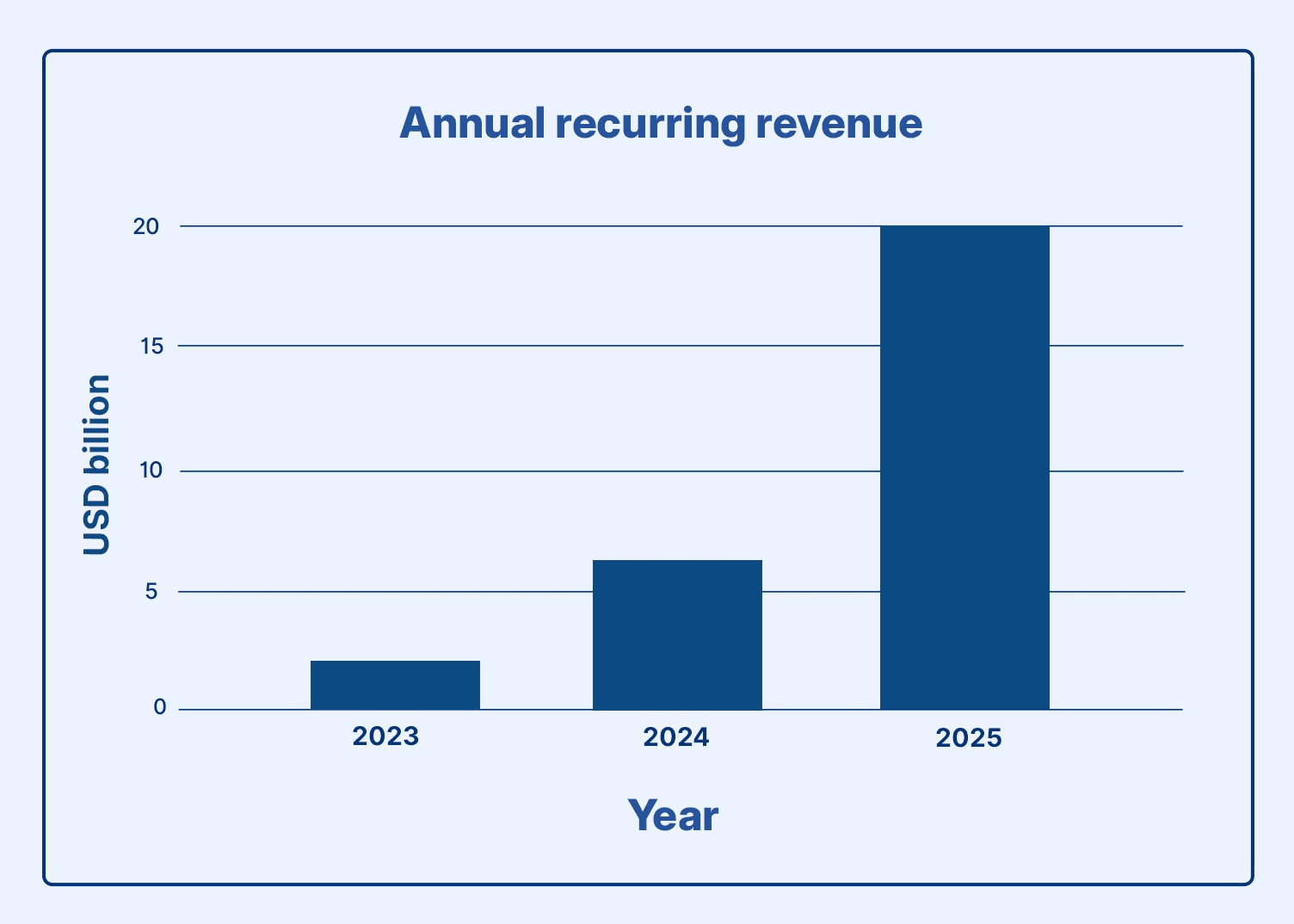
OpenAI’s revenue growth has accelerated sharply over the last three years. On 18 January 2026, OpenAI said its annual recurring revenue increased from USD 2 billion in 2023 to USD 6 billion in 2024 and more than USD 20 billion in 2025.11
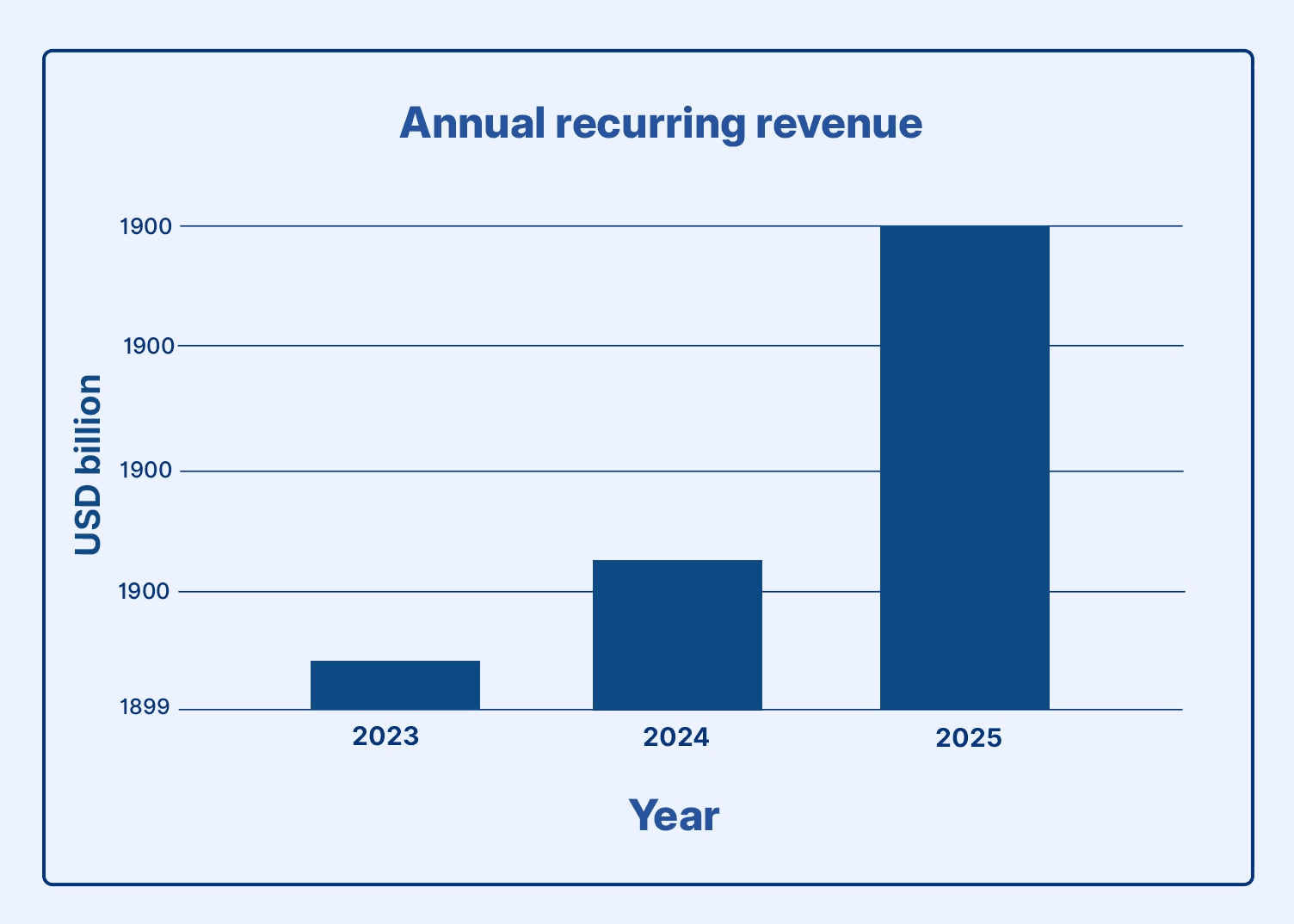
The company also said its compute capacity grew from 0.2 GW in 2023 to 0.6 GW in 2024 and around 1.9 GW in 2025. OpenAI’s revenue growth is closely tied to how much computing power it can access.12
Valuation overview
OpenAI’s valuation reflects both its commercial growth and the market’s expectation that AI will become a major technology layer. On 31 March 2026, OpenAI said it closed USD 122 billion in committed capital at a USD 852 billion post-money valuation.
The funding also gives OpenAI more room to invest. The company said it expanded its revolving credit facility to about USD 4.7 billion, which remained undrawn at close.14
A high valuation can hold if revenue continues to grow faster than compute, talent, infrastructure and compliance costs.15 It becomes harder to support if user growth slows, enterprise adoption weakens or model development costs remain high.
Reported estimates suggest the cost pressure is still large. OpenAI burned USD 3.7 billion in the first quarter of 2026, compared with quarterly revenue of USD 5.7 billion.16 The company could also spend around USD 600 billion on computing resources through 2030.17
OpenAI’s financial story has two sides. Revenue momentum is clear. However, the cost structure is still heavy.
That brings investors to the risk side of the story.
Risks Associated With OpenAI
OpenAI’s technology growth potential is large, but the company carries risks that investors should not ignore. Here are the key risks to track.
OpenAI Risks | What it means for investors |
High compute cost | AI models need large data centres, chips and energy |
Cash burn | Fast growth may still require heavy funding |
Competition | Google, Anthropic, Meta, xAI and others are investing heavily |
Pricing pressure | Rival models can push prices lower over time |
Copyright disputes | Publishers and creators have challenged AI training practices |
Regulation | AI rules may increase compliance costs |
Safety concerns | Harmful outputs or misuse can affect trust and adoption |
Cloud dependency | OpenAI still depends heavily on large cloud infrastructure |
Regulation is becoming a bigger issue. The EU AI Act entered into force on 1 August 2024 and becomes fully applicable on 2 August 2026, with some exceptions. This affects transparency, general-purpose AI obligations and high-risk AI systems.
OpenAI also faces legal and trust challenges.
There are copyright disputes involving OpenAI and Microsoft. The US Federal Trade Commission has also opened an inquiry into AI chatbots, including OpenAI, to understand safety risks for children and teens.19
Hence, OpenAI has a strong market position, but it still needs to prove operating leverage. When analsying OpenAI future growth, investors should watch whether revenue grows faster than compute and compliance costs.
Should Investors Consider AI Exposure?
Investors should view OpenAI as part of a wider AI opportunity, not as a standalone investment option yet.
Investors can study AI exposure through listed cloud companies, chipmakers, data centre firms, enterprise software companies and AI-focused funds. Each artificial intelligence investment has different risk. Semiconductor companies may benefit from infrastructure demand. Software companies may benefit from AI tools becoming part of daily work.
The OpenAI case also offers an important portfolio lesson. High-growth themes can create opportunity, but they can also bring valuation risk. AI companies may grow revenue fast and still spend heavily. That means investors should track margins, cash flow, customer retention, regulation and competition.
For Indian investors, balance matters. High-growth themes like artificial intelligence can form one part of a portfolio, but diversification across asset classes remains equally important. Alongside equities, investors may also consider fixed-income investments such as corporate bond to help manage risk and generate relatively stable income. Platforms like Grip provide access to a range of fixed-income investment opportunities, enabling investors to build more balanced portfolios.
FAQs On OpenAI IPO Analysis
 |
Author: Grip Invest Editorial Team The Grip Invest Editorial Team is a group of Chartered Accountants, MBA (Finance) graduates, and Qualified Research Analysts dedicated to helping you invest smarter. We dive deep into India's fixed income landscape to deliver content that is accurate, up-to-date, and easy to understand. Whether you're exploring bonds, fixed deposits, or other fixed income opportunities, our guides cut through the noise and give you the clarity to make better financial decisions. |
Want to stay at the top of your finances?
Join the community of 4 lakh+ investors and learn more about Grip Invest, the latest financial knick-knacks, and shenanigans in the world of investing.
Happy Investing!
Disclaimer - Investments in debt securities/municipal debt securities/securitised debt instruments are subject to risks including delay and/ or default in payment. Read all the offer related documents carefully. The investor is requested to take into consideration all the risk factors before the commencement of trading.
This communication is prepared by Grip Broking Private Limited (bearing SEBI Registration No. INZ000312836 and NSE ID 90319) and/or its affiliate/ group company(ies) (together referred to as “Grip”) and the contents of this disclaimer are applicable to this document and any and all written or oral communication(s) made by Grip or its directors, employees, associates, representatives and agents. This communication does not constitute advice relating to investing or otherwise dealing in securities and is not an offer or solicitation for the purchase or sale of any securities. Grip does not guarantee or assure any return on investments and accepts no liability for consequences of any actions taken based on the information provided. For more details, please visit www.gripinvest.in
Registered Address - 106, II F, New Asiatic Building, H Block, Connaught Place, New Delhi 110001


