

Option Trading In India: Meaning, Strategies, Risks And Rewards (2026 Guide)


The growth of the Indian economy has led to the rising popularity of sophisticated investment categories like futures and options. According to a report published on 10 July 2025, the Futures Industry Association stated that equity derivative trading in India accounts for 60% of global volume. Moreover, the last fiscal year recorded the participation of 11 million traders in the equity futures and options trading, according to SEBI1.
Simply put, options allow investors to purchase or sell a certain asset at a defined price and period. This blog breaks down the seemingly complicated concept of options in detail and offers a nuanced yet beginner-friendly explainer on how to trade options in India.
Let us first understand the meaning of option trading.
Beginner's Guide To Option Trading India: What Is Option Trading?
Effective analysis of option trading meaning begins with understanding what derivatives are.
The definition of derivatives states that it is a contracts between entities that derive their worth from an underlying asset. For instance, imagine the cost of mangoes today is INR 100 per dozen. You expect the price to increase and become INR 120 in one month. So, you enter into a forward contract with your friend today, stating that you will buy 1 dozen mangoes at INR 100 after 1 month. If your assumption becomes true, you will earn a profit of INR 20. This is a derivative contract, and the mangoes are the underlying asset.
Now, options are a type of derivative. It allows investors to purchase or sell a certain asset at a defined price and period. The concept is similar to the illustration given before.
However, note that there is more to options trading. Understanding this requires us to analyse a few related concepts.
1. Call Option, Put Option Explained
Discussed below are the two key kinds of options.
- Call Option: It gives the right to purchase the underlying at a specific date and price.
- Put Option: It gives the right to sell the underlying at a specified strike price on or before expiry, depending on exercise style.
In India, stock options are American-style and physically settled, while index options are European-style and cash-settled.
2. Option Trading Key Concepts
Discussed below is an explainer on some important terminologies related to options.
- Strike Price: It refers to the fixed price at which the underlying asset is expected to be bought or sold.
- Premium: Note that the definition of option trading calls it a right to buy or sell the underlying asset in the future. It is a right and not an obligation. The option buyer pays a premium to the option writer in exchange for this right.
- Expiry: It is the final date by which an option can be exercised. After the expiry date, an unexercised option lapses and has no value.
The illustration below can explain the concept better.
Suppose the stocks of XYZ Ltd. are trading at INR 80 per share. Mr A expects it to be valued at INR 120 in one month. He uses an option and promises to buy the 100 shares at INR 80 per share by 1 October 2025. Moreover, he pays a premium of INR 100 (INR 1 per share).
Now, if the price actually increases, Mr A can earn a profit. However, if the price falls, he might choose not to exercise the option, resulting in a loss equal to the premium paid.
- Anticipated Profit: INR 12000 - INR 8000 - INR 100 = INR 3,900
- Anticipated Loss: Premium already paid = INR 100
Moreover, the decision to execute or not to execute the order must be taken before the expiry date of 1 October 2025; otherwise, the option will expire automatically.
Remember, a standalone long call limits downside to the premium paid; options can also be combined with stock (for example, a protective put) to hedge downside risk. What are these strategies that limit your losses; let's explore them.
Popular Option Trading Strategies
Discussed in this section are some key strategies for option trading, explained through their meaning, examples and charts.
1. Covered Call
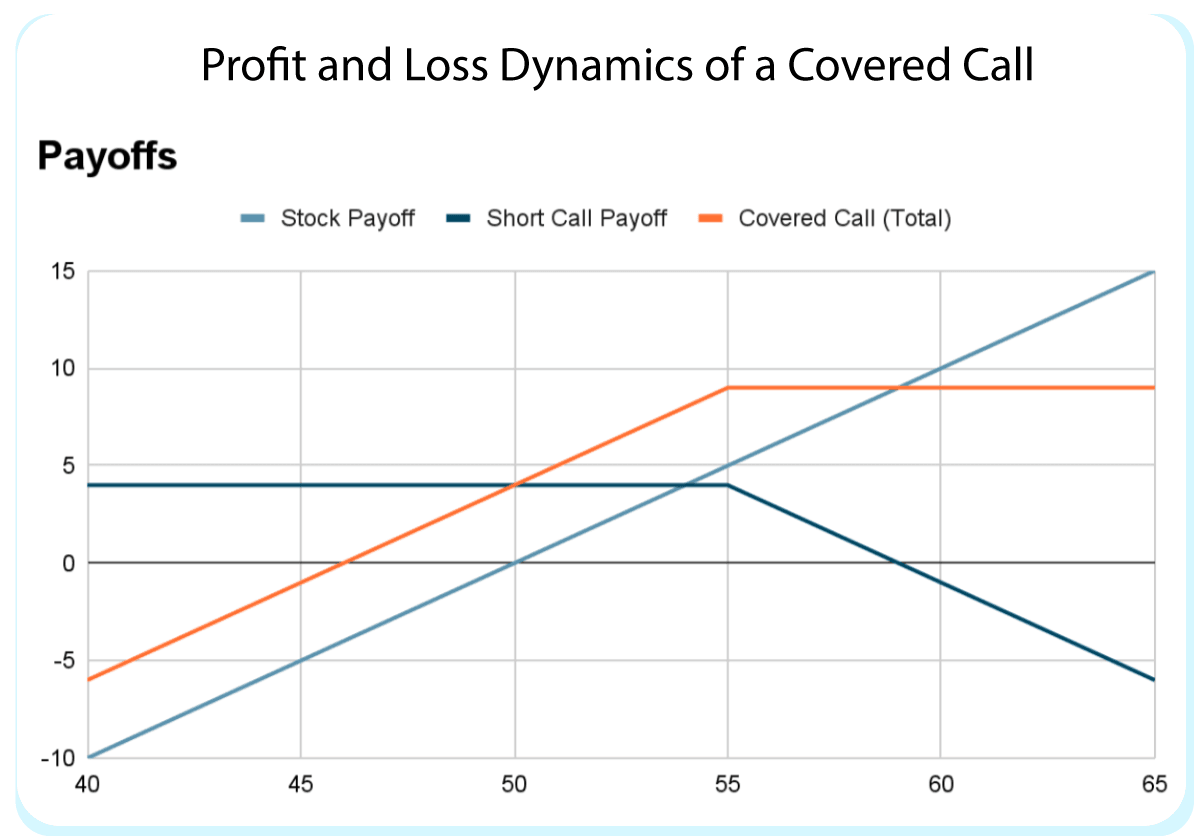
According to the covered call strategy, a trader maintains a long position on a stock that he owns and sells a call option on it.
Suppose Mr A holds stock purchased at INR 50 and sells a call option with a strike of INR 55 for a premium of INR 4 per share. Now, there can be three scenarios in the future.
Scenario A: Stock price between INR 50 and INR 55 (say INR 54)
The option expires worthless because the market price is below the strike price of INR 55. Mr. A keeps his stock, now valued at INR 54, and also retains the option premium.
Cost price: INR 50
Stock value at expiry: INR 54
Return = (54 – 50) + 4 = INR 8
Scenario B: Stock price above INR 55 (say INR 60)
The option buyer exercises, so Mr. A must sell at INR 55.
He forgoes the extra gain beyond 55 but keeps the premium.
Return = (55 – 50) + 4 = INR 9
(Missed profit = 60 – 55 = 5, but that’s opportunity cost, not an actual loss.)
Scenario C: Stock price below INR 50 (say INR 45)
The stock value falls to INR 45.
Mr. A keeps the INR 4 premium, but suffers a net loss.
Break-even = 50 – 4 = INR 46
Net Return = (45 – 50) + 4 = –INR 1
The chart below shows the profit or loss generated by selling a call option (stock payoff), premium earned on selling it (short call payoff) and their resultant summation (covered call).
2. Straddle/Strangle
Straddle and Strangle strategies are used to profit from significant price movement and volatility. Examples are the best way to understand them.
A. Straddle:
The trader purchases one call and one put option with the identical strike price and expiration. In case of large up or down movements, either of the options makes gains. If there is no significant price change, both premiums paid can be a loss. Check out the example below for clarity:
Long straddle: Buy one call and one put at strike INR 50, each at a premium of INR 2 (total premium INR 4). Breakeven points are INR 54 and INR 46. Maximum loss is INR 4 at INR 50. Profits occur if the price moves sufficiently up or down.
B. Strangle
In this case, the strikes are above or below the current price. Let's understand with the following example:
Long strangle: Buy one call at strike INR 53 and one put at strike INR 47, each at a premium of INR 1 (total premium INR 2). Breakeven points are INR 55 and INR 45. This costs less than a straddle but requires a larger move to profit.
Important Note: Long straddles and strangles benefit from increases in implied volatility and are negatively affected by time decay; without a strong move or volatility expansion, both options can lose value.
3. Protective Put
A protective put involves buying a put option while holding the underlying stock. It establishes a floor value for the shares, capping downside while retaining upside potential reduced by the premium.
For example, P buys a share at INR 50. He then buys 1 put option with an INR 45 strike for an INR 2 premium. Therefore, the maximum downside loss becomes INR 7 (50 - 45 + 2), while the upside after deducting the premium is unlimited. The table below shows the payoff.
Deciding between option trading vs stock trading by exploring various strategies is not enough. A microscopic view of the key risks and rewards is essential to optimise a strategy.
Option Trading Risks And Rewards
Discussed below are key risks and strengths associated with options trading.
- Leverage Advantage: During option trading, the investors actually buy the entire promised lot at the anticipated price. They pay a premium for the chance to make future purchases. Therefore, leverage, in the form of this premium, helps investors to take large positions with limited capital outlay.
- Loss potential: While the loss for option buyers is limited by the premium, the degree of risk for sellers is substantial. Moreover, unexpected market volatility can add to the risk. Investment decisions not backed by optimal research can cause acute losses.
- Buyers’ maximum loss equals the premium paid. Uncovered option writers face substantial risk—potentially unlimited for short calls and very large for short puts—and must meet margin and possible assignment obligations.
Additionally, the risks of options trading are not limited to sudden market swings or poor individual decisions, manipulation by institutional players can also have real effects. A notable instance is the controversy involving Jane Street, a global trading firm known for its sophisticated strategies. In 2025, the Securities and Exchange Board of India (SEBI) fined Jane Street and barred it from India's securities market after finding that the firm engaged in manipulative options trading practices, distorting index levels for profit. SEBI’s investigation uncovered that Jane Street’s activities generated unlawful gains by influencing settlement prices and creating artificial volatility, actions that exposed retail investors to sudden price distortions and unfair trades.
This underscores the need for robust risk management, platform due diligence, and maintaining diversified portfolios to safeguard against both systemic and manipulation-driven risks in options trading.
Therefore, although there are several option trading apps in India, choosing the right platform is key to mitigating risks. Moreover, portfolio diversification across different assets is also important.
Balancing High Risk with Safer Assets
Fixed-income bearing instruments like bonds, securitised debt instruments and other debt assets can offer mitigation for high-risk assets. Grip houses some of the top instruments in these categories, offering industry-competitive returns. The table below shows some of them.
| Assets | Expected Returns |
| Corporate Bonds | 9% to 14% |
| Mutual Funds | 7% to 12% |
| Corporate Fixed Deposits | 8% to 10% |
Conclusion
Options trading is a sophisticated modern investing medium that requires expertise and experience. Moreover, while volatility is a characteristic trait of the market, optimal research and portfolio diversification can help mitigate it.
To balance your portfolio, consider safer fixed-income instruments alongside high-risk trades. Grip Invest, India’s one-stop destination for fixed income returns, provides access to curated bonds, securitised debt instruments, and other debt assets to help you diversify with confidence.
FAQs on Option Trading In India
1. Can I start option trading with a small capital in India?
Yes. Buyers can start with relatively small capital because only the premium is paid upfront; however, Indian F&O trades occur in lots and also incur brokerage, taxes, and fees. Writing options require margins.
2. Is option trading riskier than stocks?
Options involve significant risk and complexity. The choice between stocks and options should reflect objectives, risk tolerance, and experience, noting that many retail participants in derivatives incur losses.
3. How are options taxed in India?
Options are taxed under the business income category. It is classified as non-speculative business income and taxed according to the applicable tax slabs.
4. Which app is best for option trading in India?
There are several options trading apps in India. The choice of a suitable app must be made after considering individual fiscal needs and goals, along with the features offered by the platform.
References:
1. CNBC, accessed from: https://www.cnbc.com/2025/07/10/cnbcs-inside-india-newsletter-indias-options-market-faces-a-reality-check.html
2. Aljazeera, accessed from: https://www.aljazeera.com/economy/2025/7/18/indias-ban-on-jane-street-raises-concerns-over-regulator-role
Want to stay at the top of your finances?
Join the community of 4 lakh+ investors and learn more about Grip Invest, the latest financial knick-knacks, and shenanigans in the world of investing.
Happy Investing!
Disclaimer - Investments in debt securities/municipal debt securities/securitised debt instruments are subject to risks, including delay and/ or default in payment. Read all the offer-related documents carefully. The investor is requested to take into consideration all the risk factors before the commencement of trading.
This communication is prepared by Grip Broking Private Limited (bearing SEBI Registration No. INZ000312836 and NSE ID 90319) and/or its affiliate/ group company(ies) (together referred to as “Grip”) and the contents of this disclaimer are applicable to this document and any and all written or oral communication(s) made by Grip or its directors, employees, associates, representatives and agents. This communication does not constitute advice relating to investing or otherwise dealing in securities and is not an offer or solicitation for the purchase or sale of any securities. Grip does not guarantee or assure any return on investments and accepts no liability for the consequences of any actions taken based on the information provided. For more details, please visit www.gripinvest.in
Registered Address - 106, II F, New Asiatic Building, H Block, Connaught Place, New Delhi 110001


