

Over Diversification Explained: When Too Many Investments Hurt Returns


Investments carry risk, and diversification is the key to managing it. Diversification involves dispersing your investments in a way that balances the risk prevalent in each. The primary aim of diversification is to reduce the risk in the overall portfolio.
However, diversification beyond a certain point may reduce the portfolio's performance. Over-diversification occurs when a portfolio consists of many investments, originally for diversification, that dilute the returns of each additional asset.
Thus, spreading money everywhere may not always be smart. This article explores what over-diversification means, how to recognise it, why it can hurt returns, and how investors can correct it using better asset allocation.
What Is Over Diversification?
Over-diversification in investing is the process of increasing investments in your portfolio to the point that they begin diluting returns rather than controlling risk.
For example, if your portfolio consists of 3 large-cap funds, 2 flexi-cap funds, and one ELSS fund, your portfolio may be diluted. This is due to the similar investment scope of all these funds, which may lead to an overlap in actual holdings. These funds commonly hold stocks like HDFC Bank, Reliance, and ITC in their portfolio. Therefore, the actual exposure is repeated rather than diversified.
Investors must comprehend the distinction between diversification vs over-diversification. A healthy diversification occurs when money is spread across different asset types. Over-diversification repeats investment of a similar nature, building overlapping portfolios. While diversification manages risk, over-diversification tackles the fear of investors.
Signs Your Portfolio Is Over-Diversified
Here are some signs that you can look for to assess if your portfolio is over-diversified:
1. Too many investment portfolios:
Check if your portfolio contains multiple funds in the same category. This may include holding too many large-cap funds or small-cap funds. Additionally, these different schemes may comprise overlapping stocks, ultimately diluting your portfolio returns.
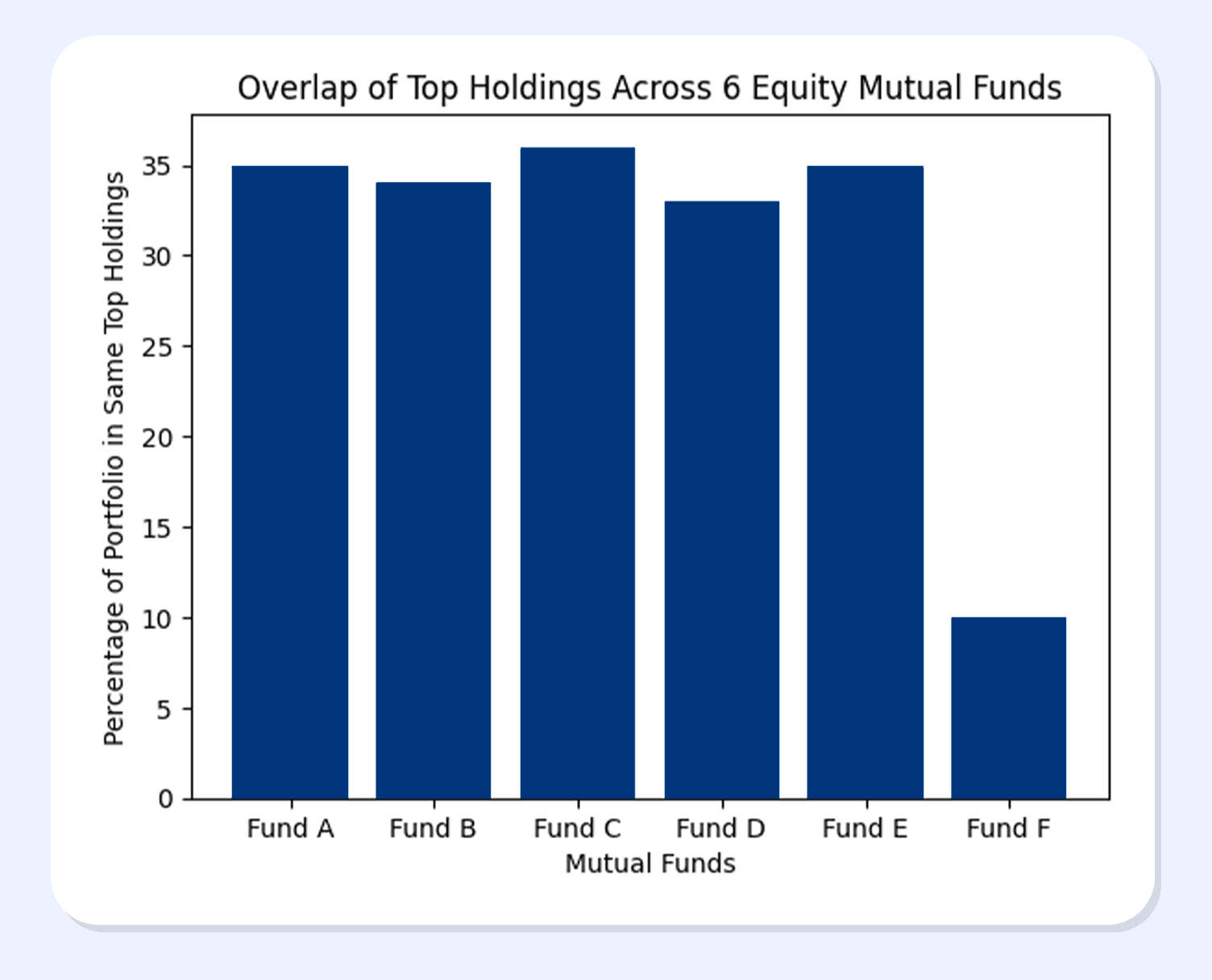
For instance, an investor owns six equity mutual funds. After reviewing their portfolios:
- Five funds hold nearly the same top ten stocks
- Those top holdings make up more than one-third of the entire portfolio
This creates the illusion of variety while delivering concentrated exposure.
2. Performance mirrors the index
When your portfolio behaves almost exactly like an index but costs you more, over-diversification is often the reason because of how exposure gets diluted and duplicated. Common signs include a portfolio closely following the Nifty or Sensex, holding many different funds, or requiring regular monitoring.
These signs may imply you are accepting additional complexity without gaining superior returns. This is known as portfolio dilution, where strong performers fail to lift the overall result because their weight is too small.
Why Over-Diversification Reduces Returns
An over-diversified portfolio can reduce returns and amplify risk.
Winning investments lose influence
When a strong performer represents only a small portion of your portfolio, its success barely improves your total wealth.
For example, you invest INR 10 lakh across 12 funds. One fund grows by 25% but makes up only INR 80,000 of your total capital. The gain from that fund is just INR 20,000. Meanwhile, the rest grow modestly.
A more focused structure would allow that outperformer to contribute more meaningfully to overall returns.
Management becomes harder
Managing a crowded portfolio becomes challenging due to frequent rebalancing, greater tax events, and increased tracking of fund managers. In fact, increased administrative burden is a crucial indicator of overcrowding in a portfolio. Investors will be overburdened with the management of their portfolios.
How To Fix An Over-Diversified Portfolio
A well-diversified portfolio holds the right amount of funds that strike a balance between risk and reward. To correct an overdiversified portfolio, undertake these steps:
1. Reduce overlapping investments: First, track funds that invest in similar stocks or sectors, employ similar strategies, or hold stocks with consistent performance.
2. Retain strong options: From among the overlapping stocks, evaluate the top-performers, lowest expense ratios, and strong future outlook.
3. Determine appropriate asset allocation: Plan how much of your portfolio is to be allocated within each asset class. Consolidate into a smaller set of a well-diversified portfolio rather than holding fewer assets.
4. Combine with fixed-income instruments: Use a combination of fixed-income instruments along with equity to balance growth and stability.
Where Fixed Income And Bonds Fit In
Fixed income and bonds play a critical role in reducing volatility and improving predictability.
1. Using bonds as stabilisers instead of multiple low-return assets
Instead of holding several low-return or overlapping investments, bonds can act as stabilisers within a portfolio. They provide a steady income and protect capital during equity market downturns. This allows equity investments to focus on growth while bonds handle risk moderation. A well-chosen bond allocation can replace the need for excessive diversification across similar equity funds.
2. Curated bond options on modern platforms
Investors today have access to curated bond and fixed-income options through digital investment platforms. Platforms like Grip Invest offer structured access to bonds with varying tenures and risk levels, making it easier to build stability without overloading the portfolio with redundant assets. By selecting a few carefully evaluated fixed-income instruments, investors can achieve balance without sacrificing simplicity.
Conclusion
Diversification is essential for risk control, but beyond a certain point, it can weaken performance. Over-diversification creates overlapping exposure, reduces the impact of strong investments, and complicates portfolio management. The solution lies in thoughtful consolidation and disciplined asset allocation rather than adding more instruments. By combining focused equity exposure with stabilising fixed-income assets, investors can build portfolios that are both resilient and efficient. Ultimately, smart diversification is not about owning more, it is about owning the right mix.
Visit Grip Invest today!
FAQs On Over Diversification
1. How many investments are considered over-diversification?
There is no fixed number, but holding multiple funds with similar strategies or overlapping holdings often signals over-diversification. If several investments behave the same way and track the same index or sectors, the portfolio may be diluted regardless of how many instruments you hold.
2. Is over-diversification worse than under-diversification?
Both carry risks, but over-diversification usually hurts returns silently. Under-diversification increases volatility, while over-diversification reduces the impact of winners and adds unnecessary complexity without improving risk-adjusted returns.
3. Can mutual fund overlap cause over-diversification?
Yes. Mutual fund overlap is one of the most common causes of over-diversification. Holding multiple large-cap, flexi-cap, or index-oriented funds often leads to repeated exposure to the same stocks, which weakens diversification benefits.
4. Does adding bonds increase diversification or over-diversify a portfolio?
Adding bonds improves diversification when done through proper asset allocation. Unlike adding more equity funds, bonds serve a different purpose by reducing volatility and providing stability, making them a strategic complement rather than a source of over-diversification.
Want to stay at the top of your finances?
Join the community of 4 lakh+ investors and learn more about Grip Invest, the latest financial knick-knacks, and shenanigans in the world of investing.
Happy Investing!
Disclaimer - Investments in debt securities/municipal debt securities/securitised debt instruments are subject to risks including delay and/ or default in payment. Read all the offer related documents carefully. The investor is requested to take into consideration all the risk factors before the commencement of trading.
This communication is prepared by Grip Broking Private Limited (bearing SEBI Registration No. INZ000312836 and NSE ID 90319) and/or its affiliate/ group company(ies) (together referred to as “Grip”) and the contents of this disclaimer are applicable to this document and any and all written or oral communication(s) made by Grip or its directors, employees, associates, representatives and agents. This communication does not constitute advice relating to investing or otherwise dealing in securities and is not an offer or solicitation for the purchase or sale of any securities. Grip does not guarantee or assure any return on investments and accepts no liability for consequences of any actions taken based on the information provided. For more details, please visit www.gripinvest.in
Registered Address - 106, II F, New Asiatic Building, H Block, Connaught Place, New Delhi 110001


