

P/B Ratio: Meaning, Formula And How To Use It To Find Undervalued Stocks


It has been a major challenge for the investors to find stocks which are being sold for less than their actual worth. One of the more popular ways to find this information is to use the Price to Book ratio, or P/B ratio.
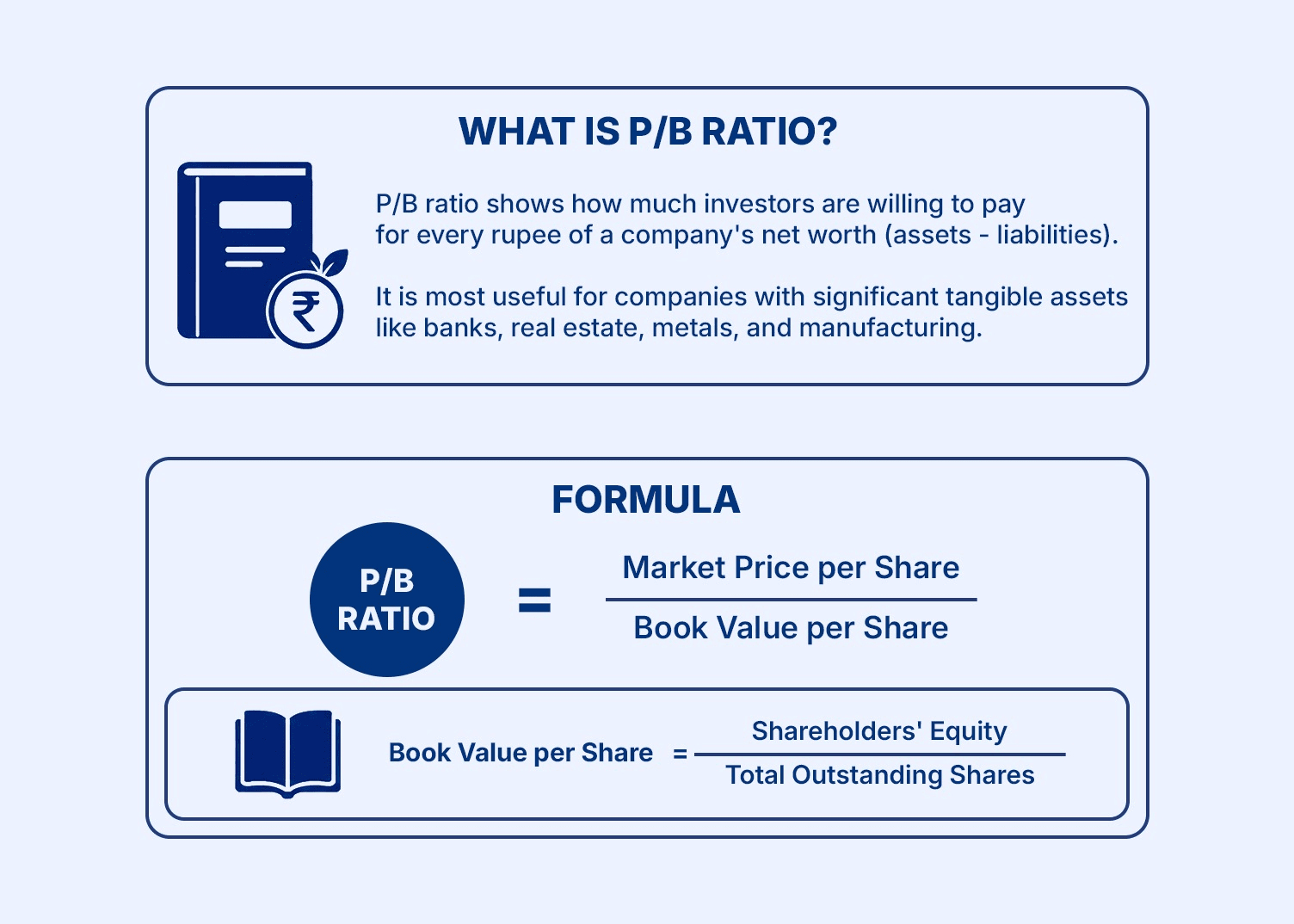
This ratio calculates the market price of a stock compared to its net asset value. The P/B ratio is particularly useful when measuring companies that have a lot of tangible assets recorded on their balance sheet.
By understanding the P/B ratio, you will be better equipped to make informed investing decisions. It shows you the current price that an investor has to pay for every rupee of the company's net worth. Let's look at a few simple examples of what the P/B ratio means.
What Is The P/B Ratio?
The P/B ratio gives investors an idea of whether the stock is cheap or expensive in relation to the company's book value. The book value of a company is equal to what would be remaining if all its liabilities were paid off and all its assets were sold. Therefore, companies with a low P/B ratio could be viewed as being undervalued in terms of their net assets.
The P/B ratio will generally work better with businesses that have a significant level of assets than it will with businesses that do not, such as banks, manufacturers, and real estate. The ratio is not as useful for technology companies because the highest value of those companies will be in their brand names. Many value investors use the P/B ratio as a screening mechanism to help them do additional research into each targeted company.
P/B Ratio Formula
The PB ratio formula is quite easy to understand and apply:
P/B Ratio = Market Price per Share ÷ Book Value per Share
Hypothetical Example:
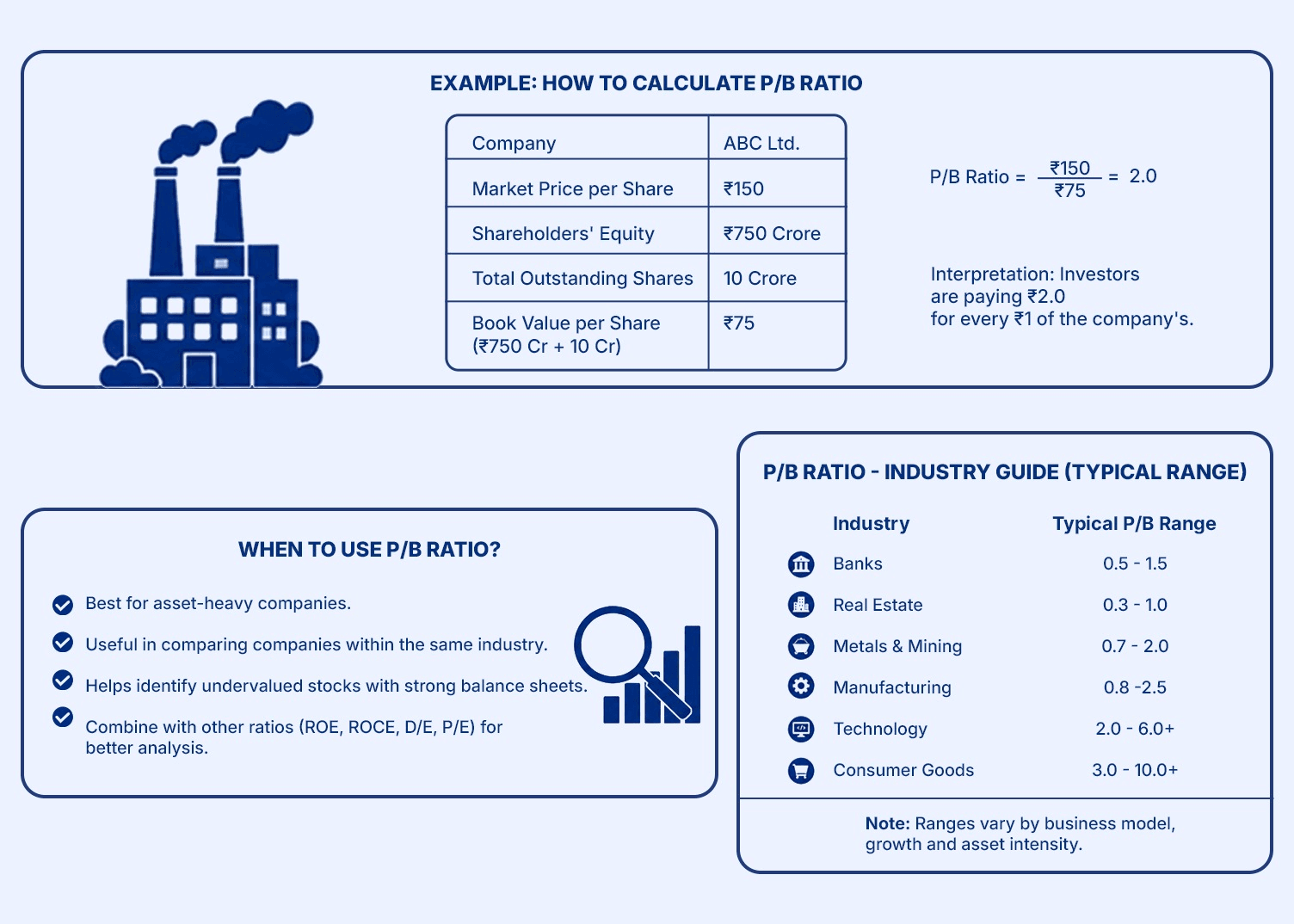
When a stock trades at INR 200 (market price) versus its book value of INR 160 per share, the resulting P/B ratio = 1.25. This means investors pay 1.25 times for every INR 1 of net asset value. The P/B ratio formula will help you perform comparisons among companies in the same industry. You should always work from the latest balance sheet figures to ensure accuracy.
How To Find A Good P/B Ratio?
P/B Ratio's value completely depends on factors, including the industry's compliance, the growth potential, and the general economic conditions.
- When it comes to a good P/B ratio, it is subjective, but if the P/B is below 1, then the stock is trading for less than its book value. This would indicate that the stock is undervalued. It may also indicate problems with the underlying asset(s) or risks in terms of the company's future.
- In terms of valuing companies in the financial or banking sector using the P/B ratio metric, companies that experience a P/B ratio within a range of 1 – 2 are generally viewed as reasonable valuations for healthy growth companies. If companies have P/B ratios higher than 3, there is the likelihood that they may be overvalued, unless they can substantiate their higher valuation through higher-than-average returns or growth.
In India, when valuing stocks in the banking sector using the P/B ratio, e.g., Private Banks or Public (Government ) Banks with strong fundamentals continue to trade at higher multiples relative to Public or Government Banks.
When The P/B Ratio Is Most Useful?
Several circumstances demonstrate the power of the P/B ratio.
- When a company owns a lot of physical or financial assets, the P/B is often an excellent measure of value. Because banks and non-banking financial corporations that focus mainly on the strength of their balance sheets use this metric extensively, it's generally a good measurement for businesses that are primarily financial in nature.
- The P/B ratio can assist investors in locating potential investments in fundamentally sound firms that are temporarily undervalued.
- The P/B ratio is also beneficial when evaluating turnaround stories because investors can determine the potential return on their investment from owning a business with a low P/B ratio.
- Screening for companies based on their P/B ratio can often reveal hidden gems in cyclical sectors or overlooked public sector entities that may have been considered value traps. Other indicators, such as return on equity and asset quality, should always be used in conjunction with this measure.
When P/B Ratio Misleads?
The price to book ratio (P/B ratio) can be a useful tool for buying stocks when evaluating value, but it's not without its drawbacks. A sizable number of businesses have intangible assets that add to their overall enterprise value but are not factored into their P/B ratios.
Companies like software developers and consumer products typically have high P/B ratios that do not adequately convey their true enterprise value due to the value of their intangible assets. Companies that own older or fully depreciated assets may also be incorrectly valued due to the way depreciation is recorded.
Additionally, companies with brand-new, highly optimised (efficiency) manufacturing plants may have very high P/B ratios on their balance sheets when they are, in fact, completely competitive and capable of generating excess returns. Having a negative book value makes the ratio unusable as well.
High levels of debt can also affect the interpretation of the P/B ratio, so care must be taken to investigate why a company's P/B ratio is lower than normal or higher than normal in comparison to other companies.
P/B Ratio vs P/E Ratio: Which To Use And When?
Investors should also consider both the P/B and P/E ratios when determining whether a company is potentially undervalued or overvalued.
While the P/B ratio provides investors with an idea of asset value as of today, the P/E ratio provides insight into expectations about future profitability. It is particularly beneficial to utilise the P/B ratio when investing in companies that are asset-heavy or not currently generating positive earnings. P/B ratios will provide investors with a good estimation of value for banks, as they can relate their P/B value to the amount they plan to lend to customers.
The P/E ratio is better suited for stable and growing companies that are generating a profit and, as such, will provide a more accurate assessment of a company's overall value. Many investors will look at both P/B and P/E ratios when purchasing shares in order to assess a company's overall financial performance and prospects.
The P/B ratio provides an investor with a minimum level of value based on the historical values of the assets of the company. This E ratio provides an investor with insight into the market's expectation of future profitability for the company. Both of these ratios should be used by an intelligent investor together rather than alone.
Additional Important Points
Buybacks can also help decrease the number of shares outstanding and have the potential to increase the book value per share and positively affect the P/B ratio when a company's profit increases as a result of these actions.
A low P/B ratio for a stock with a declining ROE may not be a true bargain. The P/B ratio should be used as part of an overall toolkit of valuation methods. Qualitative factors like management quality and industry trends should also be used to assess whether a stock is over- or under-valued. The P/B ratio can be very useful for banking stocks in India because this industry is asset-heavy.
Conclusion
The P/B Ratio serves as a good way to screen for stocks in an investor’s toolkit. Using the P/B Ratio Formula together with a proper understanding of the Book Value Per Share will allow an investor to effectively utilise the P/B Ratio to evaluate stock selection.
Investors in India are always looking for undervalued stocks P/B ratio for detailed analysis as part of their overall investment approach. When evaluating financial ratios, you should use them with patience and in context. Savvy investors will look for more than one number before they invest their capital.
Armed with this knowledge will allow you to go beyond your surface-level prices and have more confidence in your ability to determine true worth. Keep learning, keep comparing and let your data help guide you through your long-term investment journey.
FAQs On P/B Ratio
 |
Author: Grip Invest Editorial Team The Grip Invest Editorial Team is a group of Chartered Accountants, MBA (Finance) graduates, and Qualified Research Analysts dedicated to helping you invest smarter. We dive deep into India's fixed income landscape to deliver content that is accurate, up-to-date, and easy to understand. Whether you're exploring bonds, fixed deposits, or other fixed income opportunities, our guides cut through the noise and give you the clarity to make better financial decisions. |
Want to stay at the top of your finances?
Join the community of 4 lakh+ investors and learn more about Grip Invest, the latest financial knick-knacks, and shenanigans in the world of investing.
Happy Investing!
Disclaimer - Investments in debt securities/municipal debt securities/securitised debt instruments are subject to risks including delay and/ or default in payment. Read all the offer related documents carefully. The investor is requested to take into consideration all the risk factors before the commencement of trading.
This communication is prepared by Grip Broking Private Limited (bearing SEBI Registration No. INZ000312836 and NSE ID 90319) and/or its affiliate/ group company(ies) (together referred to as “Grip”) and the contents of this disclaimer are applicable to this document and any and all written or oral communication(s) made by Grip or its directors, employees, associates, representatives and agents. This communication does not constitute advice relating to investing or otherwise dealing in securities and is not an offer or solicitation for the purchase or sale of any securities. Grip does not guarantee or assure any return on investments and accepts no liability for consequences of any actions taken based on the information provided. For more details, please visit www.gripinvest.in
Registered Address - 106, II F, New Asiatic Building, H Block, Connaught Place, New Delhi 110001


