

Raamdeo Agrawal’s Investment Journey And Key Lessons For Retail Investors


When discussing some of the most impressive investor journeys of Indian billionaires, the name Raamdeo Agrawal often comes to mind. According to a recent candid interaction in a podcast, Mr Agrawal stated that earning the first one or ten crore is usually attributed to God’s grace. According to the billionaire investor, achieving that mark is one of the most challenging things to do, and the best is attained through discipline, compounding, selecting the right stocks, and perseverance.
Raamdeo Agrawal is a believer in India’s growth story and often suggests that the country is yet to attain its potential in terms of economic growth and equity market development. Over the years, he has developed a reputation for spotting multibagger stocks and sectors. Beyond his financial achievements, Agrawal’s journey holds immense significance for retail investors who often struggle with the complexities of markets. His philosophy offers a structured approach to wealth creation, moving away from speculative instincts toward disciplined decision-making
Let us delve deeper into the investment journey and the philosophy behind one of the most successful investors in the Indian equities market: Raamdeo Agrawal.
Raamdeo Agrawal’s Investing Philosophy
Agrawal frequently emphasises the importance of patience and discipline while recounting his journey to achieving net worth growth. However, just these two factors are not enough, as not every investor ends up building a billion-dollar net worth while being focused and keeping invested in the stock markets.
1. Focus On Quality And Longevity
Agrawal often suggests that there are no exceptions when choosing stocks, as most of his investments are based on the quality of the company, the longevity of the enterprise, and the sector. For him, quality is defined not just by profitability but also by management integrity, corporate governance, and the ability to generate predictable cash flows. He has consistently advocated for staying invested in companies that can withstand economic cycles and generate value over the long term.
This philosophy has helped him choose and stick with stocks for decades, supporting the idea that wealth creation is dependent on the quality of a business, rather than cyclical or short-term trends in the stock market.
2. QGLP Framework
From a philosophical and theoretical perspective, one of Agrawal’s is the QGLP (Quality, Growth, Longevity, and Reasonable Price) framework. This model helps investors identify businesses that not only demonstrate superior quality but also have strong growth potential, the ability to sustain performance over long periods, and are available at valuations that make sense.
Ever since Agrawal coined this term and concept, it has served as a benchmark for numerous long-term investors in India. This helps investors avoid speculation risks and focus on stocks and companies that can offer consistent wealth creation.
3. Long Term Compounding
Agrawal’s interviews, interactions, and communications are often full of references to the ‘power of compounding’, and he usually describes it as ‘the eighth wonder of the world’. His philosophy demonstrates how holding quality stocks for 10–20 years can exponentially multiply wealth.
He urges investors to allow time, not constant trading, to do the heavy lifting. For example, Raamdeo Agrawal Hero Honda investment has been one of the best bets, and he held the investment for over two decades.
Let us understand what he is talking about by analysing a graph:
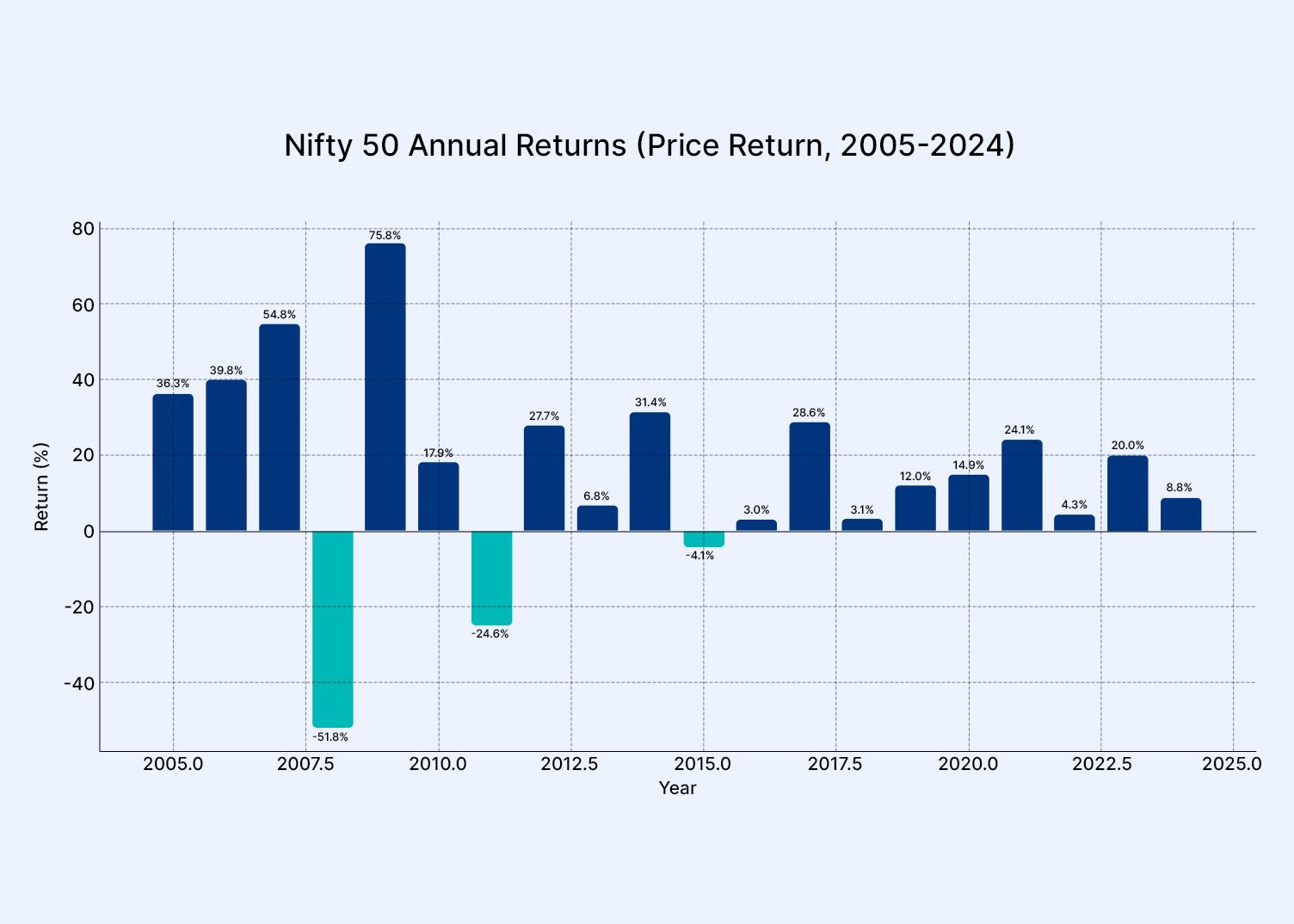
There are instances where the benchmark index of the Indian stock markets has managed negative returns. Sometimes, the annual returns were less than the FD rates. However, the benchmark still managed a CAGR of 12.34%. This implies that INR 1 lakh invested in the Nifty 50, with a moderate to low risk profile, could have easily grown to INR 9.10 lakhs. This does not include any kinds of dividend reinvestments.
What Retail Investors Can Learn From Raamdeo Agrawal
It might sound simple, but Agrawal’s portfolio consists of multibaggers, and he emphasises that due to increased transparency in the Indian markets, it is tough to recreate 80s and 90s-like abnormal returns. However, investors have more information about the markets, sectors, industries, and the economy than ever before. This should be the edge over traditional investing.
1. Patience Is The Key To Compounding
The central lesson from Agrawal’s career is the importance of patience. Markets often test investors with volatility, but those who stay the course in fundamentally strong businesses are rewarded. Many retail investors exit too soon or become distracted by short-term fluctuations.
2. Framework-Based Investing Beats Speculation
Unlike speculation, framework-driven investing ensures that decisions are not clouded by emotions or short-lived market news. Agrawal’s QGLP model demonstrates the power of using clear criteria before committing capital. Retail investors can adopt similar structured approaches, relying on checklists and predefined rules to guide their decisions.
3. Diversification And Risk Management
Diversification is more than just including stocks from different companies and sectors in a portfolio. Agrawal emphasises the importance of spreading risk across sectors and asset classes. Concentrated bets can be rewarding but carry disproportionate risks. For retail investors, diversification remains one of the simplest yet most effective risk management tools.
4. Alternate Assets For Stability (Bonds and Fixed Income Securities)
Agrawal’s philosophy also highlights the role of stability in wealth-building. Beyond equities, alternative assets such as bonds, SDIs, and curated investment products from platforms like Grip Invest provide an important counterbalance to market volatility. These instruments can generate predictable returns, offering stability when equities fluctuate.
Criticism And Challenges
Different critics argue that the Raamdeo Agrawal QGLP framework can result in filtering multiple opportunities in the market and is considered a rather ‘safe’ investment philosophy. Using this approach, it can be quite challenging for an investor to become a multibagger, and many high-growth opportunities may be missed. Other critics highlight the phases of underperformance faced by Motilal Oswal Funds, emphasising that no single philosophy can consistently work and adhering to rigidity can result in high opportunity costs in investments.
However, Agrawal’s willingness to acknowledge mistakes and refine his strategy adds credibility to his philosophy. Retail investors can take away the lesson that setbacks are inevitable, but adapting and staying committed to core principles is what defines lasting success.
Conclusion
Even though there might be a few critics underlining issues in Raamdeo Agrawal investment philosophy, there is a large number of people for whom the strategy has worked out well. The philosophy and investment approach sound quite straightforward, but as Agrawal mentioned, at times, you do need a little bit of luck to build the initial investment corpus.
The biggest takeaway is the power of compounding, allowing time and discipline to work in your favour. Equally, his insights remind investors that diversification, risk management, and including alternative assets such as bonds, SDIs are critical for balance.
Login to Grip Invest- India’s one stop destination for fixed income returns, and explore curated bond opportunities, diversified alternative investments, and smarter ways to grow your wealth with stability.
FAQs on Raamdeo Agrawal
1. What is Raamdeo Agrawal’s QGLP framework?
The QGLP framework stands for Quality, Growth, Longevity, and Price. It helps investors focus on high-quality businesses with strong growth potential, sustainable performance over time, and reasonable valuations.
2. Which was Raamdeo Agrawal’s most successful investment?
One of his most successful picks was Hero Honda (now Hero MotoCorp) in the early 1990s, which turned into a massive multibagger and remains a classic example of his conviction in quality and longevity.
3. How does Raamdeo Agrawal’s style differ from Warren Buffett’s?
While both focus on quality and long-term investing, Agrawal’s style is tailored to emerging market dynamics in India, using QGLP as a structured approach. Buffett, on the other hand, emphasises global value investing with a stronger focus on moats and capital allocation.
4. What lessons can small retail investors apply from Raamdeo Agrawal’s journey?
Retail investors can learn to stay patient, follow a disciplined framework, diversify risks, and balance equities with alternative assets such as bonds, SDIs, and Grip products for stable, long-term wealth creation.
Want to stay at the top of your finances?
Join the community of 4 lakh+ investors and learn more about Grip Invest, the latest financial knick-knacks, and shenanigans in the world of investing.
Happy Investing!
Disclaimer - Investments in debt securities/municipal debt securities/securitised debt instruments are subject to risks including delay and/ or default in payment. Read all the offer related documents carefully. The investor is requested to take into consideration all the risk factors before the commencement of trading.
This communication is prepared by Grip Broking Private Limited (bearing SEBI Registration No. INZ000312836 and NSE ID 90319) and/or its affiliate/ group company(ies) (together referred to as “Grip”) and the contents of this disclaimer are applicable to this document and any and all written or oral communication(s) made by Grip or its directors, employees, associates, representatives and agents. This communication does not constitute advice relating to investing or otherwise dealing in securities and is not an offer or solicitation for the purchase or sale of any securities. Grip does not guarantee or assure any return on investments and accepts no liability for consequences of any actions taken based on the information provided. For more details, please visit www.gripinvest.in
Registered Address - 106, II F, New Asiatic Building, H Block, Connaught Place, New Delhi 110001


