

Did RBI Sell Gold Reserves? $12 Billion Report Explained


Introduction: Why RBI’s Gold Reserves Became a Talking Point
With the West Asia conflict continuing, a recent report by Bloomberg claimed that the country’s central bank might have sold gold reserves worth $12 billion with a view to protect its foreign exchange reserves.1
The report further suggests that the world’s third largest importer of crude oil had to take this decision as the domestic currency continued falling against the US dollar, thereby further pushing up the energy costs.
The RBI, though its official communication has denied any such transaction and advised media and the general public to rely on the information provided by the Reserve Bank only2. However, this has once again resulted in a renewed interest of analysts, economists and the general public in RBI’s gold reserves.
Understanding RBI’s Gold Reserves
What Are RBI Gold Reserves?
As the manager of the country’s monetary policy and regulator of foreign exchange, the RBI has its gold reserves besides foreign currencies and government securities. These are portions of the country’s official reserve assets and gold serves as a strategic asset due to its value.
India has steadily increased its RBI gold reserves over the past decade. Gold tends to retain value during periods of economic uncertainty, inflation, geopolitical conflicts, and currency volatility.
How RBI Manages Its Gold Holdings?
The RBI actively manages the reserve portfolio, including gold to maintain liquidity, safety and returns. The RBI gold holdings are stored both domestically and abroad, thereby offering flexibility and security to the central bank. It is different from holding foreign currency assets as the yellow metal carries no counterparty risk and is a long-term hedge against global financial instability.
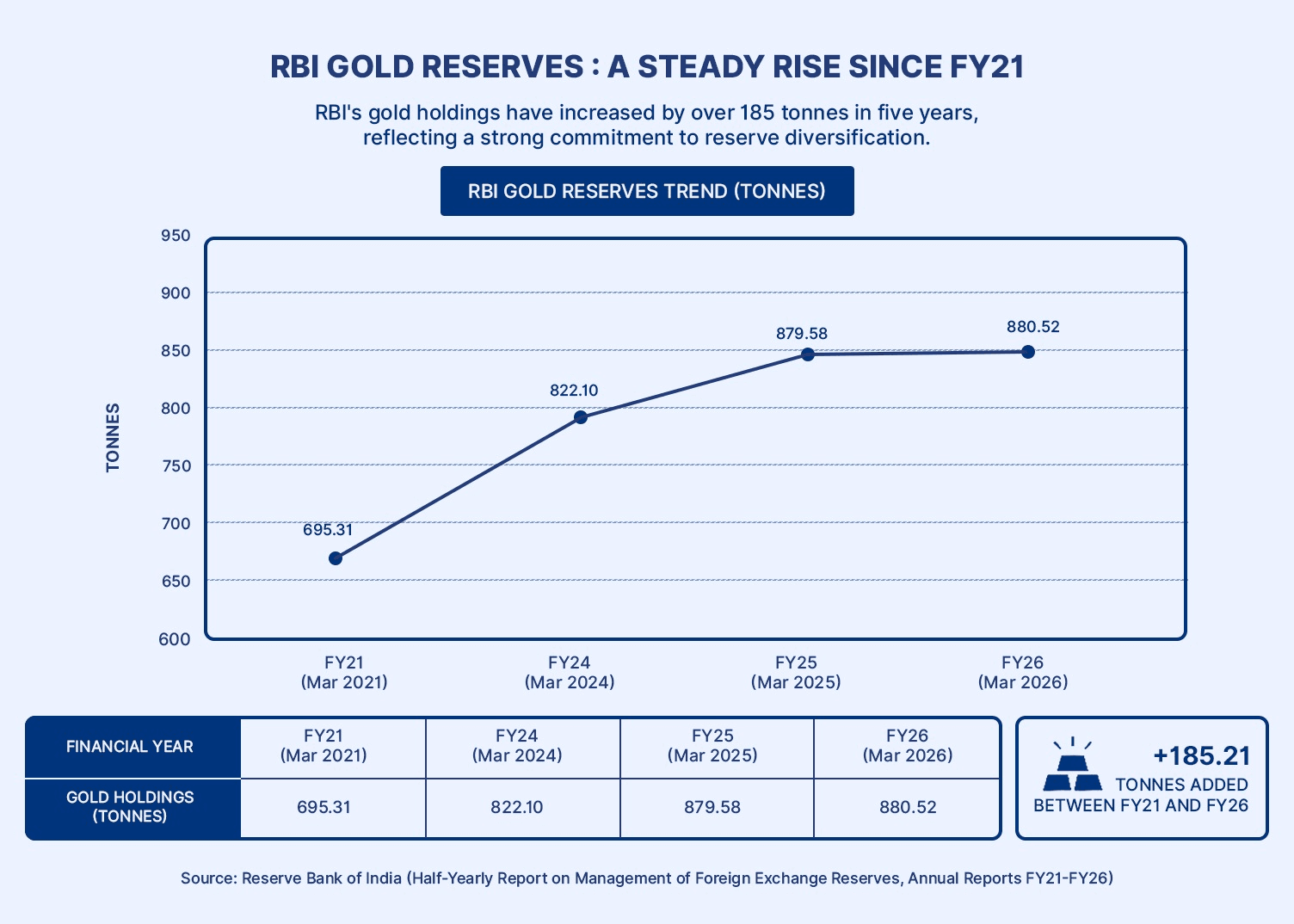
In the past five years, RBI has consistently increased its gold reserves and it was reported that in September 2025, the total reserves surpassed 880 metric tons. However, ever since the West Asia crisis started, the rupee has struggled against the US dollar and the prices of crude oil and other essential commodities have increased significantly.3
The $12 Billion Gold Sale Report: What Happened?
What the Report Claimed
The controversy began when Bloomberg Economics published an analysis suggesting that the RBI may have sold around $12 billion worth of gold during the two weeks ending May 22, 2026. The report argued that the central bank appeared to be reducing gold exposure while simultaneously increasing foreign currency assets.
The reasons for the transactions was attributed to the consistent decline in the rupee’s value versus the US dollar and the fact that the crude oil prices have increased by more than 50% ever since the conflict started.
The report also underlined how inflation in India has increased consistently in the past few weeks, surpassing 3-year levels. The Bloomberg report triggered widespread discussions about a possible RBI gold sale, especially as investors attempted to assess how India was responding to evolving global risks.
Why Would RBI Sell Gold?
There are different reasons and circumstances when the RBI decides to sell gold:
Possible Reason | Objective |
Liquidity management | Increase cash availability |
Reserve rebalancing | Adjust asset allocation |
Currency support | Strengthen intervention capacity |
Risk management | Diversify reserve composition |
Bloomberg has mentioned that it has collected information from publicly available data sources. However, the RBI has refuted any such claims and the gold reserve levels have remained the same in the latest official communication published by the central bank.
RBI’s Response: Did India Actually Sell Gold?
The RBI quickly dismissed the speculation which was also fact checked by PIB. The central bank issued an official clarification refuting the claims by Bloomberg and underlined that the gold reserves remain unchanged at 880.52 metric tons for the given period.
This entire episode can also be a reminder that the reserve data can sometimes be interpreted differently by analysts and market participants. Whereas analysts from Bloomberg analyzed the patterns, the physical gold levels remained the same, as reconfirmed by the RBI.
Gold Reserves and India’s Forex Strategy
The debate surrounding gold reserves highlights the importance of gold reserve management in modern central banking. Gold plays a critical role because it tends to move differently from other currencies. During market stress periods, it can be an excellent stabilizing agent.
Recent pressures linked to rupee depreciation have increased attention on reserve management decisions. Even though the updates regarding the increased crude oil prices and inflation are to the point, the RBI has continued to use a range of policy tools to maintain orderly market conditions.
What Does This Mean for Indian Investors?
The recent speculation surrounding the Iran war impact on India and reserve management should not be viewed as a sign that the RBI is moving away from gold. It is also a reminder of the importance of cross checking any updates from media houses as many reports can be based on mere pattern analysis and for critical areas, it is highly recommended to use the information provided by official channels only.
This is also a reminder for the investors to understand the market-related factors such as inflation, geopolitical risks, currency movements, and gold price India might pose some volatility at different points of time but it is important to trust the fundamentals of the economy.
Conclusion
The reports suggesting that the RBI sold $12 billion worth of gold generated significant market attention, particularly against the backdrop of geopolitical tensions and currency volatility. However, the central bank has categorically denied these claims and confirmed that its physical gold stock remains unchanged.
For investors, it is important to always rely on the information provided by official sources such as regulators and government agencies as media reports can be based on patter and technical analysis and might reflect incomplete information. Suryoday
FAQs On RBI's Gold Reserves
 |
Author: Grip Invest Editorial Team The Grip Invest Editorial Team is a group of Chartered Accountants, MBA (Finance) graduates, and Qualified Research Analysts dedicated to helping you invest smarter. We dive deep into India's fixed income landscape to deliver content that is accurate, up-to-date, and easy to understand. Whether you're exploring bonds, fixed deposits, or other fixed income opportunities, our guides cut through the noise and give you the clarity to make better financial decisions. |
Want to stay at the top of your finances?
Join the community of 4 lakh+ investors and learn more about Grip Invest, the latest financial knick-knacks, and shenanigans in the world of investing.
Happy Investing!
Disclaimer - Investments in debt securities/municipal debt securities/securitised debt instruments are subject to risks including delay and/ or default in payment. Read all the offer related documents carefully. The investor is requested to take into consideration all the risk factors before the commencement of trading.
This communication is prepared by Grip Broking Private Limited (bearing SEBI Registration No. INZ000312836 and NSE ID 90319) and/or its affiliate/ group company(ies) (together referred to as “Grip”) and the contents of this disclaimer are applicable to this document and any and all written or oral communication(s) made by Grip or its directors, employees, associates, representatives and agents. This communication does not constitute advice relating to investing or otherwise dealing in securities and is not an offer or solicitation for the purchase or sale of any securities. Grip does not guarantee or assure any return on investments and accepts no liability for consequences of any actions taken based on the information provided. For more details, please visit www.gripinvest.in
Registered Address - 106, II F, New Asiatic Building, H Block, Connaught Place, New Delhi 110001


