

SBI Mutual Fund Review: Best Schemes, Performance, And How To Invest Smartly


Imagine a person investing for the first time who wishes to initiate a INR 3,000 monthly SIP but is confused by the multitude of fund houses and options available. What they essentially need is stability, returns over the long term, and a brand that they can trust. A decision to go with a big AMC like SBI Mutual Fund, which not only provides a variety of products but also shows good performance across different categories and has efficient risk-management systems, is thus the very thing that energizes such an investor to make a start without deliberating too much or taking a risk that is not required.
SBI Funds Management Ltd. (SBI MF) is one of India’s largest Asset Management Companies and is among the most trusted investment houses in India. Backed by the trust, distribution power, and risk-management culture of the State Bank of India, SBI MF has become the choice of crores of Indian investors.
Its product basket, consistent performance across categories, and strong retail presence make it a preferred AMC for SIPs, long-term wealth creation, and balanced portfolio strategies. If you are a beginner looking for a reliable fund house or an experienced investor seeking the best SBI Mutual Fund options for 2026, this review covers the top schemes, performance metrics, investment considerations, and how these funds can be part of your financial planning.
Overview Of SBI Mutual Fund (SBI AMC)
Over the years, SBI AMC has become the largest AMC in India (AUM of INR 11,13,952.42 crore as of December 2024), with a presence in more than 200 locations and a significant market share in the equity, debt, and hybrid segments1.
1. Broad Spectrum of Mutual Fund Categories
SBI AMC has products from different segments, which are:
- Equity Funds – Large-cap, mid-cap, small-cap, sectoral, thematic, ELSS
- Debt Funds – Liquid, overnight, short-duration, corporate bond, gilt funds
- Hybrid Funds – Balanced advantage, equity-savings, dynamic asset allocation
- Other Solutions – ETFs, index funds, fund-of-funds
Such a configuration enables investors to build a fully diversified portfolio from a single AMC.
2. AUM Control Over Categories
The AMC leads in:
- Equity AUM — Mainly by flagship funds like SBI Bluechip and SBI Small Cap
- Debt AUM — Its low-risk liquid and short-term funds have been the main contributors
- Hybrid AUM — The growth of the popular SBI Balanced Advantage Fund has been the major factor
3. Investment Philosophy
SBI MF follows a thoroughly research-driven and long-term investment strategy:
- Strong bottom-up stock selection
- Risk-adjusted returns focus
- Experienced fund managers with sector specialization
- Disciplined asset allocation and compliance-driven framework
Top SBI Mutual Funds For 2025-26
Below is a brief review of some of the best-performing and most trusted SBI Mutual Fund schemes across categories. (Performance data is indicative)
1 .SBI Bluechip Fund (Large Cap Fund)
- 3-year return (CAGR): ~13.5%
- 5-year return(CAGR): ~17%
Why it stands out: Stability, low volatility, and strong exposure to the top Nifty 50 companies.
2. SBI Small Cap Fund
- 3-year return(CAGR): ~13-14%
- 5-year return(CAGR): ~20-22%
Why it stands out: Strong track record of stock selection in emerging businesses.
3 .SBI Balanced Advantage Fund
- 3-year return (CAGR): ~14%
Why it stands out: Dynamic asset allocation that reduces volatility and market-timing risk.
4. SBI Tax Advantage Fund (ELSS)
- 5-year return(CAGR): ~22-23%.
Why it stands out: Tax-saving + equity growth + lock-in discipline.
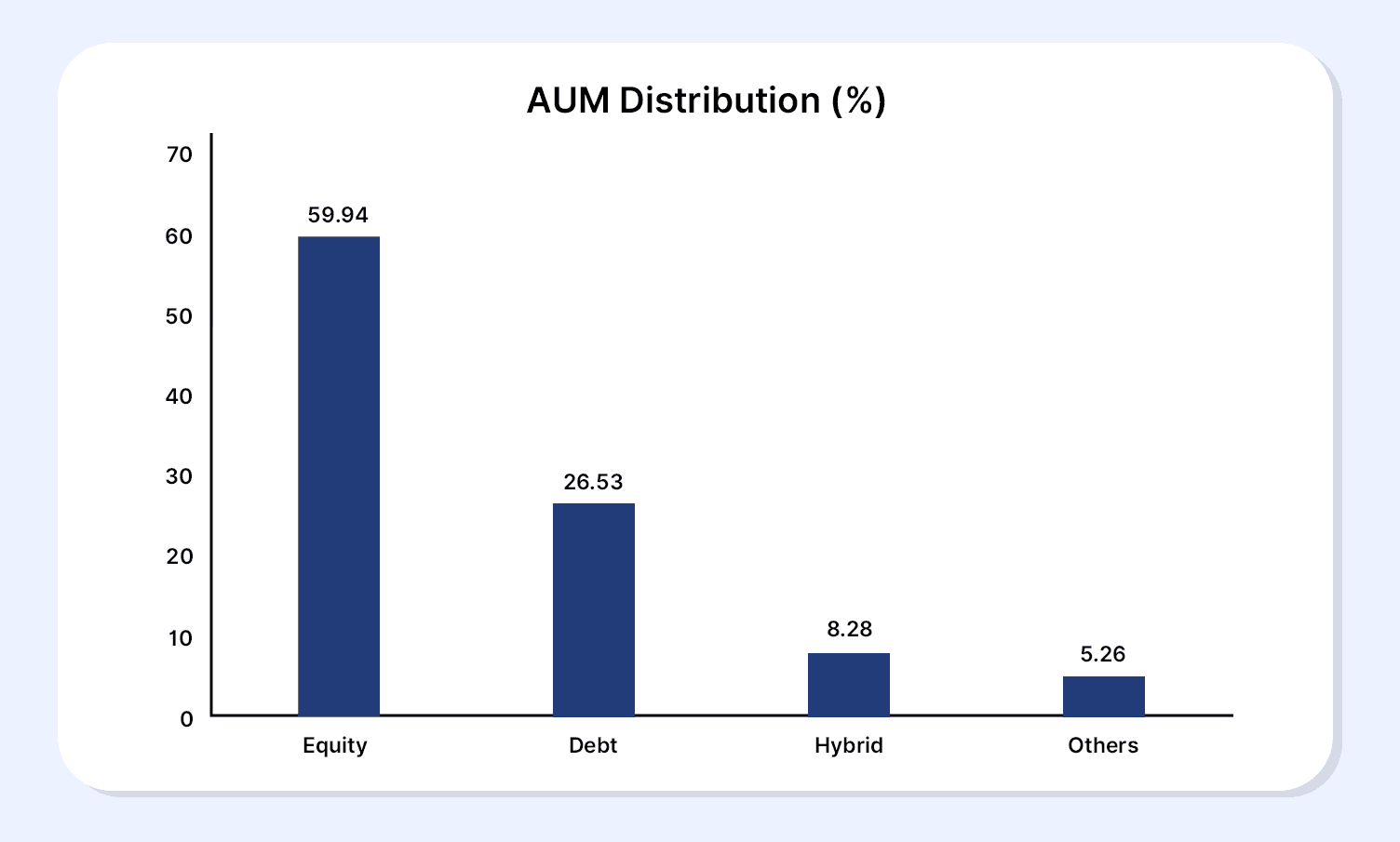
Even though the equity funds offer the highest returns, it is important to understand the importance of other funds such as hybrid and debt from the perspective of your portfolio’s diversification. Here is the category-wise AUM distribution for the mutual fund investors in India:
Who Should Consider SBI Mutual Fund?
SBI MF is a diversified fund that caters to the needs of a varied investor base. However, it mainly suits the following types of investors:
1. Beginners initiating their first SIP
New investors will opt for SBI MF due to the following reasons:
- Good knowledge of the SBI brand
- Availability of funds with low volatility
- Easy onboarding from any digital platform
Investing in a fund like SBI Bluechip or SBI Equity is a great way for a beginner to start.
2. Investors Desire to Get Diversified Exposure from a Large AMC
The size of the SBI MF gives the following benefits:
- An investor could enjoy the best of research as a result of a well-equipped team.
- Achieving the right balance across sectors and market caps
- Proper liquidity management due to high AUM
- Long-term investors can make use of this to create steadiness.
3. Retail Investors with Long-Term Wealth Creation Goals
For goals such as retirement, children’s education, and financial independence, SBI MF provides reliable SIP-based wealth creation options with consistent performance.
Considerations Before Investing In SBI Mutual Fund
Not one AMC is without flaws, and investors should also be aware of the following points.
1. Performance Varies Across Categories
While SBI Small Cap and SBI Bluechip have been performing well, other schemes, such as thematic or PSU-heavy funds, could show more volatility.
2. Expense Ratios
Direct plans of SBI MF have lower expense ratios than regular plans. Always compare expense ratios within the category before investing.
3. Fund Manager Track Record
SBI AMC has seasoned fund managers, but role changes are inevitable. Assessing a fund manager’s past strategy and consistency helps reduce risk.
Why Fixed Income Still Matters
Though SBI MF offers strong equity products, investors should not exclude fixed-income instruments. Platforms such as Grip provide fixed-income possibilities like:
- Lease financing
- Corporate bond-based products
- Low-volatility, predictable-yield instruments
These products are a mutual fund’s perfect companion as they provide stability in uncertain markets. An intelligent investor generally balances high-growth equity funds with low-volatility fixed-income options.
FAQs On SBI Mutual Fund
1. Is SBI Mutual Fund safe?
SBI MF is regulated by SEBI; supported by SBI, and follows strict risk-management frameworks. Although no mutual fund is entirely free of risk, SBI MF is among the most reliable AMCs in India.
2. Which SBI fund is best for SIP?
Long-term SIPs:
- SBI Bluechip Fund (Stable large-cap)
- SBI Equity Hybrid Fund (Balanced option)
- SBI Small Cap Fund (High-growth potential)
3. How is the SBI Small Cap Fund performing?
SBI has consistently provided strong long-term returns (over 20% for the last 5 years, hypothetically); thereby becoming one of the best small-cap funds in India.
4. What is SBI Mutual Fund NAV today?
NAVs are changed on a daily basis. So investors should get the latest NAV from the AMC website or investment platforms where the direct SBI Mutual Fund is accessible.
5.Are SBI hybrid funds good for moderate investors?
Yes. For example, SBI Balanced Advantage and SBI Equity Hybrid funds help keep stability by smartly giving equity and fixed-income shares.
References:
1. Groww, accessed from: https://groww.in/blog/top-amc-asset-management-company-india-biggest
Want to stay at the top of your finances?
Join the community of 4 lakh+ investors and learn more about Grip Invest, the latest financial knick-knacks, and shenanigans in the world of investing.
Happy Investing!
Disclaimer - Investments in debt securities/municipal debt securities/securitised debt instruments are subject to risks including delay and/ or default in payment. Read all the offer related documents carefully. The investor is requested to take into consideration all the risk factors before the commencement of trading.
This communication is prepared by Grip Broking Private Limited (bearing SEBI Registration No. INZ000312836 and NSE ID 90319) and/or its affiliate/ group company(ies) (together referred to as “Grip”) and the contents of this disclaimer are applicable to this document and any and all written or oral communication(s) made by Grip or its directors, employees, associates, representatives and agents. This communication does not constitute advice relating to investing or otherwise dealing in securities and is not an offer or solicitation for the purchase or sale of any securities. Grip does not guarantee or assure any return on investments and accepts no liability for consequences of any actions taken based on the information provided. For more details, please visit www.gripinvest.in
Registered Address - 106, II F, New Asiatic Building, H Block, Connaught Place, New Delhi 110001


