

Sector Rotation Strategy: How Investors Can Stay Ahead Of Market Cycles In India


Equity markets are not like straight lines that follow a fixed direction. Rather, they are cycles, which are affected by factors such as economic growth, inflation, interest rates, corporate earnings, and policy decisions. In India, these cycles are frequently dependent on RBI monetary policy, government spending, global capital flows, and domestic consumption trends, to name a few.
Different sectors can be in the lead at various stages as market conditions change. For instance, bank and infrastructure shares are usually the ones that boost the economy at the start, whereas FMCG and pharmaceuticals are the ones that offer stability during depressions. This is where the sector rotation strategy comes in, enabling investors to stay in tune with such shifts and avoid overexposure to sectors that perform poorly.
Sector rotation in India has become more important because sectoral trends have become more significant during both bull and bear cycles.
What Is A Sector Rotation Strategy?
A sector rotation strategy is an investment plan in which an investor moves their money from one sector to another of the economy, depending on the present or expected phase of the market cycle investing. Instead of being invested in the same sectors under all market conditions, investors adjust their exposure to align with changing economic trends, interest rates, inflation, and earnings momentum.
When the economy goes through the four stages of expansion, peak, contraction, and recovery, the leadership changes from one sector to another. Sector rotation strategy involves investing in industries that are more likely to deliver better returns in each phase, while reducing exposure to sectors that are likely to lag.
Understanding With An Example
For example, during an economic recovery, interest rates are lower, and credit growth starts to look better. At such phases, the sectors of banking, NBFCs, capital goods, and infrastructure benefit the most from the increasing demand for loans and rising capital expenditure. When it comes to defensive vs cyclical sectors a typical investor may take money from relatively defensive sectors like FMCG or IT and put it into cyclical sectors.
Sector rotation examples India can include the situations when the cycle peaks and growth slows down, and inflation may become a problem. At this point, sectors such as energy, metals, and commodities will perform better due to higher input prices and strong global demand. After that, when economic growth slows and there is greater uncertainty, investors will definitely move their money into defensive sectors such as FMCG, pharmaceuticals, and utilities to be on the safe side during market downturns.
Sector Rotation Vs Stock Picking
Now that you know what sector rotation is, let us understand how it differs from stock picking. Stock picking means selecting the best-performing companies to invest in. Sector rotation means first deciding which sectors to invest in and then identifying the best companies in those sectors.
For sector based investing India, one lessens the risk that the performance of a single company severely affects one's portfolio. Also, this portfolio diversification strategy is a simpler approach, especially for retail investors, to do it through sector rotation mutual funds or ETFs.
Understanding Market Cycles In India
Investing according to market cycles in India comprises the following four general stages:
Expansion - GDP growth rate increases, credit demand becomes more vigorous, and corporate profits soar
Peak - Growth is very strong, but so are inflation and interest rates
Contraction - Economic growth slows down, profits decrease, liquidity tightens
Recovery - Help from the government, interest rate cuts, and good mood returns
By observing the Indian market, one can see that sector performance during different phases has always been quite predictable. To illustrate, it is common for Nifty Bank and Nifty Auto to be the top performers during recoveries, while FMCG and Pharma may be the most reliable during contractions.
Key Sectors And Their Typical Market Phases
Market Phase | Sectors That Typically Perform Well |
Early Cycle (Recovery) | Banking, NBFCs, Capital Goods, Real Estate |
Mid-Cycle (Expansion) | IT, Auto, Infrastructure, Industrials |
Late Cycle (Peak) | Energy, Metals, Commodities |
Defensive / Downturn | FMCG, Pharmaceuticals, Utilities |
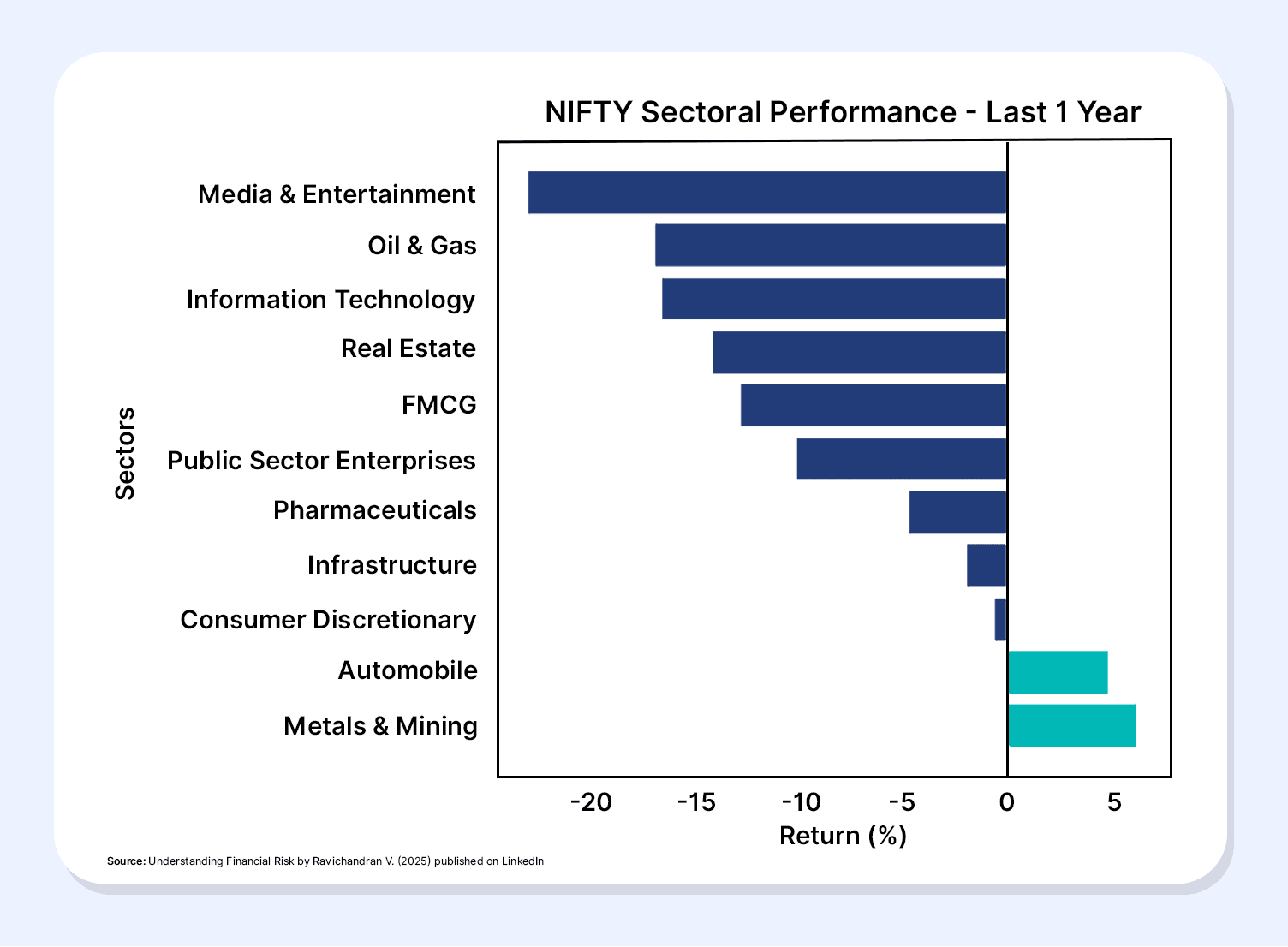
Figure 1.0: Nifty’s Sectoral Performance (One Year)
How Retail Investors Can Use Sector Rotation
Retail investors in India using a sector rotation strategy may do so without the necessity of active stock trading:
Using Mutual Funds And ETFs
Other options other than mutual funds and ETFs include:
- Sectoral mutual funds
- Thematic ETFs (Banking, IT, FMCG, PSU, Infra)
- Broad index funds alongside tactical sector exposure
Timing The Market Risks
Perfect timing is nearly impossible. If you over-rotate or react too late, your returns may take a hit. That is why gradual rebalancing is more efficient than aggressive shifting.
Balancing With Fixed Income
Sector rotation strategy is most effective if it is also associated with an asset allocation discipline. For instance, in a late-cycle situation or during a period of high volatility, the decision to reduce exposure to equity sector allocation and increase the proportion of fixed-income tools in the portfolio, e.g., bonds or structured debt products, can help stabilise returns.
One can discreetly use such platforms as Grip Invest, which offer access to selected fixed-income opportunities to balance risk while the equity sectors are getting back to normal. This behaviour not only deepens the investor's portfolio diversification but also serves as a buffer against the risk of a loss in an unstable market phase.
FAQs
1. Is sector rotation suitable for beginners?
Yes. But only if done through diversified sector funds or ETFs rather than directly picking stocks.
2. Which sectors perform well during inflation?
In the past, energy, metals, and commodities have been the sectors that benefited the most during inflationary periods in India.
3. How often should investors rebalance sectors?
Most of the time, it is done once or twice a year; depending on economic indicators and earnings cycles.
Want to stay at the top of your finances?
Join the community of 4 lakh+ investors and learn more about Grip Invest, the latest financial knick-knacks, and shenanigans in the world of investing.
Happy Investing!
Disclaimer - Investments in debt securities/municipal debt securities/securitised debt instruments are subject to risks including delay and/ or default in payment. Read all the offer related documents carefully. The investor is requested to take into consideration all the risk factors before the commencement of trading.
This communication is prepared by Grip Broking Private Limited (bearing SEBI Registration No. INZ000312836 and NSE ID 90319) and/or its affiliate/ group company(ies) (together referred to as “Grip”) and the contents of this disclaimer are applicable to this document and any and all written or oral communication(s) made by Grip or its directors, employees, associates, representatives and agents. This communication does not constitute advice relating to investing or otherwise dealing in securities and is not an offer or solicitation for the purchase or sale of any securities. Grip does not guarantee or assure any return on investments and accepts no liability for consequences of any actions taken based on the information provided. For more details, please visit www.gripinvest.in
Registered Address - 106, II F, New Asiatic Building, H Block, Connaught Place, New Delhi 110001


