

Spread Duration Explained: Measuring Credit Spread Risk In Bonds


Introduction: Beyond Interest Rate Risk In Bonds
When investing in bonds, most people make a common error of treating the interest rate as the ultimate deciding factor. Though the interest rate carries significant weight, it is one of the deciding factors and not the ultimate checkbox. Several other factors help accurately determine a bond's actual returns and risk, including its spread duration.
What Is Spread Duration?
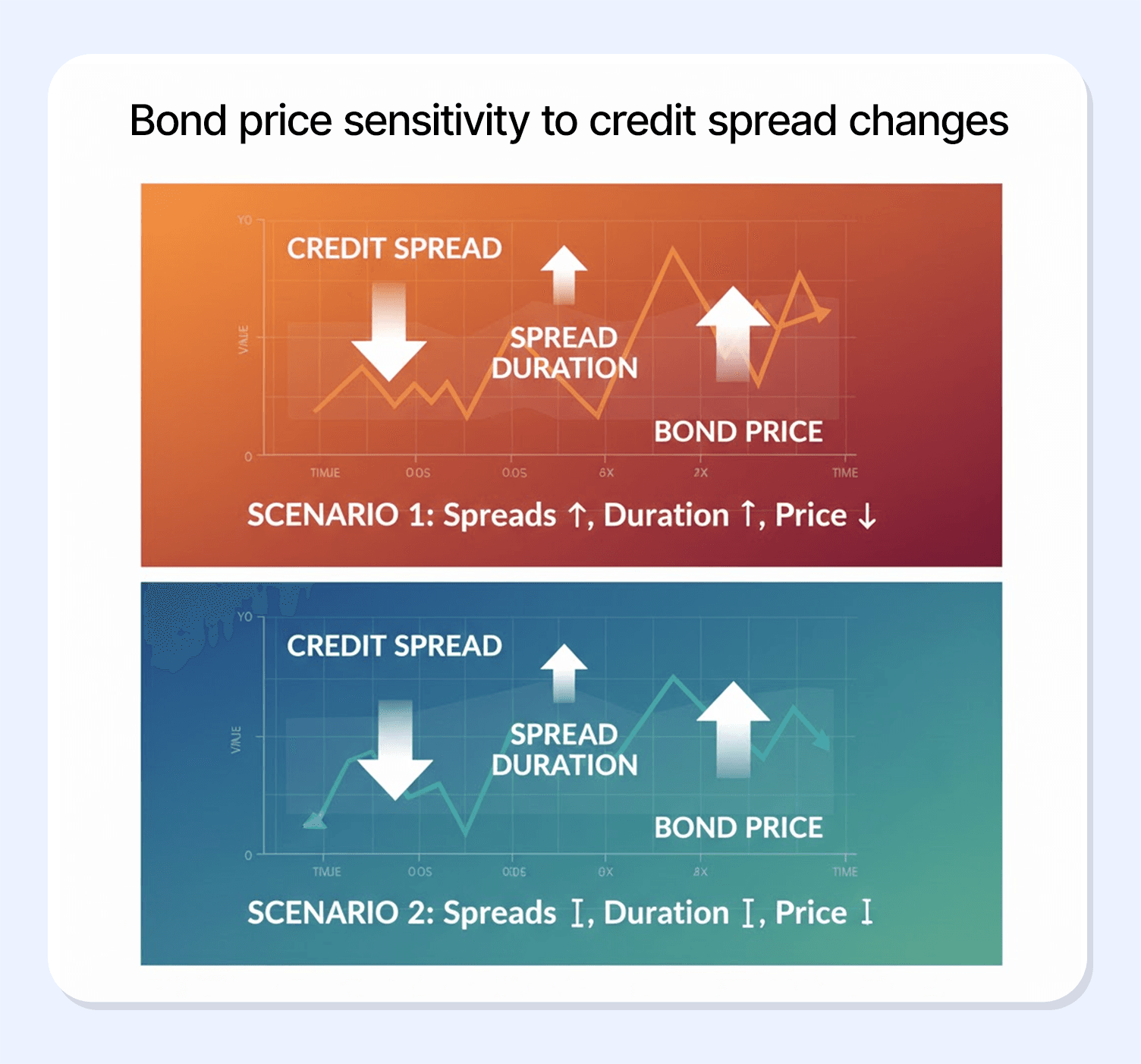
Spread duration is the measure of how sensitive a bond’s price is to changes in its credit spread, assuming interest rates remain constant.
Let's break it down to understand it better:
When you buy a bond, you earn interest. The interest you earn usually has two components: a safe rate, like that of government bonds, and an extra interest for risk, which is taken into consideration because the company might default. The extra part of the interest is the credit spread risk. So, spread duration tells you how much the bond’s price will change if this extra “risk part” of the interest goes up or down.
So, for instance, a bond has a spread duration of 4:
- If the credit spread increases by 1%, the bond price will fall by about 4%.
- If the spread decreases by 1%, the price would rise by about 4%.
Key Factors of a Spread Duration:
- Spread duration shows how strongly the bond price reacts to a change.
- Long-term bonds usually have a higher spread duration, while short-term bonds have a lower one.
- If people trust the company more, the spread will be lower. A lower spread duration means that the bond price is less sensitive to risk perceptions.
- If people get worried, the spread will be higher. A longer spread duration means the bond price is more sensitive to changes in risk perceptions.
| Credit Spread Movement | Spread Duration Tendency | Impact on Bond Price |
| Credit spread increases (widens) | Spread duration generally increases | Bond price falls, often more sharply |
| Credit spread decreases (tightens) | Spread duration generally decreases | Bond price rises |
| Stable credit spread | Spread duration remains relatively stable | Bond price shows limited movement |
Using Spread Duration To Assess Credit Risk
Credit risk and spread duration are directly related. They will help you understand how sensitive a bond’s price is to changes in interest rates. You should compare bonds with similar credit spreads but different spread durations. The general rule of thumb is:
High Spread Duration
- If a bond has high spread duration, it will experience larger price swings when its credit spread widens or narrows.
- As it is more sensitive to changes in the issuer’s creditworthiness, even a small deterioration in credit conditions can lead to a noticeable fall in the bond’s price.
This is usually more common in long-maturity bonds or bonds issued by lower-rated companies.
Low Spread Duration
- On the other hand, if a bond has a low spread duration, then the bond’s price is relatively stable and will be less affected by changes in its perceived credit risk.
- Bonds with low spread duration are generally better suited for conservative investors who prioritize capital preservation and want to limit price volatility caused by changing credit conditions.
- Such bonds are commonly short-maturity or high-quality issues, where most of the value comes from near-term cash flows rather than distant payments, reducing sensitivity to credit spread movements.
Why Spread Duration Matters For Corporate Bonds
Since spread duration is directly linked to the extra risk investors take to earn higher interest on a bond, it plays a crucial role in understanding credit risk in corporate bonds:
1. Measures credit risk sensitivity
Spread duration shows how much a corporate bond’s price will change when its credit spread widens or narrows, helping investors understand exposure to changes in the issuer’s creditworthiness.
2. Highlights downside risk
Corporate bonds with high spread duration can suffer large price declines if the company’s financial condition worsens, making this metric important for risk management.
3. Helps compare similar bonds
Investors can compare bonds with similar yields or credit spreads and choose those with spread durations that better match their risk tolerance.
4.Supports portfolio stability
Understanding spread duration helps investors control volatility in corporate bond portfolios, especially during periods of economic stress or market uncertainty.
How Retail Investors Can Apply Spread Duration
Spread duration is a great tool for retail investors, whether they want to invest in corporate bonds or structured debt instruments. Here is how they can optimise their investment by applying spread duration:
- Corporate bonds
In corporate bonds, spread duration shows how sensitive bond prices are to changes in the issuer’s creditworthiness. Bonds with higher spread duration may offer better yields but can experience sharper price declines during market stress, helping you balance return expectations with price stability.
Structured debt instruments often provide higher returns due to added credit or structural risk. Spread duration helps investors assess how vulnerable these instruments are to changes in credit conditions. Platforms like Grip enable you to evaluate such opportunities while considering spread duration alongside yield and risk.
Conclusion
Bonds, while widely considered a stable investment option, come with their own set of risks. One such component is spread duration. While a bit more complex than a bond’s other features, such as interest rate and spread duration, spread duration is a great indicator of the bond’s sensitivity to changes. This will help you in selecting an option that best suits your risk appetite.
Visit Grip Invest today!
FAQs
1. What is spread duration in bonds?
The spread duration meaning in bonds, is simple. It measures how sensitive the bond’s price is to changes in credit spread. It signals how risky a bond feels to the market, and how much its price moves when that feeling changes.
2. How is spread duration different from modified duration?
Spread duration measures a bond’s price sensitivity to changes in credit spreads, while modified duration measures price sensitivity to changes in interest rates, assuming credit risk remains unchanged.
3. Why is spread duration important for corporate bonds?
Spread duration is important for corporate bonds because it shows how exposed a bond’s price is to changes in the company’s credit risk, not just to changes in interest rates.
Want to stay at the top of your finances?
Join the community of 4 lakh+ investors and learn more about Grip Invest, the latest financial knick-knacks, and shenanigans in the world of investing.
Happy Investing!
Disclaimer - Investments in debt securities/municipal debt securities/securitised debt instruments are subject to risks including delay and/ or default in payment. Read all the offer related documents carefully. The investor is requested to take into consideration all the risk factors before the commencement of trading.
This communication is prepared by Grip Broking Private Limited (bearing SEBI Registration No. INZ000312836 and NSE ID 90319) and/or its affiliate/ group company(ies) (together referred to as “Grip”) and the contents of this disclaimer are applicable to this document and any and all written or oral communication(s) made by Grip or its directors, employees, associates, representatives and agents. This communication does not constitute advice relating to investing or otherwise dealing in securities and is not an offer or solicitation for the purchase or sale of any securities. Grip does not guarantee or assure any return on investments and accepts no liability for consequences of any actions taken based on the information provided. For more details, please visit www.gripinvest.in
Registered Address - 106, II F, New Asiatic Building, H Block, Connaught Place, New Delhi 110001


