

What Is Butterfly Strategy? Meaning, Types, Benefits And Risks


What Is Butterfly Strategy? A Beginner's Guide
A butterfly strategy is an options trading strategy that combines multiple call or put options with different strike prices but the same expiry date. It is designed for traders who expect limited price movement and want to create a position with defined profit and loss potential.
The strategy is commonly used when traders aim to profit from stable market conditions. The butterfly strategy is not based on the direction of price, as in directional trading, where a trader bets on whether an asset's price will go up or down, but rather on the possibility that the price will remain near a certain level at expiry.
The structure of this butterfly strategy options approach allows traders to create a balanced position by combining bought and sold options. Since the potential outcomes are calculated before entering the trade, traders can understand their possible risk and reward.
If you want to learn more about what butterfly strategy is and how it works, then read on and find out.
How Does A Butterfly Strategy Work?
The butterfly strategy works by combining four option contracts at three different strike prices, all with the same expiry date. The structure usually involves buying one option at a lower strike price, selling two options at a middle strike price, and buying one option at a higher strike price.
Long Butterfly vs Short Butterfly
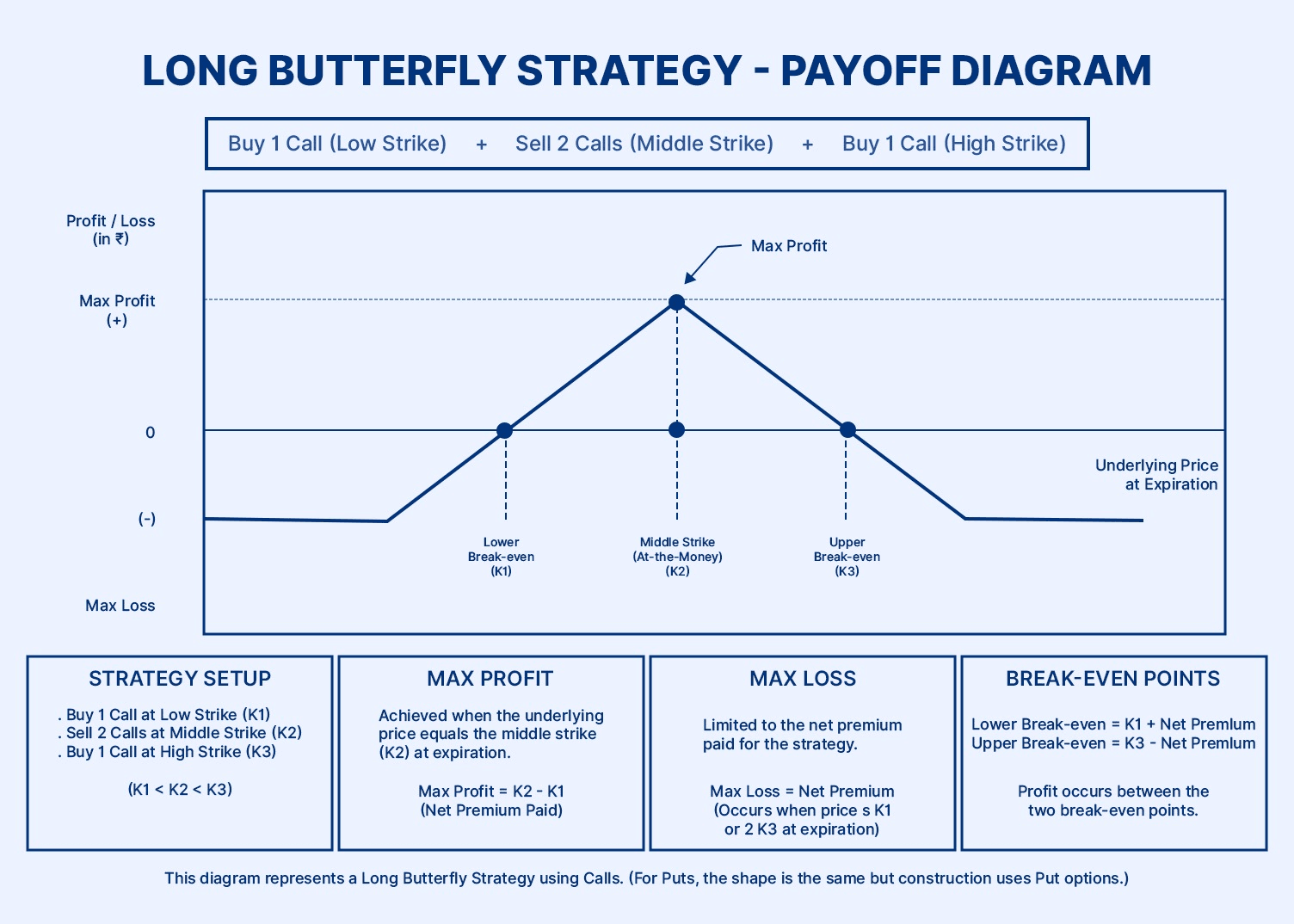
A long butterfly strategy is used when traders expect the underlying asset to remain close to the middle strike price. The strategy generates its maximum profit when the asset closes at this level on expiry.
A short butterfly strategy follows the opposite approach. It is designed for situations where traders expect the asset price to move significantly away from the middle strike price.
Both strategies have defined profit and loss limits, allowing traders to understand the possible outcomes before entering a position.
Profit and loss potential
The profit potential in a butterfly spread depends on where the underlying asset closes at expiry. A long butterfly strategy provides the highest profit when the asset price reaches the middle strike price.
If the price moves significantly above or below the expected range, the potential profit reduces. However, the maximum loss remains limited, typically to the premium paid to create the position.
Breakeven points
A butterfly strategy generally has two breakeven points. These points create a range within which the position can generate a profit. If the underlying asset moves beyond this range, the strategy may result in a loss.
Example of a Long Butterfly Strategy
Suppose a stock is trading at INR 100.
A trader creates a long call butterfly by:
- Buying one INR 95 call.
- Selling two INR 100 calls.
- Buying one INR 105 call.
Assume the total premium paid is INR 2 per share.
Possible outcomes at expiry:
| Stock Price at Expiry | Result |
| Below INR 95 | Maximum loss, limited to the premium paid. |
| INR 100 | Maximum loss, limited to the premium paid. |
| Above INR 105 | Maximum profit. |
| Between INR 95 and INR 105 | Partial profit or loss depending on the expiry price. |
This example shows how the strategy aims to benefit when the underlying asset finishes close to the middle strike price.
When Is Butterfly Strategy Used?
A butterfly strategy is generally considered when traders expect:
- Low market volatility.
- The underlying asset to trade within a narrow range.
- No major economic announcements before expiry.
- Limited price movement until option expiry.
It may be less suitable when significant price swings are expected because large movements reduce the probability of maximum profit.
Advantages, Risks And Limitations Of Butterfly Strategy
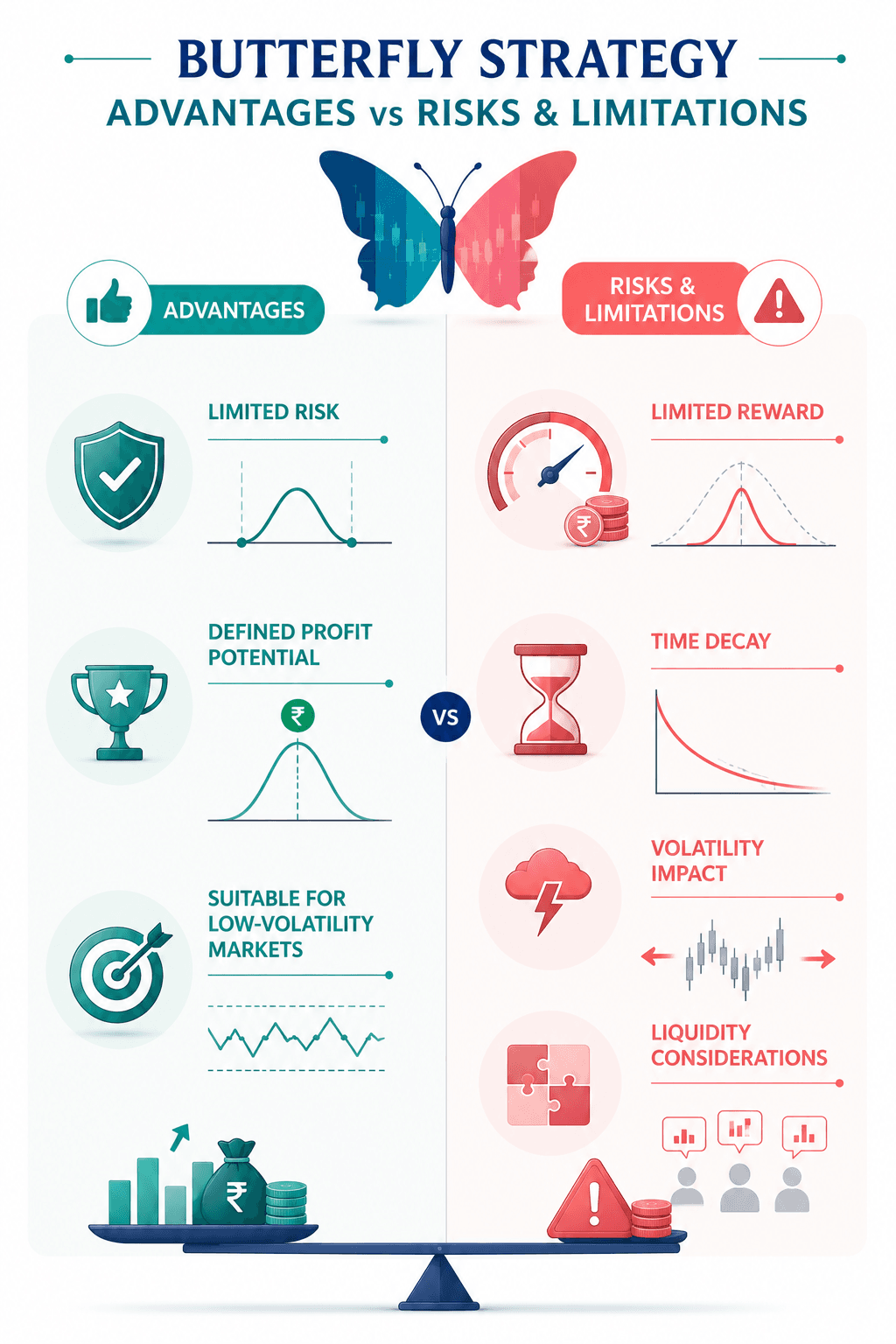
A butterfly strategy is used by traders who want a structured options trading strategy with clearly defined outcomes. However, it also has certain limitations that traders need to consider.
Advantages Of Butterfly Strategy
Limited risk
A butterfly strategy allows traders to know their maximum possible loss before entering the position.
Defined profit potential:
The maximum possible profit can be calculated based on the strike prices and options used in the strategy.
Suitable for low-volatility markets:
The strategy is designed for situations where traders expect the underlying asset to remain within a narrow price range.
Risks And Limitations Of Butterfly Strategy
Limited reward
While the risk is controlled, the profit potential is also restricted compared with some other options strategies.
Time decay
Since butterfly strategy options have expiry dates, the timing of price movement affects the outcome of the strategy.
Volatility impact
The strategy generally works better when price movement remains limited. Large movements can reduce the chances of achieving maximum profit.
Liquidity considerations
Multiple options contracts are involved, making market conditions an important factor while executing the strategy.
Is Butterfly Strategy Suitable For Every Investor?
A butterfly strategy may not be suitable for every investor because it requires an understanding of options contracts, strike prices, expiry dates, and possible market movements. Other approaches may better match the expectations of investors seeking strong directional gains. If you are not sure about using the strategy, here is a checklist to help you figure out:
Decision Checklist: Should You Consider A Butterfly Strategy?
You can consider the butterfly strategy if:
- You expect the underlying asset to remain within a specific price range.
- You prefer a strategy with limited risk and defined outcomes.
- You understand how options contracts work.
- You are comfortable managing multiple options positions.
A butterfly strategy may not be suitable if you expect a significant upward or downward movement in the market.
Trading Strategies Vs Long Term Investing
Options trading strategies, including butterfly spreads, are generally designed for experienced traders who analyse market movements and manage multiple options positions. Long-term investing follows a different approach, focusing on investment opportunities that may offer relatively predictable returns over time.
If you are an investor looking for fixed-income opportunities, you might want to check out corporate bonds and other fixed-income investments offered through Grip Invest. Unlike options strategies, which are concerned with market conditions and price movements, long-term investments are concerned with building wealth through planned investment decisions.
FAQs On Butterfly Strategy
 |
Author: Grip Invest Editorial Team The Grip Invest Editorial Team is a group of Chartered Accountants, MBA (Finance) graduates, and Qualified Research Analysts dedicated to helping you invest smarter. We dive deep into India's fixed income landscape to deliver content that is accurate, up-to-date, and easy to understand. Whether you're exploring bonds, fixed deposits, or other fixed income opportunities, our guides cut through the noise and give you the clarity to make better financial decisions. |
Want to stay at the top of your finances?
Join the community of 4 lakh+ investors and learn more about Grip Invest, the latest financial knick-knacks, and shenanigans in the world of investing.
Happy Investing!
Disclaimer - Investments in debt securities/municipal debt securities/securitised debt instruments are subject to risks including delay and/ or default in payment. Read all the offer related documents carefully. The investor is requested to take into consideration all the risk factors before the commencement of trading.
This communication is prepared by Grip Broking Private Limited (bearing SEBI Registration No. INZ000312836 and NSE ID 90319) and/or its affiliate/ group company(ies) (together referred to as “Grip”) and the contents of this disclaimer are applicable to this document and any and all written or oral communication(s) made by Grip or its directors, employees, associates, representatives and agents. This communication does not constitute advice relating to investing or otherwise dealing in securities and is not an offer or solicitation for the purchase or sale of any securities. Grip does not guarantee or assure any return on investments and accepts no liability for consequences of any actions taken based on the information provided. For more details, please visit www.gripinvest.in
Registered Address - 106, II F, New Asiatic Building, H Block, Connaught Place, New Delhi 110001


