

What Is Nifty 50? Meaning, Calculation, Features And Best Index Funds


Introduction: What Is Nifty 50?
Building and managing a solid, comprehensive portfolio is neither easy nor simple. It requires you to interact with several market segments, including the market index.
In simple terms, a market index is a list of investments that represents a segment of the financial market. It measures the values of holdings that have specific market characteristics. One of the most prominent market indices in India is the Nifty 50.
It is the stock market index of the National Stock Exchange. This index, in particular, tracks the performance of 50 largest, actively traded companies across different sectors.
Purpose
The main purpose of the Nifty 50 is to understand overall market trends and serves as a simplified indicator of how major Indian companies are performing.
- Acts as a benchmark for measuring market performance
- Helps investors track overall stock market movement
- Provides a reference to compare individual investments
- Reflects the economic condition through stock performance
Key Features and Base Value
- It includes 50 large-cap and liquid companies.
- It covers multiple sectors for broader representation.
- It uses the free-float market capitalisation method.
- It is periodically reviewed
- It has a base value of 1000, which is used to measure growth over time.
Who Manages It?
The Nifty 50 is managed by the National Stock Exchange (NSE). The stock exchange has a structured, rule-based process for managing the index. To ensure transparency in stock selection and calculation, NSE ensures periodic reviews to maintain accuracy and representation.
How Nifty 50 Is Calculated ?
Now that we know what is nifty 50, let’s get to the point of how it is calculated. Unlike what most people believe, there is more than one way to calculate a market index, including the Nifty 50. Understanding the Nifty 50 calculation is important because it helps you understand why certain stocks influence the index more than others and how changes in company performance affect the overall market trend.
1. Free-Float Market Cap Method
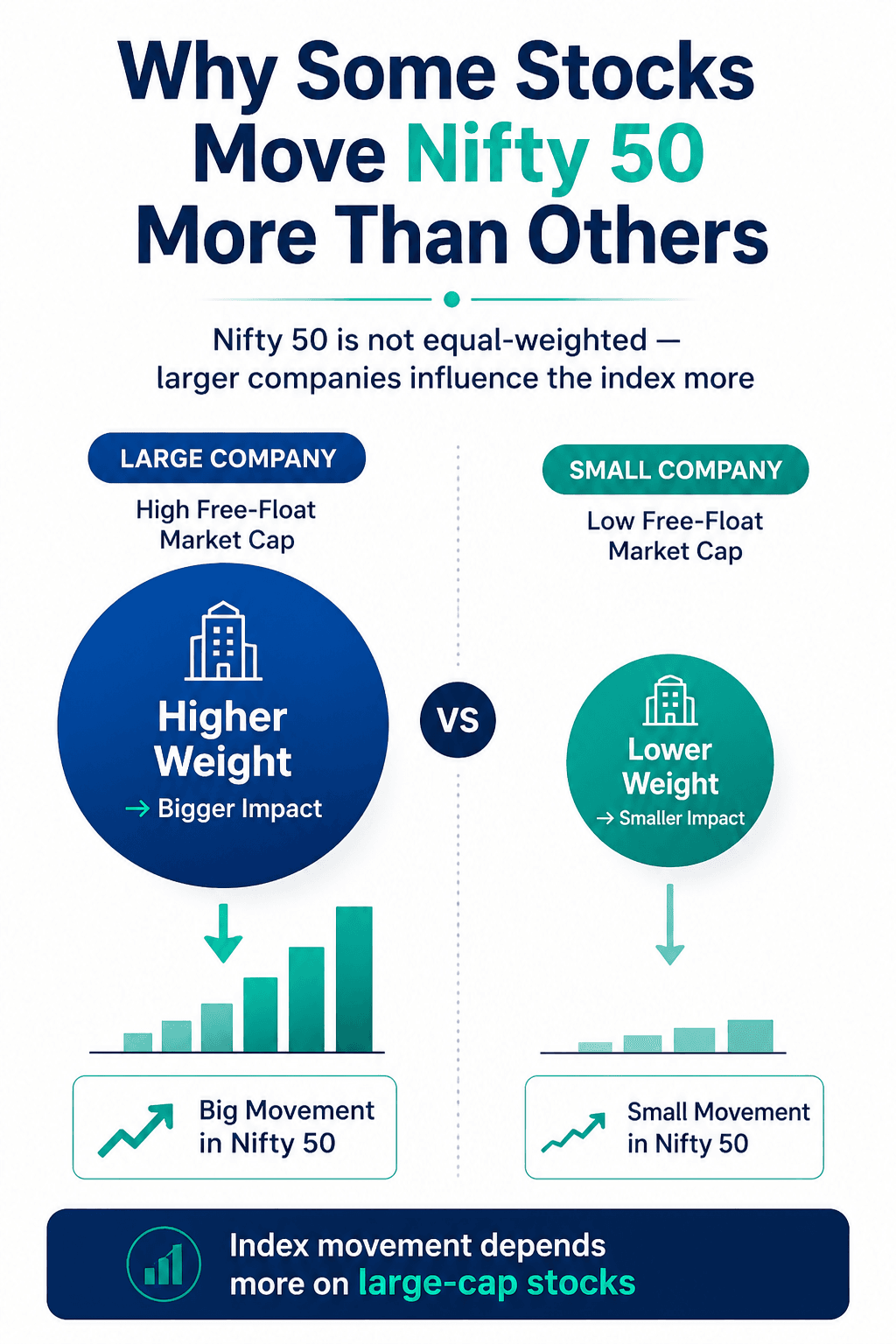
The nifty 50 stocks are calculated using the free-float market capitalisation method. Under this method, the index value is based on the shares available for public trading. Shares held by promoters or the locked-in holdings are excluded from the calculation. As each company’s weight depends on its free-float market value, larger companies influence the index more.
2. Eligibility Criteria For Stocks
The Eligibility Criteria for Stocks is a process that filters the stock for selection. The stocks are selected based on pre-defined criteria, such as large size, active trading, and consistent performance, to qualify for inclusion.
3. Rebalancing Process
One of the most crucial aspects of the process is ensuring that the Nifty 50 companies list is reviewed periodically. If any current company does not meet the predetermined selection criteria, it is removed, and new companies that meet the criteria are added to keep the index accurate.
Composition Of Nifty 50
As a leading market index in the Indian market, the Nifty 50 is composed to represent different parts of the economy. The index includes companies from multiple sectors, assigning weights based on their market capitalisation. This way, it is ensured that Nifty 50 provides a balanced and realistic picture of overall market performance.
Top Sectors and Weightage
The index includes companies from major sectors such as banking, financial services, IT, energy, FMCG, and pharmaceuticals. Some of the most repeated industries in the index include Financial Services, Healthcare, Information Technology, Automobile and Auto Components, Metals & Mining, Fast Moving Consumer Goods, Oil Gas & Consumable Fuels, Consumer Services, Construction Materials, and Power. Each of these sectors contributes differently based on the market value of its companies.
Top 10 Companies (Examples)
Some of the most prominent companies in the Nifty 50 are:
- Reliance Industries
- HDFC Bank
- Bharti Airtel
- State Bank of India
- ICICI Bank
- Tata Consultancy Services
- Bajaj Finance
- Larsen & Toubro
- Hindustan Unilever
- Infosys
Sector Diversification Benefits
Sector diversification is one of the most crucial aspects of any market index, including the Nifty 50, as it spreads investments across multiple industries. This approach helps create stability and offers a more balanced representation of overall market performance.
- Reduces dependence on a single industry.
- Balances risk across sectors.
- Provides a broader view of the economy.
Nifty 50 vs Sensex
Just like NSE, BSE also has its market index, which is known as the Sensex. As stock market indexes, both Nifty 50 vs Sensex are used to measure market performance.
Key Differences (Stocks, Exchange)
- Nifty 50 includes 50 companies, Sensex includes 30
- Nifty 50 is based on NSE, Sensex on a different exchange
- Nifty offers broader market coverage due to more stocks
Which is Better for Investors?
In Nifty 50 vs Sensex, which is a better choice for investors depends on various factors. The choice is mainly guided by every investor's preference and strategy.
While the Nifty 50 offers wider diversification, the Sensex is better for investors who prefer a more concentrated index with fewer companies, making it simpler to track and focused on a smaller set of large, established firms. However, whatever decision you make, it should be guided by a deep understanding of broader market trends.
Historical Performance Comparison
- Both indices reflect market trends over time
- Movement generally indicates economic conditions
- Used widely for performance comparison
Risk Of investing In Nifty 50
Although the Nifty 50 is one of the prominent market indices in India, representing strong companies, like any other investment tool, it is not completely free of market risks. Its prices can fluctuate due to economic changes, sector performance, or investor sentiment.
Further, contrary to popular belief, it is affected by overall market downturns. For investors who want to minimise such risks, they should consider diversification beyond equities.
Combining exposure with instruments such as bonds or corporate fixed deposits can provide a better balance. Platforms like Grip Invest offer alternative investment options, helping reduce reliance on market-linked returns.
Conclusion
The Nifty 50 remains one of the simplest ways to understand the direction of the Indian stock market because it tracks 50 of the country’s largest and most actively traded companies. Its diversified sector exposure, transparent calculation method, and regular rebalancing make it a useful benchmark for both new and experienced investors.
For investors who want market linked growth with lower stock selection effort, investing through a Nifty 50 index fund can be a practical long term strategy. At the same time, combining equity exposure with fixed income investments can help create a more balanced portfolio during uncertain market conditions.
For investors looking to balance market exposure with stable fixed income opportunities, Grip Invest can help diversify your portfolio beyond traditional market-linked investments.
FAQs On What Is Nifty 50 ?
 |
Author: Grip Invest Editorial Team The Grip Invest Editorial Team is a group of Chartered Accountants, MBA (Finance) graduates, and Qualified Research Analysts dedicated to helping you invest smarter. We dive deep into India's fixed income landscape to deliver content that is accurate, up-to-date, and easy to understand. Whether you're exploring bonds, fixed deposits, or other fixed income opportunities, our guides cut through the noise and give you the clarity to make better financial decisions. |
Want to stay at the top of your finances?
Join the community of 4 lakh+ investors and learn more about Grip Invest, the latest financial knick-knacks, and shenanigans in the world of investing.
Happy Investing!
Disclaimer - Investments in debt securities/municipal debt securities/securitised debt instruments are subject to risks including delay and/ or default in payment. Read all the offer related documents carefully. The investor is requested to take into consideration all the risk factors before the commencement of trading.
This communication is prepared by Grip Broking Private Limited (bearing SEBI Registration No. INZ000312836 and NSE ID 90319) and/or its affiliate/ group company(ies) (together referred to as “Grip”) and the contents of this disclaimer are applicable to this document and any and all written or oral communication(s) made by Grip or its directors, employees, associates, representatives and agents. This communication does not constitute advice relating to investing or otherwise dealing in securities and is not an offer or solicitation for the purchase or sale of any securities. Grip does not guarantee or assure any return on investments and accepts no liability for consequences of any actions taken based on the information provided. For more details, please visit www.gripinvest.in
Registered Address - 106, II F, New Asiatic Building, H Block, Connaught Place, New Delhi 110001


