

Rajesh Exports Case Explained: SEBI Probe, Revenue Issue And Investor Lessons


As part of its efforts to ensure the highest standards of corporate governance in the country, SEBI has recently alleged that Rajesh Exports (NSE: RAJESHEXPO) misinterpreted its accounts and sales figures involving its subsidiaries between FY21 and FY25. The regulator has barred the company and its owners from the securities market until the investigation is over.1
The company’s share price has hit the lower circuit on Monday, making it the third day in a row. In the past five days, the stock has lost more than 13% and around 23.11% in the past month.2 Most of the fall happened after the SEBI’s allegations were reported.
For investors, it is critical to understand the details of this case, the importance of proper compliance, and how corporate governance can be a critical factor in an enterprise’s growth. Since the investigation against the company is still ongoing, this article will focus only on the facts reported by the regulator (SEBI) and the responses provided by the company’s official channels.
Rajesh Exports Scam Explained: What Happened And Why It Triggered Regulatory Scrutiny?
Rajesh Exports is a well-known name in the field of global gold refining and jewelry business. Recently, the company was at the center of a controversy when SEBI raised serious concerns about revenue reporting practices involving its Swiss subsidiary, Valcambi SA.
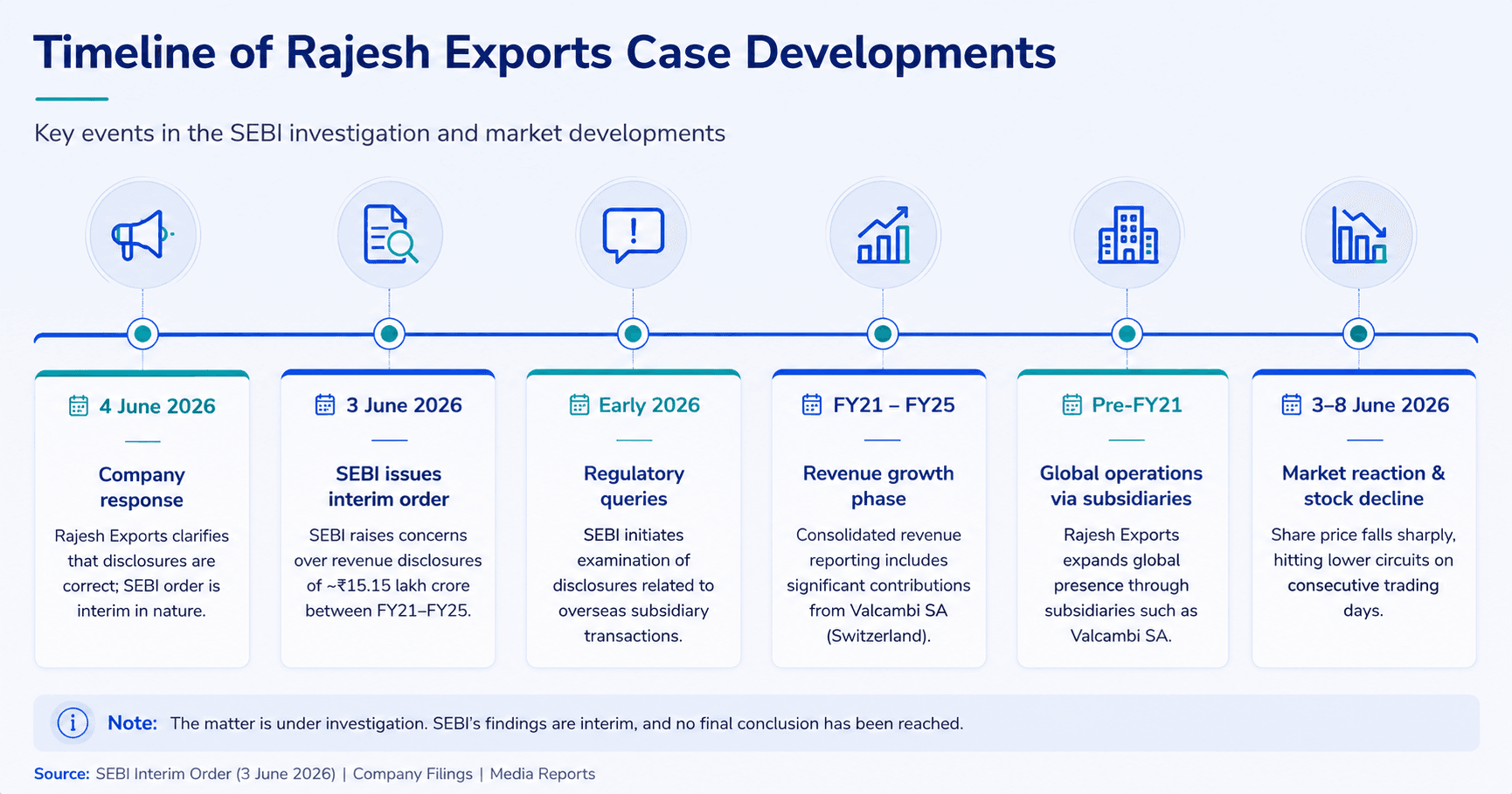
According to the regulator’s interim findings, there were concerns regarding the reporting and disclosure of significant revenues between FY21 and FY25 (approximately INR 15.15 lakh crore).3 The regulator questioned whether the nature of the underlying transactions was properly disclosed and whether investors received complete and transparent information.
The company has denied any wrongdoing and stated that all disclosures comply with applicable standards and requirements. The company has also suggested that it will cooperate with the regulators and emphasized that the order (SEBI) is interim and nothing can be concluded out of it.
What Did SEBI Investigate In The Rajesh Exports Case?
The ongoing Rajesh Exports SEBI investigation primarily focuses on the accuracy and adequacy of financial disclosures made by the company. In many ways, it is a landmark case because it is the first time the regulator has implemented the ‘investor jury’ concept, as elaborated by the Supreme Court in the Reliance Industries case.3
Here is the list of concerns raised by SEBI in the Rajesh Exports case:
- Revenue recognition and disclosure practices.
- Reporting of transactions involving overseas subsidiaries.
- Potential impact of disclosures on investor decision-making.
- Compliance with listing and disclosure regulations.
SEBI passed an interim order and continued its investigations into the issue. Investors and media usually keep a very close eye on cases involving corporate governance issues of listed companies, and hence, the impact was immediately seen in the share price movement.
How Corporate Governance Issues And Stock Market Scams Impact Investors
Cases involving alleged financial irregularities often create uncertainty among investors, regardless of the final outcome. This is quite evident, especially given that the company has lost significant market share (in terms of market capitalization) ever since the news broke.
Beyond individual companies, major instances of stock market scam India controversies can affect broader market sentiment. It would be interesting to see the actual outcome of the case, as it is still under broad-based investigations by regulators at the forefront. It is important to note that when investors lose confidence in disclosures or governance standards, capital flows and stock trading can be very cautious.
Also read on SEBI's Action Against Finfluencer Avadhut Sathe
Key Red Flags Investors Should Watch Before Investing In Listed Companies
Even though screening tests are preventive in nature, there is no absolute way for investors to eliminate investment risk arising from corporate governance and overall market volatility. However, here are some red flags that investors should consider as warning signals and should ask questions of the company:
1. Unusual Revenue Growth
Revenue growth that appears significantly disconnected from industry trends should be examined carefully.
2. Frequent Changes in Auditors
Repeated auditor resignations or frequent changes may indicate underlying governance concerns.
3. Complex Corporate Structures
Multiple subsidiaries operating across jurisdictions can make financial analysis more challenging and may require additional scrutiny.
4. Weak Cash Flow Despite Strong Profits
A persistent mismatch between reported profits and operating cash flows can signal potential issues that deserve further investigation.
5. Regulatory Actions or Investigations
Any significant SEBI action, regulatory notice, or enforcement proceeding should be reviewed carefully before investing.
Lessons Investors Can Learn From Major Indian Market Scams
As with any major financial market, India has had its share of scams in the past, some of which resulted in major regulatory actions. A common pattern across many company fraud India cases is that warning signs often existed long before regulatory intervention occurred.
It is critical that investors not solely rely on stock market performance but also consider governance indicators before making an investment decision. Some strong corporate governance indicators include:
- Transparent disclosures.
- Consistent communication with shareholders.
- Independent board oversight.
- Robust internal controls.
- Responsible capital allocation.
Also read on What Investors Can Learn from the Reliance Communications Fraud Case?
How Investors Can Protect Their Portfolio From Corporate Governance Risks?
To be honest, it is not possible to protect your portfolio from market and environment-related risks. For an investor, it is not possible to control the governance behavior of a company, but there are steps that you can take in order to reduce the chances of incurring huge losses when situations like the Rajesh Exports arise.
First, you should not forget the importance of diversification of your portfolio. An equity-only portfolio might offer a higher return during favourable market conditions, but during bearish and negative times, you need fixed income securities that can not only ensure consistent returns but also protect your capital from eroding. Corporate Bonds and SDIs offer up to 14% fixed returns on Grip Invest. These debt instruments add predictability to your portfolio and help protect the overall returns during negative times.
Second, investors should regularly review annual reports, earnings presentations, auditor remarks, and regulatory filings.
Third, always look for credible information from reliable sources. For example, if you are looking for Rajesh Export news you should always rely on the official sources, such as the regulators and the company’s spokesperson, to understand the outlook of both parties.
Finally, conducting thorough due diligence for investors before purchasing any stock is essential. Understanding a company's business model, governance framework, debt profile, and disclosure history can significantly improve investment decision-making.
Conclusion
When the regulator's allegations regarding the company were made, there was an obvious reaction from investors, as the stock plummeted for three consecutive days, hitting the lower circuit. There are updates that the central government may drop the company from the battery PLI scheme, which could be quite a setback for the organization.4 This episode reinforces the importance of governance as a critical driver of a company’s growth.
Whether the issue ultimately results in regulatory penalties or is resolved in the company's favor, the episode highlights why investors should look beyond financial statements and assess management credibility, transparency, and disclosure quality.
Investors looking to diversify beyond traditional options can explore fixed-income investment opportunities available on Grip Invest.
FAQs On Rajesh Export Case
 |
Author: Grip Invest Editorial Team The Grip Invest Editorial Team is a group of Chartered Accountants, MBA (Finance) graduates, and Qualified Research Analysts dedicated to helping you invest smarter. We dive deep into India's fixed income landscape to deliver content that is accurate, up-to-date, and easy to understand. Whether you're exploring bonds, fixed deposits, or other fixed income opportunities, our guides cut through the noise and give you the clarity to make better financial decisions. |
Want to stay at the top of your finances?
Join the community of 4 lakh+ investors and learn more about Grip Invest, the latest financial knick-knacks, and shenanigans in the world of investing.
Happy Investing!
Disclaimer - Investments in debt securities/municipal debt securities/securitised debt instruments are subject to risks including delay and/ or default in payment. Read all the offer related documents carefully. The investor is requested to take into consideration all the risk factors before the commencement of trading.
This communication is prepared by Grip Broking Private Limited (bearing SEBI Registration No. INZ000312836 and NSE ID 90319) and/or its affiliate/ group company(ies) (together referred to as “Grip”) and the contents of this disclaimer are applicable to this document and any and all written or oral communication(s) made by Grip or its directors, employees, associates, representatives and agents. This communication does not constitute advice relating to investing or otherwise dealing in securities and is not an offer or solicitation for the purchase or sale of any securities. Grip does not guarantee or assure any return on investments and accepts no liability for consequences of any actions taken based on the information provided. For more details, please visit www.gripinvest.in
Registered Address - 106, II F, New Asiatic Building, H Block, Connaught Place, New Delhi 110001


