

Why Banks Offer Higher Rates On FDs Than Savings Accounts: What Determines FD Interest Rates?



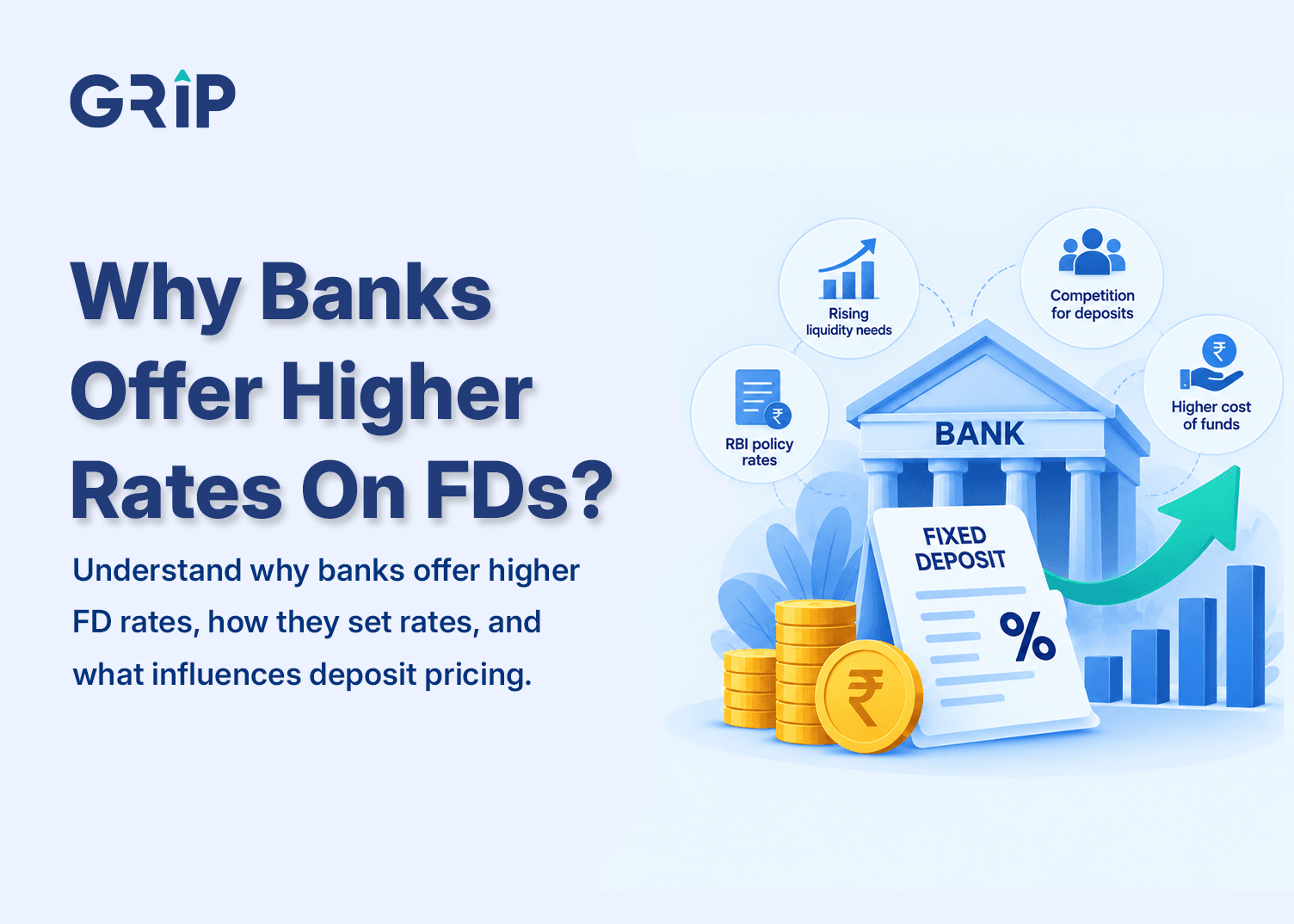
The main reason behind a bank paying more for a fixed deposit (FD) than it pays on a savings account comes down to the absolute certainty an FD provides over the availability of funds. A savings account balance can fluctuate as customers make withdrawals and payments.
However, an FD is booked for a defined tenure, thereby giving the bank greater visibility over how long those funds are likely to remain available.
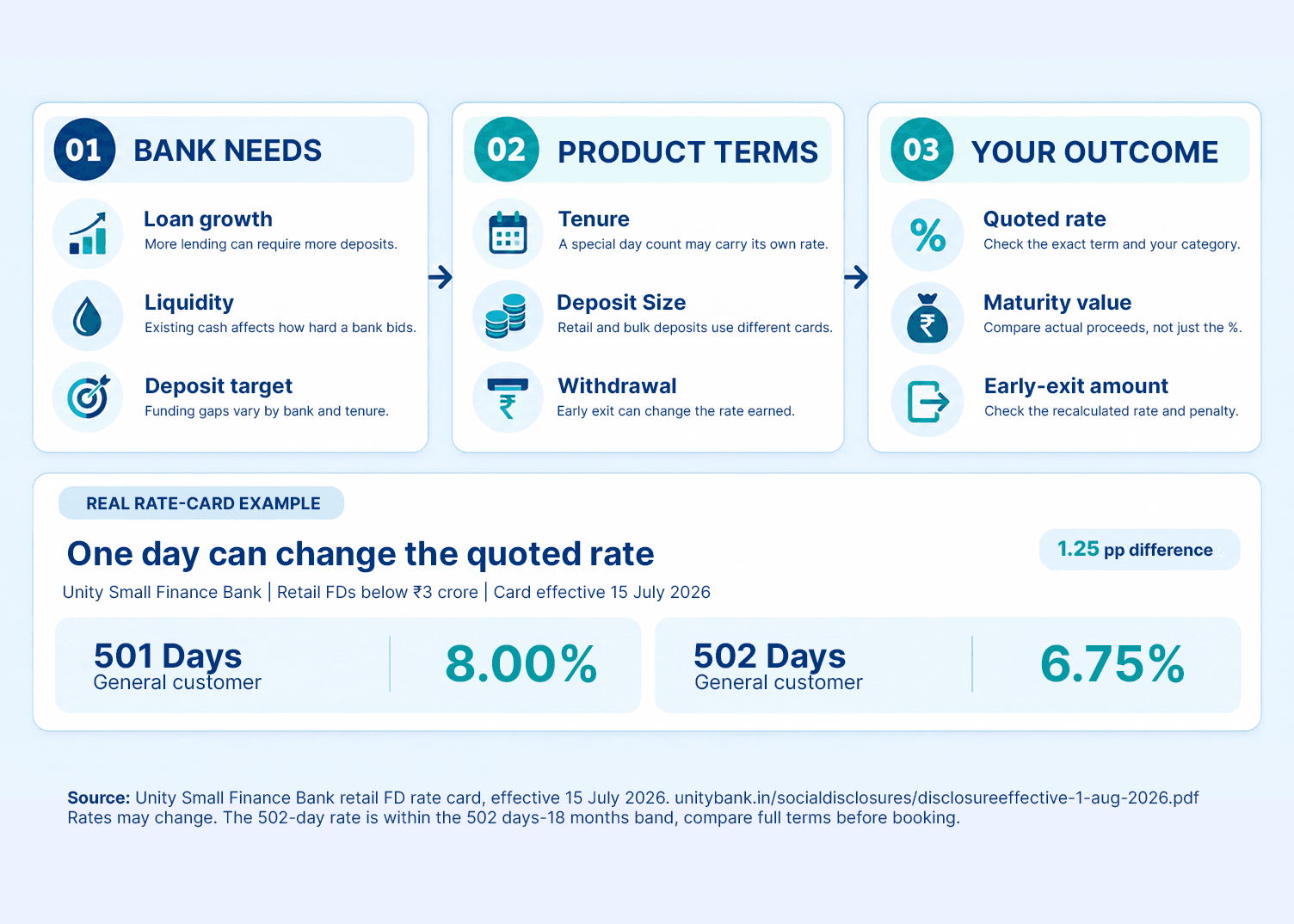
This predictability can help a bank plan its funding for loans and other activities. Yet again, banks do not simply pay the highest possible rate for every FD. They price deposits according to how much funding they need, when they need it, the cost of attracting those funds and how strongly they are competing for deposits. This is why a 501-day FD can sometimes offer a higher rate than a two-year FD at the same bank.
The difference is therefore not just between a savings account and an FD, but also about the type of funding a bank wants and the price it is willing to pay to obtain it.
How Do Banks Decide FD Interest Rates?
If a bank expects strong demand for home or business loans, it needs deposits it can rely on while those loans remain outstanding. The rate a bank offers depends on three major questions:
- How much funding is needed? Strong credit demand or slower deposit growth can increase the bank's need to attract fresh deposits.
- When is it needed? The bank may favour particular FD tenures depending on how long it expects to need the funds.
- What will it cost? The bank considers its existing cost of funds, liquidity, inflation, broader economic conditions and the rates offered by competing banks.
If deposit inflows are already comfortable, it has less reason to bid aggressively. Big deposit amounts may have separate rates for different amounts. Depending on eligibility, senior citizens may have higher rates on certain deposits.
Additionally, the RBI's monetary policy and repo rate also influence the broader funding environment. However, banks do not simply move their FD rates by the same amount as a repo-rate change. Their response depends on their own liquidity position, deposit growth targets and funding requirements.
Competition, deposit size and customer category can further affect the rate offered. Banks may use selected tenures, deposit categories or senior-citizen premiums to get the deposits they want.
Each bank therefore has commercial discretion to set its deposit rates within applicable regulatory requirements, based on its own funding strategy and market conditions.
Why Do Some Banks Offer Higher FD Rates Than Others?
Some banks offer higher FD rates because they have a greater need to attract deposits at a particular time or for a particular tenure.
Banks can have different deposit positions, loan-growth plans and funding requirements, so the rate they are willing to pay for deposits can vary.
Considering a hypothetical example, suppose Bank A already has sufficient deposits to fund its expected lending for two years and offers 6.50% on a two-year FD. Bank B has fewer deposits and expects faster loan growth, so it offers 7.25% for the same tenure. The 0.75 percentage-point difference reflects Bank B's stronger need to attract funds. It does not by itself mean that Bank B's FD is a better product.
It is also possible to observe that the difference in bank FD interest rates is narrow for one period and wide for another. The actual rate card shows how selective these rates can be.
For example, the retail FD schedule issued by Unity Small Finance Bank from 15 July 2026 places the rate of 8.00% for 501 days, and only 6.75% for a more extended period of 502 days to 18 months.
Eligible senior citizens receive 8.50% and 7.25%, respectively. Its rate card also states a premature withdrawal penalty of 1% applied to the rate for the actual holding period.
How Does The RBI Repo Rate Affect FD Rates?
One of the factors impacting the banks’ borrowing costs and lending rates is the repo rate. An increase in the repo rate can make other sources of funding costlier, which may further lead banks to raise FD rates to attract deposits.
A decline in the repo rate might mean that banks will reduce FD rates for newly placed deposits.
However, there is no certainty that either of these processes will happen rapidly or by the same number of percentage points. This lag in the actions is one of the explanations for the differences in the dynamics of FD rates in India as compared to the repo rate.
Let us consider the option that the repo rate rises by 0.25 percentage point. A bank that has enough deposits may keep its one-year FD unchanged while the bank that needs money for a lengthy period may increase its two-year FD rate.
Existing FDs generally continue at the contracted rate until maturity, while banks can change the rates offered on new deposits. Inflation expectations and the bank's own funding requirements can also influence how quickly FD rates respond to a repo-rate change.
Why Do Banks Offer Higher FD Rates to Senior Citizens?
Many banks add a senior-citizen premium to eligible domestic FDs. This can help them attract and retain deposits from this customer segment, supporting their deposit and funding needs.
Note that this is a commercial product choice subject to the applicable deposit rules, and not a guarantee that every senior citizen gets an extra rate on every type of account. For example, Unity’s retail schedule for July 2026 will be increasing its overall rate by 0.50 percentage points for a 501-day FD, going from a rate of 8.00% to a rate of 8.50%. It has a specific notation that rates for senior citizens do not apply to any customers who are non-residents.
Investors should check the age qualification, deposit type, interest payment method and applicable rules for joint accounts before booking the FD. The interest rate and payout option can also affect the cash flow received during the FD’s tenure.
Does A Higher FD Rate Mean A Better FD?
No, a higher FD rate does not always mean a better FD. If the time horizon of the investment does not go according to your plans, a high-return FD might provide you with less available money for your needs.
For example, consider the two FD offers:
- FD A, which has a duration of 24 months and an interest rate of 8%
- FD B, which has a duration of 12 months and an interest rate of 7.5%.
If the investor needs the cash after one year, there is a chance that FD A will be subject to a penalty due to early withdrawal. If FD B matures after one year, however, the investor may need to reinvest the money at whatever FD rate is available at that time.
The investor should compare the amount that would be received on the planned withdrawal date after accounting for taxes, compounding and the bank's premature-closure rules. In some cases, the investor might be able to take advantage of additional rates for senior citizens or special offers with specific terms.
What Should You Check Before Choosing A High-Interest FD?
Before choosing a high-interest FD, check whether the higher rate actually applies to the deposit and tenure being considered. A headline rate may be limited to a specific tenure, deposit size or customer category.
Check the following before booking:
1. Tenure: Does the maturity date match when the money will be needed?
2. Eligibility: Does the rate apply to the deposit amount, customer category and FD type?
3. Interest payout: Is interest paid periodically or compounded until maturity?
4. Premature withdrawal: What penalty applies, and how will the interest be recalculated if the FD is closed early?
5. Maturity amount: How much will actually be received under the selected payout option?
6. Rate validity: Does the current bank rate card match the rate shown at booking?
Also consider the total deposits held with the bank. DICGC insurance is subject to a INR 5 lakh limit per eligible depositor per bank, including principal and interest across eligible deposits.
The key is to compare the FD's actual outcome and access to funds, not just its highest advertised rate.
FAQs

Want to stay at the top of your finances?
Join the community of 22 lakh+ investors and learn more about Grip Invest, the latest financial knick-knacks, and shenanigans in the world of investing.
Happy Investing!
Disclaimer - Investments in debt securities/municipal debt securities/securitised debt instruments are subject to risks including delay and/ or default in payment. Read all the offer related documents carefully. The investor is requested to take into consideration all the risk factors before the commencement of trading.
This communication is prepared by Grip Broking Private Limited (bearing SEBI Registration No. INZ000312836 and NSE ID 90319) and/or its affiliate/ group company(ies) (together referred to as “Grip”) and the contents of this disclaimer are applicable to this document and any and all written or oral communication(s) made by Grip or its directors, employees, associates, representatives and agents. This communication does not constitute advice relating to investing or otherwise dealing in securities and is not an offer or solicitation for the purchase or sale of any securities. Grip does not guarantee or assure any return on investments and accepts no liability for consequences of any actions taken based on the information provided. For more details, please visit www.gripinvest.in
Registered Address - 106, II F, New Asiatic Building, H Block, Connaught Place, New Delhi 110001


