

Yield To Worst (YTW): Meaning, Calculation And Why Bond Investors Should Track It


While investing in bonds, investors need to take into account different indicators, just like equities. Even though investment in fixed income securities is subject to a lower risk (as compared to equity and derivatives), if you are choosing bonds or debentures for long-term investment plans, retirement, or any other life goal, it is critical that you look beyond coupons and the credit rating of the bond in which you are interested.
Calculation of bond yields is a critical aspect, as evaluating these can help in predicting real returns from your investment. Depending on the bond’s structure, especially if it includes early redemption options, the actual yield received by investors may differ from initial expectations.
This is particularly relevant for callable bonds, where issuers have the right to redeem bonds before maturity. In such cases, relying solely on traditional yield measures can lead to overestimating returns. This is where Yield to worst YTW becomes essential. It provides investors with a conservative estimate of the minimum yield they can expect, helping them make more informed and risk-aware investment decisions. Let us take account of everything you need to know about YTW, its calculation, and how it can be used for your personal financial management.
What Is Yield To Worst (YTW)?
Yield to Worst Meaning and Definition
In simple terms, the yield to worst meaning bonds refers to the lowest possible yield you can receive from a bond without the issuer defaulting. It assumes that the bond issuer exercises any available early redemption options, such as call provisions, at the most disadvantageous time for the investor.
Instead of assuming that the bond will remain active until its final maturity date, Yield to Worst evaluates all possible scenarios where the bond may be redeemed early. It then selects the lowest yield among those outcomes. This approach ensures that investors understand the minimum potential return they may receive, allowing them to assess the bond more conservatively.
Callable Bond Relevance and Why YTW Exists
YTW as a metric is quite critical when you are looking to invest in callable bonds. Let us understand how these bonds work: these bonds give issuers the right, but not the obligation, to repay the bond before maturity. Issuers typically exercise this option when interest rates decline, allowing them to refinance their debt at lower rates.
In such cases, investors stop receiving the higher interest payments sooner than expected. The callable bond yield to worst calculation helps investors account for this possibility by calculating the lowest yield they would receive if the bond were called at the earliest or most likely date. This prevents investors from assuming returns that may never materialise.
Yield To Worst Vs Yield to Maturity: Key Differences
Understanding the Difference Between YTW and YTM
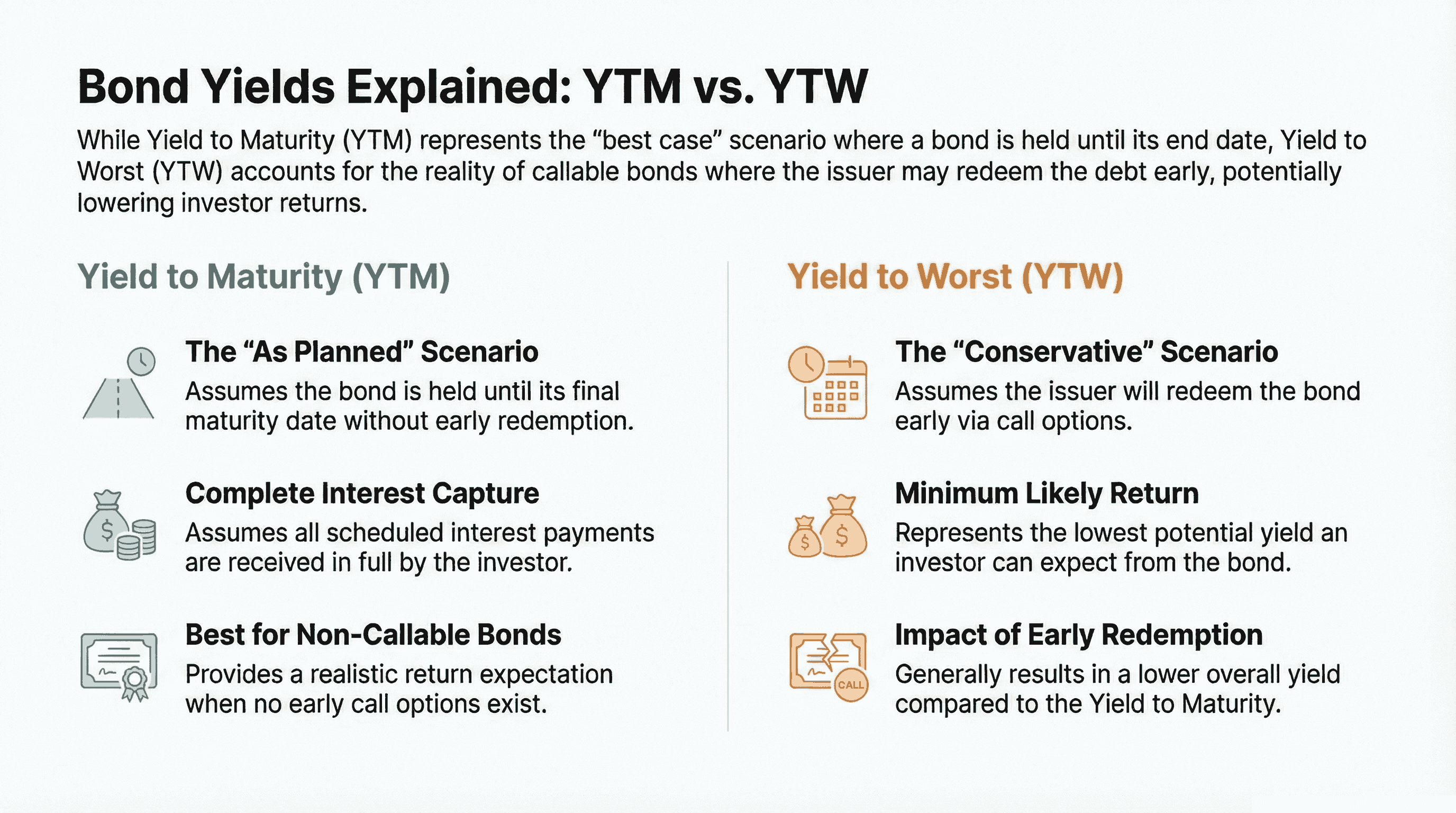
Yield to Maturity (YTM) assumes that the bond will be held until its final maturity date and that all interest payments will be received as scheduled. While this works well for non-callable bonds, it may not reflect realistic outcomes for bonds with call options.
The key YTW vs YTM difference lies in their assumptions. Yield to Maturity provides the expected return if everything proceeds as originally planned. Yield to Worst, on the other hand, assumes that the issuer may redeem the bond early, resulting in a lower overall yield (in the hands of the investor).
Yield to Worst Calculation Example for Callable Bond
To understand this better, consider a bond with a maturity of 10 years and an annual coupon rate of 8%. Suppose the bond is callable after 5 years. If held until maturity, the Yield to Maturity may be 8%. However, if the issuer calls the bond after 5 years, the yield received by the investor may drop to 6.5%.
In this scenario, investors must evaluate both outcomes. The yield to worst calculation example would identify 6.5% as the Yield to Worst because it represents the lowest possible yield the investor may receive. This ensures that investors assess bonds based on conservative and realistic return expectations rather than optimistic assumptions.
Why Investors Should Consider YTW Before Investing
Risk-Adjusted Yield Evaluation
One of the primary benefits of Yield to Worst is that it provides a more accurate measure of risk-adjusted returns. Instead of relying on optimistic projections, investors can evaluate bonds based on the minimum return they are likely to receive. If an investor wishes to have a worst-case scenario, this can be the perfect metric for predicting the returns.
This is especially important when comparing multiple bonds with different features. Among various bond yield risk measures, Yield to Worst stands out because it accounts for early redemption risk and prevents investors from overestimating income potential.
Downside Protection and Better Risk Awareness
Yield to Worst also plays a crucial role in protecting investors from unexpected income reductions. When interest rates fall, issuers are more likely to call existing bonds and refinance them at lower rates. This reduces the investor’s future income. It also plays an important role in diversification planning for a portfolio manager or investor.
Using YTW In Fixed Income Portfolio Decisions
Comparing Bond Opportunities Using YTW
Yield to Worst provides a consistent and reliable basis for comparing different bond opportunities. Two bonds may appear similar based on coupon rates, but their Yield to Worst may differ significantly due to call features.
Risk Management and Portfolio Stability
Yield to Worst also helps investors build more stable and predictable fixed income portfolios. It enables investors to estimate minimum expected income and plan accordingly. If you have a conservative approach as an investor, you should not ignore the YTW aspect while comparing a single bond or carrying out an assessment between mutually exclusive bond investment decisions.
Conclusion
As an investor, you should have clarity about different metrics that you can use to evaluate the effectiveness of your investment. This is a fundamental of portfolio management, personal finance, and long-term investment planning. In many cases, investors consider the coupon and credit rating of a bond before making the investment decision. However, for effective planning, considering YTM along with YTW is quite important.
Yield to Worst is a critical yield measure that helps investors understand the lowest return they may receive from a bond. Unlike Yield to Maturity, it accounts for early redemption scenarios and provides a conservative return estimate. By evaluating Yield to Worst before investing, investors can make better decisions, manage risk more effectively, and build more stable fixed income portfolios.
FAQs
1. What is the worst yield in bonds?
The worst yield in bonds refers to the lowest return an investor can receive without the issuer defaulting. It assumes the issuer exercises all available early redemption options, such as calling the bond before maturity, resulting in the minimum possible yield.
2. How is YTW different from YTM?
Yield to Maturity (YTM) assumes the bond will be held until its final maturity date. Yield to Worst (YTW), however, considers all possible early redemption scenarios and selects the lowest yield. YTW provides a more conservative estimate, especially for callable bonds.
3. Why is yield to worst important for callable bonds?
Yield to Worst is important for callable bonds because issuers may redeem the bond early when interest rates fall. This reduces future interest payments to investors. YTW helps investors understand the minimum return they may receive if the bond is called early.
Want to stay at the top of your finances?
Join the community of 4 lakh+ investors and learn more about Grip Invest, the latest financial knick-knacks, and shenanigans in the world of investing.
Happy Investing!
Disclaimer - Investments in debt securities/municipal debt securities/securitised debt instruments are subject to risks including delay and/ or default in payment. Read all the offer related documents carefully. The investor is requested to take into consideration all the risk factors before the commencement of trading.
This communication is prepared by Grip Broking Private Limited (bearing SEBI Registration No. INZ000312836 and NSE ID 90319) and/or its affiliate/ group company(ies) (together referred to as “Grip”) and the contents of this disclaimer are applicable to this document and any and all written or oral communication(s) made by Grip or its directors, employees, associates, representatives and agents. This communication does not constitute advice relating to investing or otherwise dealing in securities and is not an offer or solicitation for the purchase or sale of any securities. Grip does not guarantee or assure any return on investments and accepts no liability for consequences of any actions taken based on the information provided. For more details, please visit www.gripinvest.in
Registered Address - 106, II F, New Asiatic Building, H Block, Connaught Place, New Delhi 110001


