

Zero Coupon Bonds: Meaning, Features, Benefits, Risks And Taxation


Most bonds are known for their regular interest payouts, but a zero coupon bond works differently. Unlike traditional bonds, these instruments do not provide periodic interest payments. Instead, they are issued at a deep discount to their face value, and the investor receives the full face value at maturity.
The difference between the purchase price and redemption value becomes the investor’s return, making them a unique way to earn predictable, fixed income without recurring coupons.
In India, zero coupon bonds are often used by long-term investors who want to lock in returns with minimal reinvestment risk. Since they eliminate the uncertainty of fluctuating interest payments, they can be useful for goals like retirement planning, children’s education, or wealth creation over a fixed horizon.
However, they also come with their own risks and tax implications, which every investor should understand before adding them to their portfolio.
What Are Zero Coupon Bonds?
Zero coupon bonds are debt instruments that do not pay regular interest during their tenure. The issuer borrows money today and promises to repay a stated amount on maturity.
The zero coupon bond meaning differs from that of a regular coupon-paying security.
For example, a regular 10-year government bond might pay 7% interest annually until maturity, when you receive your principal back. A zero coupon bond India offering the same returns would simply be priced at a discount that reflects the compound interest over that same period.
The main features are:
- No periodic coupon: Investors receive no regular interest during the tenure.
- Discounted issue price: The purchase price is generally below face value.
- Single maturity payment: The issuer repays the stated redemption amount at maturity.
- Fixed tenure: Each instrument has a specified maturity date.
- Return through price accretion: The value moves towards the maturity amount, subject to issuer repayment.
- Higher rate sensitivity: Longer-tenure instruments can show substantial price movement before maturity.
- No coupon reinvestment risk: There are no interim interest payments to reinvest.
These features explain the zero coupon bond meaning in practical terms. They can make the instrument suitable for a goal-based fixed-income investment, but not for investors needing regular cash flow.
Why Are They Issued at a Deep Discount?
Long-tenure instruments may also be described as deep discount bonds because the issue price can be substantially below the maturity value. A longer tenure or higher required yield generally leads to a larger discount.
A historical Indian example is IDBI’s Deep Discount Bond Series I, issued in 1992. It was offered at INR 2,700 with a stated face value of INR 1,00,000 after 25 years, subject to the issue terms and early redemption options.1
How Do Zero Coupon Bonds Work and Generate Returns?
When you buy a zero coupon bond, you pay less than its face value. The issuer does not make any interest payments during the bond’s tenure.
At maturity, the issuer repays the face value. The difference between the purchase price and maturity amount becomes the investor’s return, provided the issuer makes the repayment.
The following example explains how the return works:
Particulars | Amount |
Face value | INR 1 Lakh |
Purchase price | INR 72,000 |
Tenure | 10 years |
Maturity amount | INR 1,00,000 |
Total gain | INR 28,000 |
The total gain is calculated as:
Total gain = Maturity amount - Purchase price
= INR 100000 - INR 72000
= INR 28000
The investor earns INR 28,000 over 10 years. However, this does not mean the bond provides an annual return of 38.89%.
To compare it with other investments, investors can calculate the annualised yield:
Annualised yield = (Maturity value / Purchase price)^(1 / tenure) - 1
In this example, the annualised yield is approximately 3.34%. This assumes that the investor holds the bond until maturity and receives INR 1 lakh.
No money is received during the ten-year period. Therefore, this investment may suit investors who need a lump sum in the future rather than regular income.
How Zero Coupon Bonds Work?
No periodic interest, sold at a discount, redeemed at face value
When you purchase a zero coupon bond, you pay a price significantly below its face value. This discount is the interest you would have received if it were a regular coupon-bearing bond, but compressed into the initial price rather than distributed over time.
A 10-year zero coupon bond with a face value of INR 10,000 might be sold at INR 6,000 today. The INR 4,000 difference represents your total interest earnings, which you receive all at once when the bond matures, rather than in incremental payments.
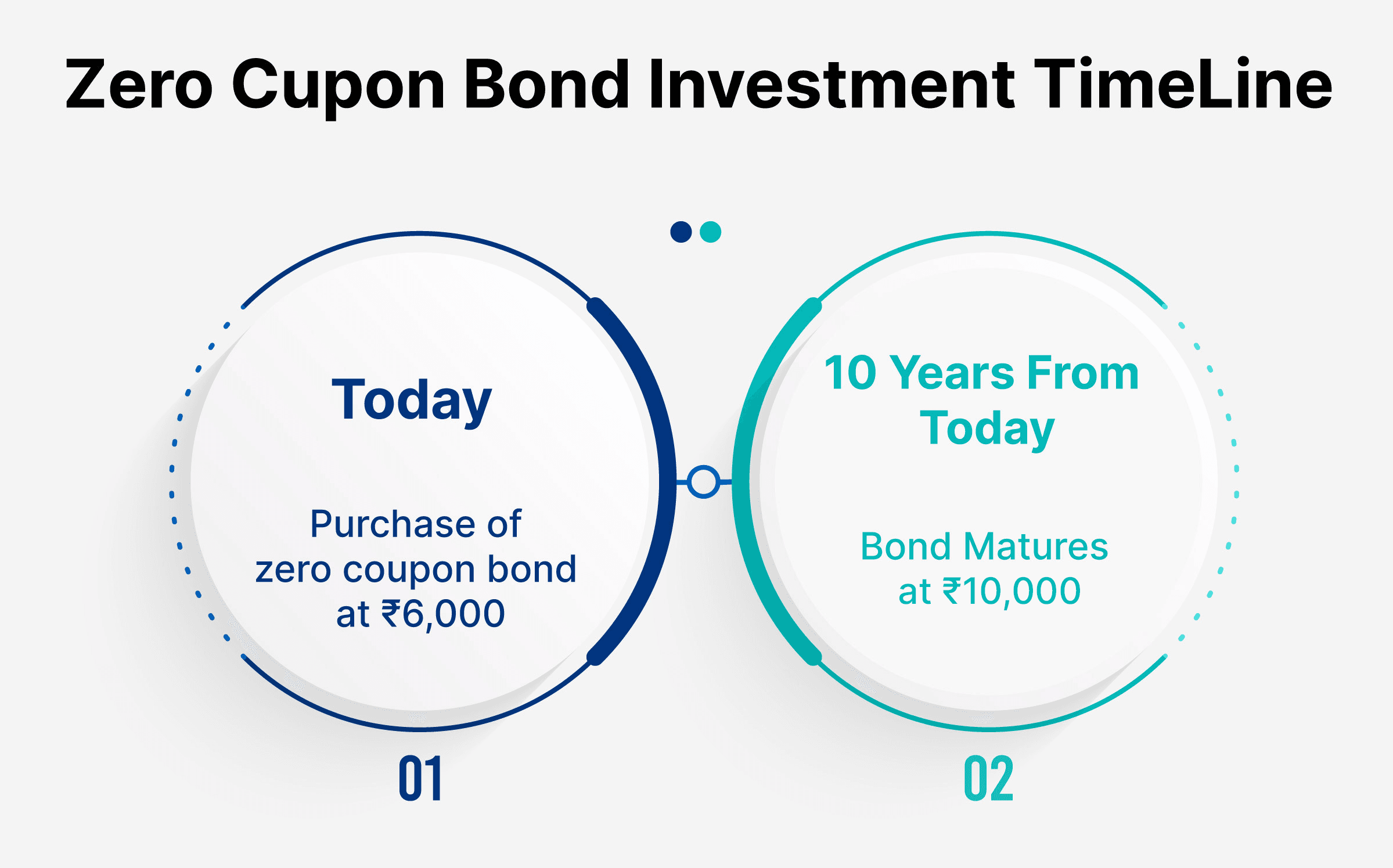
The implied yield in this example comes around 5.2% compounded annually, the rate at which INR 6,000 grows to INR 10,000 over a decade. This yield-to-maturity becomes fixed at the time of purchase, providing investors with certainty about their returns regardless of market fluctuations.
How Zero-Coupon Bonds Are Priced?
A zero bond does not pay any yearly interest. So instead of getting the interest every year, the person can buy zero bonds at a lower price and receive the full amount at maturity. The price will be decided by Face Value, i.e how much money one will get at the end, with how many years are left until the maturity, and the rate of return investors expect. The longer the time and the higher the expected return, the lower the price of the bond today.
Simple Formula
Price = Face Value ÷ (1 + Interest Rate)^Number of Years
- Price: The current market price.
- Face Value: The total amount paid at maturity.
- Yield: The annual interest rate or required rate of return.
- Years: Time remaining to maturity.
Taxation Treatment: Accrual vs Maturity Tax Impact
The difference between the purchase price and the maturity value is the profit earned from any zero-coupon bond, and since these bonds are issued at a discount and redeemed at the full value, that difference becomes the taxable gain for the person investing in zero-coupon bonds.
If these bonds are held for More Than 12 Months
The profit is treated as Long-Term Capital Gains (LTCG) and is generally taxed at 12.5% without indexation (for listed bonds, as per current tax rules).
If these bonds were Sold Within 12 Months
The profit is treated as Short-Term Capital Gains (STCG) and is taxed according to the investor’s applicable income tax slab.
Zero Coupon Bonds vs Regular Coupon Bonds
Parameter | Zero coupon structure | Regular coupon bond |
Periodic interest | No periodic payment | Pays interest at stated intervals |
Purchase price | Usually below face value | May trade below, at or above face value |
Main return | Difference between purchase price and redemption value | Coupon income plus any price gain or loss |
Maturity payment | Stated redemption value | Face value and any final coupon due |
Cash flow | One payment at maturity | Regular payments during the tenure |
Reinvestment risk | No coupon reinvestment risk | Coupons may be reinvested at changing rates |
Interest-rate sensitivity | Usually higher for the same maturity | Usually lower because some cash flows arrive earlier |
Suitable for | Defined future goals | Investors seeking periodic income |
Tax treatment | Depends on notification and listing | Coupon income and capital gains may have separate treatment |
Zero coupon instruments as securities issued at a discount and redeemed at face value. Regular bonds, by comparison, compensate investors through stated coupon payments during their tenure.
However, the choice depends on the investor’s objective. A zero coupon bond investment may suit a future lump-sum requirement. A regular coupon bond may suit someone seeking periodic income.
Advantages Of Zero Coupon Bonds
1. Known Maturity Value
The most compelling advantage of zero coupon bonds is their predictable outcome. At the time of purchase, an investor knows with certainty what amount they will receive at maturity. This fixed terminal value makes these bonds particularly suitable for financial planning where a specific sum is needed at a future date.
2. Useful for Goal-Based Investing
The structure of long-term bonds India of the zero-coupon variety makes them particularly well-suited for long-term goals. For retirement planning, these bonds offer a way to lock in returns decades in advance. A 30-year-old investor might purchase zero coupon bonds maturing in 30 years, creating a guaranteed retirement nest egg component without needing to monitor or manage ongoing interest payments.
Similarly, for children’s education funding, parents can match bond maturities to anticipated education expenses. This forced discipline helps investors stay committed to their long-term objectives.
For investors seeking greater stability and risk-adjusted returns, diversifying across different types of fixed-income products, including zero coupon bonds, regular coupon bonds, and securitised debt instruments (SDIs), is essential. Platforms like Grip Invest curate diverse fixed-income portfolios, allowing individuals to balance liquidity, yield, and risk across bond types and issuer categories
3. No Coupon Reinvestment Risk
Regular coupon payments must often be reinvested. The available rate may be lower at that time. Since these instruments make no interim coupon payments, this specific risk does not arise.
4. Lower Initial Outlay
The investor pays less than the face value at issue or purchase. This allows a smaller amount today to target a larger stated maturity value.
5. Simple Cash-Flow Structure
There are no periodic coupon receipts to track. The investor mainly monitors credit quality, market value and maturity.
These benefits can support a diversified fixed-income investment portfolio. They do not remove credit, liquidity, inflation or market risks.
Disadvantages Of Zero Coupon Bonds
1. Interest-Rate Sensitivity
Zero coupon bonds have heightened price sensitivity to interest rate fluctuations. Because all the return is concentrated at maturity rather than distributed through interim payments, these bonds typically have higher duration than coupon-bearing equivalents.
This sensitivity means that when market interest rates rise, zero coupon bond prices fall more dramatically than traditional bonds. The price volatility is particularly significant for investors who may need to sell before maturity.
2. No Regular Income
Zero coupon bonds provide no cash flow until maturity, making them unsuitable for retirees or others dependent on investment income for living expenses.
The lack of interim payments also means investors miss opportunities to benefit from potential interest rate increases over the bond’s lifetime. Unlike floating-rate securities that adjust payments as rates rise, zero coupon bonds lock in the implied yield at purchase.
3. Inflation Risk
A fixed maturity amount may lose purchasing power over a long period. Compare the annualised yield with expected inflation and the future cost of the goal.
Taxation In India
Zero coupon bond taxation is not uniform across every security using that label. The treatment depends on its statutory classification, notification status, listing and how the investor holds it.
Notified Zero Coupon Bonds
Under Section 2(112) of the Income-tax Act, 2025, a bond qualifies as a notified zero coupon bond only when it meets specified conditions.2
It must be issued by:
- an infrastructure capital company;
- an infrastructure capital fund;
- an infrastructure debt fund;
- a public sector company; or
- a scheduled bank.
The investor must not receive any payment or benefit before maturity or redemption. The Central Government must also specifically notify the bond.
The notification alone does not determine whether the gain is long-term or short-term. The bond’s listing status is also important.
Tax Treatment of Listed and Unlisted Bonds
A listed notified zero coupon bond held for more than 12 months generally qualifies as a long-term capital asset. Long-term capital gains are currently taxed at 12.5% without indexation, along with applicable surcharge and cess.
However, a different rule applies to unlisted bonds. Under Section 76 of the Income-tax Act, 2025, gains from an unlisted bond transferred, redeemed or matured on or after 23 July 2024 are treated as short-term capital gains, regardless of how long the investor held it.
Therefore, even a government-notified zero coupon bond does not receive long-term treatment if it is unlisted and falls within this provision. The gain is taxed at the investor’s applicable rate as a short-term capital gain.3
Investors should check both the government notification and the bond’s listing status before estimating the tax liability.
Zero-Coupon Bonds Vs Fixed Deposits
Parameter | Zero coupon instrument | Fixed deposit |
Return structure | Gain through discount and maturity value | Interest at a stated deposit rate |
Periodic payout | Usually none | Cumulative or periodic options may be available |
Market price | May fluctuate before maturity | Not exchange traded |
Early exit | Depends on liquidity and market price | Usually subject to terms or penalty |
Credit exposure | Depends on the issuer | Depends on the deposit-taking bank |
Deposit insurance | Not applicable | Eligible bank deposits receive DICGC cover |
Tax treatment | Depends on legal classification | Interest is generally taxed as income |
DICGC currently insures eligible principal and interest deposits up to INR 5 lakh per depositor per bank. Bond investments do not receive this deposit insurance protection.
Neither option is always better. Compare credit quality, annualised yield, liquidity, tenure and tax impact.
Liquidity Risks In The Secondary Market
Liquidity risk simply means how easy or difficult it is for a person to sell their bond before maturity. Zero-coupon bonds are harder to sell in the secondary market because not many people trade them. Some Liquidity Risks in the Secondary Market.
- Low Trading Volume & Depth: These bonds usually have fewer buyers and sellers in the market, which makes selling difficult.
- Price Fluctuation Risk: Bond prices can drop sharply when interest rates rise in the market.
- Higher Risk in Corporate Bonds: Corporate zero-coupon bonds may have more liquidity and credit risk than government-issued ones.
- High Price Volatility: The difference between the buying price and selling price can be large, and one can face a loss.
- Risk of Selling at a Loss: If the investor needs money urgently, they may have to sell at a lower price.
Things to Check Before Investing
Before making a zero coupon bond investment, review these points:
1. Issuer and Repayment Capacity
Study the issuer’s cash flow, debt, profitability and repayment history. The face value is payable only if the issuer meets its obligation.
2. Credit Rating
Check the latest rating and its rationale. A rating is an opinion, not a guarantee, and it may change during the tenure.
3. Yield to Maturity
Compare annualised yields rather than only the total discount. A large gap between purchase price and face value may still produce a modest annual return over a long tenure.
4. Maturity Date
Match the maturity date with the financial goal. An early sale may expose the investor to rate and liquidity risks.
5. Purchase Price and Face Value
Confirm both amounts and calculate the implied yield. The size of the discount alone does not show whether the investment is suitable.
6. Listing and Trading Activity
Check whether the security is listed, how often it trades and the usual difference between buying and selling quotes.
7. Security and Ranking
Find out whether it is secured or unsecured. For secured instruments, review the collateral, security cover and repayment ranking.
8. Call or Put Options
A call option may allow the issuer to redeem early. A put option may give the investor an early exit, subject to the specified terms.
9. Tax Status
Verify whether it is notified under Section 2(112), falls under another deep discount framework or is an unlisted bond covered by Section 76.
10. Offer Documents and Intermediary
Read the offer document, term sheet and risk disclosures. Use a regulated intermediary and confirm charges and settlement terms.
Should You Invest In Zero Coupon Bonds?
Best-Suited Investor Profiles
They suit investors with:
- Defined future financial obligations with specific timing
- Long investment horizons matching bond maturities
- Sufficient alternative income sources during the bond’s term
- Conservative risk tolerance seeking predictable outcomes
How Grip Invest Makes Access Easier
Traditionally, accessing quality bond investment India opportunities has been challenging for individual investors, with high minimum investments and limited secondary market liquidity. Platforms like Grip Invest have democratised access to fixed income securities by:
- Lowering minimum investment thresholds
- Providing curated selections of quality issuers
- Offering simplified digital purchase processes
- Creating more efficient secondary market opportunities
- Providing transparent information about risks and returns
Additionally, Grip Invest offers innovative fixed income options such as baskets blending zero-coupon, high-yield, and SDIs, further enhancing diversification benefits and income stability for investors
Conclusion
Zero coupon bonds offer a simple approach to fixed-income investing that reduces reinvestment risk. Their structure makes them particularly valuable for matching specific long-term goals. To build a resilient and goal-oriented investment strategy, consider a mix of zero coupon bonds along with other fixed-income products like corporate bonds and SDIs available on modern platforms such as Grip Invest. This approach can reduce the risk from any single security type and optimize for both growth and predictability
FAQs On Zero Coupon Bonds
 |
Author: Grip Invest Editorial Team The Grip Invest Editorial Team is a group of Chartered Accountants, MBA (Finance) graduates, and Qualified Research Analysts dedicated to helping you invest smarter. We dive deep into India's fixed income landscape to deliver content that is accurate, up-to-date, and easy to understand. Whether you're exploring bonds, fixed deposits, or other fixed income opportunities, our guides cut through the noise and give you the clarity to make better financial decisions. |
Want to stay at the top of your finances?
Join the community of 4 lakh+ investors and learn more about Grip Invest, the latest financial knick-knacks, and shenanigans in the world of investing.
Happy Investing!
Disclaimer - Investments in debt securities/municipal debt securities/securitised debt instruments are subject to risks including delay and/ or default in payment. Read all the offer related documents carefully. The investor is requested to take into consideration all the risk factors before the commencement of trading.
This communication is prepared by Grip Broking Private Limited (bearing SEBI Registration No. INZ000312836 and NSE ID 90319) and/or its affiliate/ group company(ies) (together referred to as “Grip”) and the contents of this disclaimer are applicable to this document and any and all written or oral communication(s) made by Grip or its directors, employees, associates, representatives and agents. This communication does not constitute advice relating to investing or otherwise dealing in securities and is not an offer or solicitation for the purchase or sale of any securities. Grip does not guarantee or assure any return on investments and accepts no liability for consequences of any actions taken based on the information provided. For more details, please visit www.gripinvest.in
Registered Address - 106, II F, New Asiatic Building, H Block, Connaught Place, New Delhi 110001


