

Target Maturity Fund Vs Fixed Deposit: Key Differences In Returns, Taxation And Risks



The main difference between a target maturity fund vs fixed deposit is how returns are generated. Fixed-date funds offer fixed interest rates, whereas target maturity funds give market-linked returns and better visibility closer to maturity.
While both can be used to help meet medium-term financial objectives, they differ on the parameters of risk, returns, taxation, and liquidity.
How Do Target Maturity Funds Work?
Target maturity funds are passively managed debt mutual funds that track an underlying bond index. Their portfolios generally contain government securities, state government bonds and high-quality public sector bonds. Each scheme has a specified maturity date, around which the maturity dates of its underlying securities are aligned.
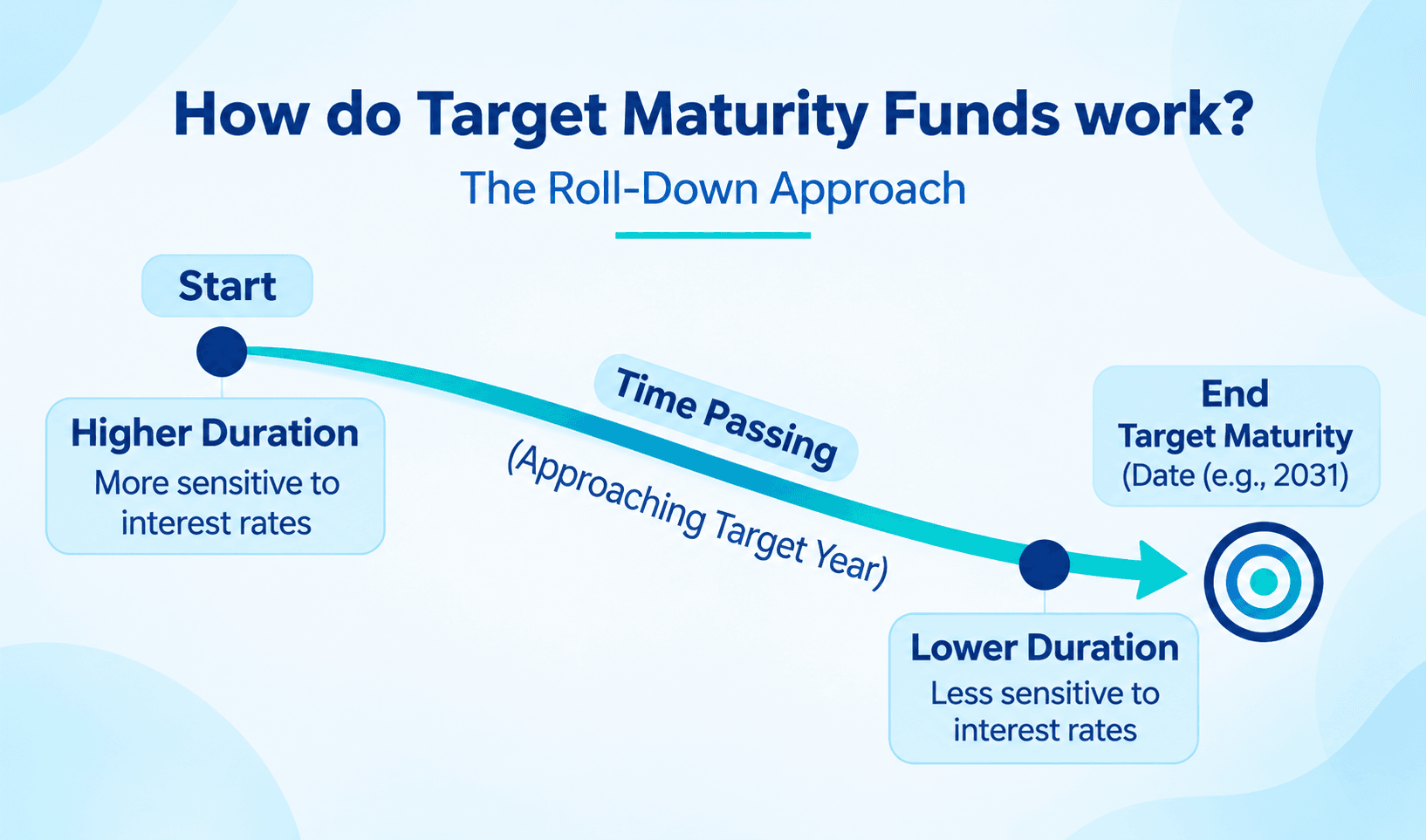
A key feature of target maturity funds is their roll-down approach. This means that the bond portfolio's duration gradually reduces, lowering its sensitivity to interest rate changes. Therefore, as the fund’s maturity dates arrive, it becomes less sensitive to market interest rate changes.
Another factor investors should understand is a fund's maturity date and its guaranteed maturity returns.
Fund's Maturity Date
The maturity date tells investors when the fund's investment period is scheduled to end. A target maturity fund has a fixed end date. For example, a fund might have a maturity date of 2031. This means its investment strategy is designed around bonds that mature around 2031.
Guaranteed Maturity Returns
Guaranteed maturity returns mean that an investor is promised a specific amount or rate of return when the investment matures. However, a target maturity fund does not work this way. Even though it has a predetermined maturity date, it does not promise a specific maturity value. Its actual returns depend on the performance of its underlying bonds, their repayment and other factors.
Bond prices, credit events, expenses and reinvestment conditions can affect the outcome. Therefore, the maturity date provides a time reference for the investment strategy, not a promise of capital protection.
Target Maturity Fund vs Fixed Deposit: Key Differences
While both options serve fixed-income investment needs, they have different structures that create important distinctions between the two. Here is how target maturity funds vs FD compare across common investment parameters.
Parameter | Fixed Deposit | Target Maturity Fund |
|---|---|---|
Returns | Predetermined interest rate | Market-linked returns based on underlying bonds |
Yield | Fixed at the agreed rate | Influenced by portfolio yield and market conditions |
Credit risk | Depends on the deposit-taking institution | Depends on the credit quality of underlying securities |
Interest rate risk | No direct market-linked NAV fluctuations | NAV can change when interest rates move |
Liquidity | Premature withdrawal may attract penalties | Units can generally be redeemed before maturity, subject to scheme conditions |
Investment tenure | Selected at the time of booking | Defined by the scheme’s maturity date |
Taxation | Interest is generally added to taxable income | Gains are taxed under applicable mutual fund tax provisions |
Minimum investment | Depends on the deposit provider | Depends on the scheme |
Returns From Target Maturity Funds Vs Fixed Deposits
The target maturity fund vs fixed deposit returns comparison depends on the interest rate offered, portfolio yield, expenses and investment period. An FD has a predetermined rate, while a target maturity fund’s expected returns are influenced by the yield to maturity of its underlying bonds.
Let's assume an investment of INR 10 lakh over a period of 5 years. Say the indicative net portfolio yield of the maturity fund in question is 6.5% and the FD is 6% per annum compounded annually.
Particulars | Fixed Deposit | Target Maturity Fund |
|---|---|---|
Initial investment | INR 10,00,000 | INR 10,00,000 |
Illustrative annual rate or yield | 6% | 6.5% |
Investment period | 5 years | 5 years |
Estimated maturity value | INR 13,38,226 | INR 13,70,087 |
Note: These statistics show how different expected rates can affect future results. They are not indicative of assured returns or the scheme's actual returns. The actual returns of the fund may be more or less depending upon the market movements, fees, and other factors of the fund.
Taxation Of Target Maturity Funds vs Fixed Deposits
Tax treatment is another important consideration when comparing these investment options.
Taxation on Target Maturity Fund:
Target maturity fund taxation is done as per the applicable tax slab rates without any indexation benefit for funds issued on or after April 1, 2023. Funds bought before April 1, 2023 qualify for Long-Term Capital Gains (LTCG) taxation at 12.5% if held for more than 24 months.
Taxation on Fixed Deposits:
Interest earned from fixed deposits is fully taxable and is added to an investor’s taxable income. It is taxed under Income from Other Sources according to the applicable income tax slab.
Which Is Better: Target Maturity Funds Or Fixed Deposits?
Neither option is universally better. The choice depends on when you need the money, your return expectations and how much fluctuation you can accept.
Target maturity debt funds may interest those seeking exposure to high-quality bonds with a defined investment horizon and greater liquidity.
An FD may suit investors who prioritise a predetermined interest rate and prefer to avoid market-linked NAV changes.
| Factor | Target Maturity Funds | Fixed Deposits |
| Returns | Market-linked returns based on the underlying bond portfolio | Predetermined interest rate |
| Risk | Subject to interest rate and credit risks | Depends on the financial strength of the deposit-taking institution |
| Liquidity | Units can generally be redeemed before maturity, subject to scheme terms | Premature withdrawal may involve penalties |
| Suitable for | Investors seeking exposure to high-quality bonds with a defined investment horizon | Investors who prefer predictable returns and greater certainty over the maturity amount |
Corporate Bonds and Yield Curve/Maturities
Investors can also consider corporate bonds as another fixed-income option. These bonds are issued by companies and offer different interest rates and maturities depending on the issuer's credit profile and prevailing market conditions. By comparing yields across different maturities, investors can identify bonds that align with their investment horizon and return expectations. However, it is important to assess the issuer's creditworthiness, repayment capacity and associated risks before investing.
Ultimately, the appropriate investment depends on how well its features align with your financial goals, investment timeline and risk tolerance.
Conclusion
Choosing between a target maturity fund vs fixed deposit depends on your investment horizon, return expectations, liquidity needs and risk tolerance. Target maturity funds may suit investors seeking market-linked returns through government securities and high-quality bonds, provided they can accommodate NAV fluctuations and credit risk. Fixed deposits, on the other hand, may suit those who prefer a predetermined interest rate, fixed tenure and greater certainty over the maturity amount.
Before investing, compare the fund's yield to maturity, portfolio composition, expense ratio and maturity date with the FD's interest rate and premature withdrawal conditions. Also consider the applicable taxation and post-tax returns of both options. Ultimately, the right choice is the one that aligns with your financial goals and comfort with investment risks.
FAQs

Want to stay at the top of your finances?
Join the community of 22 lakh+ investors and learn more about Grip Invest, the latest financial knick-knacks, and shenanigans in the world of investing.
Happy Investing!
Disclaimer - Investments in debt securities/municipal debt securities/securitised debt instruments are subject to risks including delay and/ or default in payment. Read all the offer related documents carefully. The investor is requested to take into consideration all the risk factors before the commencement of trading.
This communication is prepared by Grip Broking Private Limited (bearing SEBI Registration No. INZ000312836 and NSE ID 90319) and/or its affiliate/ group company(ies) (together referred to as “Grip”) and the contents of this disclaimer are applicable to this document and any and all written or oral communication(s) made by Grip or its directors, employees, associates, representatives and agents. This communication does not constitute advice relating to investing or otherwise dealing in securities and is not an offer or solicitation for the purchase or sale of any securities. Grip does not guarantee or assure any return on investments and accepts no liability for consequences of any actions taken based on the information provided. For more details, please visit www.gripinvest.in
Registered Address - 106, II F, New Asiatic Building, H Block, Connaught Place, New Delhi 110001


